
Categories
Health

I Got a Prenup to Protect My Emotions


When I got engaged, I was certain about a few things heading into marriage: I would keep my last name, skip some traditional wedding elements like a bridal party, and have a few deep-dive conversations with my fiancé about our compatibility on politics, parenting, and spending. While I wasn’t sure how important it was to protect my pre-marital financial assets—namely, a humble savings account and a top-notch shoe collection—a prenup seemed like a practical measure that would ensure transparency and fairness in the event of divorce, and my partner agreed.

We’re among a rising number of millennials with this mindset. A widely cited 2016 survey by the American Academy of Matrimonial Lawyers reported that 51 percent of lawyers saw a spike in millennials asking for prenups. The trend is reflected among young Hollywood couples: TMZ reported that Hailey Baldwin and Justin Bieber got a post-nup—essentially the same as a prenup, but signed after marriage. A week before Ariana Grande and Pete Davidson called off their engagement, Davidson joked about their decision to get a prenup on Saturday Night Live (“She pays, like, 60 grand for rent and all I have to do is stock the fridge.”).

Experts believe millennials—who recently made headlines for helping the U.S. divorce rate drop 18 percent from 2008 to 2016—approach marriage differently than our parents, so it makes sense that we also approach marital contracts differently. “The definition and meaning of marriage has transformed for this generation,” Liz Higgins, LMFT and owner of Dallas-based Millennial Life Counseling, told Glamour.com. “Millennials are less inclined to marry for religious, financial or family status reasons. They seek marriage for partnership and relational fulfillment. For them, I think prenups are a form of security and mutual understanding, as well as respect for marriage as a legal commitment.”

While this all rang true for us, we wanted to take our prenup a step beyond its traditional purpose to protect financial assets and be sure it protected our emotional investment, too. I got the idea to add a custom clause to our contract during a maintenance session with our couples therapist, who we used to see regularly before resolving some communication issues. When she asked how wedding planning was going, I realized it was impossible to know where our relationship would be without the work we’d done in therapy. What could be more valuable than the time, money and energy we’d put into becoming stronger, better partners? My fiance and I talked it through and agreed to add a clause stating that before divorcing, we’ll attend at least as many therapy sessions as the number of years we’ve been together.

Protecting emotional investments may not be the traditional purpose of prenups, but an increasing number of millennials are intrigued by the idea.

You might wonder why we’d need to put this into writing if we already believe in therapy as a relationship troubleshooter. Though I’d like to think we’d both willingly go if our marriage deteriorates, a prenup is by nature a worst-case-scenario contract. What’s more, if we one day decide to divorce, our intention is to build mutual respect and understanding into the process, regardless of the outcome. “The driving force of a decision like a prenup is what the couple brings to the table,” says Higgins. “If a prenup comes from a place of fear, anxiety or distrust, then it will be experienced as a tense and negative component of the relationship. In your case, the intention is not to plan for your divorce—it’s to create a plan to ensure that you’ve done everything in your control to work on your relationship before divorcing. This can be a powerful, healthy process and can improve trust, accountability, and openness.”

In spite of evidence showing that prenups are on the rise among millennials, there are still plenty who believe the cons outweigh the pros. “I didn’t get a prenup because I felt it ruined the spirit of marriage,” says Darrell, 30, of Los Angeles, who tied the knot earlier this year. “I married my wife as a lifelong partner, not a temporary one, and having that mindset from the start was key for me. I wasn’t willing to risk damaging our emotional connection by bringing it up, especially since most of my life’s wealth will be created after marriage, so a prenup to protect premarital assets is insignificant in the grand scheme.”

Most millennials who opt for a prenup, though, don’t see it as a negative reflection of their relationship. “While I’m confident that my marriage will last forever, I inherited a collection of jewelry from my grandmother, who I was close with as a child,” says Harper, 28, of New York, whose wedding is next February. “I would never risk losing something so precious and significant. My prenup is not a symbol of distrust toward my fiancé, but a way to protect a family heirloom that not only holds financial value, but tremendous emotional value, which is most important to me.”

Protecting emotional investments may not be the traditional purpose of prenups, but some millennials are intrigued by the idea. Jaclyn, 31, of Philadelphia, says she would consider including one in the prenup she and her long-term boyfriend will have when they marry. “We each have enough of our own assets to protect, and even if we didn’t, we’d get a prenup from a future earnings perspective,” she says. “My boyfriend is opposed to therapy unless it’s in a marriage-saving context, so I love the idea of including a clause like that.”

Whether you’re looking to protect family heirlooms, future earnings or hard-won healthy relationship habits, it’s never a bad idea to have an open conversation about what kind of marital contract—if any—is right for you as a couple.

The catch: A prenup therapy provision like ours is considered a soft clause, meaning it’s less legally binding than hard clauses about physical property, savings or debt. “I don’t disagree that couples are starting to look at prenups in a different light, but they need to be careful about getting too creative because then it becomes harder for the court to enforce,” says Carmela Miraglia, a Massachusetts-based divorce mediator and senior associate attorney for Lynch & Owens, P.C. Miraglia says she still sees financial security as the main motivator for millennial couples getting prenups, and that women are often the primary drivers of the decision. “With couples marrying later in life and more women holding higher-paying positions, they don’t want to feel dependent on a spouse for their financial future,” she says.

There are a few options—and price points—for getting a pre- or postnup. You can pay a lawyer an hourly rate (ranging from $100-500) or a flat fee (typically starting at $2,500). Lawyers often advise each spouse to hire their own legal counsel to review the contract on behalf of their best interests, so this option gets expensive, fast. Another avenue is hiring a more affordable, by-the-hour mediator like Miraglia, who mediates a conversation and drafts a contract based on a couple’s goals. If that’s still not in your budget, sites like legaltemplates.net, postnuptialagreement.org and pandadoc.com produce free, automated prenup templates based on state laws. But even if you and your partner sign and have it notarized, DIY prenups risk being viewed as less legally enforceable as ones drafted by pros.

Like politics or religion, prenups can spark tough conversations among couples. In the lead-up to your wedding, it’s not particularly fun to talk about how you’ll split up your savings, furniture and debt if you ever break up. But even if it’s a stressful conversation to have, it’s guaranteed to raise important issues, and if you’re anything like me and my husband, there’s a good chance you’ll feel better after talking it all through. If nothing else, you’ll know where you both stand (and wouldn’t you rather know?).

But make sure, whatever you choose to do, you’re doing it because you want to—not because you’re feeling pressure. “What ultimately works best for millennial couples is formulating the blueprint of their own relationships, not building it based on past relationships or societal or family expectations,” says Higgins. “There’s merit to coming up with hard and soft boundaries to uphold your marital stability, regardless of what’s legally binding.” For us, it felt like the right move to include a soft prenup clause about therapy before divorce, which we hope we’ll never have to invoke. Whether you’re looking to protect family heirlooms, future earnings or hard-won healthy relationship habits, it’s never a bad idea to have an open conversation about what kind of marital contract—if any—is right for you as a couple. Because ultimately, like your marriage, your prenup is what you make it.

After peaking during the 1970s and ’80s, much has been made of the fact that divorce rates are now on the decline, especially among millennials. Still, if you’re thinking about splitting with your spouse, or you’ve already been through a divorce, sunny statistics aren’t exactly useful. Throughout this weeklong series, Glamour.com explores what it means to uncouple in a modern world.
Source link

Categories
Health

Betsy DeVos' New Campus Sexual Misconduct Rules Protect The Accused


New policies that activists against sexual misconduct say will make it easier for colleges and universities to protect themselves in cases of campus sexual assault are set to be proposed by Secretary of Education Betsy DeVos, according to a New York Times report.

Most alarming, critics point out, the changes to federal policy on campus sexual misconduct will bolster the rights of the accused. The rules, obtained by the Times, would also encourage schools to provide more support for victims, but considering DeVos’ track record with education policy—especially when it comes to rolling back protections for victims of sexual assault and harassment—that’s not exactly confidence-inspiring.

This isn’t DeVos’ first go at tackling sexual assault on campus—the new Trump administration rules are a continuation of changes she announced last September that ended Obama-era Title IX guidelines that protected survivors. And while the new proposals will keep much of Title IX—the 1972 federal law banning sex-based discrimination at schools receiving federal funding—intact, it will redefine sexual harassment in schools and how institutions address incidents and allegations, the Times reports.

Here’s a quick breakdown of how DeVos and her team have addressed sexual assault on campuses so far.

DeVos quickly got rid of Obama-era rules and guideline:

In September of 2017, DeVos threw out a number of policies put into place by President Barack Obama’s administration. One key piece was the 2011 “Dear Colleagues Letter,” a comprehensive directive on how schools receiving federal funding should handle sexual violence on campus—everything from evidence-gathering protocol to how quickly cases should be investigated.

Many on the left—including California Senator Kamala Harris— argued that the decision would make it harder for assault victims to come forward.

“Every day on campus I see hundreds of women who have been sexually assaulted at least once, and 63 percent of sexual assaults are not reported to the police, according to the National Sexual Violence Resource Center,” Missouri State University student Hope Burnette told Glamour in September after the announcement.

“This is only going to weaken what little voice we already feel we have against those who have assaulted us, and give strength to those who still believe that ‘boys will be boys’ is a valid argument for groping a woman without her permission.”

The Department of Education has been criticized for valuing the accused over victims:

Some DeVos staffers are on the record saying some pretty problematic things about sexual misconduct. Candice Jackson, in her role as head of the Education Department’s Office for Civil Rights told the New York Times last July that investigative processes are not “fairly balanced between the accusing victim and the accused student.”

“Rather, the accusations — 90 percent of them — fall into the category of ‘we were both drunk,’ ‘we broke up, and six months later I found myself under a Title IX investigation because she just decided that our last sleeping together was not quite right,'” she said, according to the Times.

She later issued a statement in an attempt to clarify, saying that her opinion was based on feedback from cases involving accused students, and even if complaints don’t allege violence, “all sexual harassment and sexual assault must be taken seriously.”

Democratic attorneys general have long taken issue with DeVos’ possible policy changes:

Twenty Democratic attorneys general were so concerned about DeVos rolling back Obama-era Title IX guidelines that they sent the education secretary a letter outlining what they saw as major issues with her plan. “While we recognize that there is a great deal more that can be done to protect students and agree on the importance of ensuring that investigations are conducted fairly, a rushed, poorly-considered effort to roll back current policies sends precisely the wrong message to all students,” they wrote.

“Yet there is every indication that is exactly the approach your Department is taking.”

DeVos wants to narrow the definition of “sexual harassment:”

This latest round of proposed rules would adjust the definition of sexual harassment and only hold the schools accountable for formal complaints made to the proper authorities. (For example, a resident advisor would not count as a proper authority.) According to the Times, sexual harassment would be defined as “unwelcome conduct on the basis of sex that is so severe, pervasive and objectively offensive that it denies a person access to the school’s education program or activity.”

By comparison, Obama-era guidelines (which she killed in 2017) used a more broad definition of “unwelcome conduct of a sexual nature,” that includes “unwelcome sexual advances, requests for sexual favors, and other verbal, nonverbal, or physical conduct of a sexual nature.”

There will also be changes to how investigations are conducted—and that will impact victims:

There are also new proposed guidelines about how investigations are to be conducted.

“And, for the first time, the administration explicitly says that just as an institution’s treatment of a complainant could constitute sex discrimination, so would the treatment of the accused,” the Times writes. This is where the accused stand to hold more power.

“The 2011 and 2014 guidance documents may have been well-intentioned, but those documents have led to the deprivation of rights for many students—both accused students denied fair process and victims denied an adequate resolution of their complaints,” Candice Jackson, the Department of Education’s acting assistant secretary for civil rights, wrote at the time of the rollbacks.

In addition, the rules will still employ DeVos’ policy of using mediation to reach resolutions, meaning the accused can cross-examine the victim. These latest changes as outlined in the Times would appear to be one of the final steps in a year-long endeavor by DeVos’ Education Department to do away with Obama-era guidelines.

However, Liz Hill, an Education Department spokeswoman, says the Times‘ report “is premature and speculative, and therefore, we have no comment.”

Response on social media was still swift and damning—with many remarking on the fact that President Donald Trump himself has been accused of sexual misconduct by a number of women.

Sen. Kirsten Gillibrand (D-N.Y.) offered perhaps the harshest critique.

“When has @BetsyDeVosED ever stood with anyone but the powerful? She sides with for-profit colleges over students, lenders over borrowers and predators over survivors,” she tweeted.

“At every turn, she betrays her responsibility to the students she’s meant to serve. It’s sickening.”

MORE: 9 College Women Speak Out Against Betsy DeVos’ New Campus Sexual Assault Rules


Source link

Categories
Health

Twitter Users Promise to Protect Justice Ruth Bader Ginsburg at All Costs After SCOTUS Shakeup


After Supreme Court Justice Anthony Kennedy announced his retirement from the bench this week, questions quickly surfaced about what his exit means for the future of women, people of color and the LGBTQ community, whose rights are often on the line in high-profile cases that come before the justices.

But there was one other person the internet immediately focused their attention on: Ruth Bader Ginsburg.

Kennedy’s retirement sent Twitter into a full panic spiral, as people worried that perhaps RBG, who is 85, might also be planning her exit. Ginsburg is the oldest Supreme Court Justice, and she’s already five years past the average age at which most Justices have retired.

“Protect RBG at all cost!” tweets flying across social media read, with many users promising to send her vitamins, prayers, and even 24/7 security detail. “I’m buying Ruth Bader Ginsburg an Anytime Fitness membership, 10 years of Vitamins, and a lifetime of Smoothies…” one Twitter user wrote. “I’m becoming an organ donor but only if my organs are going to Ruth Bader Ginsburg,” someone else said.

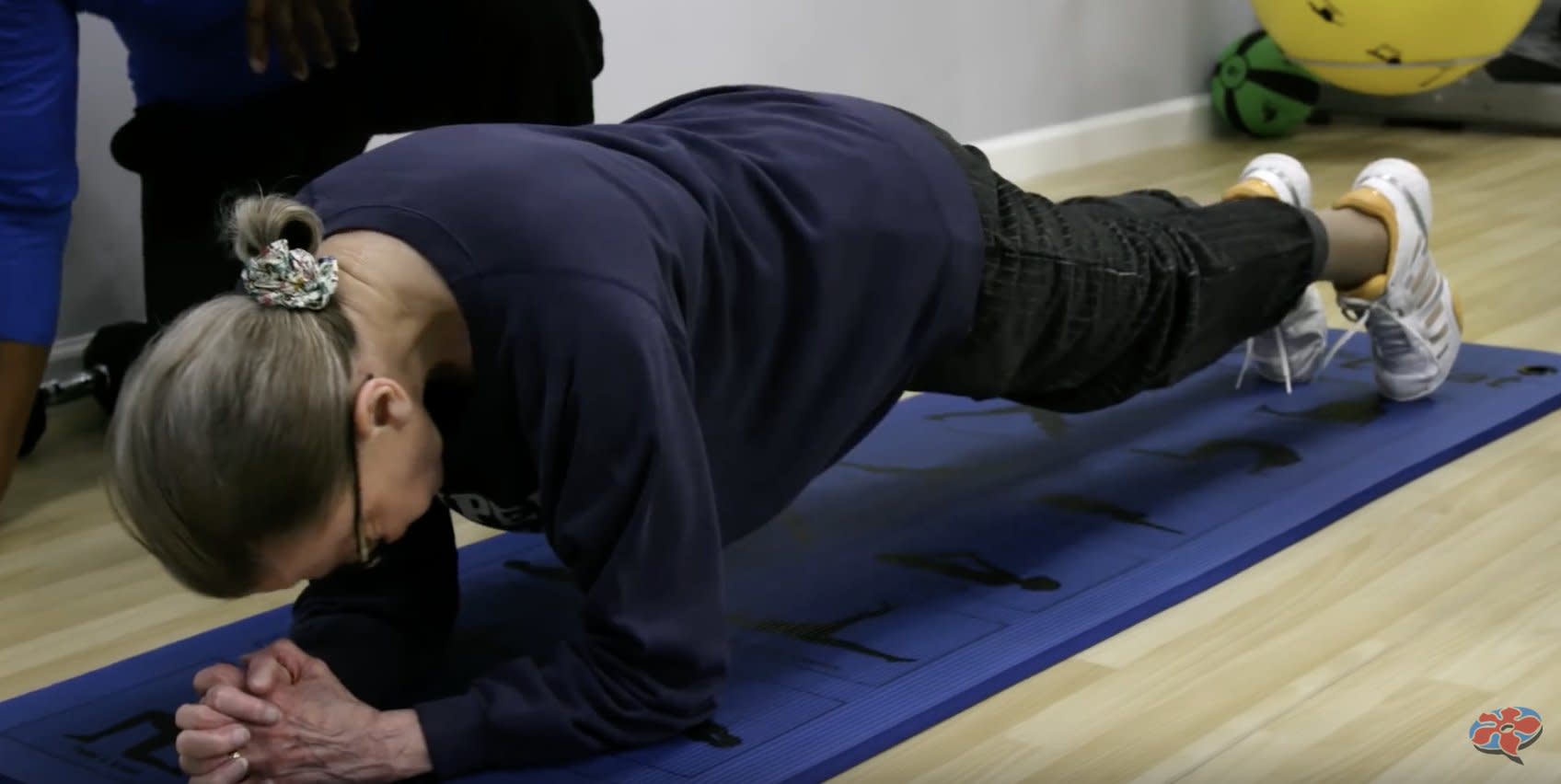
The good news for nervous RBG fans is that she’s still going strong. While many predicted she might call it quits during the Obama administration, the planking heroine of an octogenarian has kept on. She even hinted earlier this year that she hoped to follow the path of former Supreme Court Justice John Paul Stevens, who retired at the age of 90. According to the Los Angeles Times, she also said that she’s in “very good” health and that “as long as I can do the job full steam, I will be here.”

Plus, there’s recorded proof of her fitness level here, which means Twitter users can rest easy.

While the world went full-blown Liam Neeson in Taken over the Notorious RBG, she was busy reacting to Kennedy’s news like the boss she is. Kennedy, who was considered the Supreme Court’s key swing vote, could throw off the conservative-liberal balance of the bench with his retirement, but there was no trace of anxiety in Ginsburg’s sweet tribute to him.

“I will miss the pleasure of his company at our Conference, his helpful suggestions on circulating opinions, his recommendations of art exhibitions to visit with my chambers staff, and much more,” she said in a statement. “For the good he has done during the 43 years he has served as a member of the federal judiciary, he has earned a rousing Bravo.” She also called Kennedy a “true gentleman, a caring jurist and a grand colleague in all respects.”

What a class act. (But also, please never retire.)

Related Stories:

A Reminder That We Won’t Need a Full Repeal of Roe v. Wade for Abortion to Be Restricted

How Justice Anthony Kennedy’s Retirement From the Supreme Court Could Erode Women’s Rights


Source link

Categories
Health

It's Surprisingly Hard to Ban Toxic Sex Toys, But Here's How to Protect Yourself


These days, most of us will carefully check ingredients lists for gluten and trans fats, demand that our water bottles be made without BPA, and seek out paraben-free, body-safe cosmetics. But the average person can’t tell you what a toxic sex toy is—or even that they exist. Unfortunately, in the unregulated sex toy industry, plenty of sex toys are potentially rife with products that can hurt you (and not even in the fun, kinky way).

Perhaps the most well-known offender vis à vis toy toxicity is a group of chemicals known as phthalates, a plasticizer that can be blended with other substances to make them softer and more flexible. A spotlight’s been shone on phthalates in recent years, as publications like Bustle and Bitch, and via feminist-oriented sex shops like Good Vibes and Babeland have spoken out against them.

So why all the hullabaloo? It turns out that phthalates may have side-effects when they come into contact with your body that not only aren’t disclosed by most sex toy manufacturers, but could potentially be terrible for you. According to Dr. Amanda Morgan, a faculty member at the School of Community Health Sciences at the University of Nevada, Las Vegas, who wrote her Master’s thesis on harmful sex toy materials, phthalates are known endocrine disruptors that can cause health problems. “[Phthalates] mess with your hormones; they can cause birth defects, or other things related to liver or kidney functioning,” Morgan told me, referencing a studies which have linked phthalates to irregular fetal development, early-onset puberty, and lower sperm counts, among other issues. “They can really mess you up, because they pretend to be your hormones, and so your body’s hormonal cycle gets knocked out of whack from exposure to these things.”

With the short-term effects of chlorine and the long-term effects of phthalates, PVC is, Morgan says, “definitely one of the worst sex toy materials we’ve seen.”

When you hear horror stories about sex toys, though, it’s not necessarily phthalates that are to blame. One of the most common anecdotal complaints about toxic toys is that they cause skin irritation: “I first thought [it] was a yeast infection or BV, because of extreme itching and burning on my inner labia,” reports one reader who wrote in to sex toy review blog Dangerous Lilly. “My ass suddenly felt like it was on fire. A burning sensation spread throughout my butt,” recalls sex educator Tristan Taormino about a questionable dildo she used. One Playboy story describes a dildo that caused a woman “such severe pain that she could barely speak.”

I asked Dr. Emily S. Barrett, a professor at the Rutgers University School of Public Health who has done extensive research on the prenatal effects of endocrine disruptors like phthalates, whether these reported burning sensations fit with her understanding of the chemicals. She told me she hasn’t seen evidence that phthalates irritate the skin in this way, and that they tend to “act on a much more subtle level most of the time.”

So what is causing these health problems? According to Amanda Morgan, phthalates aren’t the only sketchy ingredient still getting into our sex toys. As part of her thesis research, Morgan tested 32 sex toys to determine their chemical makeup. What she found was pretty scary: The toys she tested typically contained 30-35 percent chlorine. She said PVC, a material commonly used to make inexpensive sex toys, always contains chlorine (hence the chemical name “polyvinyl chloride.”) Even scarier, in 2006 BadVibes.org—an organization which, full disclosure, is linked to pro-toy-safety sex shop The Smitten Kitten—ran lab tests on four popular sex toys. They found that two of them were made of PVC and contained “very high levels of phthalate plasticizer.”
 
“We use chlorine to kill bacteria in things,” she said. “If you are being exposed to this high level of chlorine, especially in a sensitive membrane area [like the vagina or rectum], we could definitely chalk that up to causing irritation, burning, or messing up the environment by exposing it to something that is, as we know, a sterilization product.” So with the short-term burning effects of chlorine and the long-term endocrine effects of phthalates, PVC is, Morgan says, “definitely one of the worst sex toy materials we’ve seen.”
 
Now, you might be thinking, “OK, great to know! I’ll just only buy safe toys from now on!” Well, it’s not so simple. Since the sex toy industry is unregulated, it doesn’t fall under the current purview of the Food and Drug Administration. According to FDA press officer Angela Stark, that’s because the agency “does not regulate devices meant purely for sexual pleasure. It does, however, regulate genital devices that have a medical purpose such as vibrators intended for therapeutic use to treat sexual dysfunction or to supplement Kegel exercises.” Of course, the vast majority of sex toys don’t fall under this “health aid” umbrella.+++large

The current Congress likely wouldn’t rush to make a bold, sex-positive statement like mandating sex toy safety.

The responsibility of regulating sex toys could potentially fall to the Consumer Product Safety Commission, but Morgan told me the understaffed CPSC is already in charge of regulating over 15,000 types of products—not to mention the products themselves. The complex issue of sex toy regulation would be a big ask on top of all that.

Add to all of this the fact that the current Congress likely wouldn’t rush to make a bold, sex-positive statement by mandating sex toy safety, and there are plenty of reasons your sex toy might not meet body-safe standards. “Our government doesn’t generally like to talk about people pleasuring themselves,” Morgan pointed out.

Beyond that, though, Morgan adds that regulating the sex toy industry might not even be the best solution to getting rid of toxic toys anyway. “If something is federally regulated, that means that the federal government—depending on where they are in their political leanings at that time—could potentially make it illegal to have these products, by saying they are ‘dangerous’ and then regulating them out of existence,” she reasoned. “You get certain types of people in power and they may not believe in sexual health, wellness, [or] self-pleasuring. It might go against their core values and therefore they [might] use their political agenda and the federal regulation system to regulate these products out of people’s hands.”

It’s a conclusion that Zach Biesanz, a legal assistant in the office of New York’s Attorney General, came to in his 2007 paper in the journal Law & Inequality: “Special regulation of the sex toy industry would be unreasonably burdensome from a regulatory standpoint,” he wrote. “Only banning these toxins outright will suffice to protect consumers from phthalates’ harmful and even lethal effects.”

“Sniff your sex toy. That’s the easiest thing you can do [to protect yourself].”

In the meantime, how do you tell if a toy is safe? Sex toy experts like Morgan, the Smitten Kitten’s founder Jennifer Pritchett, and seasoned sex toy reviewer Epiphora all recommend buying toys made of phthalate-free, body-safe materials like pure silicone, stainless steel, glass, and hard plastic. Still, it’s difficult to know what’s what in an industry that mislabels its products so frequently. “Sniff your sex toy,” said Morgan. “That’s the easiest thing you can do. If you smell these products and they don’t smell like anything, then it most likely is a stable chemical compound like silicone.” Phthalates and PVC, however, smell “like chemicals,” according to Morgan, “like a new shower curtain,” according to Epiphora, and “like a headache,” according to Pritchett. The sex toy smell test might sound a little weird, but it’s a pretty good first line of defense.

Morgan also recommends buying toys made by “companies that take a lot of pride in making good-quality, body-safe toys,” citing Tantus and Jimmyjane as examples. Other companies that proudly declare their products body-safe include We-Vibe, Fun Factory, Vixen Creations, and Funkit Toys.

And when in doubt, find a reviewer you can trust. Sex toy review blogs abound on the internet —Epiphora, Dangerous Lilly, and Formidable Femme, to name just a few—and while you’d be wise to take claims about sex toys with a grain of salt in this unregulated industry, sometimes the preponderance of good or bad reviews about a particular company or toy can suggest conclusions about its safety (or lack thereof).

Most importantly though, demand body-safe sex toys buy only buying from companies you can trust. “Consumers vote with their pocketbook,” said Tantus founder Metis Black. “Support the businesses that make safe toys a priority, that use their resources to educate, that take a stand and advocate for consumers.” She added that while pure silicone toys are expensive now—especially in comparison to PVC toys, which can often be under $30 a pop, versus $100+ for silicone—more consumer demand for body-safe toys will create more supply at lower prices, as bigger companies with more resources start making non-toxic toys in larger quantities. That’s just sex toy economics.

Bloggers, consumers, and ethical toymakers alike all dream of a future in which no sex toys will burn your junk, give you infections, or cause long-term bodily harm. It seems reasonable enough. And if we keep fighting for it, maybe one day it’ll be reality.


Source link

Categories
Health

Why Toxic Beauty Products Harm Women of Color, and How We Can Protect Ourselves


During the past 24 hours, I’ve read dozens of articles about how women of color are disproportionally exposed to toxic chemicals in beauty products. Every article cited the same source—a commentary published this week in the American Journal of Obstetrics and Gynecology—and listed life-threatening side effects. Many went on to explain that women of color are more at risk than white women because of racial stereotypes and beauty standards—harmful ingredients found in hair relaxers, skin-bleaching creams, and unnecessary vaginal douches were specifically called out.

As I read, I was equal parts furious, relieved, and a little confused. Of course we should be talking about the price women pay to fit into beauty-standard boxes. We should openly discuss the fact that we live in a world where how you look can get you sent home from school or cost you your livelihood. But nothing I read told me, a woman of color, how I could avoid poisoning myself. There was zero advice on how to shop for beauty products safely or what brands and ingredients to avoid. So I reached out the lead author of the commentary, Dr. Ami Zota, to figure out where this scientific data fits into the daily lives of women in America.

Dr. Zota made clear that she and her colleagues weren’t presenting new data, but were using recent research to draw attention to a serious and often undiscussed issue: Trying to adhere to Western European beauty standards is costing women their health and, in some cases, their lives. The commentary—think of it kind of a as an expertly curated Pinterest board of facts—pointed to studies conducted in the United States and around the world. The facts are clear: Women of color spend more on beauty products than white women. Women of color use skin-lightening, hair-straightening, and vaginal-douching products more than white women. And women of color have been found to have higher levels of dangerous toxins like mercury and parabens in their blood than white women. When packaged together, along with some disturbing findings like “black women’s natural hair was rated as ‘less attractive’ and ‘less professional’ than when it was straightened,” Zota’s work paints a compelling picture of a dangerous trend. But she’s quick to assert that there’s more to the story and that there are ways that women of color can actively protect themselves.

For starters, Zota recommends keeping an eye out for potentially harmful ingredients while you shop. “Some types of chemicals are more clearly labeled so you can attempt to avoid them,” she told me. “You can reduce your exposure by reading labels. Parabens, for example, are more likely to be listed on packaging and labels so you can look for things that are paraben-free.” But finding key words on ingredients lists isn’t enough. “Other types of chemicals are less likely to be labeled, typically because they’re in fragrances,” Zota said. “The FDA doesn’t require companies to list the individual components of fragrance. Historically, that’s the one place that contaminants, like phthalates, are found.”

You can also keep yourself informed on a daily basis using websites like the Environmental Working Group’s Skin Deep, which lists known chemicals in beauty products. You can search through brands or look up specific products that have been researched. While Zota doesn’t endorse EWG certification as a sole means of preventing exposure to toxins, it’s one more way to vet potential dangers.

A third factor, one that hasn’t been making the rounds in recent coverage, is that there’s another marginalized group with the umbrella “women of color” who are at the greatest risk. “Most of the literature we cited looked at immigrant women [in the United States] who were bringing in products from other countries or buying their products in small stores that are getting cosmetics from questionable sources.”

Being aware of the potentially harmful unregulated products made available to women in this country is a hugely important part of her research. “We’re not trying to fear-monger, and I’m not a fan of sensational headlines. We’re really trying to educate people, because we are learning that some contaminants, even at a low level, when used on a daily basis can have implications on reproductive health and the health of one’s offspring.”

While I’m thrilled that we’re talking about the injustices women of color face every day, it’s also important that we don’t just read, feel awful, and then move on. There’s a reason women of color are more exposed to harmful toxins in beauty products. There are ways to protect ourselves and to deal with the real, deep-rooted issues that create these problems in the first place. The conversation should continue. We need to keep talking.

Related Stories:
I Thought We Were Done Policing Black Hair?
President Obama Talks Black Hair and the Pressures His Daughters Feel to Look a Certain Way
“I Want to Show Girls It’s Not Bad to Be Dark—Different Is Beautiful”


Source link