
Categories
Health

Department of Education Releases New Guidelines for Sexual Assault on Campus


“You know you are not on trial,” said Senator Kamala Harris (D–Calif.). “You are not on trial.” It was September, and Sen. Harris was addressing Christine Blasey Ford, who’d come before the Senate Judiciary Committee to testify against then nominee (now Supreme Court Justice) Brett Kavanaugh.

It had already been a heartbreaking few hours—few weeks, really. So much of it blurs together, like a horror movie. But I’ll never forget the relief and pain I saw on Blasey Ford’s face when Sen. Harris reminded us all that holding people to account should never mean putting a survivor on trial. Just as the Senate Judiciary Committee shifted so much of the burden, shame, and scrutiny onto Blasey Ford, systems that are supposed to be created to help survivors seek justice often instead shift a massive burden to the survivor. Doing so keeps survivors from reporting and can retraumatize them in the process.

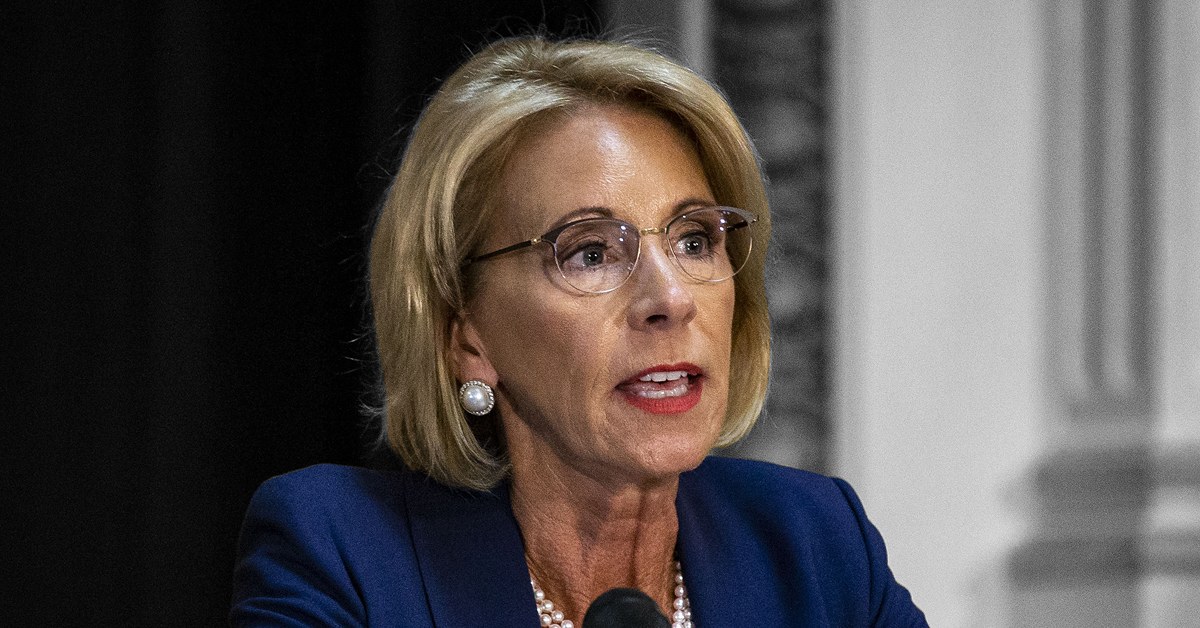
That’s just one reason I’m raising the alarm about the new regulation on Title IX that Secretary of Education Betsy DeVos released last week. If it becomes law, these rules could force millions of student survivors of sexual assault and harassment to endure the same kind of cruel process Blasey Ford did. It’s a sham procedure, not to mention one that puts the survivor on trial and gives the benefit of the doubt to the perpetrator, instead of seeking the truth.

Schools would not be required to investigate assaults that take place in several off-campus locations, shutting out the thousands of survivors who are assaulted at parties, bars, or online.

While Kavanaugh apologists waved off the accusations of misconduct against him, suggesting that violence committed in high school is either somehow irrelevant or outside the jurisdiction of the Senate committee, the new regulation intends to give schools similar latitude, claiming that these institutions should not be responsible for investigating and intervening in many instances of sexual violence that affect their students.

According to the regulation, schools would not be required to investigate assaults that take place in several off-campus locations, shutting out the thousands of survivors who are assaulted at parties, bars, or online. Schools would now be required to investigate only complaints made to individuals who are empowered “to institute corrective measures” like a Title IX coordinator. What does that mean? In short, that schools would have zero obligation to start the formal complaint process if claims of assault are raised with coaches or resident advisers. If it’s hard to picture what an impact that could have, let me put it like this: Under the new rule, Michigan State University may not have been required to intervene in the case of Larry Nassar, because reports of his sexual abuse were made to coaches and athletic trainers. Further, the definition of sexual harassment that schools can now investigate is so limited and narrow that survivors could have to endure severe and repeated harassment before their treatment would “count” toward a Title IX complaint.

This proposed regulation from the Department of Education has been written in a manner that could prevent survivors from reporting their assaults and let schools avoid investigating Title IX complaints (and the bad press and expense that comes with it). Make no mistake: This will not make campuses safer, nor will it end sexual violence. What it will do is cause a huge decrease in reports of sexual violence at schools.

If it takes effect, this rule could make reporting and investigation procedures for survivors cruel, degrading, and difficult to access, in the hopes perhaps that survivors will give up on reporting if the process retraumatizes or marginalizes them enough.

Moreover, the regulation would disproportionately affect students of color, LGBTQ students, students living with disabilities, and low-income students by creating additional traumatic barriers to healing and justice. And in a flagrant misapplication of Title IX, which was implemented to protect and expand opportunities for women in education, the rule allows named harassers to claim sex discrimination if the school opens an investigation into their conduct.

It’s not enough to claim that we “support survivors” if we don’t commit to policies and proposed action that would do just that.

Thanks to the Me Too movement, we’ve all become more attuned to the needs of survivors, and millions of us are committed to ending sexual violence. We have made believing survivors (and seeking justice) a powerful moral imperative for all. But I fear that people in power—like school administrators, senators, and DeVos herself—continue to pay lip service to the importance of taking survivors seriously, while simultaneously making it almost impossible for them to be heard. It’s not enough to claim that we “support survivors” if we don’t commit to policies and proposed action that would do just that.

Everyone who was disturbed by the treatment of Blasey Ford before the Senate should be concerned now. This regulation will make schools more dangerous and, at the height of the Me Too movement, could take us backward.

While these provisions are horrific, this rule is not a foregone conclusion. Unlike our senators who ignored their moral and democratic duties to heed our calls to believe survivors, the Department of Education is obligated to listen to our critique of its rule through the notice-and-comment process. This rule can be stopped if all of us who were outraged on behalf of Blasey Ford submitted a comment that expressed our opposition to this regulation. Submitting a comment that the federal government will “count” must meet certain requirements—but End Rape on Campus and Know Your IX have built tools to ensure that your voice can be heard. Learn more at HandsOffIX.org.


Jess Davidson is a survivor of sexual assault, and the executive director of End Rape on Campus, a national nonprofit dedicated to ending campus sexual assault through direct support, education, and policy reform.
Source link

Categories
Health

Betsy DeVos' New Campus Sexual Misconduct Rules Protect The Accused


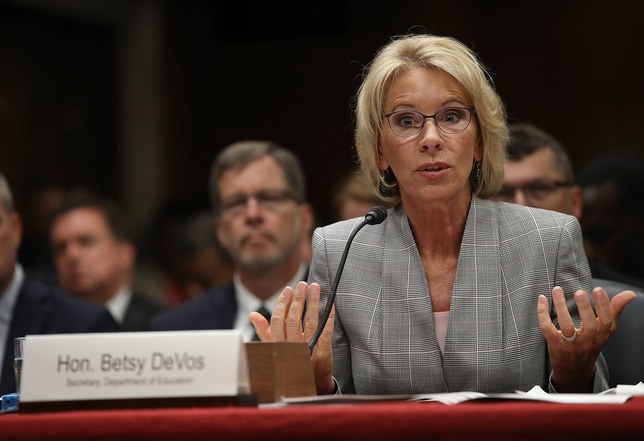
New policies that activists against sexual misconduct say will make it easier for colleges and universities to protect themselves in cases of campus sexual assault are set to be proposed by Secretary of Education Betsy DeVos, according to a New York Times report.

Most alarming, critics point out, the changes to federal policy on campus sexual misconduct will bolster the rights of the accused. The rules, obtained by the Times, would also encourage schools to provide more support for victims, but considering DeVos’ track record with education policy—especially when it comes to rolling back protections for victims of sexual assault and harassment—that’s not exactly confidence-inspiring.

This isn’t DeVos’ first go at tackling sexual assault on campus—the new Trump administration rules are a continuation of changes she announced last September that ended Obama-era Title IX guidelines that protected survivors. And while the new proposals will keep much of Title IX—the 1972 federal law banning sex-based discrimination at schools receiving federal funding—intact, it will redefine sexual harassment in schools and how institutions address incidents and allegations, the Times reports.

Here’s a quick breakdown of how DeVos and her team have addressed sexual assault on campuses so far.

DeVos quickly got rid of Obama-era rules and guideline:

In September of 2017, DeVos threw out a number of policies put into place by President Barack Obama’s administration. One key piece was the 2011 “Dear Colleagues Letter,” a comprehensive directive on how schools receiving federal funding should handle sexual violence on campus—everything from evidence-gathering protocol to how quickly cases should be investigated.

Many on the left—including California Senator Kamala Harris— argued that the decision would make it harder for assault victims to come forward.

“Every day on campus I see hundreds of women who have been sexually assaulted at least once, and 63 percent of sexual assaults are not reported to the police, according to the National Sexual Violence Resource Center,” Missouri State University student Hope Burnette told Glamour in September after the announcement.

“This is only going to weaken what little voice we already feel we have against those who have assaulted us, and give strength to those who still believe that ‘boys will be boys’ is a valid argument for groping a woman without her permission.”

The Department of Education has been criticized for valuing the accused over victims:

Some DeVos staffers are on the record saying some pretty problematic things about sexual misconduct. Candice Jackson, in her role as head of the Education Department’s Office for Civil Rights told the New York Times last July that investigative processes are not “fairly balanced between the accusing victim and the accused student.”

“Rather, the accusations — 90 percent of them — fall into the category of ‘we were both drunk,’ ‘we broke up, and six months later I found myself under a Title IX investigation because she just decided that our last sleeping together was not quite right,'” she said, according to the Times.

She later issued a statement in an attempt to clarify, saying that her opinion was based on feedback from cases involving accused students, and even if complaints don’t allege violence, “all sexual harassment and sexual assault must be taken seriously.”

Democratic attorneys general have long taken issue with DeVos’ possible policy changes:

Twenty Democratic attorneys general were so concerned about DeVos rolling back Obama-era Title IX guidelines that they sent the education secretary a letter outlining what they saw as major issues with her plan. “While we recognize that there is a great deal more that can be done to protect students and agree on the importance of ensuring that investigations are conducted fairly, a rushed, poorly-considered effort to roll back current policies sends precisely the wrong message to all students,” they wrote.

“Yet there is every indication that is exactly the approach your Department is taking.”

DeVos wants to narrow the definition of “sexual harassment:”

This latest round of proposed rules would adjust the definition of sexual harassment and only hold the schools accountable for formal complaints made to the proper authorities. (For example, a resident advisor would not count as a proper authority.) According to the Times, sexual harassment would be defined as “unwelcome conduct on the basis of sex that is so severe, pervasive and objectively offensive that it denies a person access to the school’s education program or activity.”

By comparison, Obama-era guidelines (which she killed in 2017) used a more broad definition of “unwelcome conduct of a sexual nature,” that includes “unwelcome sexual advances, requests for sexual favors, and other verbal, nonverbal, or physical conduct of a sexual nature.”

There will also be changes to how investigations are conducted—and that will impact victims:

There are also new proposed guidelines about how investigations are to be conducted.

“And, for the first time, the administration explicitly says that just as an institution’s treatment of a complainant could constitute sex discrimination, so would the treatment of the accused,” the Times writes. This is where the accused stand to hold more power.

“The 2011 and 2014 guidance documents may have been well-intentioned, but those documents have led to the deprivation of rights for many students—both accused students denied fair process and victims denied an adequate resolution of their complaints,” Candice Jackson, the Department of Education’s acting assistant secretary for civil rights, wrote at the time of the rollbacks.

In addition, the rules will still employ DeVos’ policy of using mediation to reach resolutions, meaning the accused can cross-examine the victim. These latest changes as outlined in the Times would appear to be one of the final steps in a year-long endeavor by DeVos’ Education Department to do away with Obama-era guidelines.

However, Liz Hill, an Education Department spokeswoman, says the Times‘ report “is premature and speculative, and therefore, we have no comment.”

Response on social media was still swift and damning—with many remarking on the fact that President Donald Trump himself has been accused of sexual misconduct by a number of women.

Sen. Kirsten Gillibrand (D-N.Y.) offered perhaps the harshest critique.

“When has @BetsyDeVosED ever stood with anyone but the powerful? She sides with for-profit colleges over students, lenders over borrowers and predators over survivors,” she tweeted.

“At every turn, she betrays her responsibility to the students she’s meant to serve. It’s sickening.”

MORE: 9 College Women Speak Out Against Betsy DeVos’ New Campus Sexual Assault Rules


Source link

Categories
Health

Six Women File Lawsuits Against USC Claiming the Campus Gynecologist Sexually Abused Them


Six women filed lawsuits against the University of Southern California on Monday, alleging that Dr. George Tyndall—who worked as the campus health clinic’s full-time gynecologist for almost 30 years—”sexually victimized them under the pretext of medical care” with USC’s knowledge, the LA Times reports.

The Times first broke the story last week after a lengthy investigation revealed alleged abuse dating back to the 1990s, when co-workers said he was improperly photographing students’ genitals. There were also complaints alleging the doctor was inserting his fingers into patients’ vaginas improperly and not in the manner typical to a gynecological exam.

More recently, according to the paper, Tyndall’s colleagues feared he was targeting Chinese students less familiar with American medical practices. Tyndall was suspended in 2016, and was allowed to resign with a financial payout last summer, even though an internal USC investigation showed that his “behavior during pelvic exams was outside the scope of current medical practice and amounted to sexual harassment of students.” Patients were not informed and he was not reported to the Medical Board of California.

Tyndall has denied any wrongdoing, telling The Times in interviews that his exams were appropriate. “I’m there to protect the health of Trojan women,” he reportedly said. In January, Tyndall renewed his California medical license.

The university told the Times that “in hindsight,” USC should have reported him. The university did finally file a complaint with the medical board on March 9 after a request by Tyndall to be reinstated.

John Manly, an Orange County lawyer who is representing four of the former patients told the Times, “It doesn’t matter how many people get hurt. It is all about protecting USC’s reputation.” Manly also worked on the case that ended with a $500 million settlement from Michigan State University for former patients of Larry Nassar.

Lucy Chi filed a federal class action suit alleging she was violated in 2012 when Tyndall inserted his fingers into her vagina. Another woman says he also inserted his fingers at the beginning of a pelvic exam and remarked on the tightness of her vaginal muscles. Chi says she realized the behavior was improper after reading the Times’ investigation.

USC Provost Michael Quick issued a letter Monday that apologized to patients, but maintained that the university did not ignore complaints.

“It is true that our system failed, but it is important that you know that this claim of a cover-up is patently false,” Quick wrote. “We would never knowingly put students in harm’s way.”

He says the school’s senior leadership did not learn of complaints against Tyndall until 2017.


Source link

Categories
Health

Betsy DeVos Just Officially Killed Obama's Campus Sexual Assault Guidelines


PHOTO: Win McNamee/Getty Images

Education Secretary Betsy DeVos incited an uproar early in September when she announced plans to do away with Obama-era guidelines on how campuses should investigate allegations of rape and sexual assault. Now, she’s officially followed through on her promise.

The Department of Education’s Office of Civil Rights announced Friday that it’s withdrawing two key pieces of Title IX guidance. One is the 2011 Dear Colleagues Letter, a comprehensive directive how schools receiving federal funding should handle sexual violence on campus—everything from evidence-gathering protocol to how quickly cases should be investigated. The other is a 2014 document called Questions and Answers on Title IX and Sexual Violence, which clarified certain elements of the 2011 DCL.

“The 2011 and 2014 guidance documents may have been well-intentioned, but those documents have led to the deprivation of rights for many students—both accused students denied fair process and victims denied an adequate resolution of their complaints,” Candice Jackson, the Department of Education’s Acting Assistant Secretary for Civil Rights, wrote in a new Dear Colleagues Letter. “The guidance has not succeeded in providing clarity for educational institutions or in leading institutions to guarantee educational opportunities on the equal basis that Title IX requires. Instead, schools face a confusing and counterproductive set of regulatory mandates, and the objective of regulatory compliance has displaced Title IX’s goal of educational equity.”

In withdrawing the guidelines, Jackson said the Department of Education will “develop an approach to student sexual misconduct that responds to the concerns of stakeholders and that aligns with the purpose of Title IX to achieve fair access to educational benefits.”

We don’t yet know exactly what that new approach will look like, but Jackson said the department will solicit public comment in establishing its new policies—and “will not rely on the withdrawn documents in its enforcement of Title IX.”

The news was met with criticism from the left, some arguing that rescinding those Obama-era guidelines would make it even harder for sexual assault victims to come forward.

“Survivors of sexual assault have the right to feel safe and to be heard,” California Sen. Kamala Harris tweeted. “This decision is a disgrace.”

DeVos made it well known that she was considering changes to the Obama administration’s efforts to curb sexual assault on campus. In July, she held meetings with rape survivors and men’s rights activists who advocated for those accused of sexual misconduct; when she was finished, she hinted that changes would come soon.

“We need to do this right, we need to protect all students and we need to do it quickly,” she said at the time.


Source link

Categories
Health

Title IX: What to Know About the Campus Sexual Assault Guidelines Betsy DeVos Is Rolling Back


Remember the Obama administration’s efforts to curb rape and sexual assault on college campuses? Thanks to the Trump administration, that progress is now in jeopardy.

Speaking at George Mason University on Thursday about enforcement of the Title IX law, Education Secretary Betsy DeVos announced her plans to do away with Obama-era guidelines on how schools should investigate sexual assault.

“Instead of working with schools on behalf of students, the prior administration weaponized the Office for Civil Rights to work against schools and against students,” she said.

Here’s what to know about Title IX and the uncertain future of campus sexual assault investigations.

What is Title IX?

Title IX of the Education Amendments of 1972 is a federal law banning sex-based discrimination at any school that receives federal funding.

Here’s what it says: “No person in the United States shall, on the basis of sex, be excluded from participation in, be denied the benefits of, or be subjected to discrimination under any education program or activity receiving federal financial assistance.”

In other words, the law upholds gender equality on campuses nationwide.

What does it have to do with sexual assault?

Thanks to various Supreme Court rulings and guidance from the Department of Education, Title IX’s ban on sex-based discrimination applies to sexual harassment, sexual assault, and rape on campus. A school receiving federal funding can face legal trouble if it knowingly ignores reports of sexual violence in its programs or activities.

The Obama administration was serious about cracking down on campus sexual assault, and in 2011, the Department of Education issued a key piece of Title IX guidance called the Dear Colleague Letter. The DCL wasn’t a law, but a directive on how schools should handle sexual violence issues. Here’s an overview of everything the DCL covered.

With Trump in office, those Obama-era guidelines have been in jeopardy.

It’s sad, but true—and sexual assault survivors and their advocates have been worried.

DeVos has been considering changes to her office’s policies on campus sexual assault, meeting in July with rape survivors and men’s rights activists who argued Obama’s guidelines unfairly favored accusers. At the time, she made it pretty clear that she was planning to take action.

“We need to do this right, we need to protect all students and we need to do it quickly,” she said.

On Thursday, that action finally came down.

In her speech at George Mason University, DeVos announced her plans to end Obama-era guidelines on how schools should handle sexual assault investigations.

“The era of ‘rule by letter’ is over,” she said, adding that the 2011 directive was a “disservice to everyone involved.”

As for putting together a replacement for the current rules, DeVos said the Department of Education will solicit public comment and feedback from universities.


Source link