A day after outlining a plan to allow children to return to daycares and primary schools in May, Quebec Premier François Legault is expected to announce the hard-hit province’s framework for a gradual reopening amid the coronavirus pandemic.
Legault on Monday announced a plan that would allow children in daycare and primary school in most parts of Quebec to head back to class on May 11 — though attendance won’t be mandatory. Daycares and primary schools in the Montreal area would open on May 19.
High schools, CEGEPs and universities will reopen in the fall, Legault said, adding that officials felt primary-aged schoolchildren would benefit the most from additional weeks of class time.
“We will analyze the situation every day and adjust if necessary,” he said. “The watchword here is prudence.”
“This reopening will be gradual. It won’t be obligatory so that children won’t all come back at the same time,” said Que. Premier <a href=”https://twitter.com/francoislegault?ref_src=twsrc%5Etfw”>@francoislegault</a> announcing plans to reopen elementary schools outside Montreal area on May 11. Read more: <a href=”https://t.co/pG5fW6cbJg”>https://t.co/pG5fW6cbJg</a> <a href=”https://t.co/HZT2ApD19y”>pic.twitter.com/HZT2ApD19y</a>
The province’s top doctor was quick to note that the easing of some restrictions did not mean that people should stop following public health measures and move around widely.
Tuesday’s announcement is expected to offer some detail around how the province would handle a broader reopening of the economy. Neighbouring New Brunswick, which has had far fewer cases than Quebec, has already loosened some restrictions, including opening some outdoor spaces and allowing people to form “bubbles” of two families. Saskatchewan has also released a five-phase reopening plan, with expected dates attached to the first two phases.
Ontario plan focuses on how — not when
Ontario, which unveiled its plan on Monday, didn’t attach any dates to its framework.
Premier Doug Ford said the framework is about how the province will reopen — not when.
“We’re all missing birthdays, religious celebrations and once-in-a-lifetime milestones. These are all too real, a painful loss of memories, and moments taken away by this deadly virus,” Ford said. “But that is why we must continue.”
A slow, methodical and gradual reopening will help the province avoid another period of shutdown, Ford said.
WATCH | Ontario reveals reopening plan, no timeline:
Ontario Premier Doug Ford revealed details of how the province would reduce COVID-19 restrictions and reopen businesses, but without giving any specific timeline. 1:54
Ford said he wants to see the economy “get going” but can’t risk an escalation in cases if the province opens prematurely.
As of 6 a.m. ET on Tuesday, Canada had 48,500 confirmed and presumptive cases of the novel coronavirus. Provinces and territories listed 18,281 cases as recovered or resolved. A CBC tally of COVID-19-related deaths, which is based on provincial health data, local public health information and CBC reporting, listed 2,817 deaths in Canada and two abroad.
A case tracking site maintained by U.S.-based Johns Hopkins University reported more than three million cases around the world, with over 208,000 reported coronavirus-related deaths.
There is no proven treatment or vaccine for the novel virus, which first emerged in China in late 2019. Public health officials in Canada and around the world have cautioned that reported numbers don’t show the full picture, as they don’t reflect people that haven’t been tested or cases that are still under investigation.
Read on for a look at what’s happening in Canada, the U.S. and around the world.
Here’s a look at what’s happening in the provinces and territories
Manitoba is banning personal care-home workers from working at more than one home as of Friday in order to reduce the risk of spreading the coronavirus. Read more about what’s happening in Manitoba.
Ontario unveiled its three-stage reopening plan on Monday. The three stages will see businesses and workplaces reopen at different times, though likely with distancing measures in place. Restrictions on public gatherings will also be eased, but Premier Doug Ford says large concerts and sporting events are still a long way off. Read more about Ontario’s plan to reopen.
WATCH | Testing needs to increase as COVID-19 restrictions are reduced:
Health experts say coronavirus testing needs to increase across Canada to quickly identify new cases and prevent further spread as restrictions are reduced. 2:02
New Brunswick’s chief medical officer says it’s possible masks become mandatory in some situations as the province moves forward with its reopening plan. “It’s very important that you get used to wearing masks,” Dr. Jennifer Russell said. Read more about what’s happening in N.B.
WATCH | Why Canada’s top doctor changed her stance on masks:
Part 2 of 3 of Rosemary Barton’s exclusive interview with Chief Public Health Officer Dr. Theresa Tam about Canada’s response to the COVID-19 pandemic. 3:07
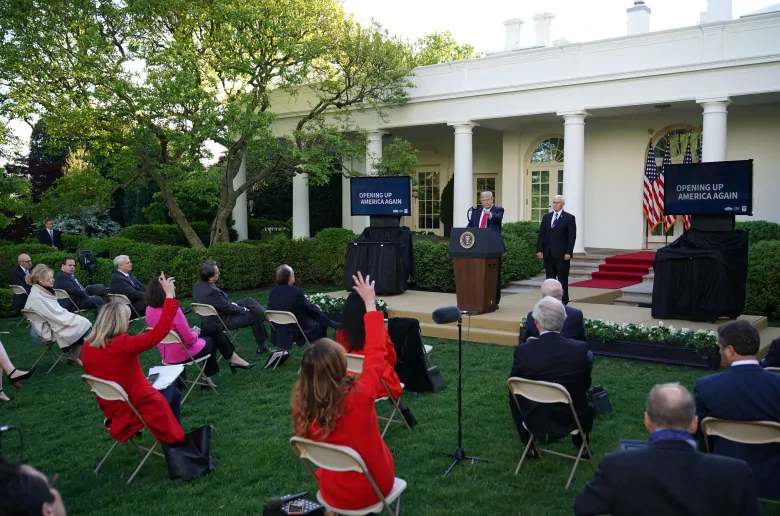
In the United States, which has the world’s highest death toll at more than 56,000, President Donald Trump said states should “seriously consider” reopening their public schools before the end of the academic year, even though dozens already have said it would be unsafe for students to return until the summer or fall.
“Some of you might start thinking about school openings, because a lot of people are wanting to have the school openings. It’s not a big subject, young children have done very well in this disaster that we’ve all gone through,” Trump said.
U.S. President Donald Trump takes questions from reporters during a news conference on the novel coronavirus in the Rose Garden of the White House in Washington on Monday. (Mandel Ngan/AFP/Getty Images)
Trump also admitted the number of virus deaths could reach 70,000 in the U.S., after citing 60,000 several times this month.
Here’s a look at what’s happening around the world
From The Associated Press and Reuters, updated at 7 a.m. ET
The UN humanitarian chief said Monday that $90 billion US could provide income support, food and a health response to the coronavirus pandemic for 700 million of the world’s most vulnerable people. Mark Lowcock told a video briefing most experts agree that the peak of the COVID-19 pandemic hasn’t reached the poorest parts of the world, but may peak in the next three to six months.
He said about 700 million people — 10 per cent of the world’s population — are most vulnerable and concentrated in about 30 to 40 countries that already receive humanitarian assistance and will see a big drop in incomes as the virus spreads and governments impose restrictive measures and lockdowns.
Brazil, Latin America’s most populous country with 211 million people, has reported 4,600 deaths and 67,000 confirmed infections. But the true numbers are believed to be vastly higher given the lack of testing and the many people who haven’t sought hospital care.
Medical officials in Rio de Janeiro and at least four other major cities have warned that their hospital systems are on the verge of collapse or are too overwhelmed to take any more patients. There are also signs that a growing number of Brazilian victims are dying at home.
People in Rio de Janeiro line up outside a public bank, where a staff member is offering information about emergency aid given by the federal government to the most vulnerable. (Ricardo Moraes/Reuters)
“We have all the conditions here for the pandemic to become much more serious,” said Paulo Brandao, a virologist at the University of Sao Paulo.
President Jair Bolsonaro has insisted that COVID-19 is just a “little flu” and there is no need for the type of restrictions that have slowed the infection’s spread in Europe and the U.S. but upended their economies. Bolsonaro has said Brazilians need to resume their lives to prevent an economic meltdown, but most state governors have adopted restrictions to keep people home and slow the spread of the virus.
Argentina, meanwhile, has banned ticket sales for commercial flights until September.
New Zealand reported just three new infections Tuesday. Prime Minister Jacinda Ardern said people had done an incredible job of breaking the chain of transmission but cautioned they need to remain vigilant.
“There may still be some smouldering ashes out there, and they have the potential to become a wildfire again, if we give them the chance,” she said, quoting a microbiologist.
WATCH | New Zealand loosens lockdown restrictions:
Prime Minister Jacinda Ardern says New Zealand has ‘won the battle’ against the virus but plans a careful, staged return to normal life. 1:23
Her government loosened its lockdown, which had shuttered schools and most businesses. Surfers hit the waves at dawn, builders returned to construction sites and baristas fired up espresso machines. Most students will still keep studying at home, employees must work from home if possible and everyone is required to maintain physical distancing.
In Australia, authorities reopened Sydney’s iconic Bondi Beach to swimmers and surfers on Tuesday and hundreds of people returned to the water. People can only use the beach during daylight, cannot linger and are limited to ensure physical distancing. Australia has only 83 confirmed virus deaths, less than the death tolls in at least half of the U.S. states.
Singapore’s health ministry has said it is not able to test all migrant workers in dormitories and has been isolating some symptomatic patients first, a method that a government health adviser said was causing a lag in the reporting of cases.
The Southeast Asian island nation of 5.7 million people has nearly 15,000 confirmed coronavirus infections, one of the highest totals in Asia, largely because of outbreaks in cramped dormitories housing more than 300,000 mostly South Asian workers. The ministry on Tuesday confirmed 528 more coronavirus infections, the smallest daily rise in almost two weeks.
While under partial lockdown, the Bangkok Metropolitan Authority has deployed mobile coronavirus testing units, sending medical staff with personal protective gear to high-risk and vulnerable communities to perform systematic testing. (Lauren DeCicca/Getty Images)
Health authorities in Thailand on Monday reported the country’s lowest number of new cases of the coronavirus in more than six weeks, as the government considers easing some restrictions imposed to control the spread of the virus. Nine new confirmed cases were reported, the smallest single-day increase since March 14.
Thailand has confirmed 2,931 cases, including 52 deaths. Officials said a proposal will be submitted to the cabinet on Tuesday for easing restrictions according to suggestions from the state planning agency.
The head of Japan’s medical association thinks it will be difficult to hold the Olympics without an effective coronavirus vaccine.
“I hope vaccines and drugs will be developed as soon as possible,” Japan Medical Association President Yoshitake Yokokura said Tuesday.
Japan and the International Olympic Committee agreed to postpone the Tokyo 2020 Summer Games until July next year due to the coronavirus pandemic. Japan is under a monthlong state of emergency amid a rapid increase of infections throughout the country, where hospitals are overburdened.
Yokokura did not say whether he opposes the Olympics without a vaccine.
“The key is a situation with the infections at that point. If the infections are under control only in Japan, it will still be difficult to hold the games unless the pandemic is over in the rest of the world,” he said.
Experts have said it could take 12-18 months or longer to develop a vaccine that is safe and effective for clinical use.
Japan has 13,576 reported virus cases, plus 712 others from a cruise ship quarantined near Tokyo earlier this year, with 389 deaths, the health ministry said Tuesday.
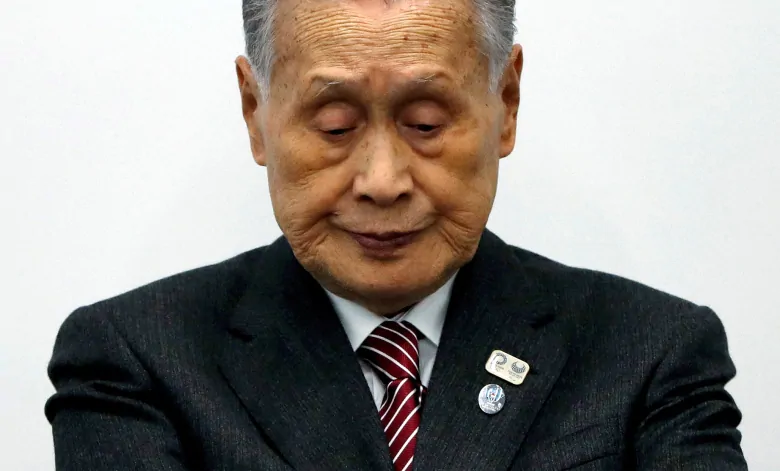
Tokyo 2020 president Yoshiro Mori said the Olympic Games would be “scrapped” if they could not take place in 2021, according to an interview published Tuesday. (Issei Kato/Reuters)
Meanwhile, Tokyo 2020 president Yoshiro Mori said that the Olympic Games, already postponed to 2021, would be “scrapped” if they could not take place then, according to an interview published on Tuesday.
The International Olympic Committee and the Japanese government last month postponed the Games until July 2021 because of the impact of the coronavirus outbreak.
With the epidemic’s worldwide infection rate climbing and experts suggesting a vaccine is still a long way off, questions are being asked about whether the huge setpiece event might need to be delayed further.
PM believes Games will go ahead
“No. In that case, the Olympics will be scrapped,” Mori said in the interview with Japanese sports daily Nikkan Sports, when asked if the Games could be postponed again until 2022.
However the former prime minister remained confident they would go ahead in 2021.
“We have delayed the Olympics until next summer after we will have won the battle,” he was quoted as saying.
“The Olympics would be much more valuable than any Olympics in the past if we could go ahead with it after winning this battle. We have to believe this otherwise our hard work and efforts will not be rewarded.”
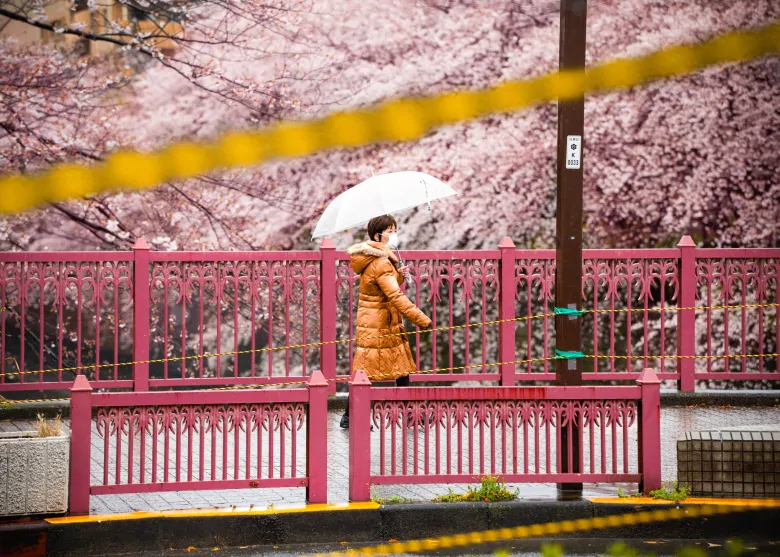
Like the iconic blossoms that fill Tokyo every spring — the pale pink Sakura — much of Japan is currently out of bounds. Roped off, closed or otherwise deemed unacceptable to visit. But unlike authorities in other places in the world, those in Japan have resorted to suggestions instead of commands. Violating them could get individuals a stern look, businesses a public shaming, but rarely a fine. The declaration of a national state of emergency was meant to send a signal, but the change has been incremental.
(Saša Petricic)
Routine behaviour
Physical distancing is a goal, not a national obsession — partly because it runs up against Japan’s rigid work culture, which usually requires long hours in the office. Tokyo’s morning rush hour is lighter now, about 30 to 50 per cent of normal on the trains into downtown. But commuters still rub elbows on benches, escalators and platforms.
(Saša Petricic)
What’s behind the relaxed attitude on Japan’s streets? Infection numbers that are still relatively low by world standards, if growing steadily. There are just over 13,500 cases nationally, less than a third of Canada’s. This even though Japan’s population is more than three times the Canadian population. Total deaths are around 375, fewer than New York is experiencing daily now. Testing is also lower here, as Japan has put more emphasis on its own system of targeted contact tracing.
Business ventures
(Saša Petricic)
Faced with that low sense of risk, businesses like Daisuke Shimazaki’s Tokyo sushi bar choose to remain open. “Of course, I’m afraid,” he said, “but I have to eat. I have to pay my bills and my staff.” Many stores, restaurants and bars have closed for a few weeks, but it’s unclear whether they will stay closed if the government extends its emergency decree, even with an economic support package worth more than $1.6 trillion Cdn.
(Saša Petricic)
Fishing has been hit hard, with much lower demand at Tokyo’s normally bustling fish markets. The value of bluefin tuna — a Japanese staple — has tumbled 30 to 40 per cent. That’s prompted some fishermen to stay ashore while others — such as those in Onjuku harbour — keep catching other varieties, including yellowtail, everyone waiting for life to get back to normal and demand to increase to normal levels.
Rural life
(Saša Petricic)
“It’s hard work, but I don’t mind,” said the woman stooped to plant rice near the village of Kamifuse. Except for the masks people wear, life in the countryside doesn’t look much different amid the coronavirus. Infection levels are much lower than in major centres such as Yokyo or Osaka — so much so that people who live in the cities have been asked to stay away from rural Japan to keep the virus from spreading.
Age differences
(Saša Petricic)
Throughout Japan, the most vulnerable — and the most afraid — are seniors. You don’t see many on the streets of Tokyo even though the country has the oldest population on earth, with more than one in four people older than 65. At least 220 of the total 375 deaths are in this demographic, so many older people stay at home.
(Saša Petricic)
Many young people, on the other hand, are still out doing what they usually do. Still out on the surf in Chiba prefecture, east of Tokyo, on a Sunday afternoon. “Just look,” said Akira Sato as he came out of the water with a friend, “the danger is very little for us.” Maybe out on the water, but numbers nationally show those in their 20s to be one of the groups with the highest level of infection.
(Saša Petricic)
Slowly, people in Japan are drifting away from each other, doing more to isolate on beaches in Chiba, as in downtown Tokyo. But the sense of crisis seen elsewhere around the world just isn’t on display here.
Canada’s two largest provinces announced plans on Monday to ease restrictions put in place in response to the COVID-19 pandemic.
In Quebec, Premier François Legault said for the good of children, especially those with learning difficulties, the province is moving forward with a plan to begin reopening schools.
In his daily briefing Monday, the premier said five or six months without attending school could pose serious, long-term risks for many children.
“Life must go on,” he said.
A closed schoolyard is seen through its fence in Montreal on Monday. (Paul Chiasson/The Canadian Press)
Elementary schools and daycares will begin reopening on May 11 outside of Montreal and on May 19 on the island of Montreal.
All other schools — high schools, colleges and universities — won’t reopen until late August.
But Legault said that timeline will depend on the number of hospitalizations for COVID-19 remaining stable. There are now 1,541 people in hospital — an increase of 23 over Sunday. Some 210 patients are in intensive care, down five from yesterday.
WATCH | Legault details plans to reopen schools:
Premier François Legault says elementary schools and childcare centres outside Montreal are expected to open May 11, though attendance will not be mandatory. High schools, CEGEPs and universities will remain closed. 1:06
Eighty-four more deaths have been recorded in the past 24 hours. Of those, 79 were residents of long-term-care homes, or CHSLDs.
The premier has spent the past several weeks pleading with various medical professions for help, especially in those besieged CHSLDs. He said that a critical short-staffing situation is beginning to ease.
“It’s like a weight has been lifted from my shoulders,” Legault said at the government’s daily news conference.
A man brings in supplies to a seniors residence in Montreal on Monday. (Ryan Remiorz/The Canadian Press)
In Ontario, the government announced it will reopen the province’s economy through a three-stage process in the coming weeks and months, though it offered no firm date and few details about when that effort will begin.
Health and safety “will continue to be a top priority as Ontario transitions to a ‘new normal,'” a government document unveiled Monday afternoon said. A Framework for Reopening our Province emphasizes that public health officials will have input during each phase of the process.
According to the province, the stages are as follows:
Stage 1: Open select workplaces and allow some small gatherings.
Stage 2: Open more workplaces and outdoor spaces, and allow some larger gatherings.
Stage 3: Further relax restrictions on public gatherings and open all work places “responsibly.”
WATCH | Ford moves cautiously to reopen economy:
Doug Ford says the province has ‘flattened the curve’ against COVID-19 but warns the timing to allow businesses to reopen still depends on some strict criteria. 0:57
Each stage will last at least two to four weeks, at which point Ontario chief medical officer of health will be able to tighten certain restrictions, extend the stage or advise that the province can move into the next phase.
While there are no specific dates included in the planning document, when and how Ontario begins reopening will depend on a number of factors, including:
A consistent two-to-four week drop in new daily COVID-19 cases.
A decrease in cases that can’t be traced to a source.
A decrease in new hospitalizations.
Dr. David Williams, Ontario’s chief medical officer health, said last week that the province would need to see fewer than 200 new cases daily for an extended stretch before relaxing COVID-19 emergency measures would be feasible.
With the province still falling somewhat short of its goal of processing 13,000 tests per day, whether the number of new cases being reported daily reflects the true number of new infections remains a question.
WATCH | Trudeau on provincial plans to reopen their economies:
Prime Minister Justin Trudeau spoke with reporters on Monday 2:14
Prime Minister Justin Trudeau, who said the federal government is working with provinces around “shared” guidelines, reiterated on Monday that provinces have broad authority around reopening.
Deputy Prime Minister Chrystia Freeland said the federal government is still actively discussing reopening plans with provinces, adding that the process would be collaborative, gradual and guided by science.
Worldwide cases pass 3 million
The announcements comes as the reported worldwide coronavirus case count surpassed three million, according to a database from Johns Hopkins University.
The novel virus, which causes an illness called COVID-19, first emerged in China and has since spread around the world. The U.S-based university’s tracking tool, which draws on a range of sources including national and local public health data, reports more than 209,000 deaths linked to the virus.
A health worker wearing a protective suit is disinfected inside a portable tent in Manila, Philippines, on Monday. (Aaron Favila/The Associated Press)
As of 6 p.m. ET on Monday, Canada accounted for 48,450 of those cases. The provinces and territories that provide data about recoveries listed 18,228 cases as recovered or resolved. A CBC News tally based on provincial data, local health information and CBC reporting has found 2,784 COVID-19-related deaths in Canada, with an additional two deaths abroad.
The head of the World Health Organization (WHO) warned on Monday that the new coronavirus pandemic was far from over and said that he was “deeply concerned” about the impact of the disruption of normal health services, especially on children.
“The pandemic is far from over,” said WHO Director-General Tedros Adhanom Ghebreyesus, adding that the body was concerned about increasing trends in Africa, eastern Europe, Latin America and some Asian countries. “We have a long road ahead of us and a lot of work to do,” he said.
Tedros also said all countries should have heeded the agency’s warning when it declared COVID-19 to be a global emergency on Jan. 30, when there were only 82 cases of the disease beyond China.
WATCH | Can’t force countries to take our advice, WHO says:
The World Health Organization says it declared its highest level of global emergency on Jan. 30 due to COVID-19, and the world should have listened. 2:48
He added that shortages of vaccines against other diseases were being reported in 21 countries as a result of border restrictions linked to the pandemic, citing the GAVI global vaccine alliance.
“The number of malaria cases in sub-Saharan Africa could double,” he said. “That doesn’t have to happen; we are working with countries to support them.”
Canada’s top doctor told CBC News the federal government could have made earlier efforts to keep the pandemic from sweeping across the country — but moves to close borders and screen travellers for the illness sooner might not have made much of a difference.
WATCH | Tam says more could have been done:
During her first sit-down interview since the COVID-19 crisis began, Canada’s Chief Public Health Officer Dr. Theresa Tam tells CBC’s chief political correspondent Rosemary Barton that some pandemic measures could have been better executed and could have happened sooner. 1:43
In a wide-ranging interview, Chief Public Health Officer Dr. Theresa Tam told CBC News that simply shutting the border to travellers from China and other coronavirus hotspots earlier wouldn’t have stopped the virus — and that expecting officials to identify travellers at the border with symptoms was “unlikely.”
She also said the closure of the Canada/U.S. border did not happen sooner because it wasn’t part of the government’s pandemic preparedness plan.
“Could we have done more at the time? You can retrospectively say yes, absolutely, you could screen more, or you could change your stance. But at the time we had very, very few cases globally and in Canada,” Tam said.
Wage subsidy program opens
Monday also marks the first day that eligible businesses can apply for Ottawa’s $73-billion wage subsidy program.
The federal government initially proposed a 10 per cent wage subsidy for eligible workers but after criticism from businesses and the opposition, the government boosted the subsidy to 75 per cent of wages, offering up to $847 a week. Businesses that can are being urged to top workers up and cover the remaining 25 per cent.
The first payments should begin to arrive as soon as May 7, Trudeau said at his daily briefing on Monday.
“Whether you’re a charity that employs 200 people or a fast-growing startup that employs just 20, you will be eligible to up to $847 per week, per employee.”
The program should help employers and staff stay connected through the pandemic, the prime minister said, adding that 10,000 businesses have already applied since the portal opened Monday morning.
WATCH | Epidemiologist on why testing is key to reopening economy:
‘There will be re-infections,’ says Dr. Christopher Labos, but if they can be identified early, he says it should help with efforts to contain the virus. 5:26
With no proven vaccines or treatments, governments around the world imposed a range of public health measures — including stay-at-home orders, physical distancing requirements and sweeping business closures — to try and slow the spread of the virus, or flatten the curve.
Saskatchewan has announced initial details around how it plans to proceed with a phased reopening and New Brunswick recently loosened restrictions on some outdoor spaces and allowed families to partner up in what’s been described as two-family bubbles.
Here’s what’s happening in the provinces and territories
The Office of the Seniors Advocate in British Columbia has announced an additional $500,000 to help support caregivers and seniors as part of the province’s emergency COVID-19 response plan. “Family care-giving can be intense for people,” seniors advocate Isobel Mackenzie said. “It can be stressful in the best of times.” Read more about what’s happening in B.C.
Alberta reported two new deaths and 216 new cases. Health officials say there is an outbreak involving 13 people at the Bearspaw First Nation in the southern part of the province, and four people have also tested positive in Calgary’s homeless community.
WATCH | Province takes over Alberta long-term care home after COVID-19 outbreak:
Some residents and former staff are questioning the decision to have Alberta Health Services take over running the Manoir Du Lac long-term care home after a COVID-19 outbreak. 2:05
Saskatchewan reported another death from COVID-19, bringing the toll there to five. The government says the person was in their 80s and hailed from the far north.
That region is experiencing an outbreak of cases, with the mayor of La Loche, a remote community about 600 kilometres northwest of Saskatoon, saying it had around 20. Read more about what’s happening in Saskatchewan.
Ontario is reporting 424 new cases, and 57 new deaths. In long-term care — information that comes from a separate database — there were 17 more deaths in the previous day and there are now outbreaks in 150 homes. Read more about what’s happening in Ontario.
People wearing protective face masks are seen in Toronto on Monday. (Evan Mitsui/CBC)
Quebec announced 84 more COVID-19 deaths in the province. Premier Francois Legault said the COVID-19 situation is largely under control with the exception of long-term care centres, where 75 of the 84 new deaths originated.
He thanked the thousands of people who have submitted CVs to work in the facilities, including Olympic medal-winning figure skater Joannie Rochette and Super Bowl-winning football player Laurent Duvernay-Tardif. Read more about what’s happening in Quebec.
New Brunswick did not report any new cases for the ninth straight day. To date, 112 people have recovered from the virus and three remain in hospital, none of whom are in the intensive care unit. Read more about what’s happening in N.B.
People wear protective face mask in colours honouring the victims of the Nova Scotia killings on Monday in Westmorland County, N.B. (Graham Thompson/Radio-Canada)
Prince Edward Island, which has reported only 26 coronavirus cases since the outbreak began, had no new cases to report on Monday for the 12th straight day.
Chief Public Health Officer Dr. Heather Morrison said the plan to ease public health restrictions is being finalized and should be released this week. Read more about what’s happening on P.E.I.
WATCH | Ian Hanomansing checks in with some of the people who’ve shared their stories about life during the COVID-19 pandemic:
Ian Hanomansing checks in with some of the people who’ve shared their stories about life during the COVID-19 pandemic to find out how they’re adjusting to the new normal. 4:56
Newfoundland and Labrador is reporting no new cases of COVID-19. The province has confirmed 258 cases of the illness and 221 people have recovered.
Dr. Proton Rahman, a clinical scientist and professor of medicine at Memorial University of Newfoundland, presented models Monday looking at the spread in the province, showing the first wave of infections has been brought under control. Rahman said it’s appropriate to start thinking about reducing public health measures in a phased and controlled way.Read more about what’s happening in N.L.
From The Associated Press, updated at 3:30 p.m. ET
In the U.S., the Centers for Disease Control and Prevention (CDC) was to release new priorities for coronavirus testing Monday, including testing asymptomatic individuals in high-risk settings.
And the White House was set to unveil what it described as a comprehensive overview of its efforts to make testing for COVID-19 more widely available.
The White House is aiming for states to have enough tests and needed supplies to test at least 2.6 per cent of their populations per month — a figure needed to catch asymptomatic spread.
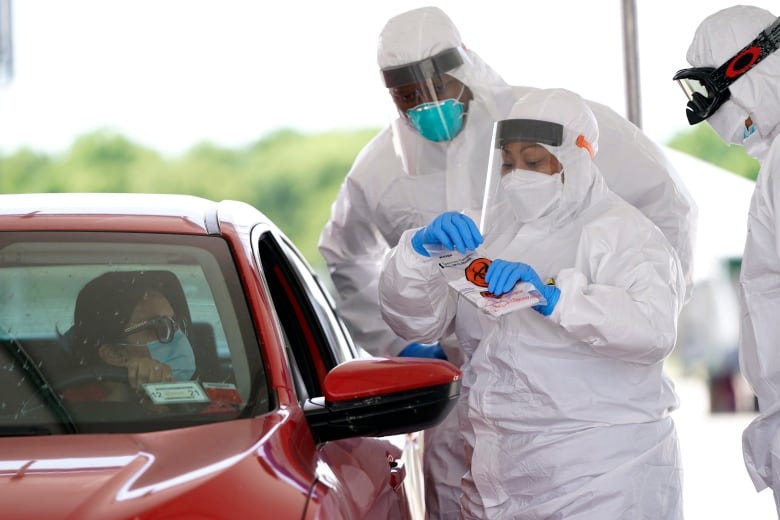
Health-care workers prepare to administer a test at a COVID-19 drive-thru testing site in Houston on Monday. (David J. Phillip/The Associated Press)
The administration is also releasing a “testing blueprint” for states, outlining how they should prioritize testing as they devising their reopening plans.
It includes a focus on surveillance testing, as well as “rapid response” programs to isolate those who test positive and identify those they came in contact with.
The administration aims to have the market “flooded” with tests for the fall, when COVID-19 is expected to recur alongside the seasonal flu.
Governors in states including hard-hit New York and Michigan are keeping stay-at-home restrictions in place until at least mid-May, while their counterparts in Georgia, Oklahoma and Alaska are allowing certain businesses to reopen.
The split in approaches to reopening in the U.S. has often been along partisan lines.
Oklahoma Gov. Kevin Stitt, a Republican, said with hospitalizations dropping in his state, he will reopen churches and restaurant dining on Friday, with physical-distancing guidelines in place.
WATCH | More businesses open in Georgia as COVID-19 restrictions ease:
Some health experts and local politicians are concerned that restrictions put in place to slow the spread of COVID-19 are being lifted too soon in some U.S. states such as Georgia. 2:34
But Michigan Gov. Gretchen Whitmer, a Democrat, told ABC that her state is not ready and needs more robust testing, community tracing and a plan for isolating people who get sick.
“We’ve got to be nimble, and we have to follow the science and be really smart about how we re-engage,” she said.
The U.S. death toll is nearly 55,000 — close to the 58,000 U.S. troops who were killed during the Vietnam War. Italy, Britain, Spain and France account for more than 20,000 deaths each.
Here’s a look at what’s happening around the world
From The Associated Press and Reuters, updated at 4:15 p.m. ET
Italy registered its lowest day-to-day number of new cases of COVID-19 Monday since practically the first day the country was put under lockdown to contain what would become one of the world’s worst outbreaks.
According to data from the Italian health ministry, 1,739 new cases were confirmed in the 24-hour period ending Monday evening. The last time the nation saw such a low daily number occurred on March 10, when 77 new cases were registered. Italy now has 199,414 known cases. It registered 333 deaths since Sunday evening, raising to 26,977 the number of known deaths in the country. Italy has Europe’s highest death toll in the pandemic.
Some of Italy’s lockdown rules will be partially eased on May 4, but many restrictions on retail shops, museums and other businesses will last two or more weeks beyond that date. Scientists advising the government are concerned the contagion rate will start soaring again when Italians start moving around more with newly regained freedoms. Premier Giuseppe Conte has decided that reopening society will come gradually, since there is no vaccine against COVID-19.
People practice social distancing as they wait for a subway train in Rome on Monday. (Mauro Scrobogna/LaPresse via AP)
In Spain, daily fatalities from the virus rose by 331 on Monday to a total of 23,521 but well below the daily peak of more than 900 recorded in early April. Cumulative cases rose to 209,465 from 207,634 the day before.
If the daily death toll continues to fall, Spaniards of all ages will be allowed to exercise outdoors from May 2 on, Prime Minister Pedro Sanchez announced on Saturday. He also said his cabinet would approve on Tuesday a wider plan to lift restrictions and gradually restart the country’s stuttering economy.
The lockdown loosening will not be rolled out by the authorities in unison across the country. Instead, each region will decide its own plan based on several criteria, including the infection rate and capacity of local health services.
A member of the Spanish Army disinfects a nursing home in Espirdo, Spain, on Monday. (Juan Medina/Reuters)
British Prime Minister Boris Johnson said the country has reached the moment of “maximum risk” in the coronavirus outbreak, arguing that lifting the countrywide lockdown too soon would allow a second wave of infections. Speaking outside 10 Downing St. on his first day back at work after three weeks off sick with the virus, Johnson said the country was beginning to “turn the tide.”
Johnson’s Conservative government is under mounting pressure to set out a blueprint for easing the lockdown that has hobbled business activity and daily life since March 23. The restrictions are due to last until at least May 7.
Johnson said he understood people and businesses were eager to get back to work, but “I ask you to contain your impatience because I believe that we are coming to the end of the first phase of this conflict and, in spite of all the suffering, we have so nearly succeeded.”
WATCH | Boris Johnson returns to work after bout of COVID-19:
British Prime Minister Boris Johnson says he is pleased with the progress made in Britain while he was recovering from COVID-19, but says it’s still too dangerous to lift the lockdown. 5:50
China, meanwhile, was fighting back against calls for an investigation into its role in the coronavirus pandemic, citing faults with the U.S. response to the outbreak and calling for Washington itself to admit its errors.
“Indeed, lately in the U.S. many people are questioning whether the U.S. government responded in a timely and effective manner,” Foreign Ministry spokesperson Geng Shuang said at a daily briefing. China has faced questions and criticism over how it reported cases and its initial response to the virus, which first emerged in the city of Wuhan.
Medical workers collect swabs from high school teachers in Yichang, China, on Monday. (China Daily via Reuters)
Russia reported 87,147 confirmed cases on Monday, surpassing the total number of cases reported by officials on mainland China.
Desperate business owners in the country have been pleading with the Kremlin for help in the pandemic shutdown, although the response has been slow and largely focused on big industries.
That has left most smaller companies to fend for themselves and raised the prospect of massive unemployment and social unrest.
A medical worker walks out of a mobile COVID-19 laboratory in Moscow on Monday. (Evgenia Novozhenina/Reuters)
Brazil is emerging as potentially the next big hot spot for the coronavirus amid President Jair Bolsonaro’s insistence that it is just a “little flu” and that there is no need for sharp restrictions.
The intensifying outbreak in Brazil — Latin America ‘s biggest country, with 211 million people — pushed hospitals to the breaking point, leaving victims to die at home.
Brazil officially reported about 4,200 deaths and almost 62,000 confirmed infections, but the true numbers there, as in many other countries, are believed to be vastly higher, given the lack of testing and the many people without severe symptoms who haven’t sought hospital care. Some scientists said more than one million in Brazil are probably infected and the crisis could escalate as the country heads into winter, which can worsen respiratory illnesses.
A health worker holds a photo of a colleague who died of COVID-19 at a protest in Manaus, Brazil, on Monday. (Edmar Barros/The Associated Press)
Turkish President Recep Tayyip Erdogan says his government is working on a detailed plan to normalize life by easing restrictions, adding that “there is light at the end of the tunnel for Turkey.”
The government has refrained from imposing a total lockdown, fearing its negative impact on the already fragile economy. It has opted for piecemeal measures instead, including weekend curfews and banning people above the age of 65 and below the age of 20 from leaving their homes.
On Monday, Health Minister Fahrettin Koca announced 95 deaths in the previous 24 hours, the lowest since April 11. The total death toll now stands at 2,900, with 112,261 confirmed infections.
South Africa is seeking almost $5 billion US from multilateral lenders to help it fight the COVID-19 pandemic.
People wait at a COVID-19 coronavirus screening and testing site in Johannesburg, South Africa, on Monday. (Marco Longari/AFP via Getty Images)
The White House readied new guidelines Monday on coronavirus testing and reopening businesses as it sought to regain its footing after weeks of criticism and detours created in part by presidential sideshows. But U.S. President Donald Trump appeared reluctant to cede the spotlight, with on-off-on plans for a news conference to capture the flurry of action.
As part of the effort, the U.S. Centers for Disease Control and Prevention was set to release new priorities for virus testing, including people who show no symptoms but are in high-risk settings.
The White House was unveiling what it described as a comprehensive overview of its efforts to make enough tests for COVID-19 available so states can sample at least 2.6 per cent of their populations each month.
The action came as the White House tries to shift its approach after an erosion in public support for the president. What had been his greatest asset in the re-election campaign — his ability to dominate headlines with freewheeling performances at his daily briefings — is increasingly being seen as a liability. At the same time, new Republican Party polling shows Trump’s path to a second term depends on the public’s perception of how quickly the economy rebounds from the state-by-state shutdowns meant to slow the spread of the virus.
Days after he set off a firestorm by publicly musing that scientists should explore the injection of toxic disinfectants as a potential virus cure, Trump said he found little use for his daily task force briefings, where he has time and again clashed with medical experts and reporters. Trump’s aides had been trying to move the president onto more familiar and, they hope, safer, ground: Talking up the economy in more tightly controlled settings.
But hours after the White House scrubbed the nightly briefing from its official schedule, it reversed course.
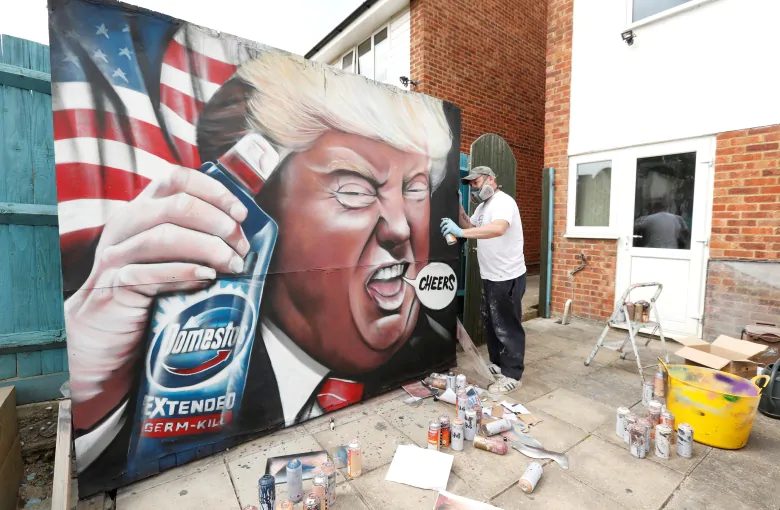
A painter in Royston, Britain, creates a mural of U.S. President Donald Trump on Monday. (Matthew Childs/Reuters)
“UPDATE: The White House has additional testing guidance and other announcements about safely opening up America again. President @realDonaldTrump will brief the nation during a press conference this evening,” White House spokesperson Kayleigh McEnany tweeted.
McEnany had said earlier that instead of holding a briefing, Trump would be meeting with retail CEOs. She said briefings would be held later in the week, but, “they might have a new look to them, a new focus to them.”
“We’re entering a phase of looking to reopen the country and with that, the president will be focusing a lot on the economy,” she said.
‘Testing blueprint’ for states
Among the planned announcements is a new “testing blueprint” for states. It includes a focus on surveillance testing as well as “rapid response” programs to isolate those who test positive and identify those with whom they came in contact. The administration aims to have the market “flooded” with tests for the fall, when COVID-19 is expected to recur alongside the seasonal flu.
Many of the administration’s past pledges and goals on testing have not been met.
The CDC also has been working on more detailed guidelines on reopening schools, restaurants and other establishments that could be released as soon as Monday. Draft guidelines sent by the CDC to Washington include a long list of recommendations for organizations as they begin to reopen, such as closing break rooms at offices, schools spacing desks about two metres apart and restaurants using disposable plates and menus. The draft guidance was obtained by The Associated Press from a federal official who was not authorized to release it.
Some states have started to ease closure orders, and Trump is expected to spend the coming days highlighting his administration’s efforts to help businesses and employees. Aides said the president would hold more frequent roundtables with CEOs, business owners and beneficiaries of the trillions of dollars in federal aid already approved by Congress, and begin to outline what he hopes to see in a future recovery package.
Worries among Republicans
Trump last left the White House complex a month ago, and plans are being drawn up for a limited schedule of travel within the next few weeks, aides said. It would be a symbolic show that the nation is beginning to reopen.
The shift comes in conjunction with what the White House sees as encouraging signs across the country, with the pace of new infections stabilizing and deaths declining.
Still, medical experts warn that the virus will continue to haunt the country at least until a vaccine is developed. And they say the risk of a severe second wave is high if physical distancing measures are relaxed too quickly or if testing and contact tracing schemes aren’t developed before people return to normal behaviours.
WATCH | Media expert says Trump’s COVID-19 briefings have no news value:
Frank Sesno, director of George Washington University’s School of Media and Public Affairs, criticizes the media for reporting on U.S. President Donald Trump’s comments at the COVID-19 briefings, which he deems to have no news value. 7:52
The White House has considered whether to continue to hold news briefings in a modified form without Trump, an effort to restore confidence in the government response so the public would be comfortable resuming more normal activities.
Worries are growing among Republicans and Trump allies over the president’s increasingly erratic handling of the coronavirus crisis.
Though the White House and the president’s re-election team have resolutely projected outward confidence, a number of Trump’s confidants have argued for a course correction aimed at retaining the White House and keeping the Senate from slipping from the Republican Party’s hands, according to four current and former campaign and administration officials.
For weeks, Republicans have grown concerned that Trump’s daily briefings were doing him grievous political damage. Though Trump cherished the TV ratings, the modest polling bump he received in the early days of the pandemic has vanished amid a flurry of misstatements and partisan fights.
Georgia on Monday will start allowing residents to dine inside restaurants or watch a movie at a theatre, as more U.S. states from Minnesota to Mississippi took steps to ease coronavirus restrictions despite the warnings of health experts.
Colorado, Montana and Tennessee were also set to reopen some businesses to start reviving their battered economies. Oklahoma, Alaska and South Carolina, along with Georgia, previously took such steps following weeks of mandatory lockdowns that have thrown at least 26 million Americans out of work.
In Georgia, restaurants and theatres on Monday joined hair and nail salons, barber shops and tattoo parlors, which were allowed to reopen last week with physical distancing restrictions.
One restaurant chain, Waffle House, was imposing seating arrangements in Georgia that will keep patrons at least two metres apart, stricter sanitization measures and a requirement that employees wear masks, CEO Walt Ehmer told WSB-TV.
“I know the unemployment system has been enhanced to help take care of the most vulnerable people, but people want to have jobs, and they want to have something to do and take care of their families,” Ehmer said. “I think it’s going to give them some hope.”
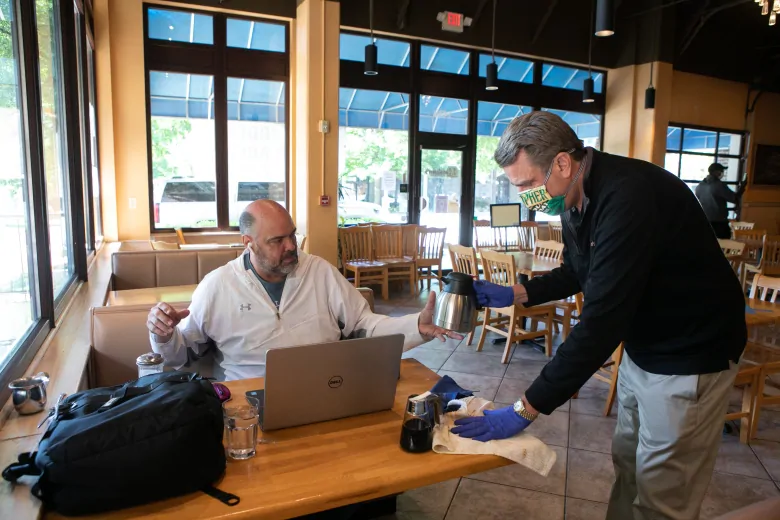
Operating manager Barry Lennon cleans up the table of customer Duke Scott in the empty dining room of the J. Christopher’s restaurant on Monday in Brookhaven, Ga. As of Monday, restaurants around Georgia are allowed to offer dine-in service. (Jessica McGowan/Getty Images)
Public health authorities warn that increasing human interactions and economic activity may spark a fresh surge of infections just as physical distancing measures appear to be bringing coronavirus outbreaks under control.
Meanwhile, the number of known infections in the United States kept climbing on Monday, topping 970,000 as the number of lives lost to COVID-19, the respiratory illness caused by the virus, surpassed 54,800.
Officials in some of the hardest-hit states such as New York, New Jersey and Massachusetts have been emphasizing for weeks that more testing and contact tracing for the virus needed to be in place before they could implement road maps for restarting their economies.
Contact tracing involves tracking down and testing people who may have been around anyone already infected.
“Testing is the way forward, and it’s been a long fight just to get the testing,” New York City Mayor Bill de Blasio said at a briefing on Monday.
He said a new “self-swab” test, which allows patients to administer it to themselves under the supervision of medical personnel, will be available this week at sites run by New York public hospitals.
Protesters demonstrate against safer-at-home orders at the Colorado Capital in Denver on Sunday. Some counties there have implemented stricter measures than the state, which had announced an easing for some businesses starting Monday. (Jason Connolly/AFP/Getty Images)
In Colorado, Gov. Jared Polis has given the green light for retail curbside pickup to begin on Monday. Hair salons, barber shops and tattoo parlors may open on Friday, with retail stores, restaurants and movie theatres to follow.
“I would stay home if the government encouraged that, but they’re not. They’re saying, ‛Hey, the best thing to do is go back to work, even though it might be risky,” Royal Rose, 39, owner of a tattoo studio in Greeley, Colo., told Reuters.
Colorado’s experience is not uniform. A few counties, including Denver’s, have stay-at-home orders that extend into May.
In a further step to ramp up supplies to fight the pandemic, Trump planned to meet with American textile industry representatives Monday as clothiers seek to shift their production lines to face masks and other critical items, the White House said.
Companies are aiming “to repurpose their factories from making things like T-shirts into gowns and masks and things like cotton swabs” used for coronavirus testing, White House trade adviser Peter Navarro told Fox News.
Executive says food supply chain is ‘vulnerable’
South Dakota Gov. Kristi Noem on Monday said she hoped Smithfield’s Sioux Falls pork processing plant can reopen soon, a day after U.S. labour regulators urged the meat industry to adopt certain measures to prevent the spread of coronavirus among workers.
“I’m hopeful that we can get it opened as soon as possible,” Noem told Fox News Channel in an interview. “They have some mitigation measures to put in place, but I think in a matter of days it could be opened, as long as everybody continues to work together and get it done.”
Smithfield Foods, the world’s biggest pork processor, has shut down several U.S. plants due to a rash of coronavirus cases among employees, raising concerns about the nation’s meat supply and worker safety.
Its cases in Sioux Falls triggered a so-called hot spot of U.S. coronavirus cases. Noem, a Republican, was among the small number of governors who did not issue stay-at-home orders.
WATCH | Clusters of cases also seen in Canadian meat processing plants:
COVID-19 outbreaks at three meat processing plants in Alberta and B.C. have forced the facilities to temporarily close, raising concerns about meat prices and supply. 5:13
On Sunday, the U.S. Labor Department’s Occupational Safety and Health Administration issued new interim guidelines with the U.S. Centers for Disease Control and Prevention that call for meat industry workers to be at least two metres apart, have their temperatures checked and wear face masks.
Tyson Foods Inc chairman John Tyson, whose company has also had to close some facilities, on Sunday said in an open letter that closures could lead to meat shortages.
“This means one thing — the food supply chain is vulnerable,” he wrote.
NYC mayor reverses course on pedestrian traffic
New York City will close some streets to vehicle traffic, expand sidewalks and create temporary bike lanes to offer New Yorkers more space to stay apart outside as lockdown measures continue, de Blasio said on Monday.
“Over the next month, we will create a minimum of 40 miles [64 kilometres] of open streets. And as the crisis continues, the goal is to get up to 100 miles [160 kilometres],” de Blasio said.
He said the city would focus on streets in and around parks, where officials expect many people to congregate as the weather gets warmer.
The road is empty in front of the MetLife Building and Grand Central Terminal in New York City on April 21. The city said Monday it favours streets near parks as candidates to be open for pedestrian traffic during the pandemic. (Ted Shaffrey/The Associated Press)
The debate comes as cities around the world experiment with ways to gradually ease restrictions without compromising safety.
Several cities, including San Francisco and Denver in the United States, and Milan, Dublin, Budapest and Berlin in Europe, have closed some streets to cars and expanded sidewalks and bicycle lanes to provide more outdoor space.
De Blasio himself in mid-April shot down the idea of closing streets to traffic, saying he did not believe it would work.
Asked about his change of mind on Monday, he said he was reassured after city council proposed community partners to help the New York Police Department keep streets safe.