Categories
Sports

Sure, the game only lasts 90 minutes, but to these World Cup fans the 27-hour train ride was worth it


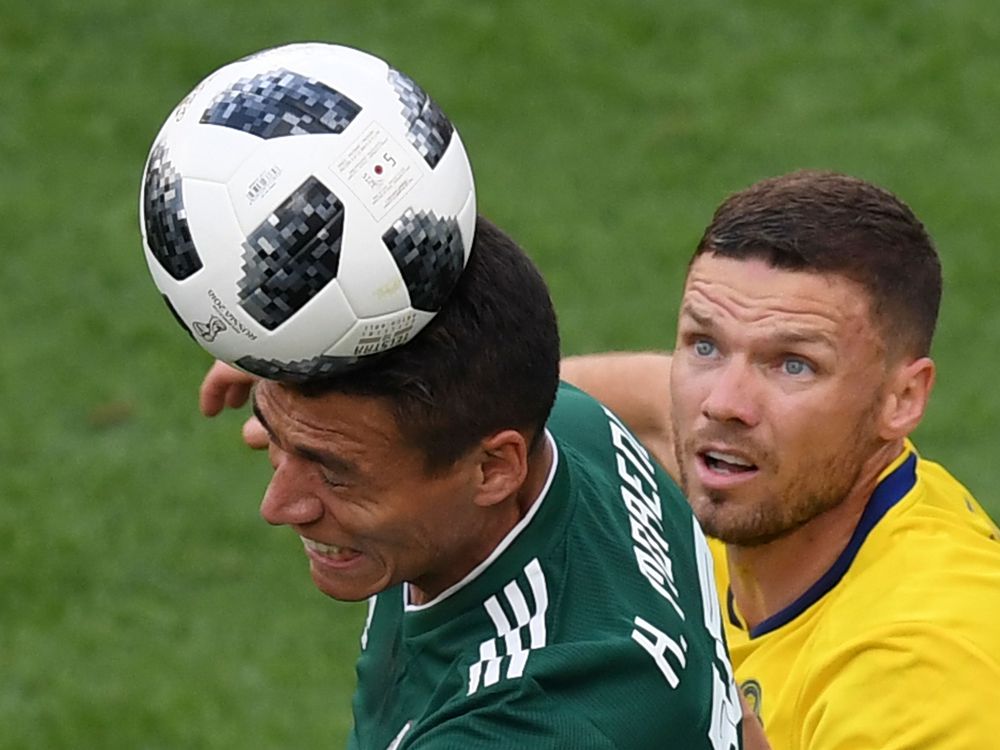
Mexican defender Hector Moreno (left) and Swedish forward Marcus Berg vie for the ball at the World Cup on June 27.

Photograph by: Jorge Guerrero

YEKATERINBURG, Russia — After nearly 27 hours and 1,500 kilometres on a train from Moscow, Hans Josefsson’s pedicure remained immaculate.

Before leaving Sweden 10 days earlier for the World Cup, he had his toenails painted blue and gold, the colours of the national soccer team.

“A professional did it. I knew I would do a lot of walking in these sandals,” Josefsson said before arriving here Tuesday afternoon in the easternmost Russian city in which matches are being played.

A fellow passenger on the daylong trip, Luis Aragones, 24, an architect, had watched in Mexico City as Mexico stunned Germany, the defending champion, in its opening game. He had joined a delirious celebration whose mass jumping may have caused the equivalent of a minor earthquake.

Inspired, Aragones cancelled plans to attend a wedding in Argentina. He sold his television and an Xbox console, got a loan from his mother, bought a one-way ticket to Moscow, stayed awake for two days without a hotel room and then boarded Train No. 118 to Yekaterinburg on Monday. He promptly fell asleep for 10 hours.

“I just knew I had to be here,” he said.

There may not be more exuberant and adventurous fans at the World Cup than those from Sweden and Mexico, whose teams met in a crucial match on Wednesday in this city where Europe becomes Asia. Sweden won 3-0, but both teams still advanced to the knockout phase of soccer’s world championship.

About 15-20 fans from each team boarded a Soviet-era train early Monday afternoon at Kazansky Station in Moscow, riding the rails instead of taking a much shorter, and surely duller, airplane trip that thousands of their compatriots were taking across the Ural Mountains.

In a cabin for four, Patrik Brunnberg and Anton Dimitrov, both 31 and longtime friends from Stockholm, became bunkmates by chance with their countrymen Claes Hedlund and Orejan Jonsson, both 59 and teachers from Goteborg.

“At least they will be snoring in Swedish,” Hedlund said.

It was a trip for those who preferred thrift and exploration over speed and luxury. The journey can expand to six days on the Trans-Siberian Railway to Beijing.

“It’s a chance to try something different,” said Brunnberg, an IT project manager. “You don’t see anything when you’re flying.”

The staff aboard Train No. 118 were patient and solicitous. The cabins were basic but clean and comfortable, though sometimes hot. Security guards patrolled the narrow aisles unobtrusively but carried batons and handcuffs.

The World Cup passengers were friendly and united by their common sporting passion. But much to the surprise of some as dinnertime approached on Monday, the train lacked even a dining car, much less access to the internet.

“We thought we would have a big party, with a restaurant and a bar where they would be playing music and dancing,” said Oscar Bonfil, 45, a native of Mexico City who is a supermarket executive in Lima, Peru. “It’s kind of boring.”

The problem, explained Alexandra Popova, an attendant working her maiden trip, is that so many trains are headed south from Moscow during the World Cup and family vacations. As a result, some eastbound trains are left without certain amenities — namely, restaurants.

That did not seem to hinder nine Swedish supporters in car No. 13. They brought their own party and restaurant on the trip. Their lubricated intent was inscribed on one fan’s T-shirt: “Beer, please.”

“No drink!” an attendant in the car admonished the group, but this seemed to be more of a suggestion than a hard and fast rule.

Certain beverages stronger than water were carried in plastic bags, along with orange juice that was not technically being administered for its abundance of vitamin C.

“It’s a long trip — you’ve got to stay hydrated,” said Brunnberg, who later detected in himself an odd medical deficiency, adding, “I’ve got too much blood in my alcohol system.”

Two hours into the journey, the train made its first stop, in the town of Vekovka. Vendors on the platform offered crystal ornaments, tea services and plaques mounted with taxidermied squirrels.

The stop was long enough for the most gastro-curious passengers to walk across the tracks to a small store that sold bread, sliced carrots, cheese and what may or may not have been chicken cutlets.

Others smoked and wondered about the missing restaurant car.

“We don’t have dishes,” Popova, the attendant, explained in English. “Just Ramen, snacks, sweets and instant mashed potatoes.”

Emmanuel Gonzalez Rodriguez, 22, a student at the University of Texas-El Paso, stood on the platform in a green Mexico jersey. Mexican fans have been criticized for the use of a homophobic chant, made when opponents perform goal kicks. Asked about it, Gonzalez Rodriguez said he was proud of his fellow El Tri fans for not using the chant against the most recent opponent, South Korea, on Saturday.

He noted that some Mexico supporters helped clean up their area of the stadium after that match, borrowing a practice from the Japanese. Supporters have also drawn praise for helping to lift a wheelchair-bound Egyptian fan above the crowd at a Fan Zone in Moscow, allowing him to watch a match with an unobstructed view.

“Let’s show the world that we are on the first level,” Gonzalez Rodriguez said.

As the train left Vekovka, Oleg Vysotskiy tried to watch Russia’s match against Uruguay on his cellphone. The reception was intermittent, not unlike the air conditioning.

It was just as well, as Russia lost, 3-0. Still, the team advanced to the second round for the first time since the collapse of the Soviet Union. Not bad for a squad rated one of the lowest of the 32 teams in the tournament.

“It’s already an excellent achievement,” said Vysotskiy, 28, a construction consultant travelling on vacation with his wife and daughter. “We’ve been looking for this quite a long time.”

The landscape was mostly unwavering: birch and pine forests dotted with clusters of wooden cottages the colour of Easter eggs.

“Trees, trees, trees,” said Marcia Bergstrom, 54, Josefsson’s wife, who works in business development. “It looks like Sweden.”

Cleverly, she had brought along children’s picture books to help overcome the language barrier in Russia. She showed an attendant the picture of a knife and quickly secured cutlery to slice a chunk of cheese and the cutlets.

Josefsson, 56, the chief executive of a facilities management company, was also traveling with a longtime friend, Janne Hedman, 56, a municipal gardener. They had grown up together in the Swedish village of Krylbo and have carried a flag bearing the hamlet’s name to each of the countless matches they have attended.

They have been traveling to the World Cup since 1990. In 1994, when the tournament was held in the United States and Sweden finished third, they apparently became among the first of the country’s fans to slather their faces in team colours.

A number of newspapers and Time magazine carried their photographs, the men said. Hedman remembered one caption that said something like, “Dearth of sanity perhaps, but a lot of passion.”

Now, Josefsson said: “I’m too old to paint my face. We have to try new things.”

So he had his toenails painted as a talisman. So far, Sweden has defeated South Korea and lost excruciatingly to Germany on a dagger of a free kick five minutes into added time.

“The worst football moment of my life,” Josefsson said of Saturday’s 2-1 defeat. “I felt empty. It hurts still to talk about it.”

At dusk on Monday, Popova, the attendant, offered salami and mayonnaise sandwiches to hungry passengers in car No. 11. Hot water was available to make tea and to cook noodles. Another attendant vacuumed the carpet in each cabin. A Russian passenger went down the aisle, graciously handing out ring-shaped bread snacks called sushki.

A few Mexican fans gathered in the car to sort out food options and broader implications of the World Cup. Mexico is considered by some to have a legitimate chance of winning the tournament. And the country was recently chosen as one of the hosts of the 2026 World Cup, along with Canada and the United States.

Yet the team’s longtime star, Rafael Marquez, has been placed on a U.S. Treasury Department blacklist of people suspected of helping to launder money for drug cartels, which he has vehemently denied.

Then there are the internal tensions in Mexico, with its presidential election approaching on Sunday, and external tensions with the United States over trade and immigration.

“Things are not doing well,” said Edgar Bonfil, 49, Oscar’s brother and an executive for Pepsico in Mexico. “The World Cup is very positive for us. If we do well, it will show that we can do better things, not only with sports but in general.”

The lullaby rocking of sleep on the train gave way to a sunny and scorching Tuesday morning. Attendants cleaned the aisles and the toilets, and offered key chains, pens and pocketknives for sale. The land briefly opened and filled with wildflowers, similar to those that Swedes traditionally wear as crowns to celebrate the summer solstice.

In the early afternoon, the train stopped for half an hour in the town of Druzhinino. The temperature had been stifling in the upper bunks, and a number of passengers stood in the shade and ate ice cream.

“I’m ready to start feeling like a functioning human again,” said Dimitrov, the Swedish fan who owns an online business.

Finally, at 6 p.m., in a time zone two hours ahead of Moscow, Train No. 118 arrived in Yekaterinburg.

Soccer is urgent at the moment, but mid-July will summon a notorious moment here from the Russian Revolution: the 100th anniversary of the killings of Czar Nicholas II, his wife, Alexandra, and their five children.

“In a way, that’s the reason I exist,” Dimitrov explained.

His mother, a tour guide, became enamoured with the story of the imperial Romanovs, learned to speak Russian and Bulgarian and, on a trip to Sofia during the communist era, met the man who became her husband and Dimitrov’s father.

Dimitrov said he planned to visit the Church on the Blood, built on the site where the Romanovs were executed in 1918. “The circle is complete,” he said.

Had his mother concentrated on romance languages and fallen in love with an Italian or a Frenchman, he added with a laugh, his life would be entirely different, but “we would have a few more World Cup titles” in the family.
Original source article: Sure, the game only lasts 90 minutes, but to these World Cup fans the 27-hour train ride was worth it


Source link

Categories
Sports

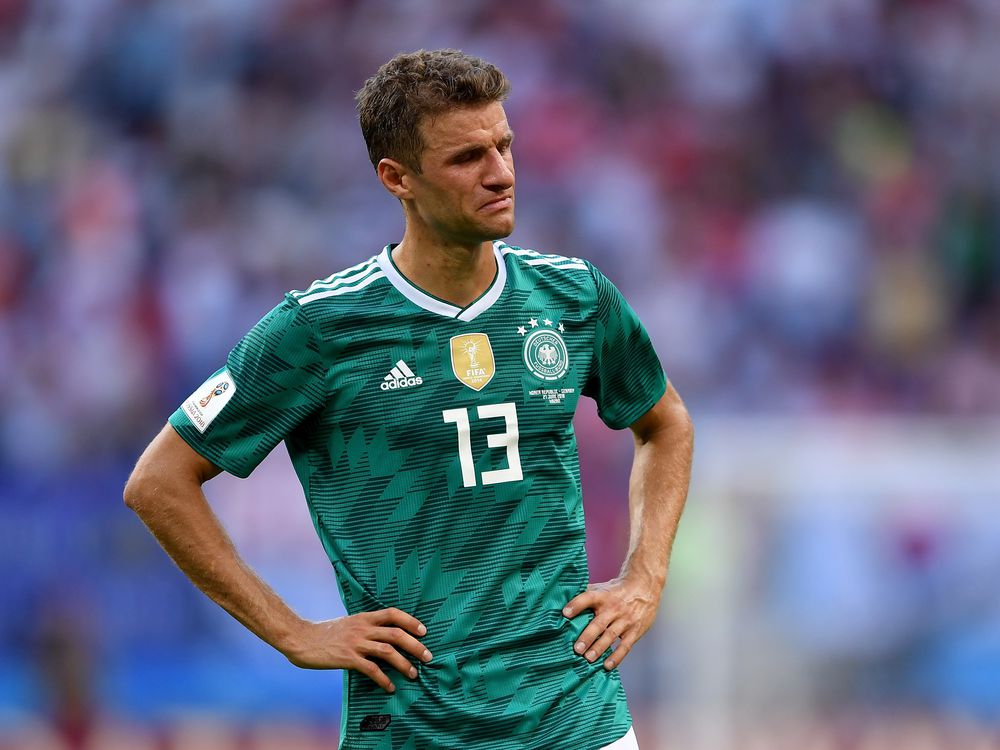
Defending champion Germany crashes out of World Cup in group stage with stunning loss to South Korea


KAZAN, Russia — Everyone was waiting for Germany to score another late World Cup-saving goal.

It never came.

Instead, the Germans have become the fourth defending champions in the last five tournaments to be eliminated in the group stage following a 2-0 loss to South Korea on Wednesday.

The four-time champions allowed a pair of injury-time goals while knowing a 1-0 victory would have been enough to advance because of the result in the other group match, in which Sweden beat Mexico 3-0.

“It’s very, very hard to put it into words,” Germany defender Mats Hummels said. “We believed until the end today. Even when it was 0-1, I think we kept trying to turn it all around.”

Germany ended up last in Group F while Sweden and Mexico advanced to the round of 16. South Korea was also eliminated despite the victory.

It was the first time Germany has been knocked out in the first round since 1938.

“I couldn’t imagine that we would lose,” Germany coach Joachim Loew said.

Even in Yekaterinburg, nearly 800 km away, the Mexican fans expected Germany to score. They were still in position to advance despite trailing Sweden, but they were waiting — some with tears in their eyes — for Germany to do the inevitable and ruin their chances of moving on.

That’s when South Korea stepped up.

Kim Young-gwon scored the first goal in the third minute of injury time, a goal that sent the Koreans cheering in Kazan and the Mexicans delirious in Yekaterinburg. Originally called out for offside, the goal was given after video review.

Son Heung-min made it 2-0 in the sixth minute of stoppage time after Germany goalkeeper Manuel Neuer came up the field to help his teammates outside the South Korea box. Son tapped the ball into an empty net after a long pass from Ju Se-jong.

Besides Germany this year, France in 2002, Italy in 2010 and Spain in 2014 were the previous defending champions to get eliminated in the group stage.

“We deserved to be eliminated,” Loew said. “For us, this is a huge disappointment. But we have young players who are talented and have the potential to go forward. It happened to other nations before. We need to draw the right conclusions.”

All four teams in the group had a chance to advance in games that were being played simultaneously, but Sweden’s 3-0 lead over Mexico put Germany in prime position to move on as well — if the Germans could score against the South Koreans.

That was the problem, for Germany.

Loew changed his line-up to mix youth with experience, calling back Hummels, Sami Khedira and Mesut Ozil while also fielding Niklas Suele and new Bayern signing Leon Goretzka. Suele made his first World Cup appearance as a replacement for Jerome Boateng.

Germany made a nervous start, playing slower than it usually does to avoid being vulnerable on the break. But the strategy did not bring much success in the first half.

The Germans kept peppering the South Korea box with harmless crosses and it was their opponents that came close to scoring from a set piece in the 19th minute after Neuer failed to control a 25-metre free kick from Jung Woo-young. The Germany keeper bobbled the ball and needed to swipe the rebound away from the attackers after a spectacular dive.

The Germans continued at the same pedestrian pace after halftime and Ozil had another poor display, with many of his passes uncompleted.

Loew brought on substitutes Mario Gomez and Thomas Mueller on either side of the 60-minute mark but his players kept giving the ball away, with most of their attacking combinations lacking precision and speed.

Gomez had a decent header stopped by goalkeeper Jo Hyeon-woo in the 68th minute and could not properly connect with a low cross from Joshua Kimmich in the 72nd as Germany’s hopes vanished.

“We did not deserve to be winning the title once again,” Loew said.

GROUP DYNAMICS

Germany ended up last in a group it expected to win. But the team never really seemed to recover from its opening 1-0 loss to Mexico.

South Korea lost its opening two matches but still entered the game with a chance to advance. It did its part by beating Germany, but Sweden’s 3-0 victory over Mexico allowed the Swedes to win the group ahead of the second-place Mexicans.

HISTORY

Germany had made it to the quarter-finals at the past nine World Cups, and reached at least to the semifinals at every tournament since 2002.

LOEW’S FUTURE

Loew, who guided Germany to the title at the 2014 World Cup after a routing host Brazil 7-1 in the semifinals, said it was too early to talk about his future with the national team.

“We need a couple of hours to see things clearly,” Loew said. “The disappointment is deep inside me.”


Source link

Categories
Sports

Bouchard, Andreescu within one win of earning a spot in main draw at Wimbledon


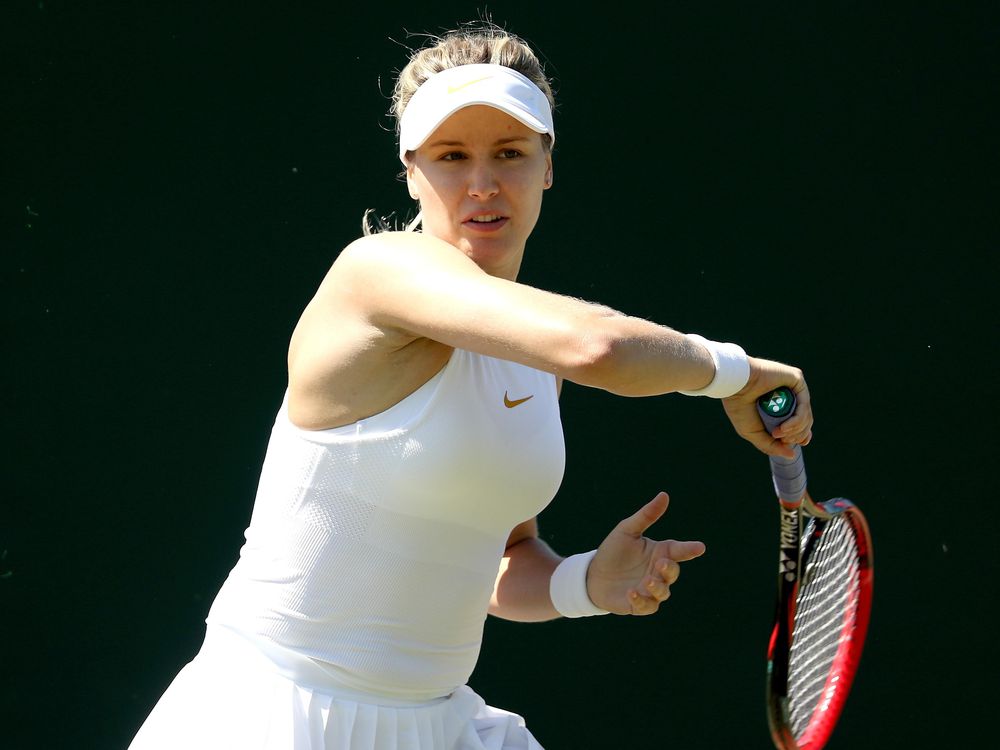
Four Canadians are one win away from reaching the main draw at Wimbledon.

Eugenie Bouchard of Westmount, Que., and Bianca Andreescu of Mississauga, Ont., both won second-round women’s qualifying matches on Wednesday to advance to the final round of qualifying on Thursday.

Meanwhile, Brayden Schnur of Pickering, Ont., and Peter Polansky of Thornhill, Ont., are in the final round of men’s qualifying on Thursday.

On Wednesday, Bouchard beat Karolina Muchova of the Czech Republic 6-2, 2-6, 6-3, while Andreescu knocked off Yingying Duan of China 6-4, 6-3.

Bouchard, the Wimbledon runner-up in 2014, was forced to enter qualifying after seeing her world ranking tumble to No. 191. The 24-year-old will face No. 97 Mariana Duque-Marino of Colombia in the final round of qualifying.

Bouchard faced criticism on social media and from nattering nabob in the media for giving short, terse responses in a post-match interview after her first-round qualifying win, but she was a bit more talkative following Wednesday’s triumph.

“I didn’t feel I was playing all that well,” she told the Wimbledon website. “I’m just happy I was able to keep myself collected in the third and find a way.”

When asked what it would mean to qualify for Wimbledon, Bouchard said, “I’d just be proud of myself for going through the matches. I have a match (Thursday) and that’s all I’m worried about right now.”

The 18-year-old Andreescu, ranked 184th, takes on No. 128 Antonia Lottner of Germany on Thursday.

The 22-year-old Schnur, ranked 235th, meets No. 200 Christian Harrison of the U.S., while the 30-year-old Polansky, at No. 110, faces No. 147 Jason Kubler of Australia.

The four Canadians will be trying to join three Canadian men in the main draw. Two were seeded when the seedings came out on Wednesday — No. 13 Milos Raonic of Thornhill and No. 28 Denis Shapovalov of Richmond Hill, Ont. The Grand Slams are given leeway to stray from the rankings, explaining why Raonic has a better seed than Shapovalov despite being behind him in the world rankings.

The other Canadian in the main draw is Vasek Pospisil of Vancouver.

In women’s doubles, Gabriela Dabrowski of Ottawa and Yifan Xu of China are the sixth seeds.

Bouchard and American partner Caroline Dolehide lost their first-round women’s doubles qualifying match on Wednesday, falling 7-5, 6-2 against Bibiane Schoofs of the Netherlands and Ysaline Bonaventure of Belgium.

Play in the main draw begins on Monday.


Source link

Categories
Sports

Will England and Belgium go for it Thursday with only World Cup seeding on the line?


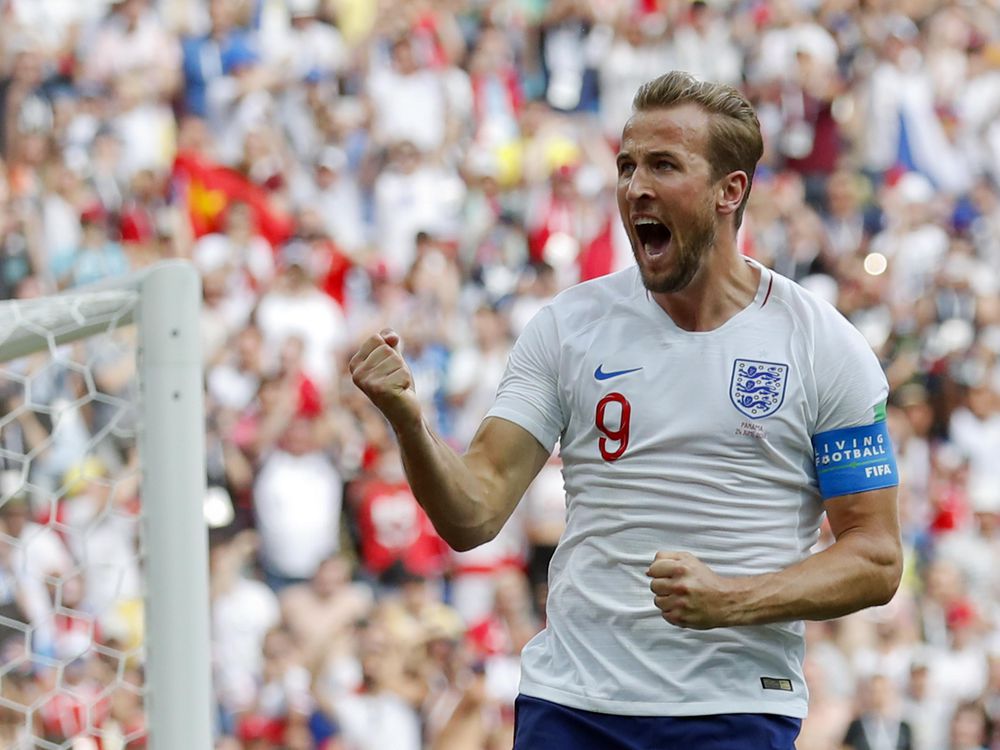
MOSCOW — Harry Kane and Romelu Lukaku have starred in this year’s World Cup, and neither may see much playing time when England and Belgium play Thursday.

Both teams have already advanced to the round of 16, and the match in Kaliningrad will only determine the Group G finishing order. The low stakes have created speculation as to how England and Belgium will use their players, and if finishing first or second in the group would be more advantageous.

The winners and runners-up will end up on different sides of the draw following the match.

Kane is the leading scorer at the World Cup with five goals, including a hat trick against Panama. Kane became the third Englishman after Geoff Hurst and Gary Lineker to score a hat trick in a World Cup match.

“He’s sitting really proudly at the top. He’s gone ahead of some major, major names in English football history in terms of World Cup goals,” England coach Gareth Southgate said. “That should make him incredibly proud, but he also knows the team is the most important thing and we have to make decisions that are right for the team.”

Lukaku has scored four goals from four shots on target for Belgium. But he did not train with the team earlier this week and will likely be rested. Lukaku, Eden Hazard and Dries Mertens are all nursing injuries after Belgium’s 5-2 victory over Tunisia.

England and Belgium have identical records and goal tallies heading into their group decider, so a draw in Kaliningrad would mean tiebreaker rules would determine the group winner.

Southgate insisted his team will not try to lose to get an easier match in the knockout round.

“For our country, that would be a very difficult mindset to have,” Southgate said. “We want to win every game of football we go into. I don’t know how we would go into a game not wanting to win and not wanting to play well.”

The game is at 2 p.m. EDT.

Here’s a look at Thursday’s other matches:

Japan vs. Poland

10 a.m. EDT, Volgograd

Poland has already been eliminated from advancing but Japan can move on to the round of 16 with a draw, and even a loss with help from other teams in Group H.

Moving on in the tournament would be a surprise for Japan coach Akira Nishino, who didn’t even have the job three months ago. The team also wasn’t sure if Keisuke Honda would be able to play in Russia.

The Japan Football Association fired coach Vahid Halilhodzic in April because of underwhelming play and supposed friction with senior players. Nishino came in and organized the squad and ensured Honda, who had a poor relationship with his former coach, would be part of the tournament.

It was Honda’s equalizer against Senegal that put Japan in position to move out of Group H.

Japan became the first team from an Asian country to defeat a team from South America with a 2-1 victory over Colombia in its second game.

Senegal vs. Colombia

10 a.m. EDT, Samara

Both Colombia and Senegal are trying to advance out of Group H. Colombia can advance if it beats Senegal, and both team cans advance with a draw if Japan loses its match to Poland.

Senegal is making only its second World Cup appearance, but it shocked the field in 2002 by beating defending champion France in the tournament opener. Senegal advanced to the quarterfinals that year.

Colombia made the quarter-finals four years ago in Brazil but lost 2-1 to the hosts. It was the furthest Colombia had ever advanced at the World Cup.

Senegal has gained attention in this year’s World Cup for its warmup routine, which resembles a choreographed dance and includes chanting before the players huddle together in laughter. A short video of the routine has drawn more than a million views on Twitter.

Panama vs. Tunisia

2 p.m. EDT, Saransk

Tunisia and Panama have already been eliminated so each team will be trying to leave the World Cup with a respectful performance.

Tunisia is winless in its last 13 World Cup matches, with four draws and nine losses. It’s only World Cup victory was in 1978 against Mexico.

“We played two matches against better teams than us, as we were in a difficult group,” Tunisia defender Hamdi Nagguez said. “Now, we should focus on the last match and win against Panama and stop this run of 40 years without winning a World Cup match.”

Panama is in the World Cup for the first time but wasn’t competitive in Group G and lost 6-1 to England in its second match. Even so, coach Hernan Dario Gomez has been thrilled with the tournament experience.

“I’ve had to play against two spectacular opponents. But that’s absolutely fantastic because that’s how you learn and draw conclusions and that’s how you can tell where your team is,” Gomez said. “There are tremendous teams here at the World Cup, all with tremendous physical fitness, with lots of tactics and good technique, good pressing and organization, speed on the pitch. I’ve really enjoyed watching the games at this World Cup and been very, very happy to be here.”


Source link

Categories
Sports

Face it: Major leaguers are embracing an old solution to protect their noggins


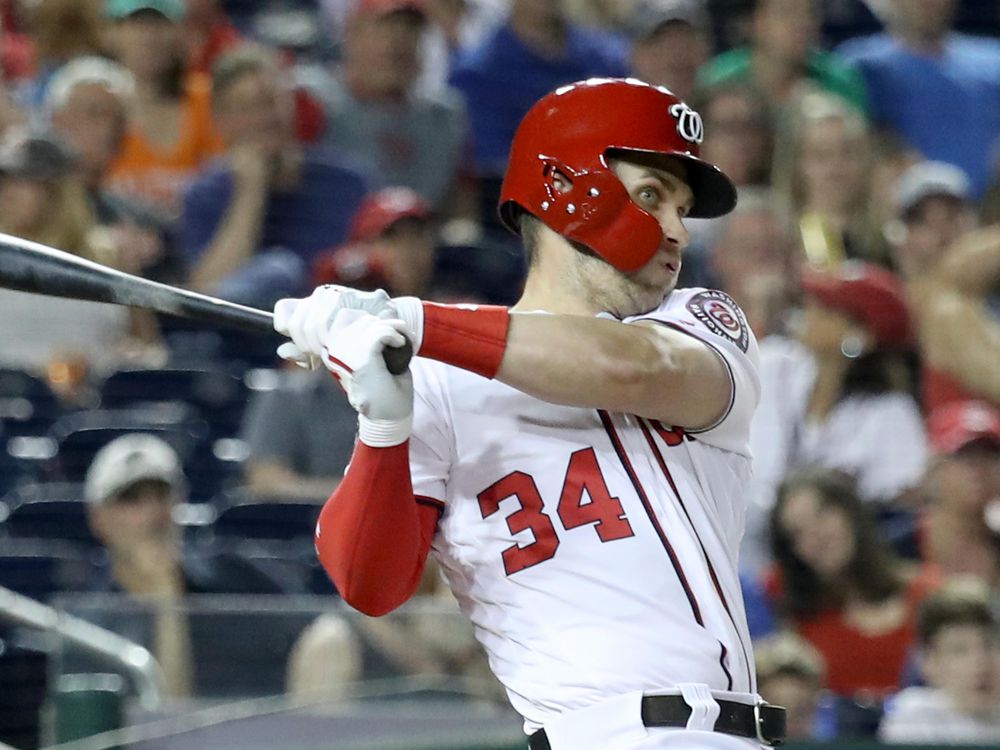
Bryce Harper of the Washington Nationals slugs an eighth-inning double against the Baltimore Orioles at Nationals Park on June 21, 2018.

Photograph by: Rob Carr

A year before the most important decision of his life, Bryce Harper made one with that future in mind last winter, one on display every time he’s stepped into the batter’s box this season. It’s a piece of plastic across the right side of his face, the side facing the pitcher, attached to his batting helmet. It’s called a C-Flap, named after the man who invented it in his kitchen nearly 40 years ago, and it affords Harper an additional sense of safety at the plate.

A specific event didn’t spur Harper to add the apparatus. He has never been hit in the face by a pitch. But pitchers are throwing harder than ever. One wild flash could cost weeks on the disabled list, or worse, and millions of dollars in free agency this winter. So he decided he would work with the extra armor over his check and jaw this season.

“Why not?” asked Harper, 25.

It’s a question an increasing number of players across the majors have asked in the last few years. Until recently, C-Flap sightings were rare. They were taboo – too goofy and too cumbersome in a sport bursting with machismo – and used only when a facial injury rendered them absolutely necessary. Even then, they were temporary. Those aesthetics concerns have seemingly faded. Now, some of the sport’s top stars, previous facial injury or not, have made the C-Flap as standard as a cap and mitt.

Jason Heyward was the first to adopt the guard permanently, and his decision wasn’t voluntary. He only began wearing it after 90-mph fastball hit him flush in the face and broke his jaw in 2013. It was a scary scene, and it sparked a subtle movement.

Giancarlo Stanton, Mike Trout, Carlos Correa, Kris Bryant, Jose Altuve, Yadier Molina and Miguel Cabrera are all C-Flap converts. The list goes on throughout the major leagues into the minors – and it’s growing.

***

Dr. Robert Crow was a plastic and reconstructive surgeon working for the Atlanta Braves in the 1970s when he encountered a problem: players recovering from facial injuries didn’t want to wear the protection available. The devices were too bulky or interfered with their vision or impeded breathing. But they needed something, so Crow set about finding a solution in his kitchen. He initially created the C-Flap with othoplast, the plastic used for splints, and took prototypes to Braves spring training to have players try them out before they were sent to Wayne State University in Michigan for impact testing. He called it a C-Flap after his last name and what it protected – the cheek.

“It was made to, number one, not interfere with vision, to allow the access to the mouth, the airway, and to not look like an added-on piece,” Crows said. “In other words, it was colored to match the helmet so it looked like an extension of that rather than just a piece of equipment that was put on for protection.”

Crow was granted patents in the United States and Japan by the late 1980s, and distributed his product to stores and leagues until he sold his small company to Markwort Sporting Goods in 2004. Initially, C-Flaps made up less than 1 percent of the St. Louis-based company’s sales, but sales have tripled each of the past three years, according to CEO Herb Markwort, with boosts from popularity in Korea and Taiwan. C-Flaps currently comprise around 15 percent of Markwort’s business, and the share continues increasing.

“For a product to be 38 years old and, at the 35-year mark, all of a sudden start taking off, growing, tripling sales, is just unheard of,” Markwort said. “And we don’t pay any of these guys to wear it. We don’t give any of the guys free products to use. It’s just the product itself selling itself.”

Rawlings, Major League Baseball’s helmet manufacturer, buys the C-Flaps from Markwort and distributes them to clubs and their minor league affiliates. While individual players at the major league level decide whether they want to attach it on their own, the Milwaukee Brewers were the first team to require all minor leaguers to use C-Flaps this season.

Herb Markwort pinpoints the surge’s genesis to Heyward getting hit in the face in August 2013, when he was with the Atlanta Braves. The next year, an 88-mph fastball plunked Giancarlo Stanton, then with the Miami Marlins. He suffered facial lacerations, multiple fractures, dental damage and was carried off on a stretcher. In April, Chicago Cubs third baseman Kris Bryant – now Heyward’s teammate – was hit in the head, though he avoided serious injury. All three wear the C-Flap, and the incidents motivated others to do the same. Last year, Brewers outfielder Keon Broxton credited his C-Flap for saving his life after getting hit by a fastball in the face.

“Some of the people have given [Yadier] Molina here in town credit for being one of the first major league baseball players to wear it before he got hit, just as a preventive measure,” Markwort said, referring to the St. Louis Cardinals catcher. “So the lightbulb went off and a lot of other people thought, ‘I should probably wear it too before I get hit.’ ”

Amateur players, however, are effectively forbidden from attaching C-Flaps to their helmets because most baseball governing bodies, including the NCAA, abide by the rules the National Operating Committee on Standards for Athletic Equipment (NOCSAE) have established. And those standards deem drilling holes in a NOCSAE-certified helmet, which is necessary to attach a C-Flap, voids the helmet’s certification.

Rawlings and other companies are expected to enter the market with NOCSAE-approved helmets with holes for flaps pre-drilled by the end of the year to serve the amateur and, effectively, professional markets – and challenge Markwort’s dominance. For now, amateurs are encouraged to wear wire guards – resembling football masks – for facial protection. Numbers indicate they don’t want to. Markwort said wire guard sales have dropped 90 percent in the last decade and have fallen another 64 percent this year.

“Kids want this helmet,” Rawlings executive vice president of marketing Mike Thompson said. “Kids want to wear the flap. Kids see stars wearing it and it’s like anything: They want to be like their heroes.”

***

C-Flaps aren’t for every major leaguer, at least not yet. Harper is the only player on the Nationals’ current roster using it, though Jayson Werth and Raudy Read both wore them last season. Ryan Zimmerman said he’s never thought about utilizing it. Matt Wieters said it doesn’t make sense for him because, as a switch-hitter, he’d be on the opposite side. If he gets hit in the face, he figures, it’d be on purpose.

Matt Adams spent his first six major league seasons with the Cardinals and Braves, playing with Molina, Heyward, Kolton Wong, Dansby Swanson and others who have joined the burgeoning C-Flap faction. But he hasn’t given it a try.

“I feel like my head would be lopsided,” said Adams, now with the Nationals. “I’d need time to get used to it.”

Harper used batting practice in the cage during spring training to become accustomed to the apparatus. Meanwhile, Tampa Bay Rays and former Nationals catcher Wilson Ramos made the adjustment in May on the fly.

“I’ve seen various players from various teams that have used it,” Ramos said in Spanish. “I initially thought it would bother me, but the truth is it doesn’t affect me at all. I feel comfortable. I feel a little more protected.”

While Ramos’s decision was precaution-fueled, Philadelphia Phillies outfielder Rhys Hoskins is the latest to have been pushed to using the C-Flap because of an injury – and he’s taken it to an extreme. The frightening scene occurred on May 31, when he fouled a pitch off his face and suffered a fractured jaw.

Hoskins, 25, was given a choice: miss four to six weeks or return after 10 days on the disabled list with a C-Flap on both sides for complete armament. Hoskins opted to return early with the double-C-Flap look and has batted .310 with five home runs and a 1.044 on-base-plus-slugging percentage in 15 games with the unconventional safeguard.

Hoskins said his C-Flaps are a little lower than others’ because they’re designed to protect his jaw more than his orbital bone. He’ll shed the right half of the shield when his jaw heals, but will continue using the C-Flap on the left side. It all comes down to one question he and dozens of others have asked: Why not?

Original source article: Face it: Major leaguers are embracing an old solution to protect their noggins


Source link

Categories
Sports

It’s official: James Hinchcliffe will miss the Indy 500 but will be at the track to support teammates


James Hinchcliffe once likened Indianapolis Motor Speedway to a cruel mistress.

A few days ago, he found out just how cruel when he was bumped from the race that means the most to him — and really, any IndyCar driver.

One of the circuit’s most popular competitors and a likely contender for the overall championship, Hinchcliffe and his No. 5 car did not make the field for Sunday’s Indianapolis 500. He announced on Twitter on Wednesday that he would “no longer pursue” other options to get into the race.

But he isn’t expressing any animosity toward the 2 1/2 mile oval, however. Nothing even close.

“The Indianapolis Motor Speedway is a tricky track, a very temperamental track,” 31-year-old Canadian star said. “It is super sensitive to weather and car setup. You can have a perfectly good car one day and roll it in the garage, and the next morning roll out the same car and the thing is trying to kill you.

“And then the event itself, just the way the month goes, you have these good days, you have these bad days, and qualifying is super unique and super stressful. And then you have the race itself, it’s the biggest deal in racing.

“It is interesting, you get so emotionally tied to that race it can be a bit cruel at times.”

There had been speculation that Hinchcliffe, the top driver for Schmidt Peterson Motorsports, would climb into one of the 33 cars on the starting grid, replacing another driver. He is fifth in the IndyCar standings and missing the 500, a double points race, will be a massive blow to in his championship hopes this season. But that will not happen.

Hinchcliffe will be at the track Sunday, helping Indy 500 teammates Robert Wickens, Jay Howard and Jack Harvey in any way possible. He will honour commitments with Arrow, his main sponsor, and other partners, and recognizes there will be media requests. Those he will be considering on a “case-by-case basis,” but he has no idea what emotions he will be feeling.

Well, actually, he does.


James Hinchcliffe throws up his hands as time expiries during Saturday’s qualifying sessions for the Indianapolis 500.

Darron Cummings /

AP

“I expect Sunday to be one of the hardest days in my career, to be honest. The difference of watching in 2015 was I couldn’t physically do it if I wanted to, and frankly didn’t really feel much like doing it that day,” Hinchcliffe said comparing the experience of being laid up because of a serious crash prior to the 2015 race. “This time I am very physically capable and very much want to be doing it, so it’s going to be tough.

“I got to put on a brave face. I am not running away, I am going to the track, I am going to support my team. Robbie is in his first 500, Jack and Jay have been a big addition to the team for a month, have been very helpful. I am just going to go there and do what I can for the team and the greater good, and try to get one of our cars home in victory lane.”

Hinchcliffe was the first driver out Saturday after a 2-hour, 20-minute rain delay that changed the conditions. His four-lap average of 224.784 mph was far slower than anyone anticipated. With a large group of drivers waiting to get through the qualifying line and another 51-minute rain delay, nobody got a second chance until the final hour.

As Hinchcliffe’s car sat in the second qualifying lane — designated for cars attempting to improve their time without withdrawing their speed — Conor Daly bumped him from the race. His team then scrambled to push him to the front of the first lane, those designated for cars withdrawing times or with no time, so he could go first.

When he finally did get on the track, a vibration forced him right back to the pits. He never got another shot.

“This sport in general has a lot of highs and a lot of lows. As a driver — I think as an athlete in any sport — you learn how to deal with those things,” he said. “Indy is just so special to us that the good days are extra special and the bad days hurt a little bit more.”

In a weird way, being bumped from this race could have a side benefit for Hinchcliffe and his team. No, they aren’t likely to be in the championship chase after getting zero points at Indy. But their approach for the rest of the 2018 schedule could be impacted by this weekend’s idleness.

“I think for us as a team, that’s all we can do is really buckle down and use this as motivation,” he said. “Not that our team needed any. It’s a great group of people, a very competitive group of people, and we’ve actually had a really strong start to the year.

“For a championship point of view, missing a double points race is about as big a blow as you can get. So that definitely stings. But at the same time if you are no longer really thinking about the points, you might be willing to take extra risks strategy-wise during races and go for those wins. That’s really where the focus goes for the rest of the season.”


Source link