Video games can be an enjoyable part of someone’s day when played as a healthy recreational activity. However, the games which started out as short entertainment episodes gradually evolved to immerse many children, teens, and adults with this new pastime and even addiction.
With an increasing evidence the video game addiction is now considered as a process addiction similar to compulsive gambling where the excitement of winning is the main motivations for playing.
Dangerous Effects
It is also studied that some people experience compulsions that make this apparent pastime to interfere with everyday activities and responsibilities and job performance. For teenagers in school, grades may suffer if they spend too much time playing games and neglect studying. Employment could be in jeopardy if they play games during work time. Friendships and family relationships may be affected when they spend more time with video games and less time interacting with friends and family.
Physical health may also be impacted when a person continuously uses a computer or a game console. Health issues such as carpal tunnel syndrome affects hands and wrists while headaches, back issues and eye problems are other complaints generally reported by gamers. Lack of physical activity due to the sedentary lifestyle could develop weight issues along with other related health problems. In addition, the compulsive behavior of gamers can cause emotional problems, with depression among the top issue for gamers.
A gamer may express anger or irritability more often, particularly when anyone intrudes in their gaming time. On the other hand, when they are away from their game, they are likely have feelings of anxiety and disturbed. In some instances, gaming could become so uncontrollable that they forget to bathe, eat, and sleep.
Video Game Addiction and Warning Signals
People experiencing compulsions to play video games typically exhibit warning signs. Common signs of a problem include a preoccupation with video games to the point of neglecting relationships and responsibilities. Signals to watch for include:
Thinking about gaming all or a lot of the time.
Needing to spend more and more time playing to feel good.
Feeling bad when you can’t play.
Not wanting to do other things that you used to like.
Not being able to quit or even play less.
Having problems at work, school, or home because of your gaming.
Need to seek help
If a compulsion to play games gets out of control and become an issue, it is important to seek to resolve these feelings. Treatment is available which includes behavioral therapy. Regular treatment can help a gamer move past the video game addiction and control the urges. Therapy helps the compulsive person refocus their time and energy on different activities including healthy hobbies.
One northern Manitoba First Nation has cancelled the remainder of its school year, while others face barriers to educating students while classroom learning is suspended due to the COVID-19 pandemic.
Last month, the province of Manitoba suspended classes a week before the scheduled spring break, with schools to remain closed until at least April 10.
For students in Garden Hill First Nation, their last day of classes was March 13, according to Catherine Monias, education director for the Garden Hill Education Authority.
Garden Hill is a fly-in community 500 kilometres northeast of Winnipeg. There are two schools: nursery to Grade 5 and Grade 6-12. Together, their enrolment is more than 1,200.
At the time the temporary suspension was announced, a decision was made by the chief and council to give non-resident teachers an option to return to their home communities.
Monias said some of those teachers took the opportunity to be with their families outside of the community. They expected teachers would return to work on April 13.
Catherine Monias, Garden Hill’s education director, says most students in the community don’t have access to computers. (Submitted by Catherine Monias)
However, the province restricted travel to northern Manitoba on March 20.
“The majority of our teachers are from out of town and they do not have access to their classrooms to provide instruction,” said Monias.
When the province announced it was closing schools indefinitely on March 31 and that teachers would teach remotely, Monias said there weren’t any discussions in Garden Hill about online learning.
“We can’t. There were no discussions because we can’t,” said Monias.
“Most students do not have access to a computer and a printer, and most students do not have the internet at home.”
Even if all students had internet at home, there would still be barriers to online learning, said Monias.
“Our internet bandwidth is so narrow, that it’s impossible to [teach online],” she said.
St. Theresa Point sends home homework packages
Glenn Beardy, a band councillor and the education portfolio holder, said he would prefer that students in Garden Hill continue learning.
“I’m not happy that these kids can’t continue to learn at home,” he said.
“[Other] schools have homework and online classes but over here it is a hassle because of the internet.”
Beardy has a school-aged grandchild in his care and said he is trying to homeschool, although he recognizes that many families in his community lack the resources.
“I’m not happy to see the kids not doing anything and wasting a day. We’re prohibited from visiting and the kids are bored,” said Beardy.
Online teaching also isn’t an option at nearby St. Theresa Point but teachers from the community’s three schools prepared paper homework packages two weeks ago.
Cornelius Harper, the community’s assistant director of education, said the teachers sent out paper packages to all Grade 1-12 students, but they were limited to core subjects such as English and math.
The students are expected to complete the homework.
Indigenous Services Canada did not provide comment before time of publishing.
A torched traditional house and belongings at an anti-pipeline camp located near farmers fields in southern Manitoba is being investigated as arson, according to RCMP.
Some camp supporters and observers on social media are calling on police to investigate it as a hate crime.
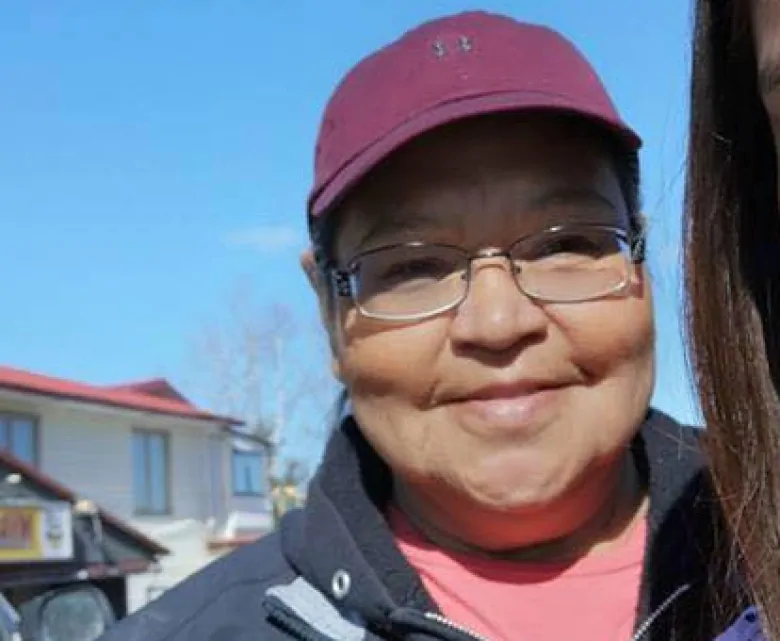
“It felt like my whole world was gone,” said Geraldine McManus, a Dakota two-spirit person who has spent a lot of time organizing the Spirit of the Buffalo camp in the traditional territory.
“That camp means the world to me. That’s where I sit and speak with ancestors. That’s where we sit and pray. People don’t understand. It’s like someone coming and going and burning down a big church.”
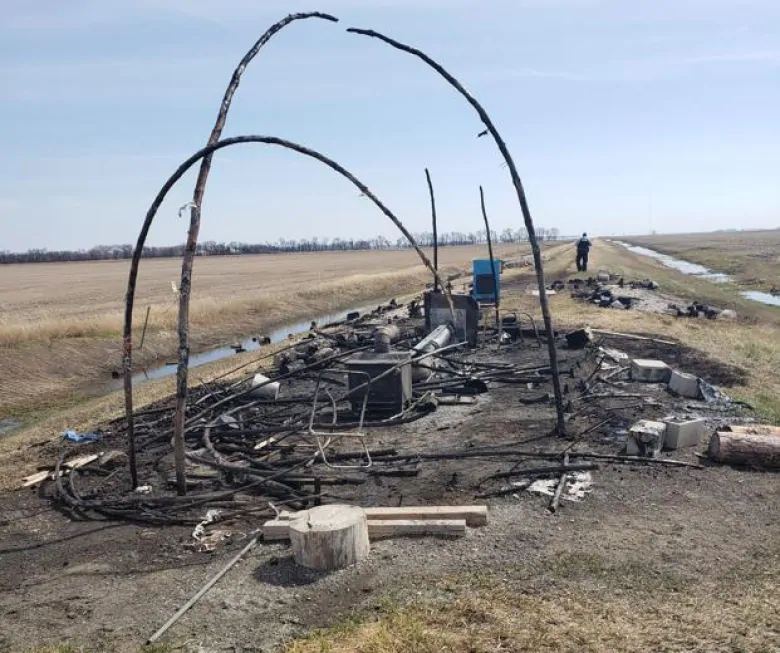
RCMP are investigating a fire that may have been intentionally set at the Spirit of the Buffalo camp, an anti-pipeline demonstration site near Gretna, Man., to oppose Line 3. (Submitted by RCMP)
A fire broke out Saturday at approximately 11 p.m. at the site near Highway 30 and the Gretna port of entry from North Dakota into Manitoba, RCMP spokesperson Paul Manaigre said in an email.
It was not called in to 911, he said.
A volunteer firefighter who lives nearby the area saw the fire Saturday night and reported it to his crew, who in turn attended and put it out. Carman RCMP received the report Sunday morning.
A wigwam and several wood piles were destroyed, police said.
‘Whole thing is gone’
Camp leader McManus said more than $1,700 in firewood for a sweat lodge was ruined by blaze earlier on Saturday.
“They burned that first, so I came to town to kind of regroup my mind,” McManus said, adding that “they left a hell of a big mess when they set that fire.”
McManus had planned to return to camp to clean it up on Sunday. That was until friends delivered the message: “The whole thing is gone now. They burned the entirety of everything down,” McManus said.
McManus said the Spirit of the Buffalo is located on Crown land has been claimed by the camp in an international area along the Canada-U.S. border between Gretna and Emerson, Man.
It has been almost two years since people opposing pipeline development through the region began demonstrating at the camp atop Enbridge’s Line 3 project.
A community of supporters who visited the demonstration site helped build the permanent structure over the pipeline so McManus could stay there throughout the winter “to just pray and ask that those lines don’t get put in, that it doesn’t hurt the animals or the plants or the water or our people,” McManus said.
Some workers and farmers in the area have attempted to intimidate demonstrators at the site, according to McManus, who says the site is not a place of protest.
The group, which is receiving support from the Manitoba Energy Justice Coalition, refuses to leave the area, despite ongoing threats against pipeline opponents and their proximity to a nearby shooting range.
“It’s a prayer camp. It’s not an action camp. I’m not trying to, you know, burn peoples’ properties down. I’m out there praying on that line, that it doesn’t hurt everything in its path.”
Spirit of the Buffalo camp pictured on April 10, two-and-a-half weeks before the fire broke out. (Submitted by Peter Charbonneau)
“When we pray on things hard enough, we can make things happen,” McManus said.
“And that’s what I’ve been doing out there, praying and making things happen. And the ancestors keep speaking to me out there and showing me things to do. So it wasn’t like I was sitting out there alone. I was out there with the ancestors.”
Pipeline company responds
The crude oil infrastructure is designed with potential for a forest or surface fire, and is at a “more than a sufficient depth to ensure the safety of the pipeline, people and environment,” the company said in an email.
According to Enbridge, the pipeline infrastructure in the area is located at least four metres below the roadbed.
“In the event our pipeline infrastructure is threatened, we would activate our emergency response protocol in close cooperation with local first responders,” reads the statement.
Enbridge officials have said the pipeline, which was built in the 1960s, is deteriorating and needs to be replaced.
Current capacity is 390,000 barrels per day, but the new 36-inch pipeline will restore it to its former capacity of 760,000 barrels per day, the company said in July 2018. The original 34-inch pipeline will be deactivated and left in place, which Enbridge says causes less damage than removing it.
Enbridge said Monday it is cooperating with the police investigation.
One of the most hotly anticipated Canadian horror films of the year will be available to watch online starting Tuesday, after its theatrical release was cancelled due to the COVID-19 pandemic.
Blood Quantum features a near all-Indigenous cast and is a gory, fast-paced movie about a fictional Mi’kmaq reserve facing a zombie outbreak.
“In qualified and political terms, it’s 100 per cent a Native zombie exploitation film,” said the film’s director, writer and editor, Jeff Barnaby.
Barnaby, who is Mi’kmaw from Listuguj, Que., has been making films for over 20 years. His debut feature film was Rhymes for Young Ghouls in 2013.
He started working on the script for Blood Quantum over 13 years ago and never expected a pandemic would affect its release.
“I’m stuck in the most infected neighbourhood in the most infected city in the country,” said Barnaby, who lives in Montreal.
Jeff Barnaby shot the movie in his home community of Listuguj, Que., among other locations. (Elevation Pictures)
In Blood Quantum, a zombie outbreak is taking place in the fictional Mi’kmaq reserve of Red Crow and Indigenous people are immune.
“The film wrote itself,” said Barnaby.
“People keep calling it a pressing film with all of the stuff happening now because of the virus. Meanwhile Native people have been putting up with it forever.”
Barnaby said the film also doubles as a metaphor for environmental catastrophe.
“The beginning of the film, the fish are coming back to life, the pollution is going directly to the water, then the water goes to the baby… the presentation is subtle,” said Barnaby.
Blood Quantum was produced by Elevation Pictures and had a $5.5 million budget. It screened at the Toronto International Film Festival last fall and was supposed to have a theatrical release this spring.
The film was shot in one month in Barnaby’s home community of Listuguj, in Kahnawake and in parts of Montreal.
When dreaming up scripts for his movies, Barnaby said that as a Mi’kmaw director he doesn’t have to worry about whether he is going to accurately portray Indigenous people in his films.
“If you’re a non-Native filmmaker and you are making a Native film, you are hyper aware of it,” he said.
“But if you’re from the community there’s nothing novel about seeing a bunch of Native people walking around being Native people.”
Mostly Indigenous cast
The film features performances from Elle-Máijá Tailfeathers, Michael Greyeyes, Forrest Goodluck and Gary Farmer.
Tailfeathers, whose father is Sami and mother is Blackfoot from the Blood reserve, said the cast was loving and supportive.
“I’ve never laughed so much on set,” said Tailfeathers.
While the movie is a mixture of humour and zombie tropes, she said it has political messaging that Indigenous people can relate to.
“The film builds on this history of Indigenous people surviving the apocalypse and here we are in this serious time and we are reliving the past in some ways,” said Tailfeathers.
“I’m excited for indigenous communities to see this.”
The film will be available to rent or own on digital platforms in Canada on April 28.
On Jan. 28, weeks before the World Health Organization would declare COVID-19 a pandemic, a nascent federal network for First Nations emergency management met in Ottawa and began discussing how to respond to the threat posed by novel coronavirus to Indigenous communities.
“It was very good timing for us to be able to start to gather the international information and bringing people together in order to be able to talk about how we were going to support communities, what our communication efforts were going to be,” said Valerie Gideon, senior assistant deputy minister for the First Nations Inuit Health Branch.
This was the first face-to-face meeting of the National Health Emergency Management Network (NHEMN) and the beginning of Indigenous Services Canada’s COVID-19 planning. The novel coronavirus was the lead topic of discussion at the previously scheduled two-day Sheraton Hotel meeting, according to a copy of the agenda provided to CBC News.
The NHEMN was created in 2019 from $79.8 million in new funding for First Nations emergency management announced in the federal budget that year.
It is made up of representatives from Indigenous Services Canada, which includes the First Nations and Inuit Health Branch (FNIHB), the First Nations Health Authority in British Columbia, and the Public Health Agency of Canada.
Representatives from national Indigenous organizations can also participate in the network, according to its terms of reference.
“We anticipated that COVID-19 would have a presence in Canada, we anticipated … that there would be positive cases in First Nations communities,” said Gideon, who is Mi’kmaw from Gesgapegiag in Quebec.
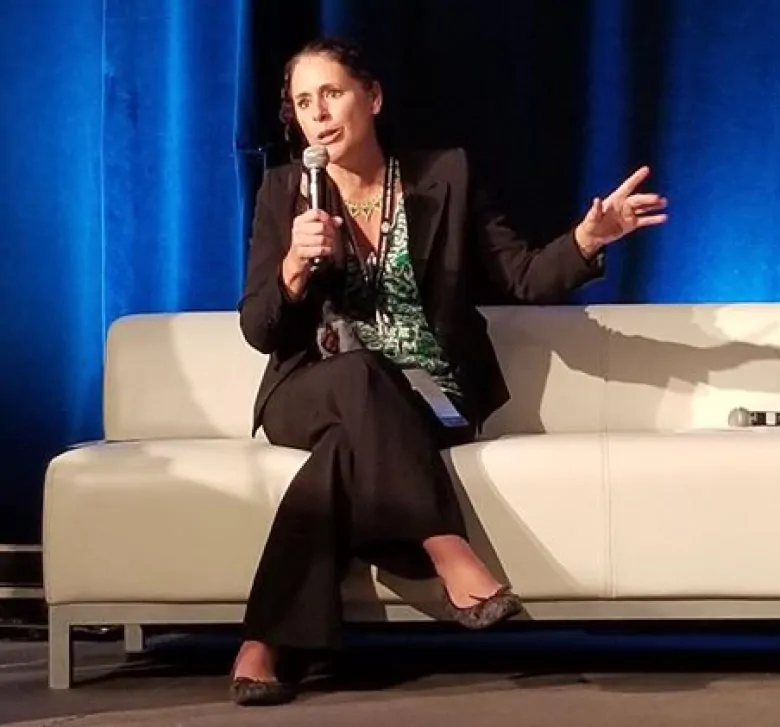
Valerie Gideon, senior assistant deputy minister for the First Nations Inuit Health Branch, said timing of the meeting coincided with emergence of COVID-19 outbreak. (Indigenous Services Canada/Facebook)
Dr. Tom Wong, the chief medical officer for Indigenous Services Canada, opened the meeting with a presentation summarizing the status of the outbreak and said FNIHB was monitoring the virus’s evolution. Wong reiterated the importance of hand washing and said the branch was already conducting training on the use of personal protective equipment in each region, according to slides from his presentation provided to CBC News by Indigenous Services Canada.
“Regional co-ordinators to align with their respective province or territory as public health emergencies may differ slightly in each jurisdiction,” said a slide from Wong’s presentation under the heading, Next Steps.
“This is an evolving situation and we will provide new information as we know it.”
Wong’s remarks were followed by Katheryn Stonier, a senior policy analyst for Indigenous Services, who led a brainstorming session on the role of the NHEMN co-ordinator dealing specifically with the novel coronavirus, according to the agenda of the meeting.
The meeting also discussed how Indigenous Services, FNIHB, the Public Health Agency of Canada and Public Safety could “collectively…support communities should the 2019 novel coronavirus be declared a public health emergency in Canada.”
Information about COVID-19 had already been circulating in the department’s health branch for nearly two months. Dr. Wong first sent information about the emerging virus to regional medical officers on Jan. 2.
Department working on health transformation initiative, says official
FNIHB’s communicable disease and emergency health managers began weekly calls — which were normally done monthly — by Feb. 5 to start co-ordinating preparations in all the regions and at the branch’s headquarters. By the end of February and early March, the department began to send out its first shipments of personal protective equipment to First Nations, according to information provided by the department.
On March 12, a day after the WHO declared COVID-19 a pandemic and Prime Minister Justin Trudeau announced a $100 million envelope to help Indigenous communities prepare, Indigenous Services Minister Marc Miller appeared before the House of Commons Indigenous affairs committee and said that his department was ready.
When the pandemic began, many Indigenous communities already faced significant health gaps compared to the rest of the country — from limited access to health resources, nursing shortages, overcrowded housing to higher rates of diabetes and other health indicators.
Gideon said her branch is working to ensure that when the next pandemic hits, Indigenous communities won’t face the same shortcomings. She said the department is working on a health transformation initiative that will see B.C.’s First Nations Health Authority model adapted to the realities of different regions across the country.
Gideon said under these planned changes, First Nations will be better co-ordinated with provincial health authorities and have the purchasing power to arm themselves with resources and invest in the type of health care models that fit their needs best. She said increased departmental investments in children and mental health will also see fundamental health indicators improve with the next generation.
“When my two First Nations daughters reach my age and if they have a pandemic at that time, they will see things have fundamentally changed from when their mom was involved,” said Gideon.
However, despite all its preparations for the current pandemic, the federal health branch’s response depends on its co-ordination with provincial and territorial health authorities.
Report noted problems in information sharing
A 2006 federal report, co-written by Dr. Theresa Tam, who is now Canada’s chief public health officer, identified potential jurisdictional gaps as one of the major weaknesses in a potential pandemic response in Indigenous communities.
The report, titled The Canadian Pandemic Influenza Plan for the Health Sector, noted information sharing sometimes failed between FNIHB and provincial health authorities.
“This informal collaboration with provinces and FNIHB regions has not been tested during a massive national public health emergency, such as pandemic influenza.”
Chief Public Health Officer Theresa Tam co-authored 2006 report on pandemic planning. (Adrian Wyld/The Canadian Press)
Gideon said one of the major changes since the 2009 H1N1 outbreak is that FNIHB is in better sync with provincial and territorial health authorities. She said there have been few if any problems in the flow of information between the jurisdictions.
“At this point in time, we have not had a situation where we have not felt connected to notifications with respect to tested positive cases on-reserve,” she said.
As of April 26, ISC said it is aware of 111 confirmed positive COVID-19 tests on reserves.
Gideon was the FNIHB’s regional director for Ontario during the H1N1 outbreak. Gideon said provincial and territorial health departments didn’t really understand the role of the branch at the time.
The Public Health Agency of Canada was also relatively new, created through legislation in 2006 as a result of the SARS epidemic.
“We have over a decade of additional experience in terms of establishing those relationships with provincial health agencies,” she said.
Lessons being learned
Alvin Fiddler, Grand Chief of the Nishnawbe Aski Nation, which represents 49 First Nations in northern Ontario, said it’s too early to pass judgment on Indigenous Services’ response to COVID-19.
Nishnawbe Aski Nation Grand Chief Alvin Fiddler says it’s too early to pass judgment on Indigenous Services’ COVID-19 response. (Justin Tang/The Canadian Press)
“Because we are in the middle of a pandemic, there are a lot of moving parts at different levels. It is going to be very difficult right now to sort of step back and assess the response to date,” said Fiddler.
“Once this pandemic passes, it will be the opportunity to look at this whole experience, what it means.”
Fiddler said the response to the first wave and the lessons they are learning will shape the expectations and reactions from communities when the expected second wave hits.
These are some of the themes Indigenous artists are exploring, recognizing and appreciating in the fifth edition of the Contemporary Native Art Biennial (Biennale d’art contemporain autochtone — BACA) in Montreal. BACA is aimed at supporting contemporary Indigenous art through exhibitions every two years.
This year’s edition is called Kahwatsiretátie: Teionkwariwaienna Tekariwaiennawahkòntie/ Honouring Kinship and features over 200 works by more than 50 Indigenous artists.
The work was supposed to be viewable at six museums and galleries in Montreal but as the coronavirus pandemic continues, this year’s programming moved online.
“While we can’t have access to the physical spaces, we’re going to put out as much as we can virtually,” said Mike Patten, director of BACA.
“We were really interested in not just curating objects, but also gathering together people having some sort of way of connecting. Art can often do that,” said David Garneau, who curated the exhibition along with the support of rudi aker and Faye Mullen.
“Having events beyond the galleries, beyond the objects was always really important. Finding ways of extending that hasn’t been too uncomfortable but has been a part of our plan from the beginning.”
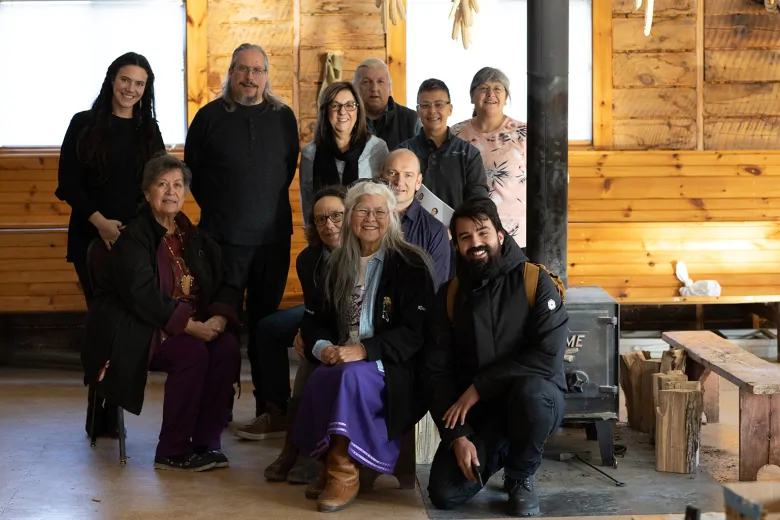
The BACA organizers and board of directors visited the Mohawk Trail longhouse in Kahnawake, Que., last December for guidance with the biennial which takes place on traditional Mohawk territory. (BACA)
In December, the BACA team visited the Mohawk Trail longhouse in Kahnawake, Que., and received guidance from Mohawk elder Otsitsaken:ra Charles Patton and Faith Keeper Niioieren Eileen Patton. The two gifted the title of the show.
“The title actually means coming together in a circle, and lifting weight together,” said Mullen.
“We’ve seen its resonance throughout the months of winter, as we’ve been organizing and selecting artists’ work, but even more so during this time of COVID care.”
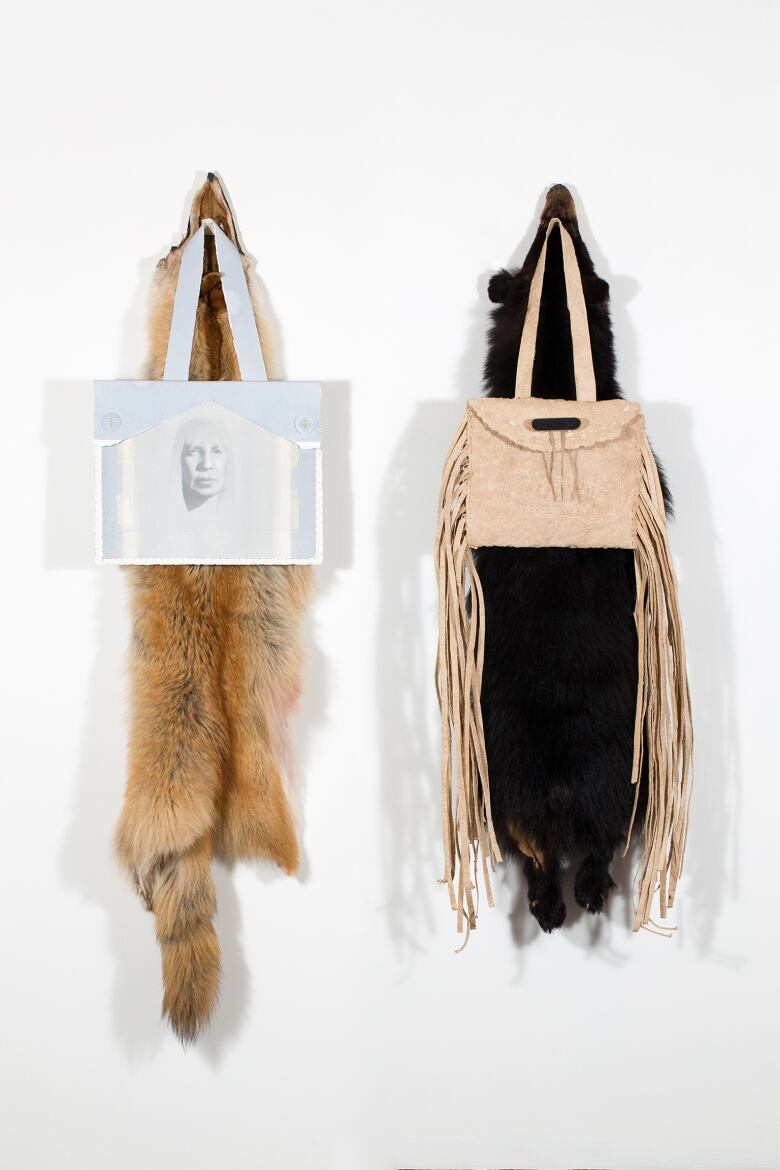
Artists in the event were encouraged to invite their “kin” to participate in the exhibitions in the form of collaboration or a mentorship role. For Cree artist Judy Anderson, that meant including her son Cruz Anderson as well as two of her students at the University of Calgary. Three of the four pieces included in the exhibition are a part of work Anderson has done on honouring people in her life.
Judy Anderson (Nêhiyaw). This one brings me the most pride, 2016-2017. (Andrew Barcham)
“Sometimes we have these relationships where it’s difficult to tell people how much we care about them,” she said.
“I know that we still love each other but to say it is a different thing.”
It’s the first time her work is being featured in the biennial, which was established in 2014 following a ground-breaking Indigenous group exhibition curated by Nadia Myre in 2012 at gallery Art Mûr in Montreal.
Anderson said it’s “fantastic” BACA is continuing online.
“I was wondering how can you work through something like this. It’s unfortunate, but at the same time you want to make sure everyone is safe.”
Judy Anderson and Cruz Anderson (Nêhiyaw) Side by Side, 2020. (BACA)
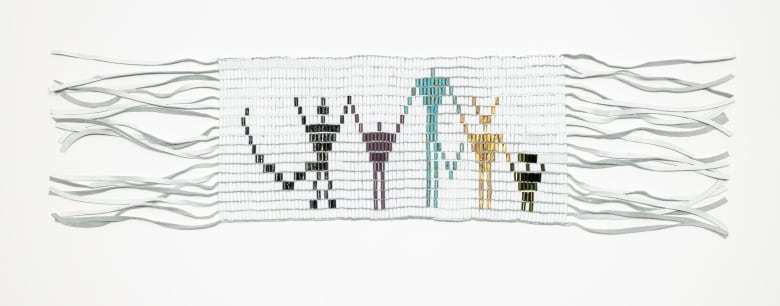
Mohawk artist Skawentati expressed similar sentiments. The exhibition features a handful of her works including Intergalactic Empowerment Wampum Belt. It’s a part of a series of wampum belts that features the xenomorph from the movie Alien, a Na’vi from Avatar, a Twi’lek from Star Wars, and E.T., along with an Indigenous person in purple weaved in glass beads and white leather.
“They’re wampum belts that I imagine are made in the far future when we are making agreements with alien nations. That wampum has all aliens from popular science fiction,” said Skawennati, who is based in Montreal and originally from Kahnawake, Que.
Skawennati is a multimedia artist who often uses cyberspace and virtual environments as a metaphor for Indigenous representation into the future.
“I’m very interested in seeing how the world can go online,” she said.
“When we can’t go into the museums, can this be a substitute for now? I think its wonderful that people are experimenting. It’s exciting for me. COVID-19 is moving us into a new realm and giving us another reason to be using these digital spaces that we’ve been building and trying things.”