Categories
Health

Secret Obsession Is an Even Creepier Version of You—So Get Ready


The premise of Netflix’s new thriller Secret Obsession, now streaming, is right in the title: A deranged stalker, Russell (Mike Vogel), forms an all-consuming fixation on Jennifer (Brenda Song). When Jennifer wakes up from a car accident with severe memory loss, Russell is there claiming to be her husband. Oddly, no one at the hospital questions this—and so, Jennifer believes him. She goes home to what Russell tells her is their beautiful (albeit secluded) mansion, but soon cracks appear in his plan. Jennifer starts getting suspicious—as does a detective—and Russell does everything in his power to keep his charade going. Including, as you’d expect, killing people.

If that premise sounds familiar to you, it’s because…well, it is. Not only is the stalker genre a staple in entertainment—please see: Fatal Attraction, Obsessed, The Boy Next Door—but it’s had a strong resurgence this year due in large part to You, the thriller series about a bookstore clerk (Penn Badgley) who uses technology to cyber-stalk a woman. The show became a viral sensation late last year, when Netflix acquired the rights to it from Lifetime. Secret Obsession is essentially You‘s feature-length twin: Both pieces are campy and over-the-top but nonetheless disturbing. The former has all the ingredients to become major social media fodder, just like the latter.

“I do feel like there is a similar aspect [between Secret Obsession and You],” Brenda Song tells Glamour. “Stories like this really take us out of our lives. Regardless of what anyone says, we all love scaring ourselves with worst case scenarios and sort of living out that nightmare-slash-fantasy without actually being a part of it.”

Both of these nightmares, You and Secret Obsession, have one similarity that stands out above all: the “hotness” of the male stalkers. Fans were so smitten by Joe on You that they seemed to forget he’s a serial killer—something Penn Badgley pointed out countless times on Twitter.

Song already knows what she’ll say to fans who may swoon over Secret Obsession‘s chiseled-but-chilling antagonist, Russell. “Just because someone’s handsome doesn’t mean they aren’t crazy,” she says. “You have to remember that when romanticizing these killers, stalkers, rapists—whatever they are—you still have to remember the crimes they did and the lives they affected, if we’re talking about real life.”

Source link

Categories
Health

The USWNT World Cup Team is Ready to Win Their Fourth Title


Adds defender Kelley O’Hara, 30, who’s making her third World Cup appearance this summer: “At the end of the day, we’re all playing soccer because we love it and we’re good at it and it’s something that we’re passionate about. But I do think that it’s important to understand that we have a responsibility. We are in a place where we can impact the game and impact society—this team has always done a great job of balancing those two things.”

The balance isn’t always easy. In March 2016, five of the team’s most recognizable players—Hope Solo, Carli Lloyd, Alex Morgan, Becky Sauerbrunn, and Megan Rapinoe—filed an official complaint with the Equal Employment Opportunities Commission alleging that the U.S. Soccer Federation paid women “substantially less” than men in the sport. Fresh off their World Cup win, they found support: Two months later the U.S. Senate came together to unanimously pass a bipartisan resolution supporting the women and asking the Federation to grant the players equal pay. The resolution was nonbinding, but the players got one step closer to victory regardless. In Feb 2019 the EEOC sent a “right to sue” letter to the team, so this March—on International Women’s Day—that’s exactly what they did. The entire team sued the U.S. Soccer Federation for gender discrimination.

It’s easy to see why they’re frustrated. The women’s team handily outperforms the men’s: They’re ranked significantly higher, hold more World Cup titles and Olympic medals (four golds), draw bigger TV audiences, and since their 2015 win, have generated more money for U.S. Soccer. (Meanwhile the U.S. men’s team failed to even qualify for the 2018 World Cup.) Still, they’re paid significantly less—some players make just 38 percent of what their male counterparts make, according to the lawsuit. “Right now the structure is set up so that our counterparts on the men’s national team have the opportunity to make so much more money,” says Press. When the men’s team qualified for the 1990 World Cup, each player got a $10,000 bonus; when the women’s team earned the same honor a year later, they reportedly got a T-shirt.

Things haven’t improved much. For the last Women’s World Cup in 2015, FIFA, the international governing body of the sport, offered the winning team $2 million in prize money. The winning men’s team had been paid $35 million—17.5 times more—in the men’s World Cup a year earlier. (The Federation maintains that it hasn’t discriminated against the women’s team, and that the men and women players have fundamentally different jobs, team organizations, and compensation setups.)

Some critics point out the USWNT is among the most well-funded women’s sports programs in the world. But being the highest paid woman at your company who’s still making less than men at your level isn’t equality. “We’re very grateful for what we have, but we’re definitely demanding what we deserve,” says forward Alex Morgan, 29. “My hope is that the next generation will be able to have [total equality]—it will just be a given.” (To help make it a reality, Secret recruited Morgan to launch the brand’s Equal Pay for All campaign, pledging $100,000 to Girls Leading Girls.)

Pissing off the powers that be when they are in some of the most crucial months of their careers is risky for these players—but they aren’t backing down. “It’s part of our job to do this,” says Lloyd. “It’s not something that is comfortable, but in order to get what you deserve, you have to be a little uncomfortable.”


Source link

Categories
Health

I Wasn't Ready To Think About My Fertility—Then I Got Brain Cancer


The conversation on fertility—whether you’re thinking about kids in the near future or not—is still plagued by anxiety-inducing messages that keep women up at night picturing a ticking biological clock. Women deserve better—no fear mongering, just facts. So Glamour took the pulse of what women do and don’t know about their reproductive health to bring you the Modern State of Fertility.


My roommate came with me to my first IVF class. We took our seats between a couple and a woman there on her own. She had a folder full of information; her eagerness apparent in the tapping of her foot, her informed questions, her careful note taking. The couple held hands and smiled. Under the table, I texted the friend who’d be picking me up for the next doctor’s appointment. I’ll be late. People have lots of questions.

I had no questions, and little interest in being in the class at all. It was required to attend by the clinic I was working with—a clinic I hadn’t researched or purposefully chosen, the clinic I had ended up with because it was affiliated with the team of doctors treating my newly diagnosed brain cancer.

After months of brain fog, memory problems, and word finding issues I’d assumed were related to the stress of grad school, an MRI revealed a tumor in my brain—anaplastic astrocytoma grade 3, to be exact, in the same class as highly terminal glioblastoma. One craniotomy, ICU stay, and pathology report later, I found myself staring blankly as a doctor explained that the chemo I needed would likely destroy my chance of getting pregnant someday, should I ever want to do so.

Fertility was far from my mind. I was 27, busy pursuing my Masters in social work, hanging out with my friends and my girlfriend, and dreaming about being financially stable enough to get my first dog. The doctor suggested I look into fertility preservation as soon as possible. “You want to give yourself the chance,” he said, “just in case.” Suddenly I was on what my doctors called the fertility “fast track”—my appointments, medications, even my enrollment in the IVF info sessions expedited to get ahead of the vigorous regimen of radiation and chemotherapy I was about to endure.

I wanted more than just a chance at motherhood; having children has always been a dream. For as long as I can remember I’ve pictured starting a family one day—just one day very far in the future. Adding to the ambiguity, I’m in a queer, same-sex relationship and I hadn’t even begun to think about how my partner and I might go about having kids. We weren’t even certain we’d even end up together. We’ve been dating for almost two years, and while it seems likely that we are heading in the direction of marriage at some point, we are definitely not ready to have kids together. We’d barely talked about moving in together or whether she’d come to Thanksgiving next year, let alone whether we’d want to conceive biologically, adopt, or foster. We were, and are, at the beginning of considering a life together—a time that should be filled with the glow of possibility, the freedom to dream without commitment.

Navigating the line between what we’d decide together, and what was up to me, became a new challenge in our relationship. We went together to appointments, but she let me do the talking and the decision making. She told me it was my body, my future, and she’d be there beside me no matter what I did. I was grateful, but mourned a world in which we’d have had the time to know what we’d wanted together, to be able to fully have her on my team.


Source link

Categories
Health

Is the World Ready for Miki Agrawal and Her Next Big Idea – Miki Agrawal Discusses Her Bidet Startup, Tushy


In fact, society is wrong about a lot more than just “periods, pee, poop, and pizza,” Agrawal said, drawing laughter from the audience. “This generation and the next is not interested in doing the things that people did 100 years ago. Not interested.” To that point, each chapter of Disrupt-Her names a common way of thinking, then explains where it came from in order to present an alternative. For the notion that “failure is embarrassing,” for instance, readers are instructed to “replace the word ‘failure’ with ‘revelation.’”

Disrupt-Her isn’t billed as a memoir, and much of it focuses on universal topics like the importance of investing one’s money, cultivating a partner’s best qualities, and decluttering one’s home. It is a rebirth, in a sense: Before its launch, Agrawal released a video-poem that begins with her crawling from a bleeding animated vagina. (A hat is conveniently waiting nearby; she puts it on.) While the public may view it as a comeback, the timeline isn’t so linear: Agrawal founded Tushy two years after she launched Thinx, then hired leadership to run it while she focused on the period underwear brand; when she left Thinx, she seamlessly transitioned over to Tushy. If Disrupt-Her answers any question about Agrawal, it’s how she wants to present herself to the world after being accused of abusive behavior in the workplace. Less contrition, more ideology.

In her emphasis on transforming anger, betrayal, and pain into empathy and gratitude, Agrawal performs an amazing alchemical act. The book creates a space in which she’s able to comment on the bad publicity—effectively getting the last word—and land on higher ground. This puts those members of the public who are reckoning with how to regard her, post-Thinx, in the difficult position of arguing against positivity, against personal growth, if they question her at all.

Someone who worked with Agrawal at the time, who only agreed to talk on the condition of anonymity, says that Agrawal knows the value of building her personal brand through this kind of storytelling. Publishing a new book in the aftermath of the Thinx allegations reinforces a narrative in which, the former staffer says, “She’s the hero.”


In February, I visited Agrawal at her home in Williamsburg, Brooklyn, a sleek space filled with colorful woven rugs and air plants. During our interview, her husband, Andrew Horn, popped in and out of the room on his way to and from errands. Their 20-month-old son, Hiro, occasionally toddled into the conversation, cheerfully making a grab at a water glass or one of the cell phones recording the conversation.

Agrawal wrote Disrupt-Her in the two-and-a-half months following Hiro’s birth in July 2017. Laid up in bed healing from her C-section, she wrote between feedings and while the baby was asleep. “I had so many thoughts around the culture of complaining, takedown culture, feminism, patriarchy, fake feminists, people who wear the feminist T-shirts and the vagina necklaces but are really mean girls on the inside,” Agrawal says. These topics appear in the book, in chapters that deal with woman-on-woman hate and gossipy media coverage—the products, Agrawal writes, of scarcity mindsets and a news business that rewards clickbait.

Agrawal says she believes in creating a culture that is progressive and supportive of people being themselves—but that doesn’t mean lowering her standards. “I demand excellence. I do,” Agrawal says. “Shouldn’t you demand it for yourself? And if I’m going to bring it out of you, that’s a good thing. If that sometimes requires tough love, like, ‘Hey, I asked for that three times, come on, you’ve got this.’ Then you go back and tell everyone, ‘She’s yelling at me!’ Like, is that yelling or just being like, ‘Come on, you’re better than this!’?”


Source link

Categories
Health

13 Signs You’re Ready to Move In Together


More couples are shacking up before tying the knot than ever before. As of 2016, 18 million unmarried adults were living with a partner—up a whopping 29 percent since 2007. And more than half of these cohabiters are under the age of 35, a.k.a. millennials. But just because moving in with your beau seems like the “trendy” thing to do, that doesn’t mean it’s right for you.

Before you go ahead and sign that lease or take out that mortgage, you have to get real with your partner about your expectations and your finances. Here Glamour has compiled all of the conversations you should have and milestones to hit with your significant other before you order the U-Haul.


Source link

Categories
Health

‘The Big Bang Theory’ Season 12, Episode 17 Recap: Are Sheldon and Amy Ready to Have Kids?


The Big Bang Theory has only seven episodes to go before the show wraps up its 12-year run. While there are a few things I don’t expect to be resolved—Penny’s maiden name, or the elevator being fixed—there are some storylines that have a good chance of happening before we say goodbye: Namely, Amy and Sheldon becoming parents. No, Shamy fans, nothing has been confirmed…yet. But it’s been established on Young Sheldon that they have kids eventually. (In the season-one finale, adult Sheldon says, via narration, that he often drew up relationship contracts for his roommates, his wife, and “even with my own children.”)

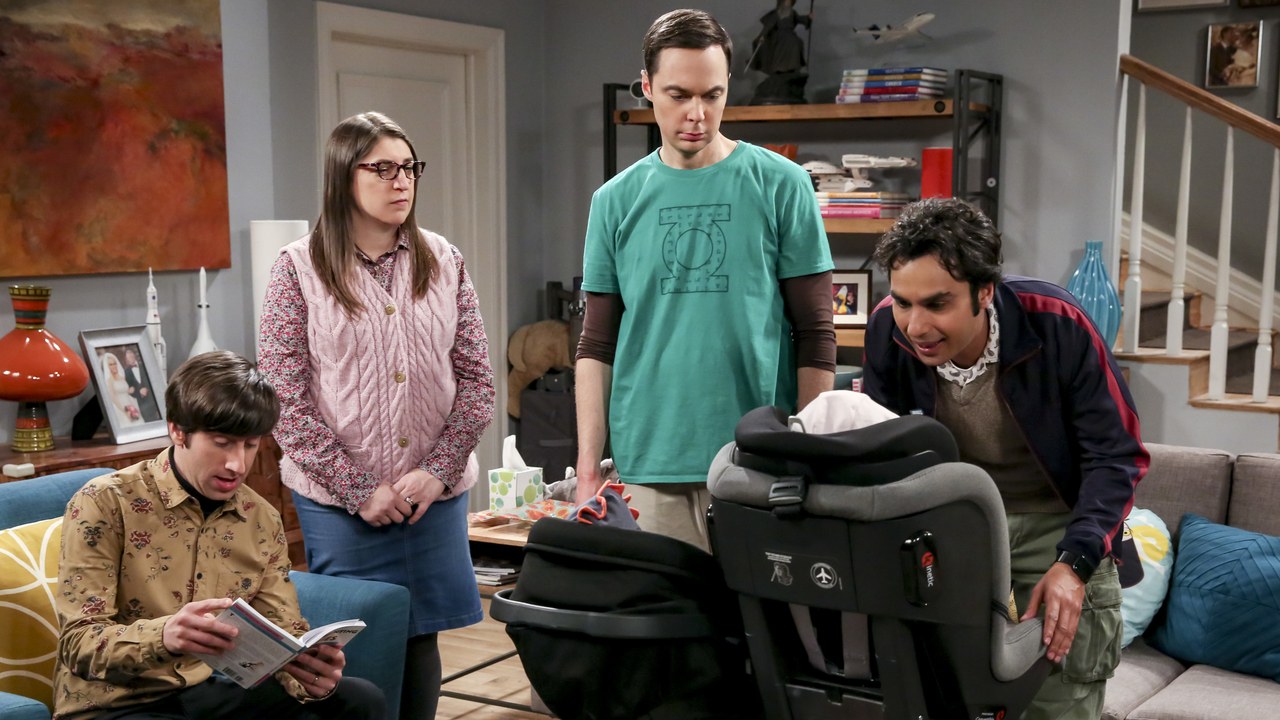
And on tonight’s episode of Big Bang—titled “The Conference Valuation”—we see the first big step toward that actually happening. Howard is in charge of the kids, Michael and Halley, while Bernadette is out of town, so Amy uses the opportunity to get Sheldon more comfortable around children. She shows him a book on experiments to do with kids (no way to write that without it sounding weird, right?), which leads to a weekend of fun Sheldon didn’t know was possible before.

The episode seemed like it was setting up a reveal at the end—I thought once Sheldon came around to enjoying the little “scampers,” Amy would announce she’s pregnant. For example, take this exchange while Amy and Sheldon are in bed:

Sheldon: Spending time with Michael and Halley today made me think about our future children….

Amy: [Playing dumb.] What an unforeseen development. What are you thinking?

Sheldon: Well, either five sets of triplets or three sets of quintuplets. [Pauses.] You know what, it doesn’t matter, as long as they’re healthy. And divisible by three.

Amy: That’s a lot of babies, Sheldon.

Sheldon: Well, only for humans. For frogs it’s just a drop in the bucket.

Amy: Sorry I’m not a frog.

Sheldon: Aww, don’t feel bad, Amy, you’re good enough for me.

Instead of an announcement, though, the episode faded to black and the credits rolled. What gives? “An announcement did not happen,” executive producer and showrunner Steve Holland tells Glamour with a laugh. “But we know they do eventually have kids. I can’t answer this exactly, but I will say that having that revealed on Young Sheldon was a big moment for our series. I think it’s part of our journey to end Sheldon in a spot where that future is possible.”

[embedded content]

Holland wasn’t able to say anything more than that, though he was a bit more open about his plans for Penny—especially after she turned down what appeared to be a major offer from a rival pharmaceutical company. “I don’t want to tease too much, other than to say this show has always been a positive show about people who love each other,” Holland says. “We want to honor that in the finale. We don’t want to give fans every happy moment they want, but we love these characters and want the best for them.”

For the time being, Holland says he loves to find any reason to group Kaley Cuoco, Mayim Bialik, or Melissa Rauch in a scene together. “Whether it was the Dungeons and Dragons episode, or tonight with Melissa and Kaley at the conference, it’s great. They are so funny together; anytime we can pair them in a scene, we do.” Those scenes were also fulfilling for another reason, as it shows Penny thriving in a career she didn’t envision for herself. “For her to find this job that she’s actually good at and enjoys is important for us,” Holland says. “I like watching her grow in a career that she’s starting to like.”


Source link