Categories
Health

This Mom Has Terminal Breast Cancer, But She’s Still Fighting for Her Kids


My first diagnosis was stage IIIC breast cancer, which is as close as you can get to stage IV without actually being stage IV, which is terminal. At that point, IIIC, you’re still considered curable.

My oncologist told me that I had triple-negative breast cancer, which can be more aggressive and more difficult to treat than other forms of breast cancer. (Triple-negative breast cancer doesn’t respond to some common breast-cancer treatments, such as hormone therapy.)

I went through chemotherapy and then had a double mastectomy in May of 2018. The lump was in one breast, but I felt like I would always worry that we’d missed something if I hadn’t had both removed. I have three sons—now 12, 13 and 16—and every step of the way, I’ve wanted to do whatever I could to heal myself and be here for them.

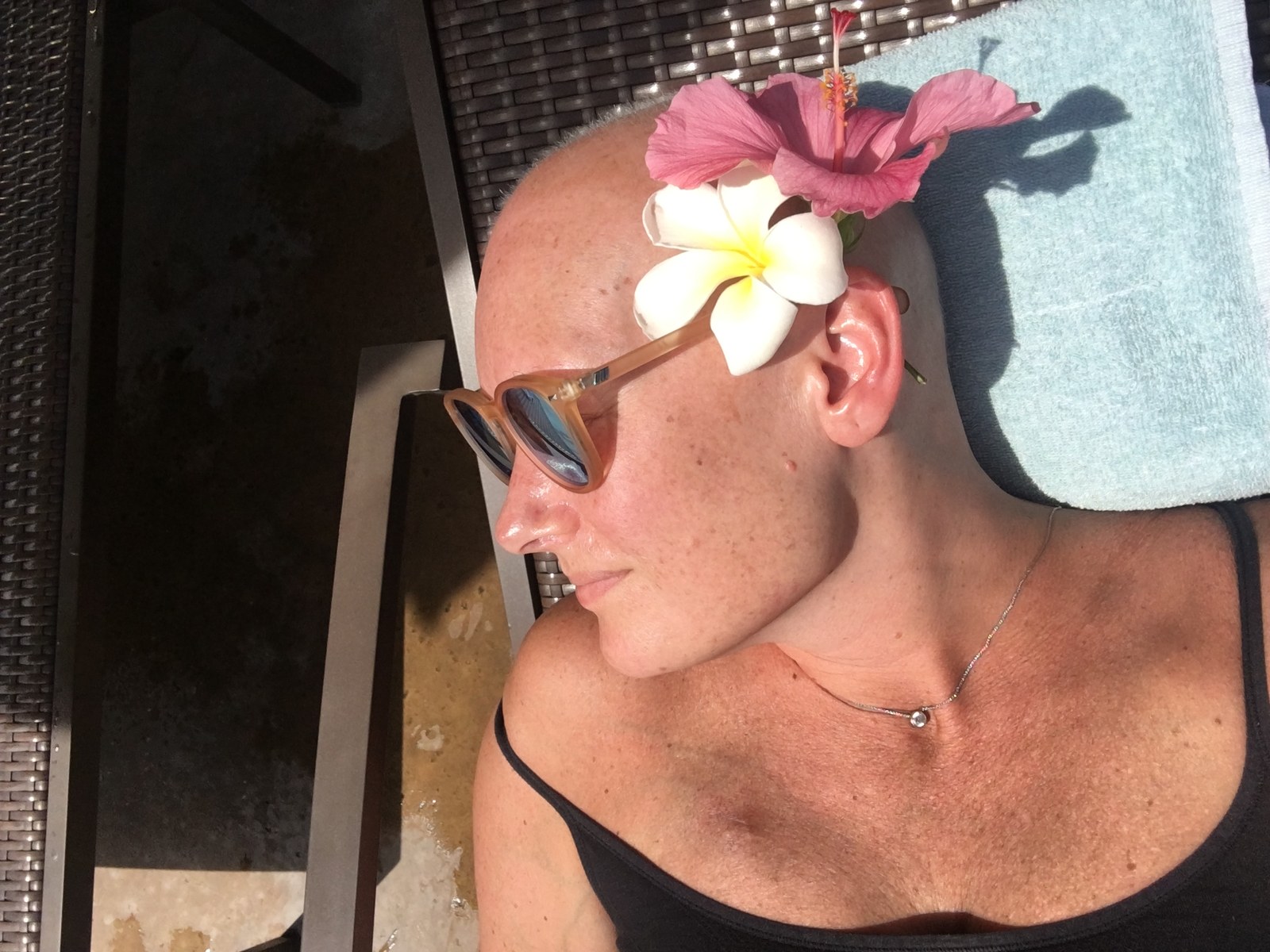
I made the most of my (bald) 44th birthday.

Courtesy of Shumanay Lowry. 

The mastectomy was followed by a second round of chemotherapy, which was followed by radiation. And then my oncologist said, “You’ve done all the treatment that’s reasonable at this point. Now you need to go back to your normal life and watch for any symptoms. We’ll check you out every three to six months.”

After recovering from the radiation I went back to work the first week in December. I worked for a month and then was diagnosed with stage IV cancer the first week of January.

The cancer had metastasized to my liver and lungs. I did even more chemotherapy, but a follow-up scan showed that the tumor in my liver had doubled in size in the three months since my last scan. Following treatment, some tumors will shrink or disappear. The 14-centimeter tumor in my liver didn’t react that way; it’s there, not getting smaller. There really isn’t much room left in my liver. For now, my best-case scenario is that the cancer doesn’t spread further.

It was really hard to tell my kids. I’ve always wanted to be really honest with them. I was honest about what I had and that it was serious. They’re old enough that they can do their own research. There was no point in trying to mislead them from the beginning. Also, I tried to be lighthearted.

My eldest son has thanked me a couple of times for handling things so well. He feels like the fact that I’m not complaining a lot or acting down or sad or depressed has been really helpful. I really try to stay positive and make the most out of all the moments that I still do have with them.

It was hard for them to see me go bald again. Having my hair grow back was a big milestone for my kids. My youngest, especially was so excited when my hair started to grow back. He would measure it and rub my head—he really celebrated me starting to look more normal again.




Source link

Categories
Health

10 Breast Cancer Symptoms (Besides Lumps) That Everyone Should Know About


Lumps get all the attention. As they should: A new lump or mass is the most common symptom of breast cancer. But there are other explanations for lumpy breasts—and other breast cancer symptoms you should know about.

Many women have lumpy or uneven breasts. And even if yours are as uniform as Hostess cupcakes, they can change over time for a bunch of reasons. Your breasts may feel more swollen or tender before or during your period. If you’re pregnant, the glands that produce milk may multiply and become larger. Before menopause, hormonal changes may make your breasts lumpier. Weight loss, weight gain, and certain medications can also affect your breasts.

The bottom line: Breast changes are very common, and they’re not usually cancer. In fact, the two most common causes of breast lumps are fibrosis, or the formation of fibrous tissue, and small fluid-filled cysts.

With that said, if you notice a new lump in your breast or armpit—breast tissue can extend into your underarm area—you should see your doctor right away. A lump that’s painless and uneven is more likely to be breast cancer, but breast cancers can also be tender and symmetrical. They can be soft or rubbery. Unless your breasts are small and the lump is very large, you probably won’t be able to see it.

Other reasons besides a lump to make a doctor’s appointment ASAP? If you notice any of the following symptoms:

  • thickening or swelling of part of the breast, even without a
    noticeable lump

  • dimpled or irritated breast skin that can look like an orange peel

  • red, flaky, scaly, dry, or thick skin around your breast or nipple

  • a change in the direction of your nipple (it may turn inward, pull to
    one side, or point in a different direction)

  • pain around the nipple

  • an ulcer on the breast or nipple

  • nipple discharge (other than breast milk), including blood

  • swollen lymph nodes (sometimes breast cancer spreads to the lymph
    nodes under your arms or around your collarbone and can cause a lump
    there before you can feel one in your breast)

  • pain in any part of the breast

  • any change in the size or shape of your breast

While mammograms are important, they don’t find every breast cancer. Most breast cancers are found by women while they’re soaping up in the shower, putting on deodorant, and doing other daily activities that bring them into close contact with their breasts. So get familiar with yours—there are some good guidelines here—and know your risk factors. And if you anything seems amiss, get yourself to a healthcare provider stat.

Additional resources: CDC, National Cancer Institute, American Cancer Society, MD Anderson Cancer Center, Moffit Cancer Center


Source link

Categories
Health

My Friend Has Stage IV Breast Cancer. Here Are Some Things She Wishes You Knew


Don’t wait to start self-exams and mammograms.

“You’re never too young to start self-exams, and you should go for an annual mammogram as soon as possible, certainly by 40, but earlier if you have a history of breast cancer in your family,” says Tami. Be your own advocate on the latter; controversially, the American Cancer Society recently raised its recommended age for starting annual mammograms from 40 to 45, yet most insurance companies will still cover routine mammograms at age 40, often younger. “If I’d followed the age-45 guideline, I wouldn’t be alive today,” Tami once said to me. Terrified, I went and got my first at age 38 by asking my ob-gyn to write me a prescription. At the time, I had no family history, but insurance did cover the test. Now, lo and behold, I do have a family history; my mom is currently being treated for breast cancer. I’m so glad that I already got a couple “baseline” mammograms—ones that future tests can be compared against to look for changes.

No type of breast cancer is “no big deal.”

Since one in eight women get breast cancer, almost all of us know someone who’s had early-stage and seems perfectly healthy now. “The perception is, ‘Oh, you have breast cancer, you’ll be fine,’” Tami says. “People think you can just have a double mastectomy and be cured.” She did, when doctors initially thought she was stage II. “In my mind, I said, “OK. I know there’s a high survival rate. I don’t care, I don’t need my hair, I don’t need my boobs. Now I know that even for stage II, a mastectomy is just the first step of a year-long process of reconstruction and treatment.” And much too often, the story doesn’t always end there: “Thirty percent of early-stage breast cancer will eventually come back as stage IV or metastatic, where it has spread to other organs or the bones, and there is no cure for that.”

Picture an airplane falling from the sky every single day.

And each time, 115 people die. Imagine the hysteria and outrage we would all feel. Yet that’s how many people die each day from metastatic breast cancer. I found this analogy so powerful when Tami first shared it with me. Research leading to new treatments for MBC is the only thing that can reduce that number, yet just 3 to 5 percent of U.S. breast cancer research funding currently goes toward that. How to begin to shift that imbalance: Find out what percentage of dollars from any breast cancer donation you make will go toward research, versus awareness and programming. Better yet, donate directly to metastatic breast cancer research. METAvivor is currently the only U.S. organization dedicated solely to awarding annual peer-reviewed stage IV breast cancer research grants. To raise awareness for this cause, metastatic breast cancer has its own awareness ribbon, one with stripes of green (representing spring and the triumph of life over death), pink (indicating that the cancer originated in the breast) and teal (representing spirituality and healing). More than 80 iconic landmarks around the globe have showcased the colors during Breast Cancer Awareness Month in 2019.

There are so many people just waiting for that next drug to come out.

“Will there be another drug by the time this one doesn’t work?” It’s the question Tami’s friend Monica was asking until she recently passed away at age 33, leaving a 3-year-old daughter behind. “What gives people hope is the fact that they are coming out with more drugs, so the money and the research does make a difference, even if it’s not curing the disease.” Ultimately, MBC patients know that they will need to resort to clinical trials. “There are amazing resources out there now to help patients navigate clinical trials,” Tami notes. “One of the best websites available was designed by a metastatic patient for metastatic patients. Called The Storm Riders Network, it pulls trials from all over the world into an extremely user-friendly interface.”


Source link

Categories
Health

I Survived Cancer Once—Then I Was Diagnosed with Triple Negative Breast Cancer


Staring at my ever-growing to-do list, I contemplated canceling—or at least postponing—the appointment for my annual mammogram. Next month, I reasoned, things would be a little less hectic. Why not save myself some stress?

Like most, I have a fear of cancer. In 1999, I lost my 37-year-old husband in a fast battle with Hodgkin’s disease, leaving me to raise our three young children—6, 4 and 2 years old at the time—alone. A year later, I was diagnosed with papillary thyroid cancer after my doctor found a small nodule in my neck during a routine visit for a sore throat. I endured several years of tests and treatments before the doctor declared me cancer free.

I’d tried not to think about cancer in the 16 years after that, always trying to push it from the corners of my brain. But when my annual mammogram rolled around cancer seemed to be all around me: Several close friends were being treated for breast cancer and a close neighbor was battling leukemia. Cancer seemed to be closing in—again.

A year earlier, I started having what felt like small electrical charges in my left breast. Zippy little jolts that felt like a nerve misfiring all day long, setting me on edge with each zap. Test results showed that there was nothing to worry about and within a few weeks the “charges” had subsided. I figured things were fine and went back to trying not to think about cancer. But a few months before my scheduled mammogram, they came back.

As I sat in front of my calendar, debating whether or not to put off my mammogram, I couldn’t get the thought of cancer out of my mind. I thought about my kids, now adults, and everything they’d already been through. They’d watched both of their parents battle cancer, and mourned the loss of their dad. I was eager to tell them I had a clean bill of health again so I kept my appointment on the books.

“This is your mass,” the radiologist said, drawing an imaginary circle around a black spot on my X-ray as I sat in his office after my appointment. “My mass?” I kept asking over and over again as if repeating the question would make the answer change. It didn’t. There was a mass in my left breast.

My mass was tiny—it was possible it was only Stage 0 if it was cancerous at all. I needed to have a biopsy to confirm but somehow I already knew what was coming. A biopsy, a partial lumpectomy, a CAT scan, and several blood tests later, I learned that I had triple negative breast cancer. It had already spread to some lymph nodes in my armpit, kicking my cancer diagnosis up to Stage 2.

As far as cancer diagnoses go, triple negative breast cancer is a particularly bad one to get: it’s aggressive, more likely to spread and more likely to recur. TNBC is less common—about 10-20% of breast cancers are triple-negative, according to BreastCancer.org—and gets its name from the fact that it tests negative for estrogen receptors, progesterone receptors, and excess HER2 protein. Translation: Triple-negative breast cancer doesn’t respond to hormonal therapy medicines or medicines that target HER2 protein receptors.

It does respond well to four rounds of what’s known as “Red Devil” chemotherapy followed by 16 weekly treatments of Taxol chemotherapy and then 33 rounds of radiation.

While it might sound silly, my first question to the breast surgeon was, “Is this lose-your-hair chemo?” I had read about some chemotherapy treatments that didn’t cause hair loss but this unfortunately wasn’t one of them. After finally growing my hair to the longest it has ever been—a feat I’ve been trying to accomplish for years—I was going to lose it all. I started bawling in the doctor’s office, bitter over the symbolic loss and the thought of battling cancer yet again.


Source link

Categories
Health

How to Support a Friend With the Breast Cancer Gene


Each year, an estimated 330,500 women (and 2,670 men) in the United States will be diagnosed with breast cancer. But many more women are living with the knowledge that they are a carrier for what is commonly known as the “breast cancer gene.”

Technically “breast cancer gene” refers to a mutation in one of two genes, BCRA1 or BRCA2. Everyone has the BRCA1 and BRCA2 genes but certain mutations in them can significantly increase your risk of breast and ovarian cancer. To put it in context, the average woman in the U.S. has a 12% risk of developing breast cancer in her lifetime, according to BreastCancer.org—a BRCA mutation ups your risk to a 72% chance of being diagnosed with breast cancer during your lifetime.

A BRCA gene mutation doesn’t mean you will get breast cancer—but it is something to take seriously.

As a friend of someone who recently found out that they have the breast cancer gene mutation, you might be wondering: What can I do during this difficult time? Can I help my friend? What is the best way to offer support? We spoke with six women who have been there about the kind of support that actually helped. Below, their 10 best pieces of advice on how you can support a friend with the breast cancer gene.

Show up for her.

“I would make sure to call or text her on a regular basis. Having people check in was so nice. I had one friend who thought she was giving me space, but when people give you space and don’t call, it just feels like they’re too uncomfortable to care.” —Zina, 31

Let your friend simply talk about her feelings.

“In the days after I found out, the most helpful thing was just having honest conversations about my feelings with friends. Just having friends that let me talk out my feelings was incredibly helpful.” —Sarah, 37

Or let her cry if she needs to.

“After I screamed at my mom who was trying to tell me what to do—or not do—as a result of the genetic results, my brother admitted that he didn’t know what to do and how to help. So he just sat with me and let me cry and complain and process.” —Angela, 37

Don’t offer advice unless you’re asked.

“The most helpful reaction was asking what exactly it meant, what my plan was and how they could support me. No judgment, no suggestions of alternative lifestyles or comments like ‘but you breastfed so your risk is lower.’ We have doctors for advice. Friends are for support.” —Katrina, 31

Know that knowledge is power, so arm yourself with it.

“My family and friends all rallied around me. We sat down with my breast oncologist and she gave us a lot of information. I know it is scary as hell to find out you carry the gene, but knowledge is power. Be there for your friend, go to appointments, show up and show support. If you have to, utilize the internet for information and join Facebook groups. At the end of the day, just be there for her so that she knows she’s not in this alone.” —Beth, 39

Don’t try to sugarcoat their diagnosis.

“Honestly, it’s just nice when someone isn’t trying to make you feel better or try to show you the silver lining. Having BRCA sucks and I don’t need someone to sugarcoat that.” —Zina, 31

Offer to help in practical ways.

“If your friend opts for preventative surgery, offer a practical act of service, like bringing her a meal or babysitting for her afterwards.” —Sarah, 37

Do not try to give advice on what you would do.

“Do not freak out. Do not tell them that they need to remove their breasts or ovaries ASAP. Don’t assume you know what a BRCA mutation means; do your own research and learn a bit more about it. And do not bother sharing with your friend what you would do if it was you. It’s not you; everyone’s situation is different.” —Jennifer, 47

Connect your friend with someone dealing with the same thing.

“The absolute best thing was when someone is able to connect you with another previvor—someone who is a survivor of a predisposition to cancer but who hasn’t had the disease—so you can hear from someone who has been there.” —Katrina, 31

Reach out, even if you haven’t spoken in a while.

“I had a lot of friends come out of the woodwork and reach out to me, people with whom I had not spoken in years, and I was really touched. If you’re not sure if it’s okay, just reach out. The worst that will happen is that the person will not respond, but it may change the outlook for someone struggling.” —Angela, 37


Source link

Categories
Health

This Breast Cancer Ribbon Has a Different Take on Pink. Here’s What It Means


As a nurse, Jessica Moore knew her injury should be healing more quickly. A varsity girls’ basketball coach, she’d gotten elbowed in the breast while playing the game one day, and the resulting pain kept lingering. After she visited doctors to get checked out, she found out she had metastatic breast cancer (MBC)—meaning the disease had already progressed and spread to her bones, despite her having no other symptoms. She was only 32.

Moore’s family and friends are among many who choose to embrace a different type of breast-cancer awareness ribbon, one with stripes of green, pink, and teal. While the instantly recognizable pink ribbon—originally created by Self in 1992—is often associated with early detection and celebrating survivors, there’s no surviving or “beating” MBC. Also known as stage IV or advanced breast cancer, MBC means breast cancer has spread to other organs, typically the liver, lungs, brain or bones. Although some people live for a long time while undergoing treatments, average life expectancy is just 24 to 36 months; Moore fought the disease for four years, passing away at age 36. The reason MBC has its own ribbon: While 30 percent of early-stage breast cancer patients will eventually see their disease return as metastatic and 114 people a day die from MBC—the only kind of breast cancer that kills—only two to five percent of all breast cancer funds raised go toward researching treatments for MBC. The tri-color ribbon aims to make people aware of the need for more research for MBC, its green representing spring and the triumph of life over death, pink indicating that the cancer originated in the breast, and teal representing healing and spirituality.

Metastatic Breast Cancer Ribbon Charm from Metavivor, $5.Courtesy of Metavivor.

It’s a color combination more people are beginning to recognize thanks to Moore’s best friend, Laura Inahara, who along with other friends and family (via an organization they named Moore Fight Moore Strong) has been working tirelessly to shine light on MBC and its symbolic colors—quite literally. Later this week, more than 70 monuments around the world will be illuminated in the three colors of the MBC ribbon, in time for Metastatic Breast Cancer Awareness Day (Oct. 13). Those who know someone fighting the disease are encouraged to find your local Light Up MBC site, snap a picture, and post it on social media along with the hashtags #LightUPMBC #METAvivor. (Be sure to make it a public post.) “You can use Google Earth to post a screenshot of the lighting if you can’t get there in person—just don’t forget the hashtags,” says Inahara.

Metastatic Breast Cancer Awareness Day Memorial Bridge in Portsmouth N.H. lighted in the colors of the metastatic...
Memorial Bridge in Portsmouth, N.H., lighted in the colors of the metastatic breast-cancer awareness ribbon.Shawn Pierce Photography

It’s an idea sparked by Moore, who never stopped hoping and fighting. “Prior to Jessica’s passing she said she thought it would be amazing to light a landmark for MBC as a way to raise awareness,” Inahara says. In October 2017, five months after Moore died, the group had their first landmark—the Memorial Bridge in Portsmouth, N.H.—lit up near her hometown. A busy mom who works in finance by day, Inahara sits down each night around 9 p.m. to work on #LightUpMBC and add to the impressive list of locations now participating, and more and more people have been offering their help approaching landmarks around the world. The ultimate goal: More donations, via Metavivor, going to researching treatments that could turn stage IV breast cancer into a chronic disease vs. a deadly one. “[Metavivor remains] the only U.S. organization dedicated to solely awarding annual, peer-reviewed stage-IV breast cancer research grants,” Inahara explains. “That is what it will take to find a cure and stop losing more than 42,000 lives to breast cancer each year. We feel certain that we can get more research funding so no more of our friends have to die from this disease. There is often a misconception there is a cure for breast cancer and we want to share with anyone that will listen that there is not.”


Source link