
Categories
Health

If Missouri’s Last Abortion Clinic Closes, There Might Not Be Room for Patients in Neighboring Centers


Missouri might become the first state without a single abortion services provider since 1974, the year after Roe v. Wade was enacted. The state’s last remaining abortion clinic—called the Reproductive Health Services of Planned Parenthood of the St. Louis Region—is currently at risk of losing its license and being forced to close by the end of the week. However, the health center would still be allowed to provide STI testing, cancer screenings, birth control, and more.

Planned Parenthood is currently in a standoff with Missouri state officials over an audit of the clinic, which began this spring. According to the New York Times, “Lawyers for the clinic say that the audit, which began this spring, has become wide-ranging and includes demands they consider to be unreasonable…. The clinic agreed to meet a number of the state’s demands, including a requirement that it provide an additional pelvic exam for abortion patients. But the clinic is now deadlocked with state officials over a request to interview seven of its doctors, including fellows and residents.”

Yesterday, Colleen McNicholas, a physician at the clinic, was interviewed by state officials along with one of her fellow doctors. About the interview McNicholas told Glamour, “They asked about our practices and reproductive health services, including how we work with residents and fellow trainees. And while I still believe the interviews are completely unnecessary—because we have provided exceptional care for a very long time—I am also glad that the department finally agreed to sit down with me, and hopefully, through that conversation, they now understand what is the standard medical education process. I hope that resolves any remaining issues for them.”

Though McNicholas is hopeful about how her meeting went, she’s saddened that across the country there’s a “larger framework and strategy to criminalize abortion.” She went on to say, “Most people are familiar with legislative attempts, with all of the [abortion] bans that are sweeping our country—but for states that have really hostile restrictions to abortion care, the licensing process has become a weapon of these politically appointed health directors. This is something we face on an annual basis, but this year it was ratcheted up and we really saw investigators asking and demanding for things like interrogating physicians, which is so outside the bounds of what this process is supposed to be.”

While Planned Parenthood has filed a lawsuit requesting a restraining order against the state in the hope of keeping the clinic’s license—which will be brought to a circuit court judge today—the physicians at the clinic are already working on ways to make sure Missourians are granted access to abortion. One of the ways they’ll do so is by having more patients go to nearby clinics in places like Illinois or Kansas to receive abortion care. However, with the restrictions on abortion in Missouri, these neighboring clinics are becoming overcrowded.

“Over the last five to seven years, we’ve seen a significant increase in our number of patients from Missouri,” said ob/gyn Erin King, executive director of Illinois’ Hope Clinic for Women, which is located about 20 minutes from downtown St. Louis, in an interview with Glamour. “We’ve actually doubled the number of doctors that are seeing patients at our clinic in just the last year and a half. So we’ve really had to take on some of the burden of seeing those patients—and with the potential closing of this last clinic in Missouri, we anticipate a drastic increase [in patients] that we probably cannot accommodate right away. Obviously we’re doing everything we can to help our colleagues in St. Louis, and we’re working around the clock here to try to have the staff in place so that these patients can [come to us].”

And with the growing restrictions on abortion in Missouri—just last Friday, Governor Mike Parson signed into law an antiabortion bill that prohibits the procedure after eight weeks of pregnancy—McNicholas believes that self-managed abortion will become more and more of a reality for people seeking the procedure. “We know communities of color, people who are low-means or low-income, and rural Missourians [already] have tremendous difficulty accessing abortion care in the medical system,” says McNicholas. “So it should be expected, and we’ve already seen this, that people will turn to self-managed abortion. There are a variety of ways that self-managed abortion can come to fruition. If patients are able to access the medications that we use traditionally for an abortion, then they can safely manage their own abortion through that process with the right education and tools. However, there are going to be patients who can’t access that medicine, or think they’re accessing that medicine but get the wrong one. So we still have to be prepared for other methods of self-managed abortion and helping people to safely end their pregnancy.”

Missouri is currently one of six states with only one remaining clinic, according to data from the Guttmacher Institute, and would be the only state in the nation to not have a single clinic.

Source link

Categories
Health

Migraine Relief Is Finally Accessible to Patients Living in Years of Migraine Hell Thanks to a New Drug


In my decades dealing with the vicious pounding in my skull, I’ve tried just about everything to get it to stop: I cut out alcohol, soy sauce, balsamic vinegar, chocolate, aged cheeses, overripe bananas (banana bread is bad news), bacon, pizza, gluten, down pillows, crack-of-dawn flights, exercise, ponytails, hats, movie theaters, dinner parties, social small talk, sleeping in rooms over 70 degrees, too much screen time… The list went on.

I tried every over-the-counter medication (the equivalent of jumping into a bull pen armed with a toothpick); every available prescription drug (only useful once an attack had already brought me to my knees); and every natural tincture I could get my hands on (ironically most herbal concoctions actually gave me migraines). I tried acupuncture, mouth guards, osteopathy, Reiki, massages, and a migraineur’s fave: banging my head against a wall. At best, I found little relief.

In the nineties, pharmaceutical companies released a class of drugs called triptans, which helped significantly with stopping migraines once they started—but still, no magic pill existed to prevent them. That didn’t stop doctors from trying all the options available; faulty-brained folks like me could be prescribed antidepressants, anti-seizure meds, and beta blockers—all pills for another purpose that patients had accidentally discovered reduced their migraines.

I was throwing an entire arsenal of drugs and therapies but none could shove the bully in my brain aside. Instead, they unleashed insomnia, jitters, weight gain, fatigue, uneven brows, and a near nervous breakdown. I felt like I was living my life in purgatory—always waiting for the next blow to my head.

I thought I would be forever doomed to this migraine-induced hell, but recently science (praise you, science!) has delivered a breakthrough to those of us desperate to leave our days of writhing in pain in dark rooms behind.

In 2017, my neurologist, Peter McAllister, M.D., co-founder and medical director of the New England Institute for Clinical Research, told me about a promising new drug. Researchers had discovered a specific peptide released during a migraine episode, part of a chain reaction that triggers that ice-pick-in-eyeball pain I’d been trying to eradicate for four decades. Dubbed a “CGRP Blocker,” the drug travels directly to the site of this pesky peptide and stops the bugger in its tracks. “This is the first preventative drug designed specifically for migraine,” says Dr. McAllister, who was a principal investigator on the studies behind the development of the drug. In his experience as a neurologist, it was like night and day for migraine sufferers, he told me.

Only one issue: the please-let-it-be-a-miracle drug wasn’t yet available. I held my breath for six months, fantasizing about the new life I might have—as I had every time I heard about a potential “cure.” I would spend time with my kids every morning, instead of hiding under the damp towels they fetched for my head. I would enjoy a vacation without inevitable days spent locked in my hotel room whimpering after the blows of another migraine. I would feel the simple bliss of being able to take a yoga class or leisurely swim without paying in pain the next morning.

Then in happened: in May of last year, the FDA approved the first CGRP blocker (Amgen’s Aimovig) and it was as if heaven itself had opened up. Cue the chorus of angels: ahhhhhh! I tried to manage expectations. It might not work for me—until this point nothing had—but when my first cooler pack containing the drug arrived last September, I could barely contain my excitement.


Source link

Categories
Health

Weight Stigma Is the Deadly Problem Keeping Patients from Getting the Care They Need


Ellen Maud Bennett, 64, a Canadian costume designer with a penchant for fresh lobster, peonies, and the “perfect shrimp-wonton soup,” spent years feeling unwell. But when she sought medical intervention, no one offered suggestions beyond weight loss treatments. When her cancer was finally discovered, she had only days to live. “Ellen’s dying wish was that women of size make her death matter by advocating strongly for their health and not accepting that fat is the only relevant health issue,” her obituary read.

Bennett’s case may be extreme, but when it comes to weight, doctors often have a big blind spot. When a heavier patient comes in with symptoms but a doctor sees only fat, it can mean treatment will fail to help her get healthier—or worse, add to her health issues. Weight stigma may even be part of what causes the laundry list of risks we typically hear linked to being heavier. Studies show weight shaming can cause spikes in levels of cortisol, the stress hormone which can contribute to high blood pressure, diabetes, and heart disease—“the very conditions that doctors blame on an individual’s weight,” says Louise Metz, M.D., a board-certified internal medicine physician. And the stress of constantly being judged for your size? Ironically, it’s been linked to weight gain—a 2018 academic opinion paper that examined nearly 70 studies on weight stigma found that it lead people to eat more.

Making matters more complicated, the stigmas and biases associated with being fat are almost impossible to escape: “Weight stigma affects so many life experiences—from the size of chairs, to the pace of exercise classes, to the availability of good medical care,” says Deb Burgard, Ph.D., a fellow of the Academy for Eating Disorders. Even the terminology used to describe larger bodies can be shaming. “Overweight” reinforces the idea that larger bodies are somehow wrong, and “obese” pathologizes the ratio of weight to height, even though it’s not always a great indicator of health. (That’s why fat advocates like me prefer terms like larger, heavier, and plus-size.)

Jessica, a 31-year-old who works in retail, had a history of eating disorders that started when she was 10 and was bullied about her weight at school. As an adult, she started to get a foothold on healthier habits, but fat shaming encounters with a doctor can still trigger destructive behaviors around food. “Recently, I went to a gastroenterologist who insisted I [must have] a fatty liver due to my size,” she says. Blood work and an ultrasound revealed her liver was perfectly healthy, but the episode triggered a relapse of her eating disorder. Even though her liver was healthy, her doctor didn’t look beyond her size.

“I was left with the feeling that I was fat, it was my fault due to a lack of character, and I only had one option: permanent life-altering surgery.”

Stories like Jessica’s aren’t uncommon—women dealing with weight stigma are actually at a greater risk for eating disorders, says Chevese Turner, chief policy and strategy officer at the National Eating Disorders Association (NEDA). “Often, the same behaviors that would be considered red flags in thin people”—obsessively counting calories, going overboard at the gym, developing a preoccupation with the scale or with food—“are seen as positive behaviors for ‘weight management’ in plus-size people,” Turner says. “In some cases, they’re even celebrated by doctors.”

But that’s not the only way weight stigma can affect patient care. After injuring herself in a fall, Gretchen, a woman in her 40s, made an appointment with an orthopedist. Instead of discussing her options for hip surgery, she was told it was “too dangerous” given her weight and her diabetes. When she pressed for further evaluation, it was suggested she wouldn’t be able to fit into an MRI machine. (She had an MRI a few weeks before and fit in the machine just fine.) Instead, another risky procedure was recommended: weight loss surgery. “I was left with the feeling that I was fat, it was my fault due to a lack of character, and I only had one option: permanent life-altering surgery that came with not only gigantic physical trauma but more than likely emotional distress,” she says.

Some weight shaming leads women to stop seeing a doctor at all. “I have many patients who come to our practice who have avoided medical care for years due to the weight stigma,” Dr. Metz says. Sophie, a 34-year-old teacher, knows exactly how that feels. She wanted help from a psychiatrist for her ADHD, but he weighed her at the beginning of every session before quizzing her on her eating habits. “At my last session, he asked me if I could eat less, and when I said I listen to the cues my body gives me, he put his head in his hands in a dramatic way and said ‘Oh, no no,’” she says. The appointments finally became too much. Sophie hasn’t gone back, even though missing her medication affects her sleep, focus, and concentration. She is trying to find another psychiatrist but she says it hasn’t been easy.

The good news is, some doctors are finding a way to treat patients—and even health issues related to weight—without the shaming. Health at Every Size (HAES), an approach developed by the Association for Size Diversity and Heath, shifts the focus from weight management to health promotion. Instead of directly targeting weight loss to help an overweight or obese patient feel better, HAES doctors prioritize positive health behaviors, like healthy sleep habits, movement that brings joy, and nourishing food. Whether a patient actually loses weight isn’t how her doctors measure success. “It is essential that we, as health care providers, begin to eliminate weight stigma from medical care,” Dr. Metz says. That means recognizing diversity of body size, eliminating the focus on weight as an indicator of health, and making treatment decisions informed by evidence-based medicine—not size, says Metz.

Health care providers who are using these practices are seeing all kinds of benefits. “You can connect and partner better and quicker with your client when you’ve eliminated this significant risk factor that creates shame and stress,” says Anna M. Lutz, R.D., a HAES dietician based in Raleigh, North Carolina.

“My current doctor is the first doctor to see me as a patient, instead of as a fat woman wasting her time.”

If you’re feeling judged by your doctor for your weight, push for weight-neutral care. Before you make an appointment, call the office ask if they have experience with weight-neutral care. (Try saying something like, “For my health, I need a practitioner who will work from a weight-neutral perspective, meaning focusing on my health and not my body size—is that something you can do?” To find a weight-neutral practitioner, check review sites like Ample, which helps people with marginalized bodies find non-judgmental care.) If you are given weight loss as a treatment plan, ask if thin people get the same health condition and what their treatment would be. If a thin patient would get a different intervention and you’re being prescribed a diet, ask why.

Regardless of your size (or your health) you have a right to care that respects your body and your choices for how you want to approach your overall wellness. When that happens, the results are powerful. It took Rachel King, a 30-year-old teacher, 12 years to find a doctor who would look beyond her size to diagnose and treat her Polycystic Ovary Syndrome (PCOS). When she finally found a doctor who would treat her from a HAES perspective, she got not only the treatment that she needed to manage her PCOS, but also finally felt she had the support to make a full-recovery from the eating disorder she’d battled for years. “My current doctor not only understood my diagnosis of atypical anorexia nervosa in a fat body, she asked me what I need in a doctor to help me be successful in recovery,” King says. “She’s the first doctor to see me as a patient, instead of as a fat woman wasting her time.”

Ragen Chastain is a speaker and writer in Los Angeles training for her first IRONMAN Triathlon. She’s also the current Guinness World Record Holder for heaviest woman to complete a marathon.


Source link

Categories
Health

Meghan Markle and Prince Harry's Royal Wedding Flowers Were Made Into Bouquets for Hospice Patients


As more and more details about Meghan Markle and Prince Harry’s royal wedding become available, there’s a consistent theme throughout: everything, even the most subtle touches, hold some significance to the couple. Just take the wedding flowers, designed by Philippa Craddock, for proof.

Meghan’s bouquet was filled with “spring blooms” that Harry handpicked from the couple’s private garden at Kensington Palace. And that’s not all: Forget-Me-Nots, white peonies, and white garden roses—all said to be Princess Diana’s favorite flowers—were used throughout the arrangements. “The couple specifically chose [Forget-Me-Nots] to be included in Ms. Markle’s bouquet to honor the memory of the late Princess on this special day,” the palace confirmed in a press release.

Then, the day after the wedding, Meghan sent her bouquet to be placed on the Grave of the Unknown Warrior at Westminster Abbey. According to a statement from Westminster Abbey, this is a tradition started by Queen Elizabeth, the Queen Mother, after her marriage to King George VI to honor her brother Fergus, who was killed in 1915 at the Battle of Loos during WWI. The Duchess of Cambridge (a.k.a. Kate Middleton) also sent her bouquet to the grave after she married Prince William.

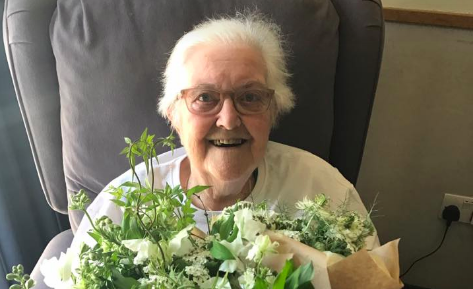
That’s not the only place Meghan sent her wedding flowers, though. A “special delivery” of some “beautiful bouquets made from the royal wedding flowers” were sent to St. Joseph’s Hospice in London, according to a Facebook post from the facility.

“Today we got a very special delivery,” the post reads. “Beautiful bouquets made from the #royalwedding flowers which we gave to our patients. A big thank you to Harry and Meghan and florist Philippa Craddock. Our hospice smells and looks gorgeous. Such a lovely gesture.”

Take a look at the sweet photo, below:

As if their royal wedding didn’t give us enough reasons to cry, Meghan and Harry went ahead and did this. I’m sure tissue companies are having a very good week in sales.

More Royal Wedding News:

Meghan Markle’s Royal Wedding Hair Only Took 45 Minutes

These Celebrity Wedding Guest Tributes to Meghan Markle and Prince Harry Will Melt Your Cold Heart

Here’s What It Was Actually Like to Attend the Royal Wedding


Source link