Categories
Health

The Situation Room Didn’t Prepare Me for a Life Confined to My Living Room


I know what it’s like to make big decisions in small rooms, separated from the rest of the world, alone with the weight of your choices.

It seems, in fact, that such acts defined my government career. For six years, I was an official in the Obama administration, advising secretaries of state and ambassadors, spending my days in secure rooms at the State Department, the White House, and the U.S. Mission to the United Nations.

I frequented gilded conference rooms behind key-carded hallways where men—it was so often me and a room full of men—considered the direction of U.S. foreign policy. I’d glance at the portraits of former Secretaries—Marshall, Kissinger, Albright, Powell—and feel the privilege and responsibility of my presence. There among the dark suits in stiff chairs. Bright lights shining above. Heavy doors that locked with a click and left you to answer: Will aid prevent a humanitarian crisis? Is our counterterrorism policy working? How can America lead?

I spent hours alone in Sensitive Compartmented Information Facilities, or SCIFs, the rooms where you go to read classified intelligence. The briefings always warned of potential crises, and my job was to help keep not-yet-disasters from becoming full-blown conflagrations.

By myself at a plain table, I’d open coded folders concealing stories from distant places: infectious diseases ravaging populations, ethnic tensions simmering, and protests that might birth democracies or ignite civil wars. Every day the reading was different, but, in a way, the messages were all the same: plain type, small print, huge consequences.

When the stakes were highest, I would, on occasion, be invited to the Situation Room, which looks in real life like it does on TV, digital clocks lined up on the wall, one always displaying the local time of the President. I’d check my electronics at the door, see the expansive mahogany table, and then stop to catch my breath, understanding that America has the power to start wars or forge peace, to ignore suffering or to end it, to live our values or to breach them.

The rooms I inhabit now are more ordinary and unassuming, living as I do in a two-bedroom apartment, sheltering in place with my wife and young child in the age of COVID-19.

There’s my bedroom, where the light peeks through the shutters in the morning, and for a brief moment before I rise, I can almost forget that things are not normal. The laundry is piled in the corner undone, and my business suits hang in the closet unworn. There’s a stack of serious books on my nightstand, but I reach most often for my phone which alerts! (of a market crash), and alerts! (of school closings) and alerts! (of death tolls, rising, rising).

There’s my daughter’s room, with its soft pastel colors and shelves lined with books; they tell stories of dragons and monsters, but not an invisible virus more powerful than any imagined villain. From the toddler bed, she looks up at me with plaintive eyes and asks, “Is tomorrow going to be a school day?” From the doorway, I stand and answer, “Not tomorrow, baby, but maybe soon.”

There’s our living room—our everything room—where we cook, and eat, and build a fort, and chase the toddler, and Zoom with grandparents, and collapse at the end of the day, bleary-eyed and exhausted, but grateful that we are healthy and safe when so many others are not.

When I was in government, I would try to keep my personal life out of the rooms I inhabited. But sometimes it snuck in.

That day when I went to the SCIF, heavy with labor, rushing to read the intel before I went to the hospital, needing to provide advice just one more time.

That day when the Supreme Court struck down the Defense of Marriage Act, and my eyes filled with tears outside my boss’s office, knowing that my upcoming marriage would be recognized under U.S. law.


Source link

Categories
Health

If Missouri’s Last Abortion Clinic Closes, There Might Not Be Room for Patients in Neighboring Centers


Missouri might become the first state without a single abortion services provider since 1974, the year after Roe v. Wade was enacted. The state’s last remaining abortion clinic—called the Reproductive Health Services of Planned Parenthood of the St. Louis Region—is currently at risk of losing its license and being forced to close by the end of the week. However, the health center would still be allowed to provide STI testing, cancer screenings, birth control, and more.

Planned Parenthood is currently in a standoff with Missouri state officials over an audit of the clinic, which began this spring. According to the New York Times, “Lawyers for the clinic say that the audit, which began this spring, has become wide-ranging and includes demands they consider to be unreasonable…. The clinic agreed to meet a number of the state’s demands, including a requirement that it provide an additional pelvic exam for abortion patients. But the clinic is now deadlocked with state officials over a request to interview seven of its doctors, including fellows and residents.”

Yesterday, Colleen McNicholas, a physician at the clinic, was interviewed by state officials along with one of her fellow doctors. About the interview McNicholas told Glamour, “They asked about our practices and reproductive health services, including how we work with residents and fellow trainees. And while I still believe the interviews are completely unnecessary—because we have provided exceptional care for a very long time—I am also glad that the department finally agreed to sit down with me, and hopefully, through that conversation, they now understand what is the standard medical education process. I hope that resolves any remaining issues for them.”

Though McNicholas is hopeful about how her meeting went, she’s saddened that across the country there’s a “larger framework and strategy to criminalize abortion.” She went on to say, “Most people are familiar with legislative attempts, with all of the [abortion] bans that are sweeping our country—but for states that have really hostile restrictions to abortion care, the licensing process has become a weapon of these politically appointed health directors. This is something we face on an annual basis, but this year it was ratcheted up and we really saw investigators asking and demanding for things like interrogating physicians, which is so outside the bounds of what this process is supposed to be.”

While Planned Parenthood has filed a lawsuit requesting a restraining order against the state in the hope of keeping the clinic’s license—which will be brought to a circuit court judge today—the physicians at the clinic are already working on ways to make sure Missourians are granted access to abortion. One of the ways they’ll do so is by having more patients go to nearby clinics in places like Illinois or Kansas to receive abortion care. However, with the restrictions on abortion in Missouri, these neighboring clinics are becoming overcrowded.

“Over the last five to seven years, we’ve seen a significant increase in our number of patients from Missouri,” said ob/gyn Erin King, executive director of Illinois’ Hope Clinic for Women, which is located about 20 minutes from downtown St. Louis, in an interview with Glamour. “We’ve actually doubled the number of doctors that are seeing patients at our clinic in just the last year and a half. So we’ve really had to take on some of the burden of seeing those patients—and with the potential closing of this last clinic in Missouri, we anticipate a drastic increase [in patients] that we probably cannot accommodate right away. Obviously we’re doing everything we can to help our colleagues in St. Louis, and we’re working around the clock here to try to have the staff in place so that these patients can [come to us].”

And with the growing restrictions on abortion in Missouri—just last Friday, Governor Mike Parson signed into law an antiabortion bill that prohibits the procedure after eight weeks of pregnancy—McNicholas believes that self-managed abortion will become more and more of a reality for people seeking the procedure. “We know communities of color, people who are low-means or low-income, and rural Missourians [already] have tremendous difficulty accessing abortion care in the medical system,” says McNicholas. “So it should be expected, and we’ve already seen this, that people will turn to self-managed abortion. There are a variety of ways that self-managed abortion can come to fruition. If patients are able to access the medications that we use traditionally for an abortion, then they can safely manage their own abortion through that process with the right education and tools. However, there are going to be patients who can’t access that medicine, or think they’re accessing that medicine but get the wrong one. So we still have to be prepared for other methods of self-managed abortion and helping people to safely end their pregnancy.”

Missouri is currently one of six states with only one remaining clinic, according to data from the Guttmacher Institute, and would be the only state in the nation to not have a single clinic.


Source link

Categories
Health

Prince Harry Is Away for Valentine's Day, so People Covered His Room With Meghan Markle Pics


We’ve known for a while now Prince Harry and Meghan Markle aren’t spending Valentine’s Day together this year. Unfortunately, royal duty calls for the Duke of Sussex: He’s currently in Bardufoss, Norway, visiting the Exercise Clockwork, an “annual winter exercise, based in one of the world’s most demanding environments—200 miles inside the Arctic Circle—which has trained over 16,000 Royal Marines and Royal Navy sailors and airmen since 1969.” So, in other words, he’s seriously watching people work out in the freezing cold instead of hanging out with Meghan. So sad!

But the people at Exercise Clockwork just brought her a little bit closer to him. In a very sweet move, they covered one of the makeshift shelters Prince Harry stopped by with photos of him and Meghan on their wedding day. Prince Harry’s smile when he saw these photos is absolutely priceless:

Press Association via AP Images

“You weirdos,” Prince Harry joked when he saw the photos, according to E! Online. “It’s very kind of you to invite me into your private shrine or whatever you want to call it.”

This means Markle is spending Valentine’s Day on her own too—but if this recently unearthed blog post from her old website The Tig is any indication, she’s not sweating it. Back in 2015 Markle wrote about how practicing self-love on Valentine’s Day is the most important thing.

“This Valentine’s Day I will be with friends, running amok through the streets of New York, likely imbibing some cocktail that’s oddly pink, and jumping over icy mounds in my new shoes through the salted snowy streets of the West Village,” she wrote, according to People. “But those shoes, by the way, were my gift to myself. Because I’ve worked hard, because I’m not going to wait for someone to buy me the things I covet (nor do I want to), and because I want to treat myself as well as I treat those dearest to me. Because I am my own funny Valentine.”


Source link

Categories
Health

A $500 Dining Room Table Changed My Life. Here's How.


At first, my husband refused to spend $500 to ship a dining room table from Cleveland to New Jersey. He thought it made no sense. (“Why not just buy a table at Ikea?”) I pointed out that the deal included six chairs and four leaves, that it opened up to seat twenty people and that it was made from genuine American cherry, for crying out loud. We already owned enough manufactured wood to build a bridge over the Cuyahoga River.

Ethan was unmoved. He’s a self-described “anorexic spender,” able to go into complete financial lockdown during lean times. Unfortunately for me, this was one of those times. Unfortunately for him, I’d already been in love with this table for fifteen years.

The table belonged to Joanie and Paul Levin, old friends of Ethan’s family. All we had to do was pay for transportation to our house, where we ate meals with our three toddlers crowded around an old desk resurfaced with tile leftover from a bathroom renovation. The grout was stained with tomato sauce and the legs were gouged from being banged into by the tricycles we kept in our dining room.

“Trust me,” I said. “We need this table. It’s a huge upgrade, and it’s a bargain!”

Ethan pointed out that we didn’t have twenty people to invite over; we were new in town. He thought the Levins’ elegant antique would look out of place among the hodgepodge of junky furniture in our fixer-upper—“like putting a Porsche engine in a Chevy.” Then he went low: reminding me of all the parking tickets I’d gotten recently, resulting in the suspension of his driver’s license (our minivan was in his name); and of the $800 we’d paid a collections agent after I defaulted on the contract for a rent-to-own clarinet (I thought the bills were receipts!).

Our civil discussion devolved into the silent treatment followed by a series of terse emails and then reconciliation.

Ethan agreed to call the movers.

The first time I went to Shaker Heights, Ohio for Thanksgiving with my future in-laws, we celebrated at the Levins’. Joanie and Ethan’s mom, Amy, had grown up on the same block, then raised their kids in houses next door to each other. Paul and Ethan’s dad, Phil, had organized the Sutherland Road block party together for a decade and shared a lifelong loyalty to their hometown, Boston.

I’d never been away from my family for a major holiday, but I immediately felt at home that night. I loved the easy shorthand between Ethan’s family and the Levins—the way Amy knew where to find extra paper towels and Phil stood at the stove ladling pumpkin soup and the kids spoke to each other in the easy shorthand of adopted cousins. Everyone doted on the grandmothers, Edith and Doris, who smiled over the whole tableau as if they were the luckiest people in the world.

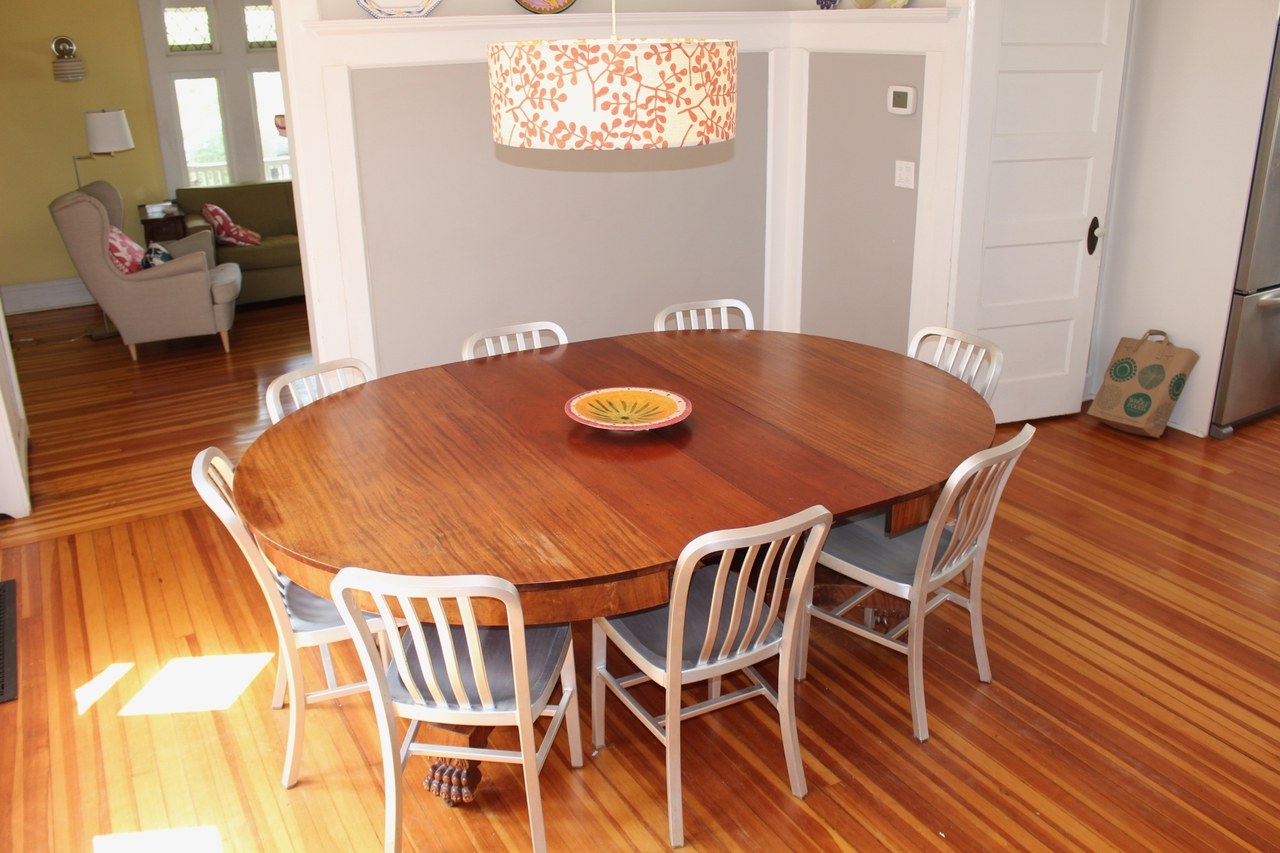
Aside from the hamish vibe—a term I learned from these families—I also loved the Levin’s table. It was round, extended to oblong and dressed up in blue and white linens inherited from Paul’s mom. Our Thanksgiving was the whole enchilada of Americana, right down to the Jello mold, but the table would have been equally at home at a banquet with finger bowls and silver candelabra. A lesser piece of furniture might have groaned beneath the bounty (a vat of mashed potatoes, Paul’s famous pies in six flavors); this one didn’t make a peep.

Under the table, Ethan and I held hands through the whole meal.

After that, we found ourselves in the Levin’s dining room for a rained-out Fourth of July barbecue, an engagement party and a celebratory lunch when we brought our first baby to Cleveland. Every time I was there, I admired the table—amber in some lights, reddish in others. Bending down to pick up a dropped pacifier, I noticed that the feet were carved to look like claws.

I love this table the way some people love their dogs. It’s a steady presence, a port in a storm. I know it’s only a piece of wood, but I swear: the table knows things.

Joanie and Paul became surrogate in-laws to me and grandparents to my kids—they were even friends with my parents—so I was surprised and sad when I found out they were getting divorced. I was equally surprised when Joanie called to offer me the table. Didn’t one of her kids want it? Didn’t she want to try to squeeze it into her new place? No and no, she said firmly. Even before Ethan was on board, Joanie gave me instructions on how to take care of the table: “Just a little polish every now and then and don’t worry about coasters. And, trust me, it’s the best place to sit with a cup of coffee in the morning.”

She apologized for any nicks and scratches. I said I was sorry about Paul.

The table arrived on a warm spring day when the magnolias were in bloom. The smell wafted through the front door as the movers lugged in one piece at a time: first the top, then the leaves and finally the two halves of the base, marveling all the while at the heft.

I paid, signed and watched the truck drive away. Then, with my youngest napping upstairs, I arranged all the chairs and the high chair and sat down to eat a civilized lunch alone. Suddenly, it didn’t matter that our couch was hopelessly stained or that our cabinets were held together with duct tape. It was as if this one beautiful thing had waved a magic wand over the rest of our kingdom, making everything around it look just a little bit brighter.

Overnight, the table became the backdrop for our lives. We eat every meal there, plus afternoon snacks and late-night ice cream. Our kids plunk their coats and backpacks on the table when they come home from school. It’s where we blow out birthday candles, fold laundry, do homework, read the newspaper and conduct all important conversations. (Once I overheard our middle kid say to our oldest, “They want to talk to me in the dining room.” His sister’s response: “Wow. You must have used a lot of data.”) The table has been witness to our family’s evolution from picture books to chapter books to SAT prep books to self-help books (mine). It’s been home to art projects—dioramas, posters, construction paper chains—and weathered every writing instrument and form of adhesive (crayons and colored pencils; glitter glue and ModPodge). And don’t get me started on slime; turns out, cherry is no match for Borax.

We only had a few Thanksgivings without Paul. We missed his pies and funny stories, but in the meantime, he always kept up with me and Ethan and our kids. After my dad died, he and Phil quietly took turns filling the empty seat, and they never let me down.

And then the Levins had a grandson of their own, and Joanie and Paul were a team again. That year, as he was arranging his Thanksgiving offerings on Amy’s sideboard, I cornered Joanie in the kitchen: “I’m really happy to see you guys together, but does this mean you’ll want the table back?”

She laughed, looking exactly like Edith, who was also gone. So was Doris. “No, honey, we’re on to a new phase. It’s yours.” Suddenly, it hit me: Joanie and Amy were the grandmothers now.

We have yet to host a dinner party for twenty, and most days our table is only set up for six. But we’ve used the extra leaves for Easter, Thanksgiving, Christmas Eve, a seder and countless book clubs. A few years ago, we upgraded from the high chair and the tricycles to jute placemats and matching silverware. We only have one tablecloth which we don’t use it very often—I like to see the table—but every time I lift it up to put it away, I think of that moment when the groom raises the the veil from the bride’s face. I love this table the way some people love their dogs. It’s a steady presence, a port in a storm. I know it’s only a piece of wood, but I swear: the table knows things. It’s seen it all.

Every morning when I sit down in the dining room with my coffee, watching the sunrise over the house next door, I think of Joanie: another mom in another time, waiting for her kids to wake up while the man who would become my husband left for hockey practice on the other side of the fence. Ethan is not as sentimental as I am, but he has never missed the $500 we paid to bring this table home. And I never say a word when he places his newly-sharpened skates directly onto it; after all, the nicks and the scratches tell a story.

A few years ago, Paul got sick. Not long before he died, he came to New Jersey to visit his childhood friend, George, who also happens to be the lawyer we hired to handle the closing on our house. We invited Paul and George for brunch in our dining room, at the Levins’ old table. I polished it up and set it with my best plates and even went to a faraway bagel store to get the best lox. I hoped Paul wouldn’t notice that the original chairs were missing; I’d given them to a friend and replaced them with modern titanium chairs from Crate and Barrel.


If Paul noticed anything amiss, he didn’t mention it. He stayed for hours: through lunch and into the late-afternoon, to the point where Ethan and I offered him a cocktail and invited him to stay for Chinese takeout. He was thin and weak, and I knew this might be the last time we saw him. He told story after story: about his early days in New York with Joanie; about his kids and his grandsons, who were his pride and joy. Finally, just as Ethan and I were raising our eyebrows at each other across the table (marital shorthand for, “Who’s going to drive to swimming/basketball/dance?”), Paul stood up to go. He laid his hands flat on the table—his table, our table, someone else’s table someday—and said, “This. This is home.”

It always has been, and always will be. Until it belongs to someone else.


Source link

Categories
Health

Kim Kardashian Reveals That She Gave Khloé a Leg Up (Literally) in the Delivery Room


In case you were worried, rest assured that yes, Khloé Kardashian‘s sisters did make it to Cleveland in time for the birth of her daughter on Thursday. In fact, as older sister Kim Kardashian West revealed on Twitter early Friday morning, she actually played a crucial role in helping Khloé deliver her baby.

“I’m so happy for you! Your baby girl is so beautiful! You are so strong, you made that look so easy! I can’t wait for our baby girls to grow up as best friends the way we are!” Kim tweeted at her sister, referring to her own newborn daughter, Chicago, who arrived on January 15. “I’m so happy I was able to return the favor of holding your leg while you pushed LOL.” In a follow-up tweeted directed at her followers, Kim added, “You guys she’s so gorgeous!!!!!”

The rest of Khloé’s tight-knit family have also congratulated her on the birth of her first child. On Thursday, mom Kris Jenner retweeted a W magazine video in which daughter Kendall Jenner repeats the word “baby” over and over, adding, “BLESSED!!!” Also on Thursday, Khloé’s youngest sister Kylie Jenner posted a video on Snapchat while riding in the passenger seat of a car; a pink filter reading “Kongrats, Khloé! It’s a girl!” was overlaid on top of the video, while Cardi B and Chance the Rapper’s song “Best Life” plays in the background. And while Kourtney has yet to post a message explicitly about Khloé’s daughter, she did take to Instagram on Thursday, shortly after reports of Khloé’s delivery first broke, to post a photo of her daughter Penelope, Kim’s daughter North, and a friend with the caption “GIRL POWER.”


Source link

Categories
Health

Meredith Vieira Once Found a 'Huge Bag of Sex Toys' in Matt Lauer's Dressing Room


Following Matt Lauer’s prompt termination from NBC over allegations of inappropriate sexual conduct, some of the former Today host’s on-air moments are now coming under (warranted) scrutiny. Take a Today show sexual harassment parody, aired in 2012, in which Lauer makes light of inappropriate sexual advances in the office and paints himself as a victim. Or his uncomfortable interview with Anne Hathaway, also from 2012, that features Lauer making a creepy comment about an invasive up-skirt photo of the actress that was circulating at the time.

The latest clip to resurface comes from a 2016 episode of The Meredith Vieira Show. During an interview with her former Today co-host, Vieira gently chides Lauer about once finding a “huge bag of sex toys” in his dressing room closet.

“We had a guest on the show…she was a sex therapist,” Lauer said, trying to explain himself. “When she left, she gave each of us a shopping bag of stuff. True story. I didn’t know what to do. I put it in my closet in my dressing room.”

[embedded content]

He then went on to add that, the very next day, former First Lady Laura Bush was a guest on the show and the Secret Service found the bag in his room during their security sweep—a revelation that caused Vieira, Savannah Guthrie (who was also part of the segment), and the audience to roar with laughter.

Of course, placed in context of Variety‘s explosive investigation alleging that, among other things, Lauer once gave a coworker a sex toy as a present along with a note detailing how he’d want ot use it on her, what was intended to be a risque but lighthearted moment takes on an entirely new—and disturbing—interpretation. And, for what it’s worth, Vieira didn’t get “a bag of stuff” from the therapist despite Lauer noting that she was the one who led the segment.

This wasn’t the only troubling moment between Lauer and Vieira. In another video—this one shared by TMZ—Lauer is caught on camera between staring at Vieira as she leans over the Today show set’s coffee table. “Nice sweater,” he began, before telling her, “Keep bending over like that. It’s a nice view.”

[embedded content]

Just add both of these to the growing list of Lauer moments that make our skin crawl.


Source link