Categories
Health

Michelle Obama Shares Her Lessons on Motherhood in a Moving Personal Essay


Former first lady Michelle Obama has always had sage advice to share in speeches; in her best-selling book, Becoming; and now, in a new personal essay in People. In honor of Mother’s Day, Obama penned a deeply personal essay in which she describes the important lessons her own mother, Marian Robinson, passed onto her.

“My mother is a woman who chooses her words carefully. She’ll sometimes speak in clipped sentences, her wisdom packed into short bursts and punctuated with an infectious smile or a wry laugh. It’s a style that makes her a favorite of everyone she meets—a sweet, witty companion who doesn’t need the limelight,” Obama wrote.

Obama added that as she grew older, she realized just how important that manner of conversation really was and how it truly reflected her mother’s parenting style. “Because when it came to raising her kids, my mom knew that her voice was less important than allowing me to use my own,” she wrote.

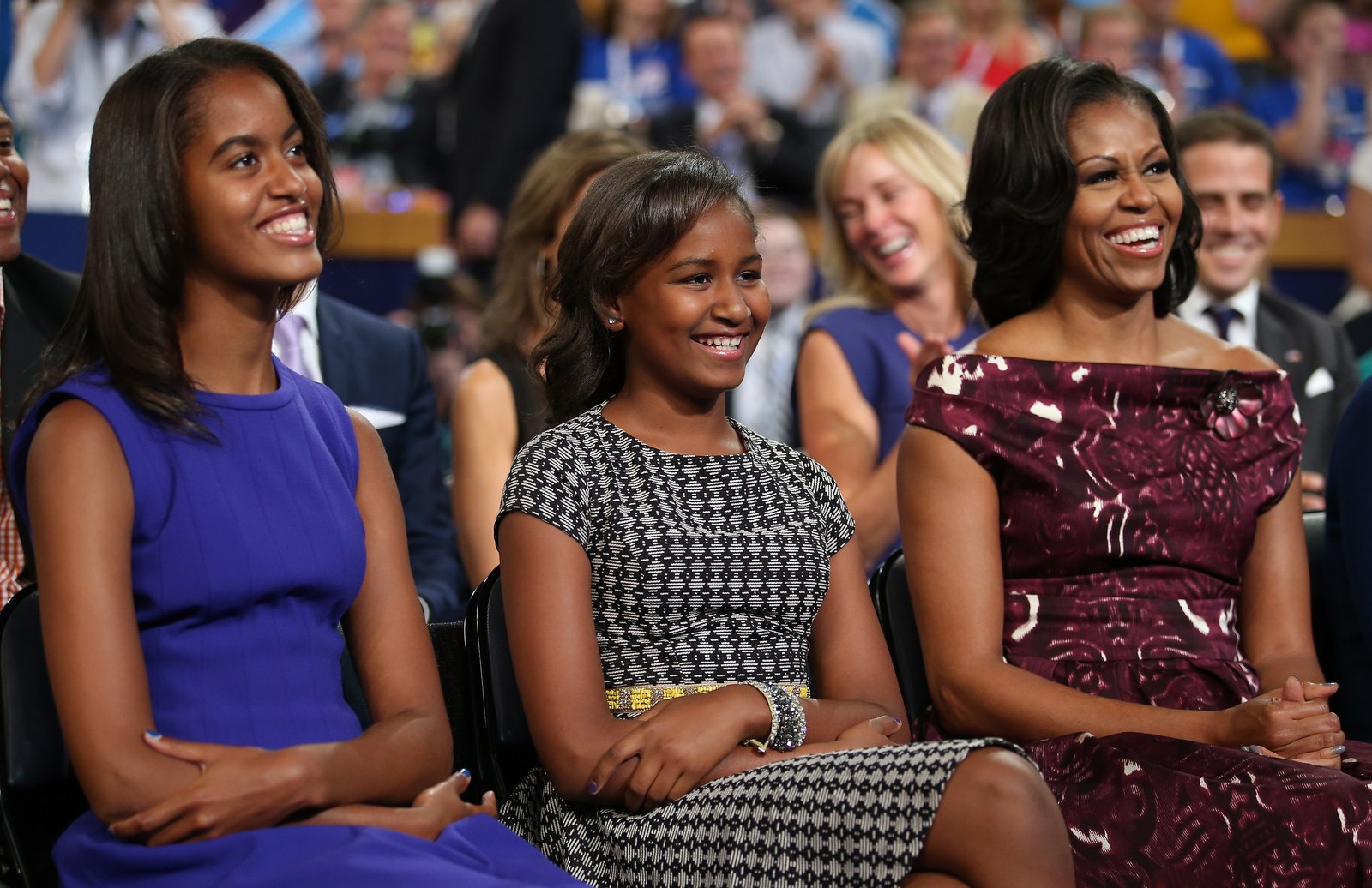
Malia, Sasha, and Michelle Obama attending the Democratic National Convention in 2012.Chip Somodevilla/Getty Images

According to Obama, that meant her mother “listened a lot more than she lectured” when answering all the questions she threw her mother’s way.

“Why did we have to eat eggs for breakfast? Why do people need jobs? Why are the houses bigger in other neighborhoods? She didn’t chide me if I scrapped with some of the neighbor kids or challenged my ornery grandfather when I thought he was being a little too ornery,” Obama wrote. “She listened intently to the lunchtime conversations I had with my schoolmates over bologna sandwiches and nodded patiently along to tales of my contentious piano lessons with my great aunt Robbie.”

Obama continued that in today’s world, it may be easy to see her mother’s actions as “negligent” because she allowed her children to “rule the roost.” But, she noted, the reality was far from that.

“She and my father, Fraser, were wholly invested in their children, pouring a deep and durable foundation of goodness and honesty, of right and wrong, into my brother and me. After that, they simply let us be ourselves,” she wrote.

Obama added that now, as a mother of two nearly grown women, she sees just how important that freedom is.

“… I see now how important that kind of freedom is for all children, particularly for girls with flames of their own—flames the world might try to dim,” she wrote. “It’s up to us, as mothers and mother-figures, to give the girls in our lives the kind of support that keeps their flame lit and lifts up their voices—not necessarily with our own words, but by letting them find the words themselves.”

Source link

Categories
Health

Kate Middleton's Brother James Wrote a Powerful Essay About Mental Health


For years, the rising generation of the royal family—specifically Duchess of Cambridge Kate Middleton, Prince William, and Prince Harry—has worked through their Heads Together foundation to change the conversation around mental illness and combat stigma around it, especially within the United Kingdom. Prince Harry, in particular, has been especially vocal about his own struggles, opening up about being “close to a complete breakdown on numerous occasions.” Now, Kate’s brother is contributing to the conversation: In a new op-ed for the Daily Mail, James Middleton—who has historically remained quiet on all matters concerning his family—openly applauds his royal sister and brothers-in-law for their work as he opened up for the first time about his own years-long battle with anxiety and depression.

In the essay, Kate’s younger brother describes the challenges of living with severe dyslexia and Attention Deficit Disorder (ADD) and how that morphed into an exhausting struggle with anxiety and depression later in life: “Each night sleep eluded me,” he writes. “During the day I’d drag myself up and go to work, then just stare with glazed eyes at my computer screen, willing the hours to tick by so I could drive home again. Debilitating inertia gripped me. I couldn’t respond to the simplest message so I didn’t open my emails. I couldn’t communicate, even with those I loved best: my family and close friends.”

Middleton goes on to acknowledge that although he’s privileged, that doesn’t make him “immune” to issues with mental health. “I know I’m richly blessed and live a privileged life. But it did not make me immune to depression,” he says. “It is tricky to describe the condition. It is not merely sadness. It is an illness, a cancer of the mind.”

According to the World Health Organization, depression is an extremely common mental health disorder affecting more than 300 million people of all ages worldwide. But despite its wide reach, depression—as with many other mental health conditions—is often culturally stigmatized. In the UK, open discussions around depression and other mental health issues are still largely more taboo than not—for men in particular—making Middleton’s essay especially important. “For many men, opening up about their feelings is the biggest social taboo,” wrote Chris Hemmings in 2016 for the Independent, a British newspaper. Instead, he writes, “[we] bury our heads in the sand—or bottle, to be more accurate, as alcoholism rates for men in the UK are three times that of women.” A report from the UK’s Mental Health Foundation places suicide—which, the report reads is “associated with depressive disorders across the globe”—as the leading cause of death in the UK among people 20 to 34 years old, with more than three times as many men as women dying as a result of suicide.

Despite his sister’s advocacy and the fact that the Middleton family had become “desperately worried” about his well-being, James writes that he found it difficult to open up to them at first, explaining that often with depression, “those who are closest to you are the hardest to speak to.” Ultimately, it was the royals’ years-long advocacy for openness around mental health that helped James come forward with his own story.

“I feel compelled to talk about it openly because this is precisely what my brother-in-law Prince William, my sister Catherine and Prince Harry are advocating through their mental health charity Heads Together,” he says.

“They believe we can only tackle the stigma associated with mental illness if we have the courage to change the national conversation, to expel its negative associations,” he writes. “So it wouldn’t be honest to suppress my story. I want to speak out, and they are my motivation for doing so.”

Ultimately, Middleton hopes that by opening up about his struggle with anxiety and depression, he’ll encourage others to do the same. Props to him for speaking out—and continuing to unravel the stigma.

If you or someone you know is struggling with depression, visit Mental Health America or the Anxiety and Depression Association of America for access to resources, help, and support.

Related Content:

Prince Harry Says He Was ‘Close to a Complete Breakdown’ in Years Following Princess Diana’s Death

Meghan Trainor Opens Up About Her Battle With Depression and Anxiety

Allison Miller Hopes A Million Little Things Will Inspire People to Talk More Openly About Therapy


Source link

Categories
Health

Barack Obama Praises 5 Parkland Survivors In Powerful 'Time' Essay


For his entry in Time‘s 100 Most Influential People list, former President Barack Obama chose five student survivors of the Parkland, Florida, shooting on February 14 that left 17 people dead at Marjory Stoneman Douglas High School. Singling out Cameron Kasky, Jaclyn Corin, David Hogg, Emma González, and Alex Wind, Obama wrote a powerful essay on how the students are helping to change the conversation around gun control without the institutional backing of politicians.

“Seared by memories of seeing their friends murdered at a place they believed to be safe, these young leaders don’t intimidate easily,” he writes in the piece.

Obama begins by addressing the canned “thoughts and prayers” response used by many politicians in the wake of a mass shooting. “America’s response to mass shootings has long followed a predictable pattern. We mourn. Offer thoughts and prayers. Speculate about the motives,” he writes. “And then — even as no developed country endures a homicide rate like ours, a difference explained largely by pervasive accessibility to guns; even as the majority of gun owners support commonsense reforms — the political debate spirals into acrimony and paralysis.”

“This time, something different is happening,” he continues. “This time, our children are calling us to account.”

Obama went on to point out that although the student activists of Marjory Stoneman Douglas High School don’t have “the kind of lobbyists or big budgets for attack ads that their opponents do,” with most of them not even being able to vote yet, “they have the power so often inherent in youth: to see the world anew; to reject the old constraints, outdated conventions and cowardice too often dressed up as wisdom. The power to insist that America can be better.”

Writing that student leaders like Cameron, Jaclyn, David, Emma, and Alex don’t “intimidate easily,” Obama commends them for taking on the powerful opponents of gun control. “They see the NRA and its allies — whether mealymouthed politicians or mendacious commentators peddling conspiracy theories — as mere shills for those who make money selling weapons of war to whoever can pay,” he writes. “They’re as comfortable speaking truth to power as they are dismissive of platitudes and punditry. And they live to mobilize their peers.”

“Already, they’ve had some success persuading statehouses and some of the biggest gun retailers to change,” he adds. “Now it gets harder. A Republican Congress remains unmoved. NRA scare tactics still sway much of the country. Progress will be slow and frustrating.”

As he wraps up the piece, the former POTUS gives readers a look into a future in which young activists like the Parkland students have effected powerful change. “But by bearing witness to carnage, by asking tough questions and demanding real answers, the Parkland students are shaking us out of our complacency,” he writes. “The NRA’s favored candidates are starting to fear they might lose. Law-abiding gun owners are starting to speak out. As these young leaders make common cause with African Americans and Latinos — the disproportionate victims of gun violence — and reach voting age, the possibilities of meaningful change will steadily grow.”

Previously, Barack and Michelle Obama wrote a letter to the student survivors, praising them for their powerful actions, including organizing the March for Our Lives after the shooting. “We wanted to let you know how inspired we have been by the resilience, resolve and solidarity that you have all shown in the wake of unspeakable tragedy,” the Obamas wrote. “Not only have you supported and comforted each other, but you’ve helped awaken the conscience of the nation, and challenged decision-makers to make the safety of our children the country’s top priority. Throughout our history, young people like you have led the way in making America better. There may be setbacks; you may sometimes feel like progress is too slow in coming. But we have no doubt you are going to make an enormous difference in the days and years to come, and we will be there for you.”

You can read the rest of former president Obama’s Time 100 essay here.


Source link

Categories
Health

Adele Wrote the Nicest Essay About Her ‘Goofball’ Friend Rihanna


Rihanna and Adele are two music queens in their own rights—and their love for each other is palpable. In 2012, RiRi said Adele didn’t “know the depth of [her] affection” toward her and that she became “so attached” to her album, 21. Adele’s said similar things about Rihanna—but none are more wonderful than the tribute she just wrote for the “Diamonds” singer in light of Time magazine dubbing Rih one of its 100 most influential people.

“I actually can’t remember the first time I met Rihanna; I was probably numb from the shock of it,” the “Hello” singer wrote in her blurb. “Whenever I’ve met her, she’s been the most gracious, loyal, and funny goofball of an icon. She glows like when someone’s taken a picture with a flash and you’re dazed for a few minutes after. But it’s also very clear in that glow that she genuinely doesn’t give a f-ck; she’s fearless and full of all the right kind of attitude to be everything that she is and will be forever.”

Adele went on to describe Rihanna’s song “Pon de Replay” as an “absolute banger” (accurate) and praised the Fenty maestro for blazing her own trail in the industry. “She has designed and conquered an entire lane of her own. The innovative and groundbreaking world of Rihanna that no one else will ever be safe in and get away with copying,” Adele wrote. “She makes her own rules and bends ours.”

So…does all this love mean a collaboration is in the works? Take my money now, if so.

Related Stories:

Adele Married Two of Her Best Friends—and Planned the Whole Wedding—Like the Angel She Is

Rihanna Is Too Rich and Too Iconic to Worry About Bro Fat-Shamers on the Internet

A Bag of Adele’s “Air,” and More Weird Celebrity Souvenirs People Actually Bought


Source link

Categories
Health

Alyssa Milano Takes on Sexual Harassment and Donald Trump in Powerful New Essay


In a detailed essay for Rolling Stone, Alyssa Milano said she’s dealt with gender inequality and harassment throughout her acting career and urged the public to hold Donald Trump accountable for his lewd comments about women.

The essay, published today, outlined why Milano is supporting Time’s Up, a Hollywood initiative designed to fight sexual harassment and assault. Milano became an integral part of the #MeToo movement when she encouraged women to share their experiences with sexual misconduct on Twitter, boosting a hashtag created by civil rights activist Tarana Burke. While she’s championed other women’s stories, Milano hasn’t revealed too much about her personal experiences with harassment in the entertainment industry.

“I have not told my #MeToo stories, but I will say I dealt with one assault case in the industry and one not in the industry. And I don’t know a week that has gone by in my 35-year career that I haven’t dealt with harassment and gender inequality in some capacity,” she writes.

She listed legislation, lobbying and education about gender inequality as ways through which the Time’s Up initiative can keep the #MeToo momentum going. Already, 30 Hollywood women, including Reese Witherspoon and Eva Longoria, have backed Time’s Up. Milano also encouraged men to become part of the solution—and called out Donald Trump for bragging about grabbing women by the pussy and trying to rollback women’s rights in his first year as president.

“We must hold Trump accountable. If we’re asking senators to resign because of sexual misconduct, what message does it send that we are allowing a man who has had 19 women come forward and accuse him of misconduct, to be our president?” she writes. “This is behavior that I think has stolen generations of women from reaching their potential, and that to me is truly heartbreaking.”

Milano described how supporting the #MeToo movement has impacted her. She explained that she didn’t just want represent voices in her own industry, but those of every woman that has been a victim of such “such a sadly common phenomenon.”

“Every fiber of who I am on a cellular level has been changed since I sent that tweet. It would be impossible not to be affected or impacted by the stories that people have shared with me,” she writes.


Source link

Categories
Health

Lena Dunham's Powerful Essay About Her Struggles With Rosacea Is Deeply Relatable


PHOTO: Ben Gabbe/Getty Images

This probably goes without saying, but Lena Dunham has made a welcome habit of getting real. The actress and activist is refreshingly open about everything from her political opinions and feminist philosophy to the chronic endometriosis she’s struggled with for years. And in this week’s issue of her newsletter, Lenny Letter, the Girls creator and star reveals the latest health issue that has her grappling with a familiar insecurity: uneven skin.

In a powerful essay, Dunham details how, unknowingly at the time, her complexion was keeping her self-esteem together as she struggled with endometriosis in her late 20s. But when she recently contracted rosacea, that last vestige of confidence went out the window and caused her to reconsider the worth she’d placed in her skin.

“Chronic illness—endometriosis, along with an accompanying autoimmune disease that gives me chronic joint pain and fatigue—has made my body far less predictable to me, and in far more frightening ways than whether I’ll wake up able to fit into my high-waisted jeans. And a few weeks ago, a course of steroids to treat a massive flare of joint pain and instability led to rosacea’s appearing overnight, making me look like a scary Victorian doll, two perfect pink circles painted on her porcelain face,” Dunham wrote. “Then, after a long, sweaty night shoot in which I was covered in strange makeup, I washed my face to reveal that the rosacea had become hundreds of tiny pimple-blisters that covered me from forehead to neck…My face burned, but not as badly as my pride.”

She continued: “I found myself [age] 31 and hysterical, in the dermatologist’s chair as she extracted infected areas, applied an antibiotic cream, and explained that rosacea is another chronic condition: once the cat’s out of the bag, there’s no guarantee she’s headed back in. The acne on my shoulders and back was also steroid induced, she explained. (I hadn’t even noticed the bacne yet. FML.)”

This sudden hit to her health wasn’t just an annoyance, she explains, rather, it made her realize how intrinsic her appearance was to her identity. Even as she’d been vocal about her love and pride for her body, it struck her that her normally clear complexion had been the one thing buoying her self-image—its loss became a catalyst for self-doubt.

“Seven years of being treated in the public eye like a punch line about female imperfection may not have felt like it was wearing me down, but it had actually forced me to rely emotionally on my one area of fully conventional beauty: my perfect f-cking skin,” she wrote. “They could tag me in a picture of a beached whale. They could call me a bag of cottage cheese. But they couldn’t take away the fact that I was able to eat seven slices of pizza, a wine spritzer, and three quarters of a chocolate cake and still look like my face was kissed by sweet, sweet angels when I woke up. I wasn’t just mourning my easy skin-care routine or my ‘No filter? No problem’ lifestyle. I was mourning a life raft that had kept me, silly as it was, bobbing above the fray.”

Dunham went on to write that she’s still coming to terms with her return to the skin of her teenage years. “I have been forced to finally mourn the long, slow hit on my self-image. I thought my adolescent attitude, the take-no-prisoners approach to my own look and form, could carry me through the onslaught of critical attention. I thought I could intellectualize it away. But I can’t.”

There is a silver lining to her story, though, and it’s the kind of real and honest advice you can only get from someone who’s been through the same emotionally exhausting situation. “I’m starting to believe that speaking this pain aloud isn’t just good for my own healing: it allows any young woman who might be watching to understand that nobody is immune from feeling bad about hateful attention. If it took spelling my pain across my face to admit it, then so be it. I’m oddly grateful. ‘I don’t give a shit’ only translates into isolation; it prevents the people who love you from reaching out their hand to remind you of what’s real.”

You can read the essay in full here. Trust, it’s worth the click.

Related Stories:
The Totally and Completely Unfair Reason You’re Still Breaking Out in Your 20s and 30s
I Didn’t Stop Partying Until My Face Told Me To
Chrissy Teigen’s Snapchat of Her ‘Period Skin’ Is So Relatable It Hurts


Source link