Categories
Health

Michelle Obama Says She's Tired of Seeing Men 'Fail Up'


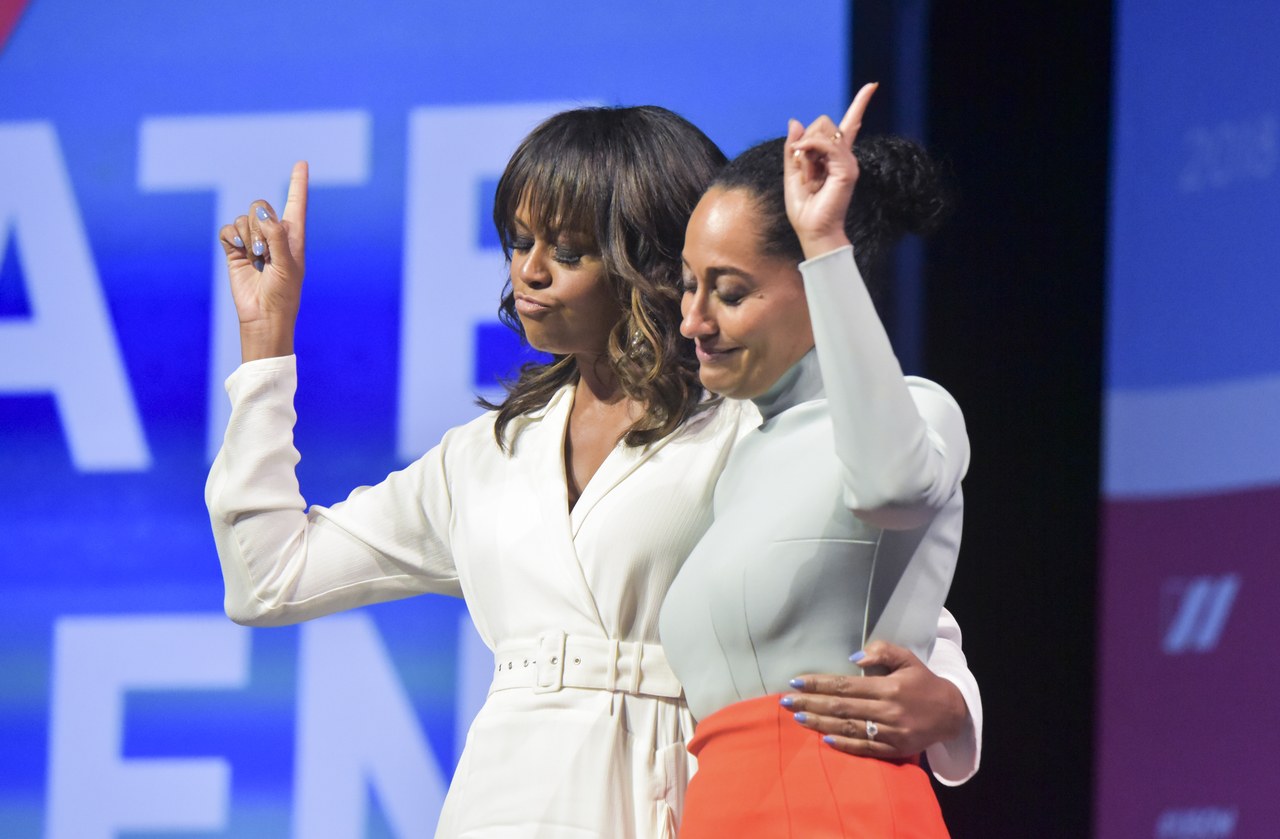
If there are two people whose conversations we’d love to listen in on, they would 100 percent be Michelle Obama and Tracee Ellis Ross. And lucky for us, that dream came true yesterday, when they got together at the United State of Women Summit in L.A. on Saturday for a frank—and oftentimes pretty funny—conversation about life lessons they’ve learned.

The summit’s main theme, gender equity, extended to the conversation Obama and Ross shared. Someone in the audience shouted out something about Michelle running for President—which she has repeatedly said she’s not even considering—and she responded: “That’s not the answer, either,” she said. “When I hear people say, ‘You run,’ it’s part of the problem. We still didn’t get ‘Yes we can’ right. It’s not yes you can, it’s yes we can. And until we get that right, it doesn’t matter who runs.”

As she’s done in the past, she discussed Trump without outright mentioning his name. Obama said she had no patience for men who could fail repeatedly and still do things like, say, become President.

“I wish that girls could fail as bad as men do and be OK,” she said. “Because let me tell you, watching men fail up—it is frustrating. It’s frustrating to see a lot of men blow it and win. And we hold ourselves to these crazy, crazy standards.”

PHOTO: Rodin Eckenroth/Getty Images

Obama and Ross also touched on inequality in the workplace. The former First Lady talked about what both women and men who find themselves with a “seat at the table” can do to ensure that the future is more equal for the next generation.

“So many of us have gotten ourselves at the table, but we’re still too grateful to be at the table to really shake it up,” Obama said about women in the workforce. “That’s not a criticism, because for so many, just getting to the table was so hard, so you’re just holding on. But now we have to take some risks for our girls… just holding onto our seats at the table won’t be enough to help our girls be all that they can be.”

And then she had some words for the men: “What I’ve been telling men is, you can’t have it both ways: You can’t whisper these magical thoughts in your daughter’s ear about who she can be or what she can do… If you’re tolerating [inequality at work], that is the workplace that’s going to be waiting for your little girl, but you sold her a bill of goods. You told her she could be anything, but then you’re not working to make sure that can be actualized. And so men have to understand things don’t just work out for your little precious pea.”

The rest of the conversation was incredibly powerful (I mean, look who was speaking). Grab a coffee, listen to these ladies, and then head into the week feeling like you can take the world on.

[embedded content]

Related Stories:
This Powerful Photo of a Young Girl Staring at Michelle Obama Portrait Is Going Viral
Here’s Why Michelle Obama Absolutely Won’t Be Running for President in 2020
Michelle Obama Says Any Woman Who Voted Against Hillary Clinton Voted ‘Against Their Own Voice’


Source link

Categories
Health

Pink Wrote a Powerful Open Letter to the Grammys President for Saying Women Need to 'Step Up'


So many women released great music last year: Cardi B., Kesha, Lady Gaga, Lorde, SZA, Pink, Katy Perry…and that’s just a few examples. And while some of these artists received Grammy nominations for the 2018 ceremony, the final list of honorees was predominantly male. This was perhaps most apparent in the Album of the Year category, which only featured one female nominee (Lorde’s Melodrama).

When it came to the final winners, men swept the 2018 Grammy Awards on Sunday night, too. The only woman who won a major award was Alessia Cara for Best New Artist. Four women were nominated for Best Pop Vocal Performance, but Ed Sheeran—the only male nominee in that category—won the honor. Women, more or less, were completely shut out of the show, which for many was both confusing and infuriating.

But not as infuriating as the Recording Academy president Neil Portnow’s rationale for the snubs. “I think it has to begin with women who have the creativity in their hearts and their souls—who want to be musicians, who want to be engineers, who want to be producers, who want to be part of the industry on an executive level—to step up, because I think they would be welcome,” he said, according to USA Today.

Yes, you read that correctly. Portnow thinks women weren’t awarded at the Grammys Sunday because they haven’t “stepped up” to the plate—whatever that means. This should go without saying, but women have been stepping up—for decades. There’s just an institutional bias in the music industry toward male artists. Their work is viewed as more valuable, and that’s why they keep winning year after year.

Pink echoed this in an open letter to Portnow that she posted to social media. “Women in music don’t need to ‘step up’ – women have been stepping since the beginning of time,” she wrote. “Stepping up, and also steppin aside. Women OWNED music this year. They’ve been KILLING IT. And every year before this. When we celebrate and honor the talent and accomplishments of women, and how much women STEP UP every year, against all odds, we show the next generation of women and girls and boys and men what it means to be equal, and what it looks like to be fair.”

See her message for yourself, below.

Female artists quickly rallied around Pink after she posted this. “Another powerful woman, leading by example,” Katy Perry tweeted. “We ALL have a responsibility to call out the absurd lack of equality everywhere we see it. I’m proud of ALL the women making incredible art in the face of continual resistance. ✊?” Charli XCX tweeted, “Women are making AMAZING music right now wtf is this dude talking about ?????” (We have no idea.)

Related Stories:

Pink’s Daughter Got to Meet Her “Idol” Rihanna at the Grammys Last Night

Pink Responds to Rumors She Cringed During Christina Aguilera’s American Music Awards Performance

Pink Finally Opened Up About Her Infamous Feud With Christina Aguilera


Source link

Categories
Health

White Roses or Not, the Lessons of 'Times Up' Were Mostly Missing from the 2018 Grammys


On January 29, 2017, exactly 364 days before Sunday night’s Grammy Awards, Lorde (the only female nominee in the coveted Album of the Year category) tweeted, “These old men in power have a storm coming, the likes of which they cannot comprehend.” On December 6, 2017, she retweeted it with an addendum:

Well, yes and no. Though the nominees for the 2018 Grammys were the most diverse group in the history of the ceremony, and the ubiquitous white roses provided the optics of female empowerment, the winners told a different story. Lorde was the only Album of the Year contender among her male counterparts who did not perform during the show. Cardi B, who roundly owned the airwaves in 2017, took to the stage not to collect a statuette but to bring one of the broadcast’s few moments of animated, organic vivacity. Kesha, who led the charge in calling out her abuser, lost Best Pop Solo Performance to a man who wasn’t even in attendance. If we watch awards shows as barometers of where the culture is (remember #OscarsSoWhite?), last night’s Grammys proved that the music industry still has a long way to go.

Few of us could have predicted just how powerful a storm the #MeToo movement would become. As Lorde tweeted a year ago, we are seeing some of those old men lose their power—and much of the drama has been playing out during Awards Season, making must-see TV out of the ceremonies that kick off with the Golden Globes and conclude with the Oscars. Historically, awards shows have been a parade of industry self-congratulation, with women fielding limp red carpet questions about who they’re wearing and being asked to peacock for the Mani Cam. And since every look and memorable moment will be regrammed and gif’d immediately after, watching in real-time hasn’t really been necessary in years past. But the #MeToo movement is making awards shows relevant again.

Since Hollywood received the memo to wear black to the Golden Globes and Kristen Bell served as the first-ever host for the Screen Actors Guild Awards, admonishing the audience that “everyone’s story deserves to be told,” award shows have been trying to “get woke“. And those attempts have been setting off miniature tempests in their respective teapots, perhaps signaling a larger cultural shift toward accountability. Just last week, Casey Affleck declined to give out the Best Actress Award at this year’s Oscars due to the sexual harassment allegations against him. (Allegations that, for what it’s worth, were public when he won the award for Best Actor last year.)

At Sunday’s Grammys, white roses took center stage to show solidarity for the #TimesUp movement. The gesture harkened back to the suffragettes and the Winner of the Popular Vote at last year’s presidential inauguration. Even the Most Important Celebrity of the Night, Blue Ivy Carter, shushed her parents while wearing an impeccable white suit. All eyes tuned in to see not just who would win Best Rap Performance but to witness how artists responded to the call for gender equality.

To come forward with allegations in such a shaky industry could be to risk everything.

The music industry has been slower to get the memo than other cultural institutions, especially compared to harassment and assault charges in Hollywood. Lily Allen observed that this could be because of the way record deals are structured. Artists sign on to decades-long contracts rather than one-off movies, so speaking up can quite literally sink your career. As Grammy nominee Ledisi told Glamour on Sunday’s red carpet, “It’s more difficult to say ‘time’s up’ in the music industry because you think you’re going to get blackballed if you do.”

That hasn’t stopped many accusers from coming forward, though. Industry titan Russell Simmons has been accused of rape by six women, and LA Reid stepped down from his position at the top of Epic Records after an assistant accused him of unlawful sexual harassment. R. Kelly had been openly predatory since marrying Aaliyah when she was 15 and he was 25, and in 2017 Buzzfeed revealed new evidence of exploitation. Atlanta-based activists Oronike Odeleye and Kenyette Barnes have organized the #MuteRKelly campaign in an effort to keep his songs off the airwaves and cancel his concerts. Still, compared to the dozens of A-list actresses speaking up in in Hollywood, relatively few female musicians have done so. To come forward in a shaky industry where revenue sources are in a constant state of flux could be to risk everything.

Kesha, who was nominated for Best Pop Vocal Album and Best Pop Solo Performance, trailblazed the call for accountability when she filed a lawsuit against her longtime producer Dr. Luke, claiming he had “sexually, verbally, and emotionally abused” her. She had been locked into an eight-album contract with the producer, a deal she signed when she was just 18 years-old. In 2016, she was denied an injunction that would have let her record music outside of her Sony contract. Her career took a major blow for a few years due to the trauma of both the violence she endured and the legal battle itself. Fellow female artists Adele, Lady Gaga, and Kelly Clarkson publicly supported Kesha, but she was unable to put out new music while her fate hung in the judge’s hands. She put out Rainbow in 2017, her first album in five years. Dr. Luke left the label this past April, yet as of now, Kesha is still on the hook to fulfill her original recording contract.

From last night’s bouquet of white roses to the handful of barn-burning speeches, the industry is taking notice—or at least acting like it. Janelle Monae’s introduction of Kesha minced no words: “Time’s up for the abuse of power. It’s not just going on in Hollywood, it’s not just going on Washington, it’s right here in our industry as well.” She called for a united front between men and women for equal pay, safe work environments, and access for all women. Kesha then took her victory lap, flanked by talented women including Cyndi Lauper, Andra Day, and Camila Cabello, performing the stirring “Praying,” which, on that stage, read like a warning to abusers.

When it came time to take home trophies, the real lessons of #TimesUp were conspicuously absent.

The moment was powerful, as the ladies’ voices blended and harmonized to support a peer musician who went through hell to regain her safety and release new songs into the world. But when it came time to take home trophies, the real lessons of #TimesUp were conspicuously absent. Singer Alessia Cara was the only solo female artist to win a main award the entire night. Speaking at a press conference after the show, she told reporters, “Things are uneven and unequal, and they need to be talked about and need to be changed.”

But talk is one thing, change is another. In a post-show interview with Variety, Recording Academy President Neil Portnow urged women who have ambitions from songwriting to producing to becoming top-level record label brass, and “to step up” because he “think[s] they would be welcome.” Judging by those who were recognized at the 2018 Grammys, that welcome mat has yet to be rolled all the way out.

Hopefully next year, Cara’s call for change will be heard.


Source link
Categories
Health

'Time's Up' Empowers American Women—Now It's Our Duty to Empower Others Around the World


In the dawn of 2018, we’ve already witnessed a wave of women rising. Women are standing up, speaking out, and continuing to organize and resist. It’s a contentious time, it’s a difficult time—and yet, I love it because our protests seem to be working. Within the first few days of the new year, Hoda is waking up with Savannah on the Today Show (although I’d advocate for a salary bump), Reese and Shonda said #TimesUp, and Gretchen is beginning a new reign over Miss America.

As a woman who arrived at her feminist identity relatively late in my life—that is, après college, après marriage, and somewhat après kids—I’m taking full advantage of this inspiring moment in history to advocate for women and girls. And I’m fortunate that my day job—heading up The Girl Project here at Glamour—affords me the opportunity to channel that energy into tackling the discrimination that girls and women face in the United States, like high dropout rates, bullying and teenage pregnancy—as well as countries like Afghanistan, Nicaragua where gender-based violence and child marriage are still very prevalent.

There can be this urge to prioritize the issues facing women and girls in the United States, because they feel so close to home. Let’s face it, there’s no shortage of things in 2018 to anger, enrage, and scare us, as women. And yes, these things do scare me as a mother of daughters and a son. The #MeToo movement has illustrated beyond a doubt that women and girls of all ages have suffered violence and trauma for too long, powerlessly and silently, often alone, and that any form of justice has been unsatisfactory at best—nonexistent at worst.

But amidst all of the scary things, what I fear most is that we may fail to leverage this powerful moment in American feminism to also address the plight of severely underprivileged women around the world. Because even in this era of empowerment, as more and more American women are finding their voices, there are countless women around the world who remain invisible, hanging on at the margins of society, with no hope of escaping the persistent abuse or pursuing an independent and stable life. This is our opportunity to stand up acknowledge that the things we may take for granted as American women — our privilege, stature, education, and influence — are the very weapons we can use to fight against the injustices that continue to plague women and girls around the world.

Here in the U.S., this means fighting for women who work low-paying jobs, with limited access to health care and other benefits, who endure horrifying abuse at the hands of their supervisors or other employees (read: men). That is why the #TimesUp initiative is significant, both symbolically and practically. Because when well-resourced, influential, and powerful women begin saying, not just #MeToo, but #HerToo, people are forced to listen and real change can happen.

Globally, gender-based violence and sexually based offenses are two major wrongs that we, American women, can help tackle on behalf of our sisters. According to UNICEF, as many as 200 million girls and women who are alive today have experienced female genital mutilation or cutting. In sub-Saharan Africa, child marriage affects four out of 10 young girls are married before the age of 18, and some even have husbands before they’ve reached double digits. And girls and women continue to be disproportionately affected by the HIV/AIDS epidemic. Research from The Global Fund indicates that in the hardest-hit countries, girls account for more than 80% of all new infections and girls can be up to eight times more likely to be living with HIV than their male peers. Let’s do the math on that one—if girls are eight times more likely to be HIV-infected than their male peers, who is infecting them? You guessed it: older men.

We all know this list of injustices against women abroad could go on, just as the list of men who have harassed, assaulted, abused, and degraded women will continue to grow with the support of movements and initiatives like Time’s Up and #MeToo. And it is not my goal to create false equivalence or divert our attention from the headlines at home to women halfway across the world. I’m saying that we have to pay attention to both.

It’s a small world that’s growing smaller by the day. We cannot afford to pretend that the issues that women face in Hollywood, Silicon Valley, and factories across the United States are not deeply connected to those faced by women in the villages of South Africa, the slums of Cambodia, and the refugee camps of Jordan. We have a responsibility to stand up and speak out, for ourselves and for those without a voice. For those who cannot stand on their own. We have to fight for our dear sisters.


Source link

Categories
Health

Al Franken's Female 'SNL' Colleagues Wrote a Letter to 'Stand Up' for Him


Less than a week after Lena Dunham had to apologize for defending Girls writer Murray Miller against accusations of sexual assault, 36 women from former Saturday Night Live casts have written a letter in support of senator Al Franken.

The senator and SNL alum was accused of alleged sexual harassment and groping by radio host Leeann Tweeden last week, who also shared a photo of Franken grinning while groping her. A few days later, another woman, Lindsay Menz, came forward claiming he grabbed her at a state fair during a photo, including a picture of the alleged exchange. Franken has since apologized to Tweeden and called for an ethics investigation, while telling CNN he does not recall the incident with Menz, but feels badly about her feeling “disrespected.”

Now, the senator’s female colleagues from SNL have written a letter supporting him, saying he never sexually harassed them and applauding him for his apology to Tweeden. It reads:

We feel compelled to stand up for Al Franken, whom we have all had the
pleasure of working with over the years on Saturday Night Live (SNL).

What Al did was stupid and foolish, and we think it was appropriate
for him to apologize to Ms. Tweeden, and to the public. In our
experience, we know Al as a devoted and dedicated family man, a
wonderful comedic performer, and an honorable public servant. That is
why we are moved to quickly and directly affirm that after years of
working with him, we would like to acknowledge that not one of us ever
experienced any inappropriate behavior; and mention our sincere
appreciation that he treated each of us with the utmost respect and
regard.

We send our support and gratitude to Al and his family this
Thanksgiving and holiday season.

The letter is signed by 36 women who include former SNL writers, production assistants, producers, and cast members. Although NBC made the letter public on Monday morning, it’s already been harshly criticized. Twitter users have particularly zoomed in on the section about “inappropriate behavior,” saying that Franken not harassing his colleagues doesn’t preclude him from harassing someone else. Others have compared the letter to Dunham’s defense of Miller and the slew of female Fox News anchors who defended Roger Ailes, who resigned following allegations of sexual harassment.


Source link

Categories
Health

Heather Heyer's Mother Remembers Her: 'They Tried to Kill My Child to Shut Her Up'


On Wednesday morning, family, friends, and other supporters gathered at the Paramount Theater in Charlottesville, Virginia, to mourn Heather Heyer, the woman who was killed on Saturday after a car plowed into a group of people who had gathered to protest a white supremacist rally.

As those who knew Heyer best gathered to grieve her sudden, tragic loss, they recounted a young woman who was compassionate, outspoken, and always trying to do what she believed was right. And no one made this more clear than Heyer’s own parents.

“She was hard not to love,” said her father Mark Heyer. “Heather’s passion extended to her ideas, her thoughts…She could tell if someone wasn’t being straight—and she’d call you on it.”

“She loved people. She wanted equality,” he continued. “And in this issue on the day of her passing, she wanted to put down hate. And for my part, we just need to stop all this stuff and forgive each other.”

Heyer’s mother Susan Bro also took the stage and began describing her relationship with her daughter. The two would talk frequently—about everything: life, work, and, of course, politics—and Bro made clear that her daughter had a “big and large” personality and a true dedication to changing the world.

“They tried to kill my child to shut her up. Well, guess what? You just magnified her,” Bro said to rapturous applause.

As Bro has seen how much of an impact her daughter’s death has had both in Charlottesville and throughout the U.S., she called on people to continue her legacy and “find a way to make a difference in the world.”

Bro was candid: She made clear that some people will feel apprehension about being as bold and outspoken as her daughter was and did not sugarcoat the fact that people will clash with one another while fighting for their beliefs—”We’re not going to sit around and shake hands and go ‘Kumbaya,’ she said. But she urged people to stop channeling their anger and fear into hate and violence, and instead to channel it into “righteous action.”

“I’d rather have my child, but by golly, if I’ve got to give her up, we’re going to make it count,” she said.


Source link