Categories
Health

Bernie Sanders Endorses Joe Biden for President: ‘We Need You in the White House’


Senator Bernie Sanders (D-Vt.) has endorsed former vice president Joe Biden as the Democratic nominee for president. The announcement was made, of course, via livestream in a conversation broadcast on April 13.

Like soon-to-be in-laws meeting up over FaceTime to graciously divvy up speaking rights at the rehearsal dinner, Sanders and Biden got together online and streamed a (remote) conversation in which the Vermont senator—himself once a frontrunner for the nomination—endorsed his longtime rival for the 2020 presidential election.

Just days after dropping out of the 2020 race, Bernie Sanders surprised many by endorsing Biden, who is the presumptive Democratic nominee. “We must come together to defeat the most dangerous president in modern history,” Sanders tweeted just before going live. “I’m joining Joe Biden’s livestream with a special announcement.”

The two men shared a spirited but exceptionally friendly conversation about unions, health care, and government response to the fallout of the coronavirus pandemic, leaning hard into their shared views. Biden trumpeted Sanders’s history of “fighting for health care and home care workers” and called Sanders “maybe the most powerful voice for a fair and more just America.”

Naturally, reactions have been mixed:

Sanders called for “all Americans to come together,” acknowledging his and Biden’s shared desire to keep Americans from going hungry or losing basic rights. “I know you’re the kind of guy who’s gonna be inclusive,” Sanders said. “We can argue it out—it’s called democracy. You believe in democracy and so do I.”

“We don’t have a choice, we’re going to have to come together,” Sanders said, veering out of a sidebar about whether the two men should start playing virtual board games. (This really did happen; watch the playback.)

“I very much look forward to working with you,” Sanders told Biden.

“So do I,” Biden said, grinning.

Jenny Singer is a staff writer for Glamour. You can follow her on Twitter.


Source link

Categories
Health

President Donald Trump is Now Tweeting About Meghan Markle and Prince Harry


UPDATE: March 29, 2020, at 5:07 p.m. EST— President Donald Trump needn’t have worried; a spokesperson for Meghan Markle and Prince Harry said that the royal couple has “no plans” to ask the United States to pay for their security, according to royal correspondent Rhiannon Millshave.

“A spokesperson for the Duke and Duchess of Sussex says they have no plans to ask the U.S. government for security resources,” Millshave tweeted. “Privately funded security arrangements have been made.”

Phew.


ORIGINAL POST: March 29, 2020, at 4:09 p.m. EST—

President Donald Trump is busy tweeting but not about the coronavirus pandemic’s crushing weight on hospitals, the stimulus bill, or how his recent comments have affected the Asian American community. Instead, he’s taken the time to comment on a report about Prince Harry and Meghan Markle.

While hospitals around the country are begging for ventilators, masks, and gowns—which some fashion brands have been taking it upon themselves to provideDonald Trump is making his POV known about news that the former senior royals have reportedly moved to Los Angeles. “I am a great friend and admirer of the Queen & the United Kingdom,” he began the tweet from March 29. “It was reported that Harry and Meghan, who left the Kingdom, would reside permanently in Canada. Now they have left Canada for the U.S. however, the U.S. will not pay for their security protection. They must pay!”

On March 27, reports began to surface that Markle—a U.S. citizen—and her husband, Prince Harry moved with their son from their Vancouver home to Los Angeles, where her mom resides. They are said to be hunkered down at a “secluded compound” amid coronavirus concerns, though their reps have yet to comment officially.


Source link

Categories
Health

Joe Biden Commits to Picking a Woman as His Vice President


Much to the disappointment of activists and those who hoped to elect the first woman president, the Democratic race has narrowed down to two white men in their seventies—former Vice President Joe Biden and Senator Bernie Sanders.

But Biden made news at the latest CNN debate on March 15 with a new commitment to choose a woman as his vice president, if he wins the nomination. (Sanders came close, responding to the question with: “In all likelihood, I will.”)

While Biden has hinted in the past that he’d like to run with a woman, this was the first time he articulated it as a firm pledge. (He also reiterated his promise to nominate the first black woman to the Supreme Court.) “I commit that I will, in fact, appoint a woman to be vice president,” Biden told CNN’s Jake Tapper. “There are a number of women qualified to be president tomorrow.”

A number of those women are, of course, Biden’s former competition. Senators Kamala Harris, Amy Klobuchar, and Elizabeth Warren have all dropped out of the presidential contest, increasing the pressure on the men who remain to choose a woman for what some call the race’s “consolation prize.”

The women’s activist group Supermajority has circulated a petition calling on both Biden and Sanders to commit to a woman with them on the ticket. Hillary Clinton said she would “love” to see a woman in the position. But it is now official: If Joe Biden is the nominee, a woman will appear on the presidential ticket.

The news made instant waves on Twitter—a lone bit of unexpected news in a stressful time. “@ewarren @staceyabrams and @KamalaHarris please sleep next to your phones. Let’s go!” tweeted the investor Arlan Hamilton. Even former presidential candidate Andrew Yang weighed in, tweeting: “Wow Joe just committed to a woman as VP. I like it.” He went on to note in a follow-up tweet that Harris and Klobuchar are obvious choices to sit “at or near the top of the shortlist.” (Some were less positive, criticizing the pledge as a form of “tokenism” and comparing Biden’s spottier record on issues like abortion access and civil rights to Sanders’ more progressive positions.)

Mattie Kahn is the culture director at Glamour.


Source link

Categories
Health

Women ‘Weep’ and Rally, As Dream of Woman President Slips Away, Again


Choo, whose work centers on the intersection of race and gender discrimination, says that the criticism of white feminism in elections is warranted. “When it comes to movements for women, we’ll often see the nod to diversity often happens with a token white woman, and that token white woman generally doesn’t change things fundamentally,” she says. But she rejects the notion that Warren let the historic nature of her campaign stand in for more progressive ideals. “I thought she had such a thoughtful agenda when it came to incorporating issues of racial justice across her platform, and really was one of the campaigns that really listened to a wide variety of people when it came to informing her agenda.” Choo says, with a sigh. “You can’t help but feel a punch in the gut.”

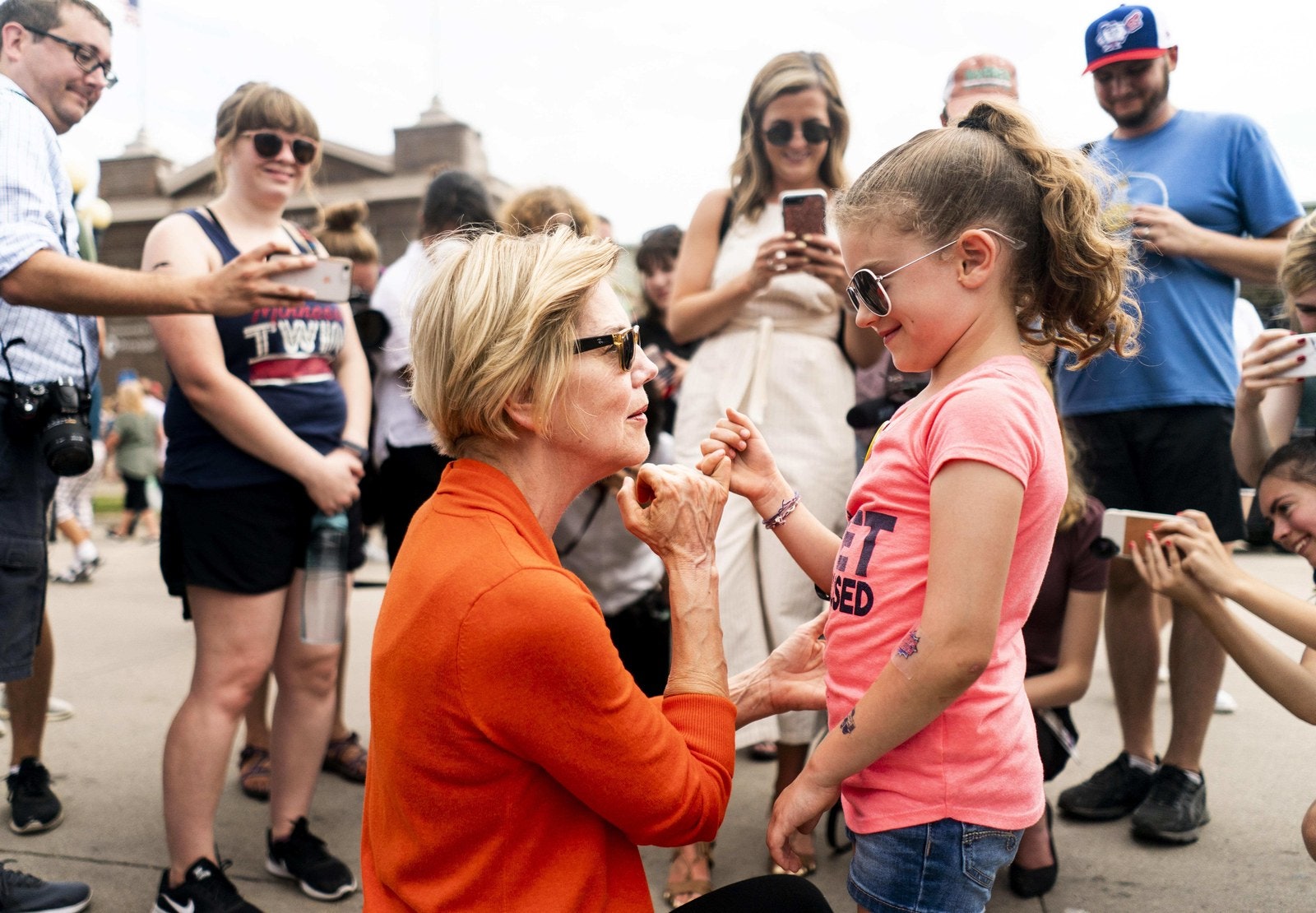
Elizabeth Warren and a supporter do a pinky-promise at the Iowa State Fair in August 2019

Melina Mara/The Washington Post via Getty Images

The language that many Warren fans—or women disappointed that the presidential race will boil down to two men—use often borrows from the lexicon of physical pain—”punch in the gut,” “hurt,” “weeping,” even “trauma.”

After Katzen tweeted that she “sobbed” on the way home from voting for Warren, she says she was flooded with messages from like-minded women, and also from MAGA fans “making fun of me and mocking my appearance and telling me I’m mentally ill and should take [psychiatric] drugs.” (Katzen says she saw “very little evidence” that the harassment was coming from Sanders supporters, despite the “Bernie Bro” reputation.) She was troubled, she says, by the idea that expressing emotion over a candidate—and over sexism—is dismissed as having a mental illness.

Williams, who noted the number of white women who cast their votes for Trump despite dozens of documented sexist comments and sexual assault allegations, reasoned that after 2016, “We really need to spend the next four years discussing sexism and misogyny if the next election’s female candidates have any chance of being taken seriously.” Male allies, she thought, should lead the charge. But four years passed. “That just didn’t happen,” she says.

At 6:30 p.m. in Florida, the night before Warren suspended her campaign, Williams was still in the volunteer office. Acknowledging that Warren would probably soon drop out, she said, she believes this can be “an opportunity, another moment to have a discussion about sexism in America.”

“I don’t have the luxury to stay in doom and gloom,” Williams said. “I have to keep persisting.”

Jenny Singer is a staff writer for Glamour. You can follow her on Twitter.


Source link

Categories
Health

Andrea Mitchell Is Still Waiting for a Woman President


When a woman succeeded, we took notice. It didn’t affect how we did our jobs, but we paid attention to that and we knew it was unique. I now am close to former Secretary of State Madeleine Albright, who was the first woman to hold that position. But even when she was first appointed, it left an impression on me. When she became Secretary of State in 1996, I was covering her swearing in, and I remember so well wanting to get an interview with her. I got to her on the street corner outside her house that morning before she went into the White House to be sworn in, and I got just a few words with her, but it helped the piece I was working on so much.

In the piece I wrote that night, I wrote that one of her commitments was going to be to increase the number of women at the State Department, which had been for generations a male-dominated institution. There was even a rule that a woman could not become an ambassador if her husband was an ambassador elsewhere; she was expected to follow him. It was just startling.

She was well aware of those dynamics, and I wrote about it and about how women in the foreign service were thinking about her appointment. That night, right after Nightly News, there was a reception in her honor. She invited the press, which was unusual, but she made it a point to have us there. And I ran into a very high level official who is still active in government and outside of government. And he said, “Where did you get that information? That’s just totally wrong. There’s no problem of sexism at the State Department. Who could have told you that?” And I just looked at him and thought to myself, “You are in for a really big shock.” And of course I was right, because that was the beginning of affirmative steps to improve gender equality at the State Department.

After Madeleine Albright, of course, there have since been more women at the State Department, and I have learned a lot from all of them. Condoleezza Rice was another remarkable woman and a great musician, which is something that I loved. She’s a wonderful pianist. We talked a lot about music, and she would have these little musical evenings at her apartment, and her friends would perform it. Later, Hillary Clinton held that position, and she came with the experience of having lived in the White House and worked to further women’s rights around the globe. For all the horrible things that happened with the war in Afghanistan, I saw something similar with Laura Bush. She worked with the State Department and the White House to help create the first co-ed institution of higher education—the American University in Kabul.

Just last week, I interviewed Anita McBride, Laura Bush’s former chief of staff, to talk about the new agreement between the Taliban and the Afghan government, which the United States has blessed. The fear is that it will undo the constitutional protections that the United States fought for under the Bush and Obama administrations, and it will put women in Afghanistan back in the Middle Ages, in terms of their rights.

Often, these stories are interconnected—the stories of female leadership and the conditions on the ground for women for women around the world. And I know that because I’ve seen it. I went with then-First Lady Hillary Clinton to Beijing in 1995 when she gave that famous speech and said, “Women’s rights are human rights and human rights are women’s rights.” I reported from Afghanistan under Taliban rule in 1998 and understood what women were dealing with there. In a crisis, women and girls are often the first to suffer. In Darfur, when I went there with Condoleezza Rice to a refugee camp, we met with all of these women who had been terrorized and raped and abused in refugee camps by the militias. You see it in Syria now with our withdrawal, what’s happening to women and children. And of course, we’ve seen it with the women and children on our own southern border, who’ve been separated and left unaccounted for and not reunited. I don’t think women have all the answers, but I do think that women leaders can often respond more affirmatively than men do. One of the few virtues of having been at this for as long as I have been is that I’ve gotten to experience these incredible social movements and transitions, for women in particular.


Source link

Categories
Health

Anything Men Can Do the Women Running for President Can Do Better


It wasn’t a glass ceiling, but something big shattered this week in Miami: every single stupid idea we have about what it means to be “electable,” to look “presidential,” to command a room.

At the first Democratic presidential debates of the 2020 presidential season, the women won. Yes, all of them. On the first night, Senator Elizabeth Warren (D-Mass.) dominated the stage. On the second, Senator Kamala Harris (D-Calif.) electrified the audience, instantly conjuring the image of her up against Donald Trump in the general election. In a debate match-up between them, as one person on Twitter noted, she would mop the floor with him.

And Warren, the New York Times’ Frank Bruni observed, “aced the first democratic debate,” with a presence and affect that “was crisper than most of her peers.”

The second debate threw the same dynamic into even sharper relief. It wasn’t just that Harris ran circles around the competition; it was that she did what a man couldn’t. Earlier in the night, Congressman Eric Swalwell (D-Calif.) tried to launch an attack on supposed front runner former Vice President Joe Biden with a quote from a speech Biden delivered in 1984. “I was six years old when a presidential candidate came to the California Democratic Convention and said, ‘It’s time to pass the torch to a new generation of Americans,’” Swalwell said, referring, of course, to Biden. The quip was meant to show Biden as out of touch and too old for the Oval Office. But the move backfired. Later Senator Bernie Sanders (D-Vt.) complained that Swalwell’s comments were “ageist.” And within a matter of minutes, the internet was flooded with memes of Swalwell…depicted as a torch. Pro Tip: you haven’t won when you’ve become a meme. With Swalwell floundering, Harris picked up the slack. She took Biden on not with forced humor or “cleverness,” but with simple, straightforward candor.

“I do not believe you are a racist,” Harris said, addressing comments Biden made about his work with segregationist senators. “But it was hurtful to hear you talk about the reputations of two United States senators who built their reputations and career on the segregation of race in this country. It was not only that, but you also worked with them to oppose busing, and there was a little girl in California who was part of the second class to integrate her public schools and she was bused to school every day, and that little girl was me.”


Source link