Categories
Health

Women Are Praising Rihanna for Creating a 'Universal Nude' Lip in Chocolate Brown


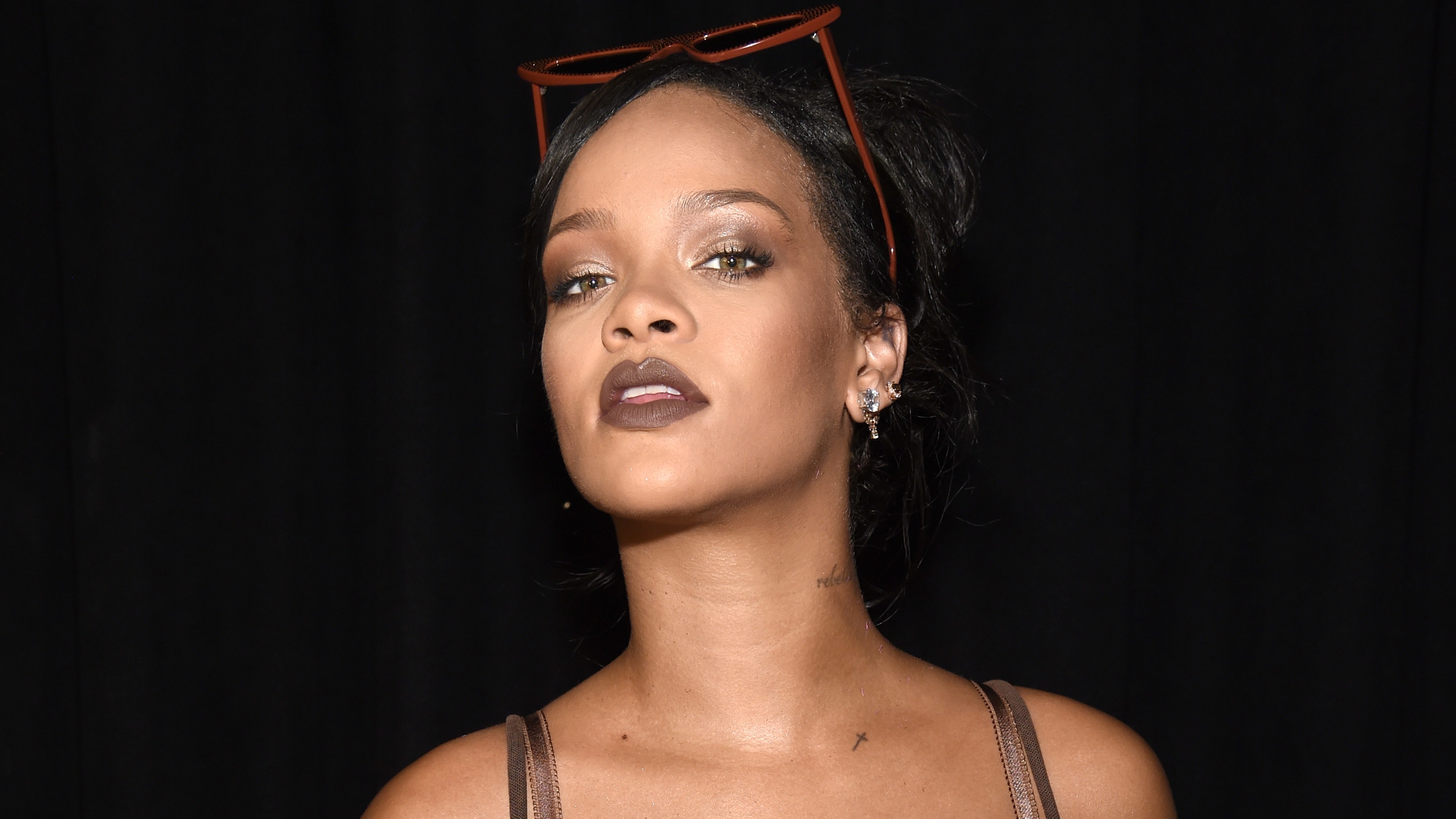
Rihanna and her team have proven time and time again that Fenty Beauty is here to shake up the beauty industry and push for more inclusivity. This time, the brand is taking on the idea of a “universal nude” by offering a new shade of its Stunna Lip Paint in a rich brown chocolate. Rihanna secretly wore the latest Stunna Lip Paint—which is called “Unveil”—at her Savage x Fenty fashion show during New York Fashion Week, and the brand took to social media on Friday to announce the addition: “@badgalriri tested SEVERAL shades before landing on this rich chocolate brown that looks good on EVERYBODY!”

“Get ready for this universal chocolate BO$$ nude, that comes in your favorite lip paint formula and dries in a soft-matte finish,” another Instagram caption reads. “One swipe of this liquid lip is enough to get you a long-lasting lip that’ll catch every eye!”

Soon after, women on Twitter were quick to note what this means for women of color and share their appreciation. “Rihanna dropped a ‘universal nude’ in a shade called ‘chocolate’. We are the Fenty default,” one fan wrote. “Never in my life have I been part of the standard or default. Rihanna really did that,” another praised.

As Glamour pointed out earlier this year, consumers have begun to demand a more inclusive selection of nude makeup. The popular social media hashtag #notmynude called out most “universal” shades for excluding women of color, an issue that Fenty Beauty has addressed since the company’s start. Fenty’s inaugural 40-shade foundation range earned the brand praise—not to mention Time magazine’s award for “Invention of the Year“—and led other brands to follow suit with inclusive shade ranges of their own.

Fans can get their hands on it themselves for $24 at Sephora and Fentybeauty.com.


Source link

Categories
Health

Why Kellie Brown Started the #FatatFashionWeek Hashtag During New York Fashion Week


Although New York Fashion Week has become noticeably more inclusive than it was five years ago, progress has been slow, particularly when it comes to body diversity. According to The Fashion Spot, which releases a report every season that surveys diversity in Fashion Week castings in the four major cities across a range of categories, only about 0.4 percent of the models to appear on the runway or at presentations were plus-sized. That translates to a total of 30 non-straight-sized models appearing in New York and Paris; London and Milan, meanwhile, didn’t have any. Those numbers don’t get more encouraging when it comes to the people going to the shows, either—in recent seasons, critics have been vocal about the ways in which mainstream street-style photography seemingly captures only one type of person (and body type) in their imagery, despite the fact that the crowds at Fashion Week can be pretty diverse.

This season, though, one blogger is shepherding in change using the hashtag #FatatFashionWeek.

Kellie Brown of And I Get Dressed came up with the hashtag while at a New York Fashion Week event hosted by 11 Honoré, the plus-sized luxury retailer—”an event filled with boss bigger women: influencers, super models, fashion directors of major publications,” she tells Glamour. “And while writing my caption, I thought to myself, How can they (the industry) pretend no stylish fat women exist?“

“I created the tag as a way to kind of show receipts that there are many bigger women working in the industry, influencing the industry and consumers alike, and looking great while doing it,” Brown adds, noting that this whole realization and conceptualization took about 30 seconds.

She’s tagged her New York Fashion Week-related posts on Instagram with #FatatFashionWeek, and has incorporated it into her Youtube coverage of the week.

[embedded content]

Other bloggers, influencers, and plus-sized Fashion Week attendees have joined in, too, including Alex Michael May, Alex Larosa, Kelly Augustine, and more. (At press time, the hashtag has over 130 posts published to it.) “I’ve seen editors using it, which is one of the biggest compliments,” Brown says.”A few people came up to me [at New York Fashion Week] to tell me they loved the hashtag and were excited to use it.”

“I started attending [New York Fashion Week] over 12 years ago as a publicist, and then I always felt like the ONLY one,” Brown explains. “I know I wasn’t, but without the luxury of social media then, we weren’t connected. I love seeing so many larger models on runways [and] diversity at shows, but there’s still much to be done.”

Brown believes that hashtags like #FatatFashionWeek are helpful because they remind everyone (in the industry or otherwise) that these people are present, as well as inspire those who are following the events from afar but don’t feel like they’re presented in the images coming out of it. “There are up-and-coming bigger people who want to work in the industry and can follow the hashtag and see that they belong here, too,” she says.

It may have started a spur-of-the-moment post, but Brown is already thinking bigger picture: “The goal is now to grow it—I’d love to see models, makeup artists, people who work backstage [and] in PR, inclusive designers using it… Hopefully more to come next Fashion Week!”

Related Stories:

Here’s What Happened When Three Plus-Size Fashion Brands Went to NYFW

How the Size Inclusivity Conversation Has Changed Denim

In 2017, Size Diversity Became a Phrase That Mattered


Source link

Categories
Health

The Brown Girl's Guide to Laser Hair Removal


Like chalky sunscreen and limited foundation shades, hair removal lasers didn’t use to work well for women with medium to dark skin. But thanks to the growing awareness around inclusivity, along with advances in technology, those of us who were told for years that laser hair removal was a no-go due to our skin tone are now finally able to get the treatment.

First, the lowdown on lasers: They beam intense light at the follicle, causing permanent damage so hair no longer grows. But because they work by targeting the pigment in the hair—it’s the contrast between darkness in the hair and lighter skin that helps the laser focus on its bullseye—the ideal candidate has traditionally been someone with fair skin and dark hair.

For women of color, laser hair removal has been a gamble: devices weren’t sophisticated enough to completely distinguish between the pigment in the skin and the hair, meaning that they could potentially cause dark and light spots, blisters, and even scarring, in the skin surrounding the follicle, says Robyn Gmyrek, MD, dermatologist at Union Square Laser Dermatology. But now, there are smarter lasers that can be used in a much more precise—and safe—way, making getting rid of unwanted fuzz a reality for a wider range of skin tones. Here’s how to get it right.

Which Lasers to Look For

The first and most important thing you need to know is how Nd:YAG and diode lasers work for darker skin. In recent years, the Nd:YAG (or just “YAG”) has become increasingly popular, as it’s as foolproof as it gets. “The wavelength of this laser goes deeper into the skin than a diode,” says Gmyrek. “So it more successfully bypasses the pigmentation present in the skin.” Because the YAG basically bypasses the melanin in your skin, it’s the safest option for dark skin. It’s one of two lasers Shobha Tummala, founder and CEO of Shobha hair removal, offers in her salons. (She’ll also use it for fair-skinned clients who’ve recently gotten a tan.)

But the diode has its perks, even though it might be more complicated for anyone above a 4 on the Fitzpatrick scale (the standard measure of skin type used by dermatologists, with 1 being the lightest and most sun-sensitive and 6 being the darkest). “In darker-skinned patients, the diode laser energy has to be delivered in a slower manner per pulse, leaving more time for skin to cool,” explains Gmyrek. “It also has an instant cooling device that protects pigment from overheating and being damaged.” The Lumenis LightSheer laser, one of the most popular diode lasers out there, even has a suction mechanism to distract your attention from the pain. “I would overall say that it’s the least painful,” says Estee Williams, MD, a dermatologist in New York City.

You’ll want to minimize the chances that you’ll develop the most common laser-related side effects for dark skin: hyperpigmentation, or dark spots, and hypopigmentation, in which the skin pigment lightens. According to Williams, hypopigmentation can be harder to treat (although Gmyrek notes that it can sometimes resolve on its own), so ask your laser removal expert to do a test patch if you think you might be prone to it—just to be on the safe side.

What You’ll Spend

Expect to need at least six sessions. Although darker skin can sometimes require more treatments than fair, “everyone’s different,” says Tummala. The downside is that the cost can add up quickly, as many providers charge by the session. According to the American Society of Plastic Surgeons’s 2017 stats, the average cost per session was $293—but it varies wildly depending on what part of the body you’re targeting. (Generally: The larger the area, the higher the price.)

At many practices, there’s no difference in cost between the YAG and diode. Some research shows that the diode might be slightly more effective at actually removing dark hair on dark skin—it could also be worthwhile if you’re closer to 3 on the Fitzpatrick scale and have a low pain tolerance. But Gmyrek believes that the Nd:YAG is the safest bet overall.

How to Prep Properly

Now is not—we repeat, not—the time to get a coupon through a discount site. The provider (and their expertise) matters. “I was willing to pay a premium and see a professional with great reviews,” says Marlene, 28, who had laser hair removal on her underarms. A pro who has extensive experience with women of color is essential.

Not only should you expect the same type of screening and forms as you would from any medical professional, it should also include your ethnicity, as different ethnicities—regardless of skin tone—react differently to lasers. Your skin may appear to be a 3 or 4 on the Fitzpatrick scale but if you’re, say, Latin or Asian, it could react to the laser as a 6 would.

Once you’re scheduled, coddle your skin. Stop using skincare products with harsh ingredients, including glycolic and salicylic acids, benzoyl peroxide, and any retinoids (including tretinoin and adapalene), at least five days before your treatment. “These can all make your skin more sensitive to the laser energy,” says Gmyrek.

Go full vampire and keep out of the sun—or, at the very least, use proper protection. (That’s broad spectrum SPF 30 or more; tinted moisturizer or foundation with SPF doesn’t count.) A tan equals more pigment, which can spur a different (and potentially dangerous) reaction to the laser. “If you’re even slightly tanned, inform the laser provider so that the treatment energy can be lowered or the treatment, rescheduled,” says Gmyrek.

What to Do Post-Treatment

Side effects can still happen—but you’ve got options. “For irritation or redness, hydrocortisone can help to resolve the inflammation,” says Gmyrek. “For an acne-like eruption, or folliculitis, use topical antibiotics.” For any hyperpigmentation, try a topical cream for dark spots, which your derm can prescribe.“It’ll help normalize the skin color,” explains Gmyrek.

But the low-stubble life is worth the risks. For women who once felt the need to shave daily, they say the minimal upkeep has been well worth it. “My overall experience was great,” says Marlene. The best part? She didn’t experience burns or pigmentation problems, proving just how far lasers have come.

Related Stories:
–What Is a Brazilian Wax Like? Here’s What to Expect—in Excruciating Detail
–7 Mistakes You’re Making When You’re Shaving Down There
–Is Anyone Actually Shaving This Summer? An Investigation


Source link
Categories
Health

Call Me Crazy, But I Can't Stop Wearing Brown Blush


What if I told you there was a way to make your face look alive, but in a secret way—a way that most people’s eyes just skate right over? You look flushed and healthy, in a Brooke Shields, tawny, sexy-outdoorsy-slightly rough around the edges kind of way. The kind of color that says, “Oh, am I hiking or modeling a picture of health? Is this a photoshoot, or the Pacific Crest Trail?” Other words and phrases I associate with the look are: quarter-zip fleece sweaters, the Sierra Club, sepia, trail mix, and the entire vibe of the 1998 movie Stepmom, featuring Susan Sarandon and a young Julia Roberts. Hello, my name is Rachel. And I’m obsessed with brown blush.

Not to be one of those people, but pink blush is out (for me). Instead, I’m leaning hard into the look that Sarah Lucero, Stila’s global executive director of creative artistry, created for Tibi last fashion week. Ninety-nine percent of fashion week trends fall into camp unwearable, but the look at Tibi was different. Lucero had done models’ eyes in a mix of colorful shades, so to keep it grounded, and she tapped on Stila’s cream blush in the ruddy, tan-meets-peach shade Camellia. It was perfect. Less precious than pink, and because it’s so close to flesh-toned, it’s almost undetectable unless you load it on.

Real beauty goes beyond the surface—and so do we. Sign up for our newsletter to get honest reviews, personal essays, and more every day.

After wearing brown blush almost exclusively for the past two months, I’ve pinned down the magic that it weaves. It falls completely outside of traditional cheek knowledge, which says that blush on the apples of your cheeks brightens your face, bronzer gives you a glow, and highlighter and contour define your cheekbones. But brown blush? It covers everything with a simple one-and-done, and because it’s not what you’re expecting to see, it reads incredibly natural. I lightly tap it from my apples up to my cheekbones, and stop just under the outside of my eyes. To borrow a phrase from makeup artists everywhere, it brings some color to your face. Your eye follows that line, which emphasizes your cheekbones without the shadow manipulation of contouring.

In terms of product reccs, I’ve stuck with creams like the Stila. Too Faced Pinch My Peach is a good one, along with Onomie’s Boosting Lip + Cheek Stick in Nightingale. The texture does actually make a difference. The Stila and Onomie have formulas on the moister side, which covers your highlighter base with a healthy-looking glisten. The dryer feel of the Too Faced makes it best for beginners, since it’s way harder to overdo. And even if you do, so what? Brown blush is an adventure, in the woods or not.

Related Stories:
–This Magic Oil Saved My Hair After Years of Relaxers
–I Asked Jade Roller Obsessives to Convince Me If I Need One
–‘Kush’ Mascara Is a Thing Now, and I Tried It


Source link

Categories
Health

Millie Bobby Brown Wore Converse to the 2018 SAG Awards Red Carpet


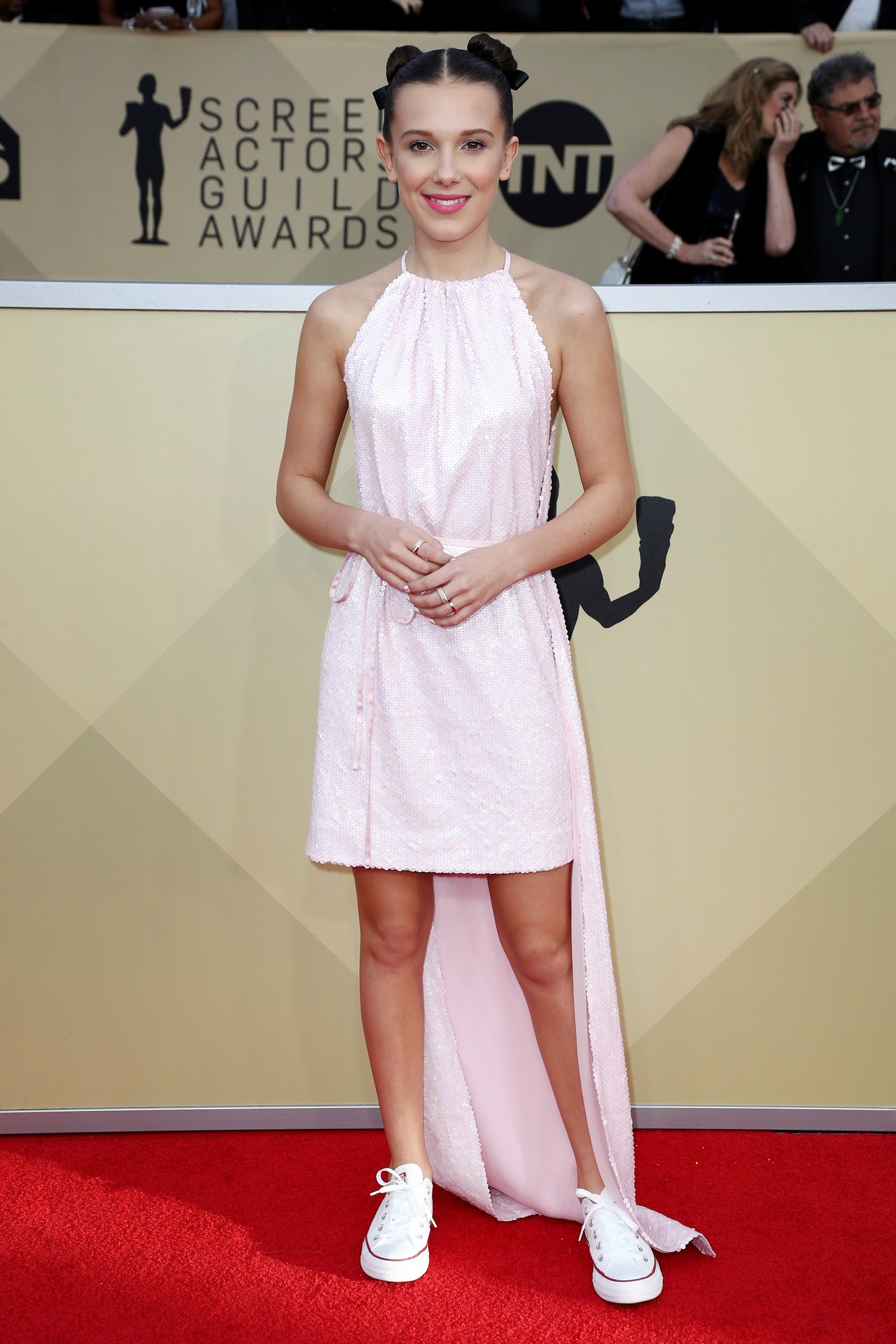
At just 13 years old, Millie Bobby Brown has already built quite the record as a fashion force. The Stranger Things star always hits the mark (and the best-dressed list) on the red carpet with some seriously impressive looks. The 2018 SAG Awards, of course, were no exception—in fact, she may have unlocked a new level with her style, seeing as she rolled up to the ceremony rocking classic Chuck Taylors. We think Eleven would approve.

Brown arrived at the SAG Awards red carpet wearing a ballerina-pink sequined dress from Calvin Klein by Appointment. The designer choice is no surprise—she’s one of Raf Simon’s main muses nowadays)—but the footwear she paired with it was quite unorthodox. The dual nominee (she’s up for Outstanding Performance by a Female Actor and Best Ensemble in a Drama Series) wore the elegant gown with low-top, white Converse Chuck Taylor All-Stars.

PHOTO: Frederick M. Brown/Getty Images

“Gotta keep it stylish,” Brown told E!’s Giuliana Rancic when questioned about her shoe choice. Had she been walking the red carpet in character, it would’ve been “bitchin’,” as Eleven would say.

Though the high-low visual is striking (and incredibly cool) on the red carpet, it’s not a totally unexpected styling move coming from Brown. She frequently wears Chuck Taylors on Instagram, and starred in a campaign for Converse last fall.

Plus, her on-screen counterpart has been a fan of the classic sneaker since the first season of Stranger Things. Who can forget the white Converse El wore with the now-iconic pink dress, or how she continued to rock them even through her punk makeover in season two? If the sneaker can weather fighting Demogorgons and trips to the Upside Down, we are pretty sure it can handle a red carpet with ease.

Related: Millie Bobby Brown Has a Whole New Look—on Stranger Things and IRL


Source link

Categories
Health

Twitter Thinks Millie Bobby Brown Is Young Natalie Portman's Doppelgänger


Millie Bobby Brown is known for her unique look, from the preteen pixie cut she sported after shaving her head for her breakout role in Stranger Things to her designer fashion sense. But recently, as Mashable pointed out, Twitter has discovered Millie actually is fairly similar to another celebrity: a young Natalie Portman. Talk about strange things.

It’s hard to unsee the resemblance once you’ve checked out some of the side-by-sides of Millie and a Star Wars: Episode I – The Phantom Menace–era Natalie. But strangely enough, this isn’t the first time the former Queen Amidala has had a celebrity doppelgänger. While on set for the Star Wars prequels, Keira Knightley worked as her double.

The Millie-Natalie connection is so close, though, we’re busy figuring out exactly who Natalie would play in Stranger Things 3. (Eleven’s secret half-sister? A second aunt who’s more open to the idea that she can chat with her mother through lamps?). The resemblance between Millie and Natalie is downright uncanny. As one person succinctly put it, “I NEED ANSWERS.”

Related: Millie Bobby Brown’s Take on Shaving Her Head for ‘Stranger Things’ Is Incredibly Empowering


Source link