Categories
Health

9 Best Home Waxing Kits of 2020 for Easy Hair Removal: Waxing Strips, Hard Wax, and More


If your fitness, social, or grooming routine has fallen by the wayside amid the COVID-19 pandemic, you’re not alone. Self-care products that replace your standing salon appointments—like the best home waxing kits—can help you build a new personal care regimen and regain some sense of normalcy.

Unless you’re quarantined with an esthetician or a hairstylist, you’re probably wondering when your next bang trim or bikini wax will be—and while you may not be quite so adventurous as to pick up the shears yourself, you can keep unwanted body hair at bay with a quality at-home waxing kit. Plus, DIY-ing a wax can save you a lot of money over time, so whether you’re trying to nix hairs from your upper lip or are looking to take it all the way off, there’s pre-cut strips, wax pots, and wax warmers out there for your next self-care session.

Finding reliable personal grooming products can get a bit, um, hairy, so we scoured the web for the best home waxing kits reviewers are obsessed with. Because if there’s one thing you may not want to be the first to test out, it’s hot body wax. Here are 9 top-rated wax kits to shop now.

All products featured on Glamour are independently selected by our editors. However, when you buy something through our retail links, we may earn an affiliate commission.


Source link

Categories
Health

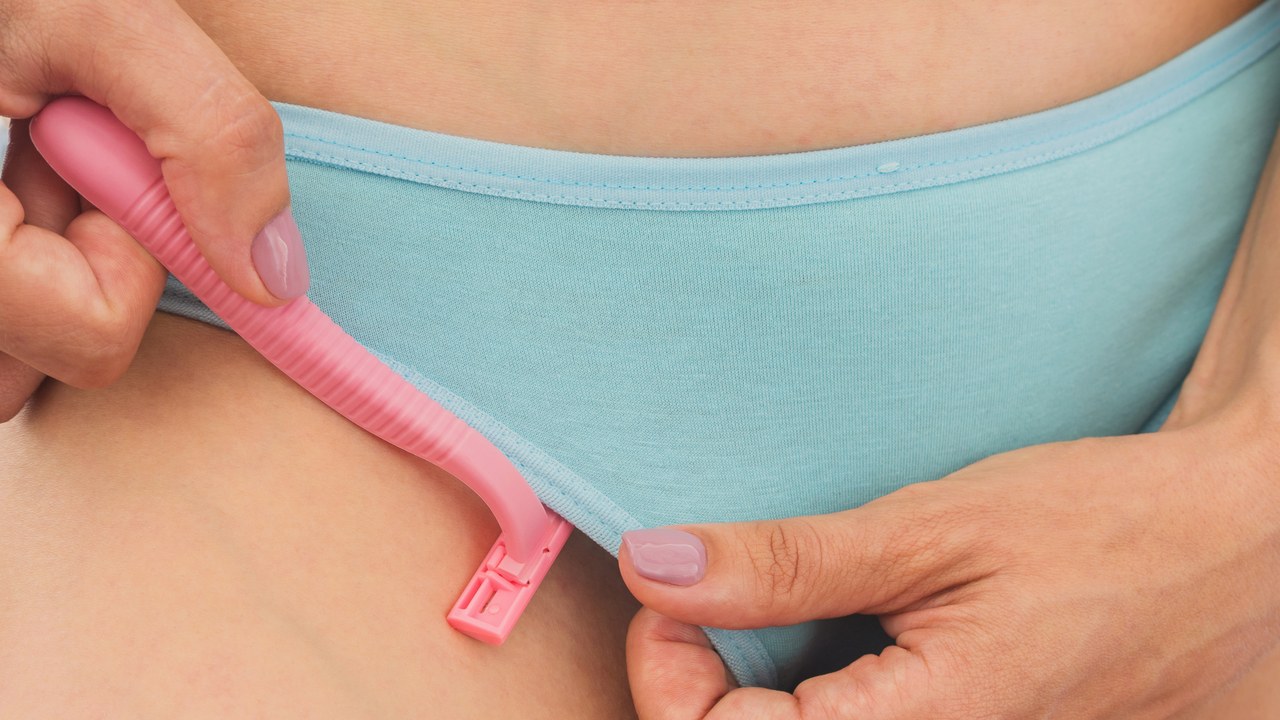
Body Hair Removal: Every Option and Which Works Best for You


Body hair removal is as much of a personal choice as any other beauty treatment. We can’t deny that for many, there’s been a lengthy history of societal pressure to remove it—but as the conversation around how we present ourselves progresses, it’s a good time to remind yourself that the decision is ultimately your own. If you want to leave it alone, then feel free to let it grow. Alternately, if you’d like to remove your body hair, there’s a long list of options currently available.

So, if you’re curious to explore them, we’re bringing you all the relevant information. We spoke to dermatologists, trichologists, and beauty experts to demystify how each process works and the pros and cons of each. Below, our detailed guide to six different types of body hair removal you can choose from.

How It Works: Even if you haven’t tried this one before, you’re likely familiar with the process. Hot wax is applied to your skin, grabs on to the roots of your hair, cools down and then gets pulled off. In order for it to be done effectively, you need to have at least a few millimeters of hair growth above your skin so the wax can properly attach. Your aesthetician may also trim your hair before waxing; when your hair is too long, it can cause extra pain as it comes off (speaking from personal experience).

“This actually removes the organ responsible for hair growth, the follicle or root, out from underneath the skin,” says Dominic Burg, M.D., chief scientist for Evolis Professional. “It not only removes your hair, but also damages the cells and apparatus needed to grow a new hair in its place, so new hairs come in finer and less substantial, more so with repeated waxing.”

Pros and Cons: Waxing can be done on any hair type and is relatively affordable depending on whether you do it at home or which salon you go to. At home, most kits will run you $5 to $30, while salons typically charge $30 to $90 (Brazilians are more expensive than basic bikini waxes since they’re more involved).

Dr. Burg also notes that it’s quick, reduces growth over regular sessions and can remove large areas of hair. On the flipside, “it can cause inflammation and irritation to your skin,” says dermatologist Joshua Zeichner, M.D.. Those with sensitive skin types should try a patch test first and it might be a good idea to apply gentle, anti-inflammatory creams to the treated areas afterward. Want more advice from pro waxers? Click here.

How It Works: Here’s a quick hair biology lesson: All of your hair goes through cycles of growth (anagen), regression, rest (telogen), and fall. “The hair on your body has a short growth phase and a medium-long resting phase,” explains Dr. Burg. “Each type of hair has its own cycle and you can surmise what this is by looking at the length, thickness and growth rate. Leg hair has a medium growth phase and a long resting phase of around six months, whereas pubic hair has a resting phase of three months.”

Laser hair removal works best during the active growth phase, which means you will need several sessions to see semipermanent or permanent results. An intense beam of light bypasses the surface of your skin and gets absorbed by hair follicles, destroying their ability to generate new hair over time.

Pros and Cons: You’re unlikely to experience ingrown hairs with this method and while sessions can be expensive, results will also last much longer than methods like waxing or shaving. Chris Karavolas, owner of New York’s Romeo and Juliette Laser Hair Removal, estimates that clients need six sessions on average, “spaced six to eight weeks apart are needed in order to achieve permanent hair reduction.” The sessions themselves are short; underarms and bikini can be treated in five to 10 minutes, while a larger area like your full leg may take 20 to 30 minutes. While pricing will vary by geographic location, Karavolas estimates a full package (for permanent reduction) costs around $3,500 for legs, $1,000 for underarms, and $1,000 for your bikini line.


Source link

Categories
Health

10 Things No One Tells You About Tattoo Removal


Are you the not-so-proud owner of some regrettable ink? Well, welcome to the club. I have four (five, if you count the one on my back as two) tattoos from my late teens and early twenties that I could probably definitely do without. So, this year I set out to do just that: get them removed.

If you’ve heard anything about laser tattoo removal, it’s probably that it’s insanely painful. I mean, if I had a nickel for every time I’ve heard, “Doesn’t that hurt even more than actually getting the tattoos?” I’d be rich. (OK, I would have enough money to buy a medium iced coffee at Pret.) But while there’s plenty of info on what to consider before getting a tattoo (and pages on pages of enticing inspo), there still isn’t a whole lot of discussion surrounding the dark side of ink jobs: What happens if you grow to no longer love that little shooting star or random Latin phrase (ahem, see below)? I’m only about halfway through the process, but I’ve picked up plenty of tips along the way. So to do you all a solid, I put together a list of everything I’ve learned.

Here’s what you need to know about tattoo removal.

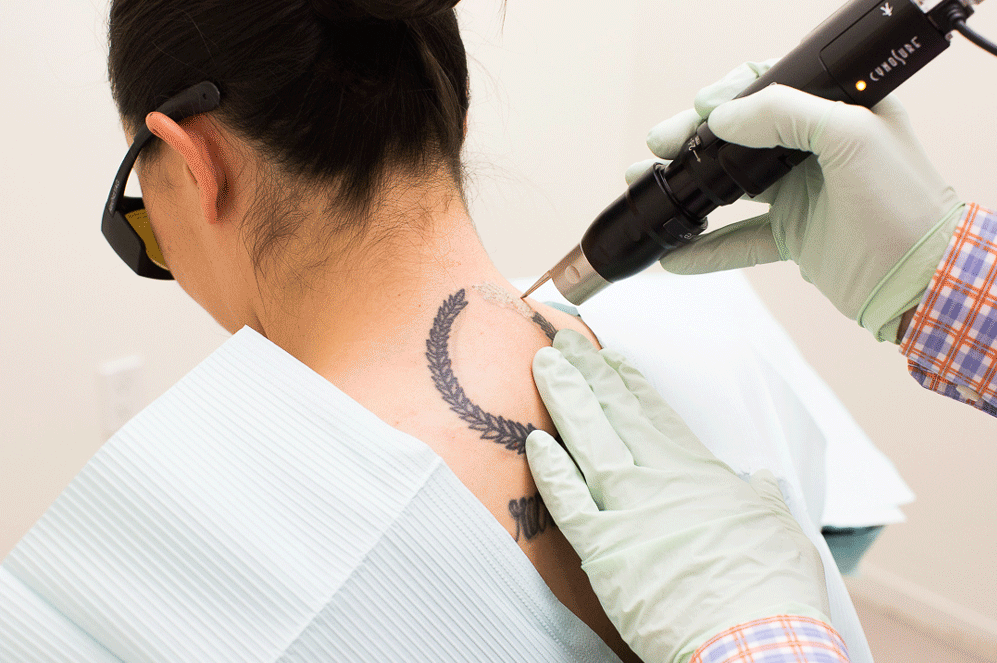
Hi, that’s me. Just getting my tatts lasered off.

1. Consider a doctor.
I’d previously had one tattoo zapped at a spa (I was living in small-town Canada where there weren’t plastic surgery offices or dermatologists), where an aesthetician used an outdated heat laser that ended up burning and scarring my skin. This time around, I’m having treatments done by Dr. John F. Adams at the New York Dermatology Group, where everything is done under medical supervision. I suggest you find your own doctor by asking friends, editors (shameless plug), and even by stopping people that you see with removal in process—which, yes, I have done.

2. It will take months—if not a year or more.
Tattoos don’t just disappear after a once-over with the laser. (I wish!) I’ve had six sessions, and I’d wager that I need about five more, despite the fact that my initial estimate was six to eight sessions. It takes a long time to complete because each time the tattoo is lasered, particles are broken down and digested by the body’s immune system. The regeneration period is up to eight weeks, and the next time you go, the laser breaks down new particles of pigment. And so on and so forth.

3. It’s expensive.
If you have your procedures done by a doctor, the bill for each visit can run you hundreds of dollars. Brace yourself: The American Society for Aesthetic Plastic Surgery (ASAPS) estimates the average cost per session at $463. But see point number one for why it’s worth it.

4. All ink can be taken out.
Contrary to the old belief that light, colored ink was hard to remove, Dr. Adams assured me that all hues will now disappear. (FYI: The previous explanation was that, similar to laser hair removal, the laser would solely be attracted toward dark colors, like black.) With PicoSure technology, he says you can even get out yellows and greens, which were previously the most stubborn.

5. Get ready for needles.
Mentally prepare for visits to consist of more than just a quick and easy laser moment. Mine have been taking about 45 minutes because we take before photos, clean the areas, inject them with lidocaine for freezing, laser them, ice them, and then bandage them. Oh, and sometimes a weird thing happens where I taste metal when the laser hits my skin. Dr. Adams says it’s a sensation that some people experience when the lidocaine is hit by the laser and that it’s totally normal…but also, I might be superhuman.

6. There’s pain afterward.
And it doesn’t stop when you leave the office. I would advise that you budget for discomfort for about a week. For me, the sites blister and need to be covered in a salve and bandaged for a few days; then, they start to de-puff, scab, peel, and regenerate. There is good news though: The more treatments you have, the less aftercare there is. (Since there’s less ink reacting to the laser.)

7. You’ll need things like Aquaphor, bandages, and even clothes that don’t rest on the tattoo.
Yes, I actually bought shirts that didn’t have material where my neck/back tattoo is. At first, I was cutting tags out, but when tagless cotton tees still made the spot hurt and itch, I figured keyhole backs were a good investment. If you have tattoos on your ribs or feet (and like to wear bras and shoes) it might be best to plan your sessions accordingly.

It also helps to apply a thin coating of antibiotic ointment or healing moisturizer three times a day, like from Aquaphor, Lubriderm, or Kiehl’s, for the first three days while the area is healing.

8. You could just lighten ink enough to go over it.
If you don’t want to take your tattoos all the way off, you can simply lighten them enough to get some good cover-ups done. I have a friend who had a bird piece lightened enough to have a tattoo artist ink a light bulb over the top. I thought it was smart because it meant her new tattoo didn’t have to be heavy-handed (which I’m sure you think is very 2000).

9. Or take it all off, but there might be white patches or scars.
If, like me, you want your ink completely removed, you should know that the skin that is left might not be flawless. I’m hoping that reading this post will prevent you from having a tattoo removal turn into scarring à la numero uno. And while the risks are nowhere near as big when you are treated by a medical professional, your skin pigment can be lightened.

10. But there’s another laser that can fix that.
We are living in the future.

Related Stories:
What I Wish I Knew Before I Spent $500 Trying to Fix My Brassy Highlights
40 Tiny Tattoo Ideas Even the Most Needle-Shy Can’t Resist
38 Celebrity Tiny Tattoos So Cute, You’ll Have No Shame About Copying Them

This story was originally published on July 26, 2017


Source link

Categories
Health

The Brown Girl's Guide to Laser Hair Removal


Like chalky sunscreen and limited foundation shades, hair removal lasers didn’t use to work well for women with medium to dark skin. But thanks to the growing awareness around inclusivity, along with advances in technology, those of us who were told for years that laser hair removal was a no-go due to our skin tone are now finally able to get the treatment.

First, the lowdown on lasers: They beam intense light at the follicle, causing permanent damage so hair no longer grows. But because they work by targeting the pigment in the hair—it’s the contrast between darkness in the hair and lighter skin that helps the laser focus on its bullseye—the ideal candidate has traditionally been someone with fair skin and dark hair.

For women of color, laser hair removal has been a gamble: devices weren’t sophisticated enough to completely distinguish between the pigment in the skin and the hair, meaning that they could potentially cause dark and light spots, blisters, and even scarring, in the skin surrounding the follicle, says Robyn Gmyrek, MD, dermatologist at Union Square Laser Dermatology. But now, there are smarter lasers that can be used in a much more precise—and safe—way, making getting rid of unwanted fuzz a reality for a wider range of skin tones. Here’s how to get it right.

Which Lasers to Look For

The first and most important thing you need to know is how Nd:YAG and diode lasers work for darker skin. In recent years, the Nd:YAG (or just “YAG”) has become increasingly popular, as it’s as foolproof as it gets. “The wavelength of this laser goes deeper into the skin than a diode,” says Gmyrek. “So it more successfully bypasses the pigmentation present in the skin.” Because the YAG basically bypasses the melanin in your skin, it’s the safest option for dark skin. It’s one of two lasers Shobha Tummala, founder and CEO of Shobha hair removal, offers in her salons. (She’ll also use it for fair-skinned clients who’ve recently gotten a tan.)

But the diode has its perks, even though it might be more complicated for anyone above a 4 on the Fitzpatrick scale (the standard measure of skin type used by dermatologists, with 1 being the lightest and most sun-sensitive and 6 being the darkest). “In darker-skinned patients, the diode laser energy has to be delivered in a slower manner per pulse, leaving more time for skin to cool,” explains Gmyrek. “It also has an instant cooling device that protects pigment from overheating and being damaged.” The Lumenis LightSheer laser, one of the most popular diode lasers out there, even has a suction mechanism to distract your attention from the pain. “I would overall say that it’s the least painful,” says Estee Williams, MD, a dermatologist in New York City.

You’ll want to minimize the chances that you’ll develop the most common laser-related side effects for dark skin: hyperpigmentation, or dark spots, and hypopigmentation, in which the skin pigment lightens. According to Williams, hypopigmentation can be harder to treat (although Gmyrek notes that it can sometimes resolve on its own), so ask your laser removal expert to do a test patch if you think you might be prone to it—just to be on the safe side.

What You’ll Spend

Expect to need at least six sessions. Although darker skin can sometimes require more treatments than fair, “everyone’s different,” says Tummala. The downside is that the cost can add up quickly, as many providers charge by the session. According to the American Society of Plastic Surgeons’s 2017 stats, the average cost per session was $293—but it varies wildly depending on what part of the body you’re targeting. (Generally: The larger the area, the higher the price.)

At many practices, there’s no difference in cost between the YAG and diode. Some research shows that the diode might be slightly more effective at actually removing dark hair on dark skin—it could also be worthwhile if you’re closer to 3 on the Fitzpatrick scale and have a low pain tolerance. But Gmyrek believes that the Nd:YAG is the safest bet overall.

How to Prep Properly

Now is not—we repeat, not—the time to get a coupon through a discount site. The provider (and their expertise) matters. “I was willing to pay a premium and see a professional with great reviews,” says Marlene, 28, who had laser hair removal on her underarms. A pro who has extensive experience with women of color is essential.

Not only should you expect the same type of screening and forms as you would from any medical professional, it should also include your ethnicity, as different ethnicities—regardless of skin tone—react differently to lasers. Your skin may appear to be a 3 or 4 on the Fitzpatrick scale but if you’re, say, Latin or Asian, it could react to the laser as a 6 would.

Once you’re scheduled, coddle your skin. Stop using skincare products with harsh ingredients, including glycolic and salicylic acids, benzoyl peroxide, and any retinoids (including tretinoin and adapalene), at least five days before your treatment. “These can all make your skin more sensitive to the laser energy,” says Gmyrek.

Go full vampire and keep out of the sun—or, at the very least, use proper protection. (That’s broad spectrum SPF 30 or more; tinted moisturizer or foundation with SPF doesn’t count.) A tan equals more pigment, which can spur a different (and potentially dangerous) reaction to the laser. “If you’re even slightly tanned, inform the laser provider so that the treatment energy can be lowered or the treatment, rescheduled,” says Gmyrek.

What to Do Post-Treatment

Side effects can still happen—but you’ve got options. “For irritation or redness, hydrocortisone can help to resolve the inflammation,” says Gmyrek. “For an acne-like eruption, or folliculitis, use topical antibiotics.” For any hyperpigmentation, try a topical cream for dark spots, which your derm can prescribe.“It’ll help normalize the skin color,” explains Gmyrek.

But the low-stubble life is worth the risks. For women who once felt the need to shave daily, they say the minimal upkeep has been well worth it. “My overall experience was great,” says Marlene. The best part? She didn’t experience burns or pigmentation problems, proving just how far lasers have come.

Related Stories:
What Is a Brazilian Wax Like? Here’s What to Expect—in Excruciating Detail
7 Mistakes You’re Making When You’re Shaving Down There
Is Anyone Actually Shaving This Summer? An Investigation


Source link

Categories
Health

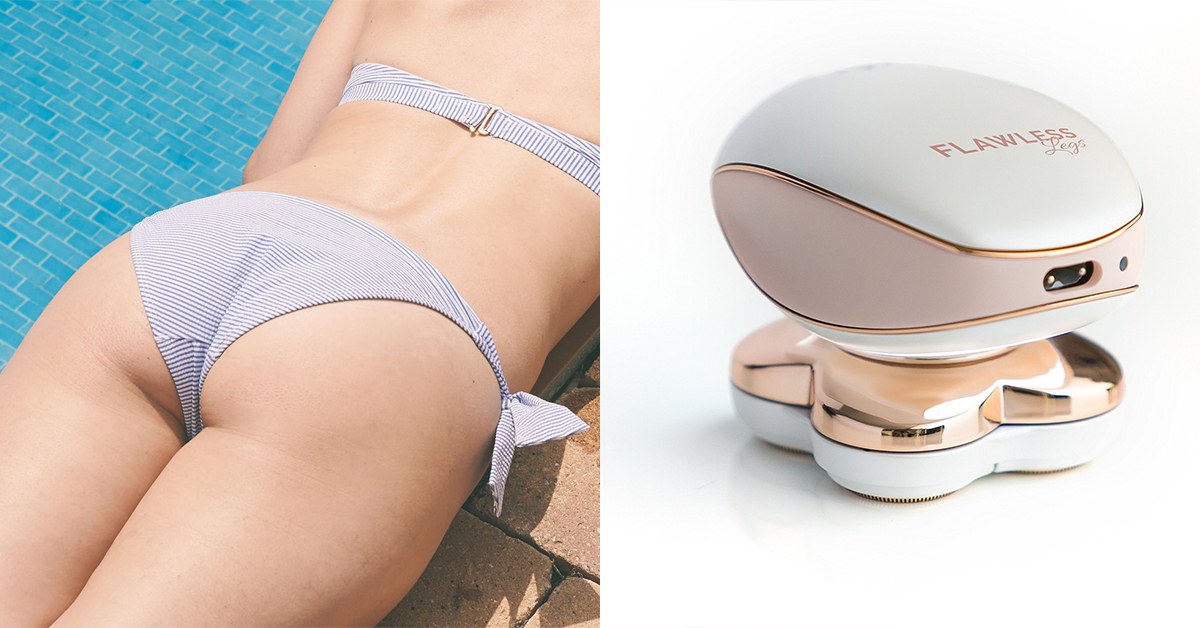
The Best Pain-Free Hair Removal Devices


While body hair isn’t the taboo it once was (see: Rihanna giving the middle finger to shaving this summer), sometimes you just don’t want to deal with stubble. But if you’re committed to keeping your legs smooth and silky, the options aren’t really all that appealing. Waxing is painful as hell, laser hair removal is pricey and a hassle, and depilatory creams are messy in every sense of the word. And then there’s shaving. It’s reliable and easy enough, but it can also just be…you know…annoying. The hair removal industry had to do better, and do better it finally has.

We recruited Glamour staffers to try all the new and proven body hair removal devices on the market, and out of the many options, we surfaced with six all-star options that didn’t disappoint. Across the board, they hover around $100 or less. But given that a year’s worth of cheap razors and shaving cream runs $140 by most estimates, and that these options last forever, they just might sell you on the investment. Ahead, our editors’ unfiltered reviews.


Source link