When I was in kindergarten—and very much in the closet as transgender—I had begun to crave a ponytail like I saw on many of the girls in my class. I’m well aware that for many girls and women, the ponytail is a “bare-minimum” style, often for lazy days, but the girls I saw in my class emulated the women I saw on television who were strong, confident, and successful. I thought they were cool, and I understood immediately I could never have one.
Even at six, I knew better. I was raised in deeply conservative Texas, in a world with firmly cemented gender roles. I was a boy and I had better keep to “boy things.” The bouncy ponytail of my dreams? Not a boy thing.
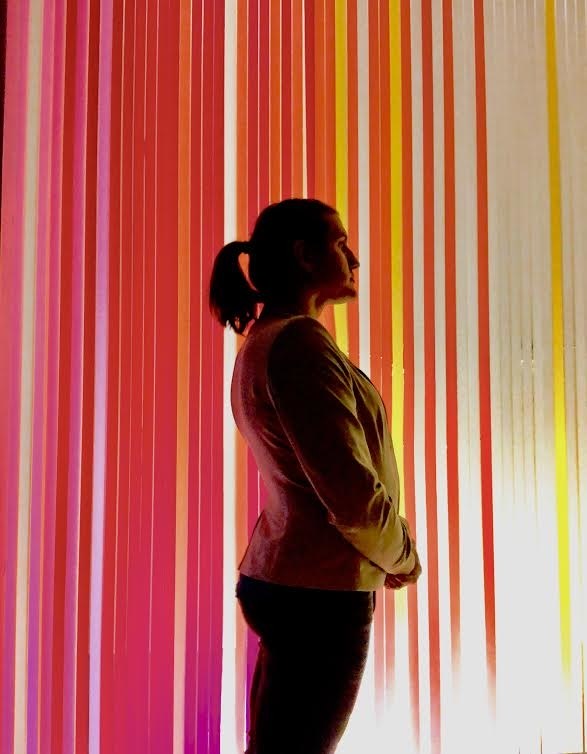
In 1999, when I was 12, the U.S. Women’s National Team won their second World Cup, and Mia Hamm became a personal icon. For weeks, I dreamed of what it would be like to have the freedom to sport a ponytail like Hamm. By then, I was fully aware of a desire within me to be a girl, but I kept it buried in the back of my brain, suppressed whenever possible. Still, it sometimes crept up, summoned by the most mundane signifiers of female-ness. Mia Hamm was confident and beautiful and successful, and although I had no sense of what “womanhood” meant to me, I couldn’t help but feel like her hair represented all the things I was missing. I wanted an authentic life. I wanted to feel confident. I wanted a ponytail.
The author
Courtesy Charlotte Clymer
I got through high school by pushing these thoughts down deep and leaning into whatever “male” things I could stomach. I played football. I engaged in some sort of half-hearted male performance when I interacted with relatives, including one who told me to “stop listening to faggot music” and was deeply upset after I purchased a scented lotion from Bath & Body Works. I joined the military—and even went into the infantry, which at the time coincidentally excluded women.
I did the things I was told a “male person” should do, believing I’d eventually be cleansed of this painful longing. Instead, the facade exacerbated my depression and anxiety. I went to therapy for years had numerous uncomfortable conversations, and came out as a trans woman in late 2017. It is the best choice I’ve ever made. It saved me.
But it took my hair took a lot longer to catch up with the new me. I’d grown accustomed to army-issue crewcuts, which grow out fast. It didn’t occur to me immediately that the hair I’d dreamed of would take years to come in, and I didn’t feel confident enough to wear a wig. So I had to wait it out, for over a year, fiddling with my hair after a shower to see if it was long enough yet and consistently bummed when it wasn’t quite there.
I hadn’t tried putting my hair up in months when one evening in late July, I absentmindedly grabbed a hair tie off my shelf and made a go of it. After some awkward handling and smoothing of rogue strands, I adjusted the band high on the back of my head and turned toward the mirror. I don’t know how to adequately articulate the combination of happiness and relief that I felt in that moment. It’s just hair, I thought. But then I glimpsed the waves, how the strands bundled together so beautifully. I couldn’t help it. I got emotional.
Here I stood on a summer night; with a life my six-year-old self wouldn’t have dared to imagine. I’m 32 now and old enough to admit my anxiety over seemingly trivial things. I think some part of me was worried this thing I’d wanted for more than 25 years would look terrible once I finally got it. I’m pleased to report: It was perfect.
When you’re sick, you’re probably not thinking about your vagina. Chances are, trying to squeeze in a doctor visit and figuring out which show to binge while you’re laying low in bed are higher on your list of priorities. But a surprising number of seemingly unrelated health issues can show up in your vagina—from stress to dehydration to the common cold, the flu, or a fever.
How your vagina is affected when you’re sick depends on a few key things: your body, what you’ve come down with, and what meds you’re taking to treat it. Here are the most common ways your vagina can change when you get sick, according to experts.
Dehydration
Any sickness that dehydrates you will also dehydrate your vagina, explains Peter Rizk, M.D. an ob-gyn specializing in fertility at Fairhaven Health. That means you may not get as wet as usual during sex (if you feel up to having it), so lube could be extra important. It also means you might see less of the vaginal discharge that normally shows up on your underwear throughout the day. When you’re sick, it’s even more important to hydrate—especially if you want to keep things slick down there.
Extra discharge
On the flip side, if you have a viral infection, things could go the other way down south. Part of the immune system’s response to any viral infection, such as a flu or cold, is to make the blood vessels more permeable, leading to an increase in all secretions containing white blood cells. And that doesn’t just mean blood: Your vaginal discharge actually contains a bunch of white blood cells, which help keep the vagina’s bacteria and yeast levels balanced, says Candace Howe, M.D., a board-certified ob-gyn in California.
If you take medicine, however, it could cancel out that effect, Dr. Howe says. Decongestants, antihistamines such as Benadryl, and mucus-reducing meds like guaifenesin can dry up your body’s mucus membranes—including those in your vagina.
Yeast infections
If you’re taking antibiotics, they can have their own effects on your lady bits. In the process of killing the bacteria that’s causing your infection, they can also kill healthy vaginal bacteria, which can increase your risk for bacterial infections like yeast infections and vaginitis, says Yvonne Bohn, M.D., an ob-gyn in California.
This bacterial issue can last long after your original infection is over, says Mary Jane Minkin, M.D., a clinical professor of obstetrics, gynecology and reproductive sciences at Yale School of Medicine. “Even if you took antibiotics a few weeks [ago], you could still show up with a yeast infection related to the antibiotics,” she says. Dr. Bohn’s recommendation: Take a probiotic to keep vaginal infections at bay, especially if you’re on antibiotics.
Irregular bleeding
Another issue Dr. Minkin points to is vaginal bleeding. Some women who get medically-prescribed steroid injections for joint problems will experience “funky irregular bleeding related to the steroid injection,” she says. If this happens to you, check in with your gyno and make sure to bring up any recent steroid treatments in the process.
The good news is, any changes that happen to your vagina while you’re sick will likely pass along with the illness. If they don’t, there may be a separate issue causing trouble. If anything seems off or different from your norm, it’s worth a chat with your doctor.
For anyone who does their own eyebrows, you know the sheer horror of realizing you plucked a little too aggressively. (And, well, if that happened to you—hi, we see you!—this magic brow pen is a great way to help fix that!) Celebrities and the otherwise well-connected are largely spared this indignity, thanks to a) access to the top brow artists in the biz and b) regular appointments with said artistes. Should the worst happen, there’s always a glam squad around to make sure it looks like it never did. You have those people, and then you have Rihanna, who reportedly employs a test model to make sure that whatever’s going to happen to her brows looks good before the process begins. Yes, we do have more details, thank you for asking.
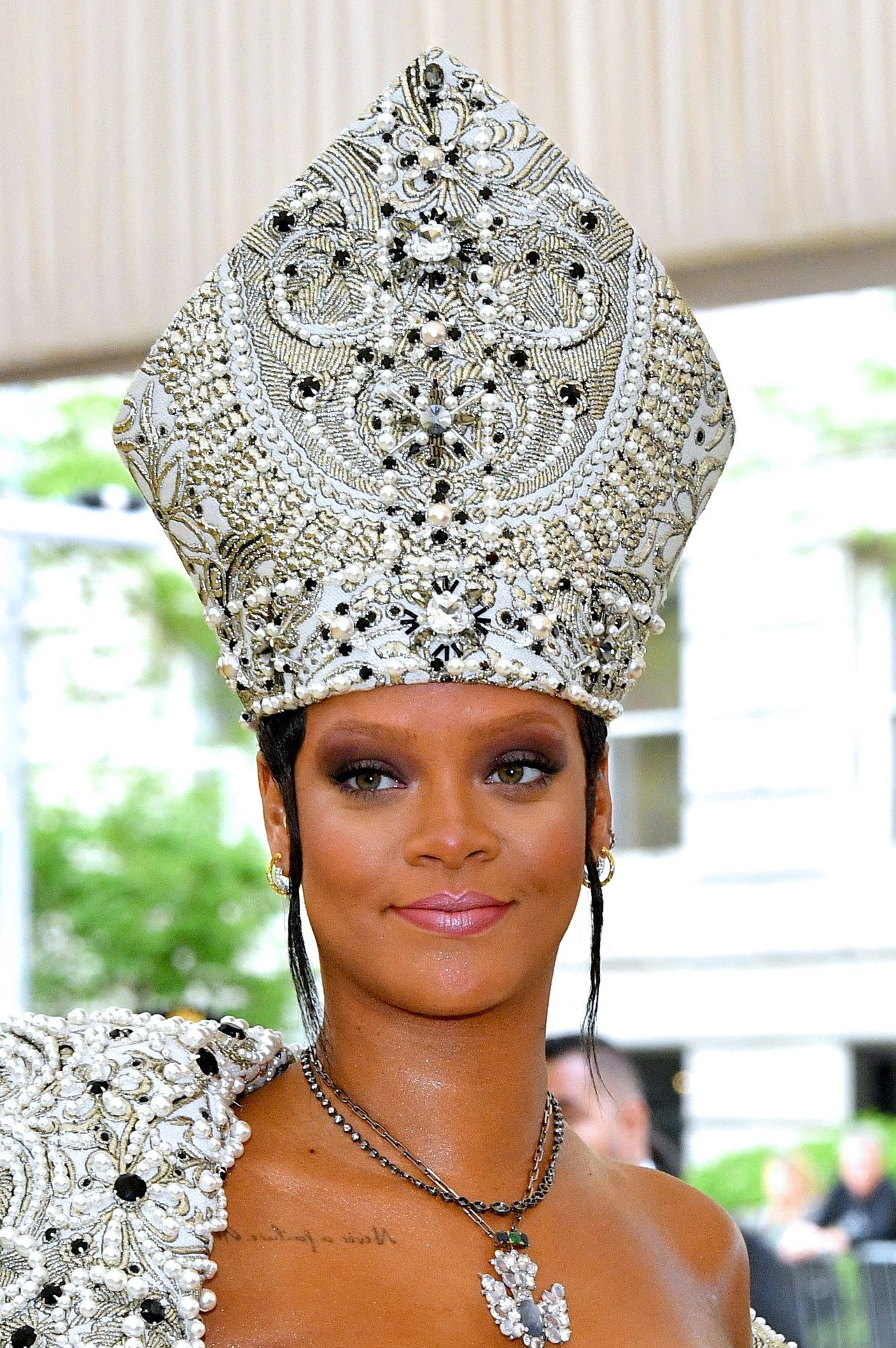
Rihanna has singlehandedly managed to repatriate the skinny brow to our collective consciousness. And according to Damone Roberts, the artist responsible for her brows (as well as those of Beyoncé, Jenna Dewan, and Oprah—yup, casual), Rihanna has a unique way of trying out new shapes. He told Entertainment Tonight: “This year, we first met for the Met Gala, and she wanted to lighten her eyebrows. So Rihanna’s so fly that she has a lookalike model come by your space, and you try out different looks on the eyebrows on the model, and you send pictures to Rihanna and she decides whether she wants to do it or not!”
Uh, what?
Let Roberts explain: “So literally a lookalike model we trialed and tried and everything else until we got them perfect, and we sent Rihanna the pictures and we heard nothing and of course two days before the Met Gala she’s like, ‘I loved them! You gotta fly to NY and take care of me!’ and do them and whatnot, and of course Rihanna shut down the show! It was really, really special.”
In the realm of celebrity, this isn’t totally unheard of: Kim Kardashian reportedly has fit models that try on her fashion looks for her. Still, brows!
PHOTO: Dia Dipasupil/WireImage
Roberts did also confirm to ET, though, that Rih is really just as awesome as she seems: “Rihanna has become one of my favorite people. Now of course I was a fan like everyone else, but once I started working with her this year I have become a fan of her as a person because she is so fly and dope! I can’t think of any other word because she really personifies ‘Rock Star.'”
We appreciate both his confirmation that she is fly and also that her brows truly come from a magical place.
Last month, a Reddit user and former Sunday Riley employee started a thread on Reddit titled PSA Sunday Riley Employee: We Write Fake Sephora Reviews. “A lot of the really great reviews you read are fake,” the user explained. “We were forced to write fake reviews for our products on an ongoing basis…I saved one of those emails to share here.”
The following screenshot of an internal email had Twitter rumbling. There it was: proof that the one of the biggest resources beauty shoppers use to solicit authentic and unbiased opinions was no longer such. The email detailed directives employees were given to hype up the brand’s products in reviews, including talking points like, “please address how cooling it felt, the green color, the non-drying mask effect, radiance boosting, got rid of your acne after a couple uses,” as well as instructions on how to set up a VPN, or virtual private network, to hide employees’ identities.
The news came as a shock to loyal fans of the brand; many of whom wondered why it needed to take such measures given that the company’s products are revered for their ability to transform your skin. (Good Genes is often cited as one of the best exfoliating serums out there.) A lone nugget of honesty in the memo seemed to point to a rationale: “The power of reviews is mighty, people look to what others are saying to persuade them,” one line read.
That’s exactly the problem—and not only in the beauty industry. Fake reviews are rampant within e-commerce, since online shopping eliminates the option of touching, testing, or swatching a product for yourself. Studies have shown that just having a lot of reviews can actually boost a shopper’s interest in a product—even if a comparable one with fewer reviews is of higher quality. (The reasoning behind this: The more reviews a product receives, the more popular and therefore more desirable it must be.)
And the beauty industry, in which brands face stiff competition and need to find ways to set themselves apart from the crowd, is ripe for all sorts of fakery. (Influencer reviews, which are a whole different beast, also recently came into question over shady practices.) It’s no wonder Estée Laundry, an Instagram account that dubs itself an Anonymous #BeautyCollective, has recently appointed itself a watchdog, calling out fake reviews, copycats, and company scandals. It already boasts 30,500 followers.
The repercussions for these behaviors go way beyond a public shaming. (Not to mention fake reviews could pose legal issues, though they’re usually too small-scale for the FTC, which has strict rules regarding endorsements, to pursue.) Online beauty reviews require some level of trust—namely, that the reviewer actually used the product and is sharing their genuine opinion. The breakdown of that trust can have lasting effects. “Trust and authenticity are keys to buyers today, particularly millennials,” says Russell Winer, Ph.D., a professor and the deputy chair of the marketing department at NYU Stern School of Business. “If that is destroyed, a company can be seriously hurt.”
Sunday Riley, for its part, owned up to it. A few days after the Reddit thread was posted, the brand took to Instagram. “First, you can be assured that the only way that our brand will communicate on all channels, including sephora.com, is with our official brand badge,” the brand said in the caption. “Second, we are going to have our business practices and company culture audited by a third-party and will publicly release the results. Lastly, we are actively listening and would love your constructive feedback on what you would like to see from us.” They followed it up with a post tagged with #TransparencyxSundayRiley.
The issue poses a unique challenge to big-box retailers and e-commerce sites, some which get thousands of shopper reviews a week. Sephora was quick to address the matter with the brand, according to a statement given to Glamour. “Sephora has very strict brand rules regarding our Ratings and Reviews, which we know are an important decision tool for our clients,” the retailer says. “Additionally, we have teams dedicated to protecting the integrity of our Ratings and Reviews, ensuring through detailed moderation that it’s a constant trusted, unbiased, authentic source for all.”
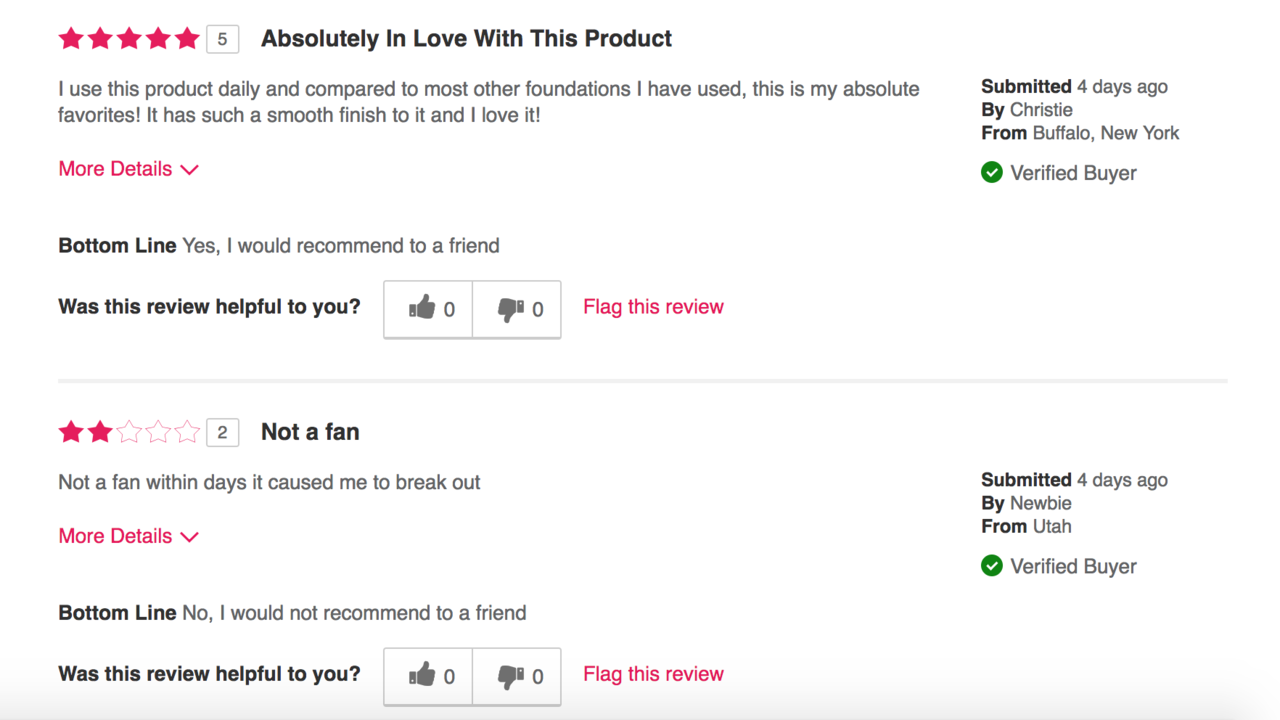
In some cases, retailers enlist third-party companies to sift through reviews. “There’s software that companies can use to spot fakes with high accuracy,” says Winer. Ulta Beauty partners with a third-party agency, PowerReviews, to help them manage their review process and covers both product reviews and product Q&As, according to a representative. It also takes steps to identify “Verified Buyers” with a badge attached to the review. That indicates it’s been written by someone who purchased the product directly from Ulta Beauty—thus minimizing the chances that it’s inauthentic.
Legitimate reviews for MAC’s Studio Fix Fluid SPF 15 Foundation.
While Amazon declined to comment for this story, the site has made headlinesfor issues with fake reviewsin the past. It’s inevitable, really, with that amount of inventory. “Anything that has a really high margin, is highly competitive, and has a low cost of goods—like, I imagine, beauty products—has a problem with inauthentic reviews on Amazon,” says Tommy Noonan, the founder of ReviewMeta.com, a website that analyzes the trustworthiness of Amazon reviews.
An elephant in the room is the retailers themselves. After all, they don’t always have a lot of incentive to take down fake reviews—especially if they’re positive. “The conflict of interest is glaring,” says Noonan. “The higher the rating of the product, the more it’s going to sell.” Sift through the foundations on Sephora and you’d be hard press to find a formula that falls below three stars. (Although, there are products in other categories with 2.5 stars or less, they’re often found buried on page six or seven of options.) Ulrike Gretzel, Ph.D., a senior fellow at USC’s Annenberg School of Communication & Journalism and the director of research at market research company Netnografica, agrees. “Retail platforms often display products based on rating scores, and the average rating score is often the only thing consumers see right under the product name,” she explains. “This means that consumers will not even look at products that receive low average ratings.” And if they’re not looking at them, they’re probably not buying.
That leaves a lot of the sleuthing up to us. Aside from looking for vetted reviews, like those that stem from verified purchases, you can take matters into your own hands by looking for the hallmarks of a fake review. “The main one is a lack of detail about the product implying that the reviewer hasn’t actually used it,” says Winer. “Sometimes, a bunch of fake reviews show up at once if the competitor’s employees have been told to do this; check the timestamps on the reviews.” Fake reviews will also often be shorter—since posters may not put as much time or effort into it if they have a ton of them to write.
He also recommends that you focus on the reviews that fall in the middle of the range—so, if the rating is one to five stars, look at the reviews that give two to four stars. “The fives are generally uniformly enthusiastic, [while] the ones are the opposite,” Winer explains. “You get more information from the middle group, as they usually list pluses and minuses, which help more.”
It’s far from a perfect system and it’s disappointing that there aren’t more ways to deter fake reviews. Not only do they undermine truly good quality brands, but they also hurt and mislead customers who spend money on products that work—or so they think. While verifying purchases and, yes, maybe calling it out when it happens will help, in the long-run, brands and retailers alike need to continue to hold themselves to a higher standard. After all, if a product isn’t getting rave reviews, maybe the solution is to re-work the formula instead of simply duping fans.
Since Universal Standard was founded in 2015, its goal has been to create a more inclusive approach to fashion. That began with sizing—its first collection came in sizes 10 through 28—but also with projects that spoke to other gaps in the market: It helped J.Crew expand its sizing across the board; it collaborated with actress Danielle Brooks; it brought attention to the lack of plus-size jewelry options out there. But its latest launch might be its more revolutionary: a line of T-shirts available in sizes 00 through 40.
“This was always a north star,” Alexandra Waldman, cofounder of Universal Standard, tells Glamour of Foundation, a capsule of seven shirts made for layering and its most exhaustive size offering yet. “We started 10 to 28, which were both outside of the traditional ‘plus size,’ because we wanted to plant our flag there. Then we went 6 to 32. Now we’re going 00 to 40 because we want to show the world that it’s possible to make beautiful clothes for everyone and it’s not just the privilege that single-digit-size girls get to have.”
“We knew Foundation was going to start at 00, but we didn’t know how high up we could go,” Waldman explains. “It made so much sense once we understood the lay of the land and how many people are going without.” Universal Standard landed on 40 because of their “intuition” and out of a desire to address “the forgotten within the forgotten,” like shoppers above a size 32. To develop its product, the brand uses a micrograding technique, “which is to change the grading between each size rather than use a formula to grade across. We pay a lot of attention to detail, to make sure it looks native to each body size,” in addition to measuring samples on models of every size, according to Waldman.
The name of this capsule is derived from makeup foundation, because “it goes from least coverage to most coverage, the way foundation does—you have a bandeau, a cami, then you have a short-sleeve T-shirt, a long-sleeve [T-shirt], then you have a turtleneck, a crewneck, and a V-neck included. We wanted to make things that were so incredibly comfortable you could wear them on their own or you could wear them underneath as a layer.”
Even before Foundation launched, an image from its lookbook went viral: It featured La’Shaunae Steward wearing one of Universal Standard’s tanks, which many praised as a depiction of plus-size bodies you don’t typically see in fashion photography. “We wanted to show someone who we thought was exceptional and beautiful and strong and deserved representation,” says Waldman. (The model shared the photo on Instagram, writing: “[A] shoot that was so special and important to me. [Being] a model that people constantly look over or being a curve model that [isn’t] conventionally attractive or ‘fat in all the right places’ and always finding myself only posting angles [I] felt were more appealing. [T]his angle shows everything [I] fought being insecure about and shows every part of me that people told me would have to be smaller in order to be accepted.”)
The response to the lookbook—which included “a lot of ‘this brought me to tears,’ a lot of ‘thank you,’ a lot of ‘I feel seen by a fashion brand,'” per Waldman—was incredibly moving for the founders: “A few times we would read them and we were brought almost to tears, because they were such emotional responses.” And there’s only more to come—Waldman promises, “This is the beginning of the entire collection’s moving to 00 through 40.”
See Universal Standard’s groundbreaking size-inclusive collection ahead.
If we were calling the shots, all of Reese Witherspoon’s spare time would be spent making Legally Blond 3 happen. But Reese is taking a break from being an actress, producer, entrepreneur, and Kate Middleton fangirl this fall to give women across the country a much-needed morale boost.
Reese (a 2015 Glamour Women of the Year) and her multimedia company, Hello Sunshine, have partnered with Together Live to bring a cross-country all-female storytelling tour to 10 cities across North America this November. At each stop, Reese will be part of the two-hour storytelling conversation meant to forge connections between women from Boston to Austin and in smaller-market cities in between. And she’ll be joined on stage by a different group of celebrity friends at each stop along the way.
Also along for the ride: Glamour. We have exclusive editorial access to all 10 events, and will be there live for four stops on the tour. Follow along in our Insta Stories and on glamour.com. Or, join us in person! I’ll be snacking at the craft services table at select stops. Here’s where and when to find everyone else: Boston (November 3); Philadelphia (November 4); D.C. (November 5); Toronto (November 6); Cincinnati (November 9); Ann Arbor, Michigan (November 11); Chicago (November 12), Minneapolis (November 13); Fayetteville, Arkansas (November 16); and Austin (November 19).
Ahead of the party that starts November 3, Abby, Connie, Maysoon, and model/trans activist Geena Rocero —who’ll all take the stage at Hello Sunshine x Together Live —joined entertainment and media exec Jennifer Rudolph Walsh, who’ll emcee the events, for a conversation about women’s struggle to find their voices. Connie, the songwriter behind the Women’s March anthem “Quiet,” spoke about not feeling heard both as a minority, and as an artist in a family of doctors who questioned her career path. “We were all supposed to be doctors or lawyers,” said Jennifer. “Instead, we’re warriors.” (TRUTH.)
Click your way over to Together Live to see which celebs are appearing in each city, and to get tickets, which start at $25 and are on sale now.