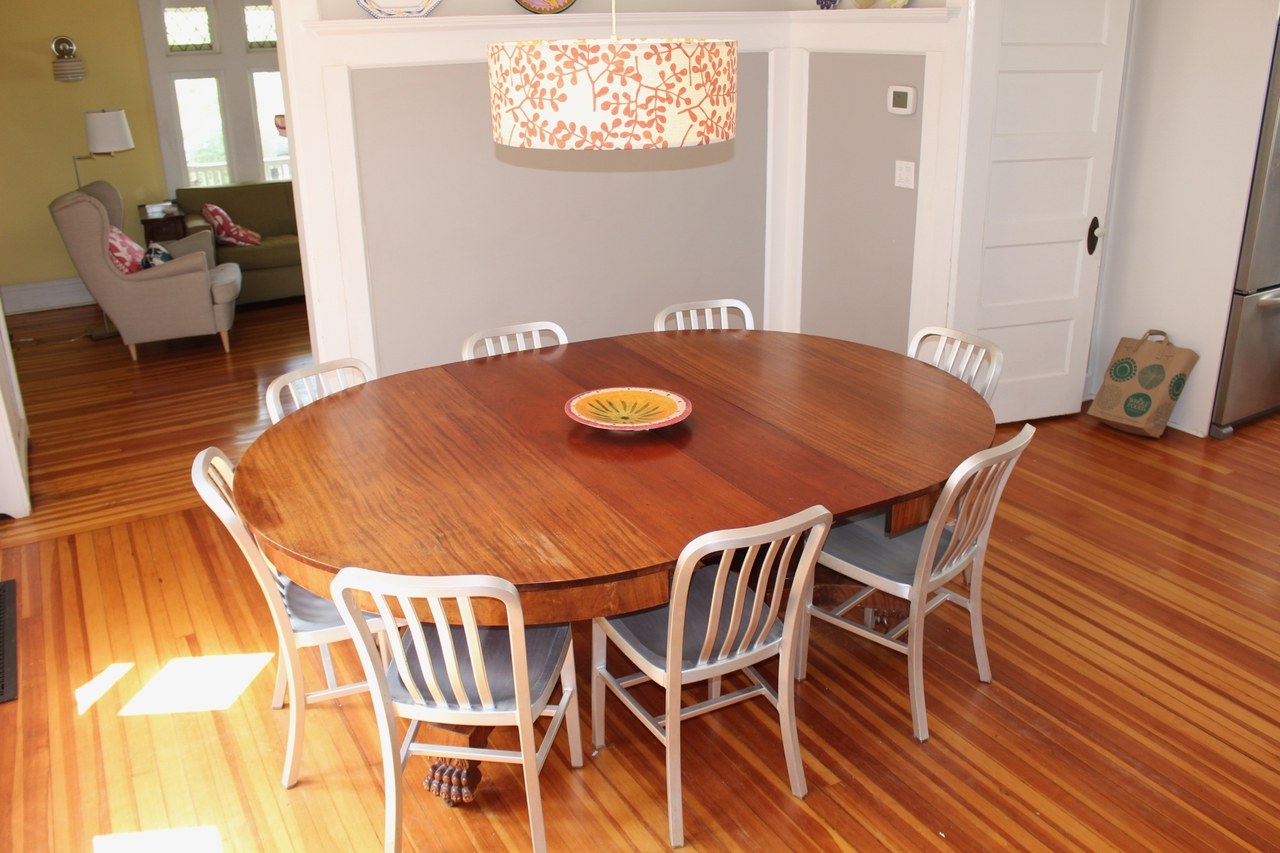
At first, my husband refused to spend $500 to ship a dining room table from Cleveland to New Jersey. He thought it made no sense. (“Why not just buy a table at Ikea?”) I pointed out that the deal included six chairs and four leaves, that it opened up to seat twenty people and that it was made from genuine American cherry, for crying out loud. We already owned enough manufactured wood to build a bridge over the Cuyahoga River.
Ethan was unmoved. He’s a self-described “anorexic spender,” able to go into complete financial lockdown during lean times. Unfortunately for me, this was one of those times. Unfortunately for him, I’d already been in love with this table for fifteen years.
The table belonged to Joanie and Paul Levin, old friends of Ethan’s family. All we had to do was pay for transportation to our house, where we ate meals with our three toddlers crowded around an old desk resurfaced with tile leftover from a bathroom renovation. The grout was stained with tomato sauce and the legs were gouged from being banged into by the tricycles we kept in our dining room.
“Trust me,” I said. “We need this table. It’s a huge upgrade, and it’s a bargain!”
Ethan pointed out that we didn’t have twenty people to invite over; we were new in town. He thought the Levins’ elegant antique would look out of place among the hodgepodge of junky furniture in our fixer-upper—“like putting a Porsche engine in a Chevy.” Then he went low: reminding me of all the parking tickets I’d gotten recently, resulting in the suspension of his driver’s license (our minivan was in his name); and of the $800 we’d paid a collections agent after I defaulted on the contract for a rent-to-own clarinet (I thought the bills were receipts!).
Our civil discussion devolved into the silent treatment followed by a series of terse emails and then reconciliation.
Ethan agreed to call the movers.
—
The first time I went to Shaker Heights, Ohio for Thanksgiving with my future in-laws, we celebrated at the Levins’. Joanie and Ethan’s mom, Amy, had grown up on the same block, then raised their kids in houses next door to each other. Paul and Ethan’s dad, Phil, had organized the Sutherland Road block party together for a decade and shared a lifelong loyalty to their hometown, Boston.
I’d never been away from my family for a major holiday, but I immediately felt at home that night. I loved the easy shorthand between Ethan’s family and the Levins—the way Amy knew where to find extra paper towels and Phil stood at the stove ladling pumpkin soup and the kids spoke to each other in the easy shorthand of adopted cousins. Everyone doted on the grandmothers, Edith and Doris, who smiled over the whole tableau as if they were the luckiest people in the world.
Aside from the hamish vibe—a term I learned from these families—I also loved the Levin’s table. It was round, extended to oblong and dressed up in blue and white linens inherited from Paul’s mom. Our Thanksgiving was the whole enchilada of Americana, right down to the Jello mold, but the table would have been equally at home at a banquet with finger bowls and silver candelabra. A lesser piece of furniture might have groaned beneath the bounty (a vat of mashed potatoes, Paul’s famous pies in six flavors); this one didn’t make a peep.
Under the table, Ethan and I held hands through the whole meal.
—
After that, we found ourselves in the Levin’s dining room for a rained-out Fourth of July barbecue, an engagement party and a celebratory lunch when we brought our first baby to Cleveland. Every time I was there, I admired the table—amber in some lights, reddish in others. Bending down to pick up a dropped pacifier, I noticed that the feet were carved to look like claws.
I love this table the way some people love their dogs. It’s a steady presence, a port in a storm. I know it’s only a piece of wood, but I swear: the table knows things.
Joanie and Paul became surrogate in-laws to me and grandparents to my kids—they were even friends with my parents—so I was surprised and sad when I found out they were getting divorced. I was equally surprised when Joanie called to offer me the table. Didn’t one of her kids want it? Didn’t she want to try to squeeze it into her new place? No and no, she said firmly. Even before Ethan was on board, Joanie gave me instructions on how to take care of the table: “Just a little polish every now and then and don’t worry about coasters. And, trust me, it’s the best place to sit with a cup of coffee in the morning.”
She apologized for any nicks and scratches. I said I was sorry about Paul.
—
The table arrived on a warm spring day when the magnolias were in bloom. The smell wafted through the front door as the movers lugged in one piece at a time: first the top, then the leaves and finally the two halves of the base, marveling all the while at the heft.
I paid, signed and watched the truck drive away. Then, with my youngest napping upstairs, I arranged all the chairs and the high chair and sat down to eat a civilized lunch alone. Suddenly, it didn’t matter that our couch was hopelessly stained or that our cabinets were held together with duct tape. It was as if this one beautiful thing had waved a magic wand over the rest of our kingdom, making everything around it look just a little bit brighter.
Overnight, the table became the backdrop for our lives. We eat every meal there, plus afternoon snacks and late-night ice cream. Our kids plunk their coats and backpacks on the table when they come home from school. It’s where we blow out birthday candles, fold laundry, do homework, read the newspaper and conduct all important conversations. (Once I overheard our middle kid say to our oldest, “They want to talk to me in the dining room.” His sister’s response: “Wow. You must have used a lot of data.”) The table has been witness to our family’s evolution from picture books to chapter books to SAT prep books to self-help books (mine). It’s been home to art projects—dioramas, posters, construction paper chains—and weathered every writing instrument and form of adhesive (crayons and colored pencils; glitter glue and ModPodge). And don’t get me started on slime; turns out, cherry is no match for Borax.
We only had a few Thanksgivings without Paul. We missed his pies and funny stories, but in the meantime, he always kept up with me and Ethan and our kids. After my dad died, he and Phil quietly took turns filling the empty seat, and they never let me down.
And then the Levins had a grandson of their own, and Joanie and Paul were a team again. That year, as he was arranging his Thanksgiving offerings on Amy’s sideboard, I cornered Joanie in the kitchen: “I’m really happy to see you guys together, but does this mean you’ll want the table back?”
She laughed, looking exactly like Edith, who was also gone. So was Doris. “No, honey, we’re on to a new phase. It’s yours.” Suddenly, it hit me: Joanie and Amy were the grandmothers now.
—
We have yet to host a dinner party for twenty, and most days our table is only set up for six. But we’ve used the extra leaves for Easter, Thanksgiving, Christmas Eve, a seder and countless book clubs. A few years ago, we upgraded from the high chair and the tricycles to jute placemats and matching silverware. We only have one tablecloth which we don’t use it very often—I like to see the table—but every time I lift it up to put it away, I think of that moment when the groom raises the the veil from the bride’s face. I love this table the way some people love their dogs. It’s a steady presence, a port in a storm. I know it’s only a piece of wood, but I swear: the table knows things. It’s seen it all.
Every morning when I sit down in the dining room with my coffee, watching the sunrise over the house next door, I think of Joanie: another mom in another time, waiting for her kids to wake up while the man who would become my husband left for hockey practice on the other side of the fence. Ethan is not as sentimental as I am, but he has never missed the $500 we paid to bring this table home. And I never say a word when he places his newly-sharpened skates directly onto it; after all, the nicks and the scratches tell a story.
—
A few years ago, Paul got sick. Not long before he died, he came to New Jersey to visit his childhood friend, George, who also happens to be the lawyer we hired to handle the closing on our house. We invited Paul and George for brunch in our dining room, at the Levins’ old table. I polished it up and set it with my best plates and even went to a faraway bagel store to get the best lox. I hoped Paul wouldn’t notice that the original chairs were missing; I’d given them to a friend and replaced them with modern titanium chairs from Crate and Barrel.