Categories
Health

Beyoncé and Jay Z's Album 'Everything Is Love' Is Now Streaming Pretty Much Everywhere


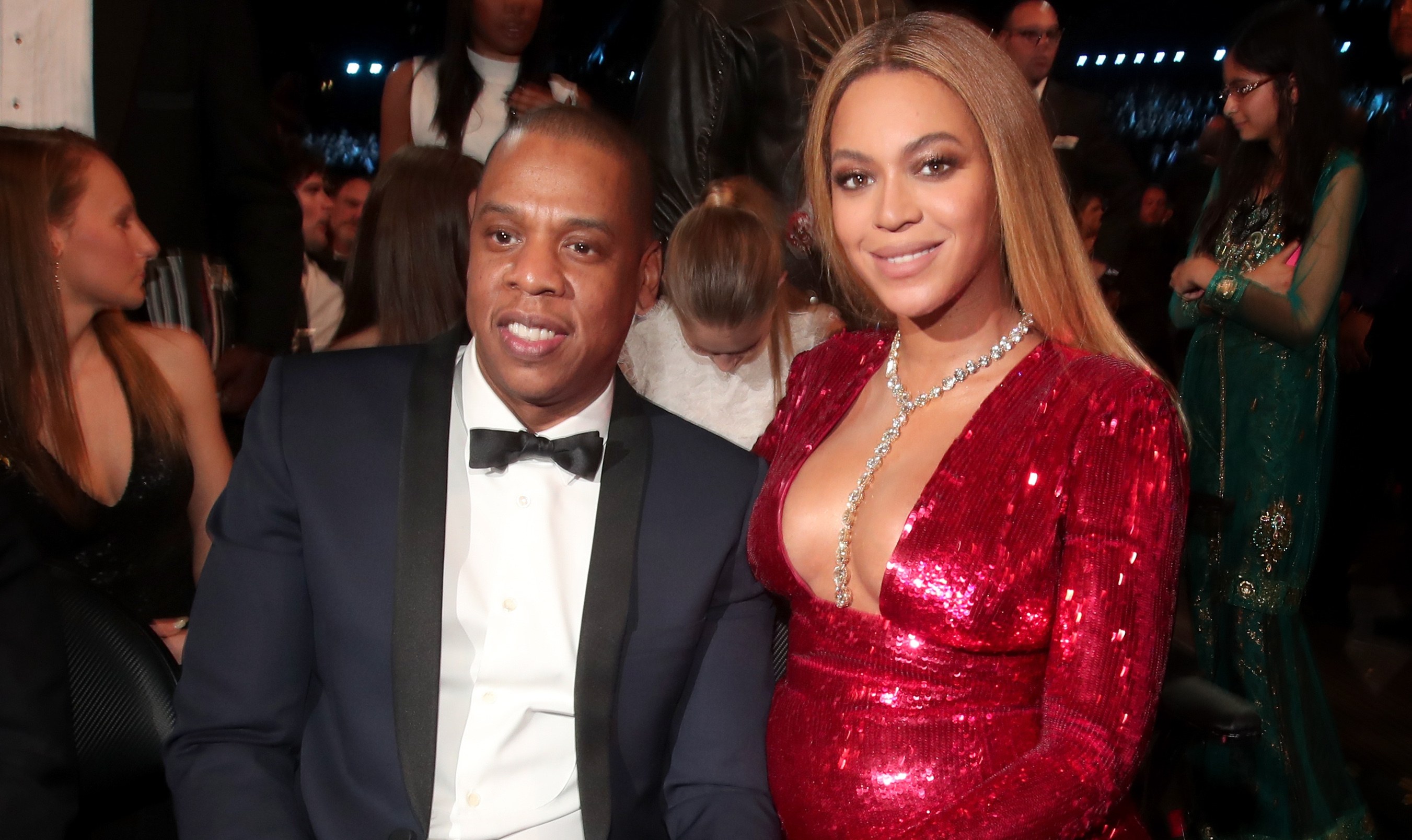
Beyoncé pulled a Beyoncé over the weekend when she and Jay Z dropped a joint album, Everything Is Love, with no warning at all. Of course, diehard fans know rumors of a Bey and Jay collaboration have been swirling for a while, but Everything Is Love still caught many by surprise. How did these two have time to make a full-blown, 90-minute album?! They’re superheroes. It’s the only logical explanation.

Everything Is Love seems to be the final piece of the trilogy that includes Beyoncé’s album Lemonade and Jay Z’s 4:44 record, and get this: You don’t have to be a Tidal member to hear it. After spending a weekend exclusively on Jay Z’s streaming platform, the album is now available everywhere, including iTunes, Spotify, Apple Music, Amazon, and Pandora Premium.

The streaming wide-release of Everything Is Love is a bit surprising. After all, on their new song “NICE,” Beyoncé raps, “If I gave two fucks—two fucks about streaming numbers / Would have put Lemonade up on Spotify,” leading fans to think this new record wouldn’t make an appearance anywhere else besides Tidal. Now that it’s everywhere, though, the BeyHive is naturally lit.

“Too happy that Beyoncé and Jay Z’s new album is on Spotify,” one fan tweeted. “I was to signing up to Tidal but the new Beyonce and Jay Z album is on Spotify! Like. What?!?!” wrote another person. Below, check out some more fan reactions to the news:

Happy listening!

Related Stories:

In the Louvre, Beyoncé Proves There’s Power in Repurposing Art History

Beyoncé and Jay Z Just Dropped a Surprise Album, So Naturally Twitter Is Losing It

Beyoncé Wore the Most Epic Dress in a Video of What Appears to Be a Vow Renewal With Jay Z


Source link

Categories
Health

Prince Louis' Birth Certificate Is Pretty Standard, Minus Two Small Details


If you thought royal birth certificates are fancier than others—like, say, hand-printed in gold ink on ivory card stock—think again. Turns out, when royals are born, they’re issued a routine birth certificate, just like the rest of us. Well, almost.

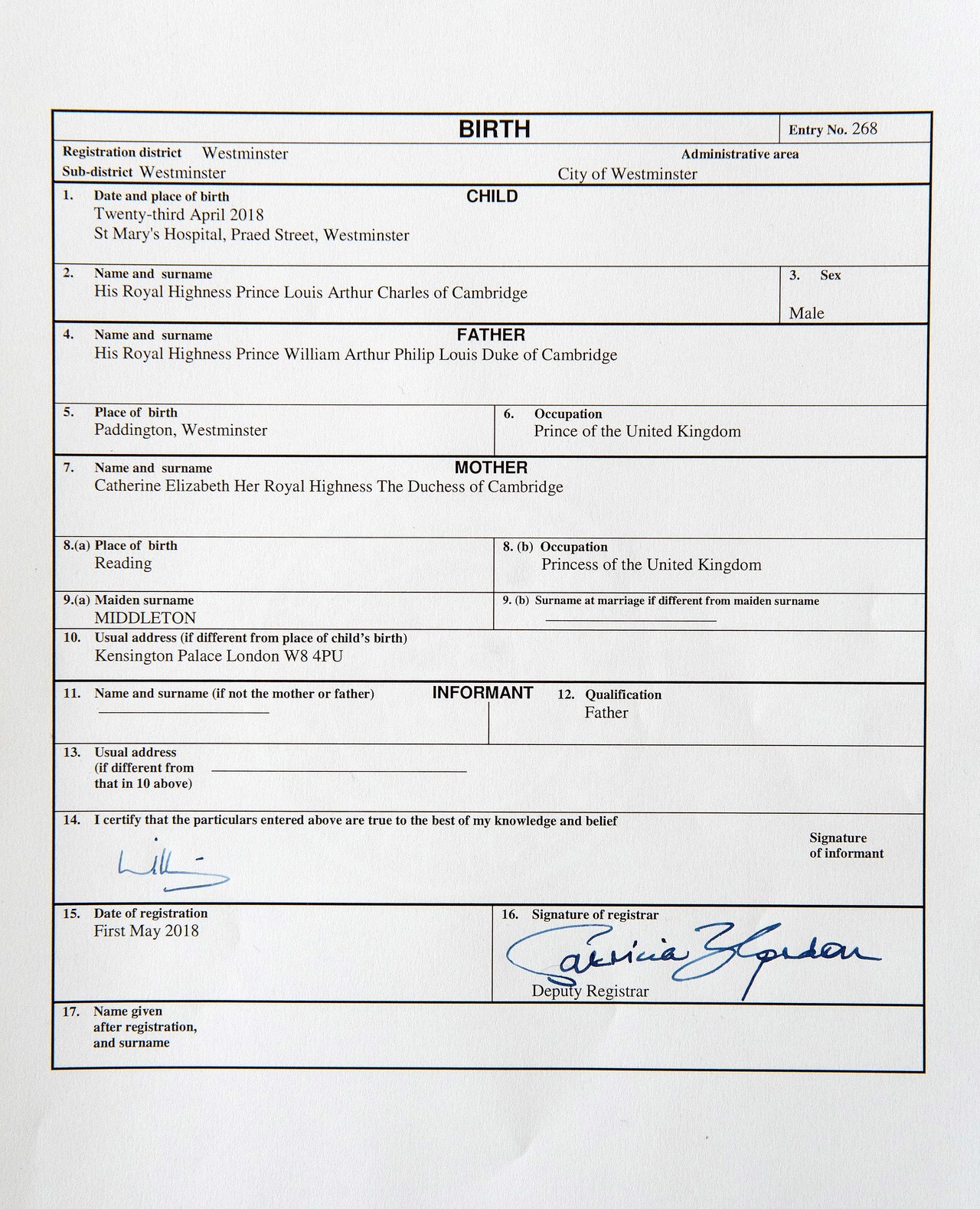
On Tuesday (May 1), Prince Louis’ birth certificate was released, and it’s pretty standard save for two small details. Under “occupation” for his mom and dad—Kate Middleton and Prince William—it reads “Princess of the United Kingdom” and “Prince of the United Kingdom.” And for “name and surname,” all three royals are listed under their full royal titles. This means Prince Louis is listed as “His Royal Highness Prince Louis Arthur Charles of Cambridge,” Prince William goes by “His Royal Highness Prince William Arthur Philip Louis Duke of Cambridge,” and Kate Middleton is ID’d as “Catherine Elizabeth Her Royal Highness The Duchess of Cambridge.”

Other than that, though, the birth certificate has all your basic info. It states that Prince Louis was born on April 23, 2018, at St. Mary’s Hospital in Westminster, that his sex is male, and that he lives at Kensington Palace in London. It also bears Prince William’s signature, which is exactly as aristocratic as you’d expect.

Check it out for yourself, below:

PHOTO: Dominic Lipinski/WPA Pool/Getty Images

Obsessed with the Royals? Same. Click here to get Kate Middleton updates—and more—from Glamour’s daily newsletter.

Kensington Palace announced the then-unnamed Prince Louis’ birth last Monday, April 23 on Twitter. “Her Royal Highness The Duchess of Cambridge was safely delivered of a son at 1101hrs,” read the tweet. “The baby weighs 8lbs 7oz. The Duke of Cambridge was present for the birth. Her Royal Highness and her child are both doing well.”

Later that week, Prince William joked that he was still “working on” the baby name, but a day later, Kensington Palace confirmed it: “The Duke and Duchess of Cambridge are delighted to announce that they have named their son Louis Arthur Charles,” read their announcement. Now it’s official, so no take-backs, William.


Source link

Categories
Health

Men Behaved Pretty Much How You'd Expect at an All-Male Fundraiser in London


On Tuesday, the Financial Times published an exclusive story by writer Madison Marriage, who went undercover to report what really goes on inside an event known as the Presidents’ Club charity dinner at the Dorchester Hotel in London, which attracts hundreds of powerful men in business, politics, finance, and sports. It does not, however, appear to attract people particularly concerned with a few things known as #MeToo or Time’s Up.

Marriage—whose Twitter bio says is the Financial Times‘ accounting and tax correspondent—posed as a “hostess” for the evening and, according to the Financial Times, was met with over 300 tuxedo-clad men, as no women are allowed inside the event. That is, except for the 130-member hostess staff. And that staff, all required to be “tall, thin, and pretty,” were both verbally and physically harassed throughout the night. “Over the course of six hours, many of the hostesses were subjected to groping, lewd comments and repeated requests to join diners in bedrooms elsewhere in the Dorchester,” she wrote.

Other complaints Marriage heard from hostesses included how men allegedly reached up women’s skirts, and another who thought it was perfectly OK to expose his penis during the night.

Though really, Marriage noted, these actions could have been foreshadowed by a few of the charitable auction’s prizes, which included a night at a local strip club and a round of plastic surgery to “add spice to your wife.”

Even during their interviews for the gig, hostesses were reportedly told by Caroline Dandridge, founder of Artista, an agency that specializes in hiring women to staff these types of events, “Some girls love it, and for other girls, it’s the worst job of their life and they will never do it again . . . You just have to put up with the annoying men and if you can do that it’s fine.”

Not that fine, though: As one 19-year-old recounted to Marriage, an attendee nearing his 70s outright asked her if she was a prostitute. She replied that she was not and told Marriage, “I’ve never done this before, and I’m never doing it again.” She added. “It’s fucking scary.”

Marriage also added that a security guard was stationed outside the women’s bathroom, but it wasn’t for their protection, but rather to call out any women who took too much time inside, perhaps to compose themselves after being harassed, and forced them back into the ballroom to interact with male guests.

At the end of the night, the women were paid the equivalent of—wait for it—$210 for their troubles, along with a little extra for a cab ride home. For their part, the Dorchester Hotel claims it’s unaware of the alleged actions that took place at the event, and the Presidents Club also told the Financial Times that it “recently hosted its annual dinner, raising several million pounds for disadvantaged children. The organizers are appalled by the allegations of bad behavior at the event asserted by the Financial Times reporters. Such behavior is totally unacceptable. The allegations will be investigated fully and promptly and appropriate action taken.”

Read the full story here.

Related Content:
Denouncing #MeToo Is Feminism Devouring Itself
I’m Ready to Say ‘Me Too’—Now Men Need to Say ‘I’m Sorry’
Time’s Up Empowers American Women—Now It’s Our Duty to Empower Others Around the World


Source link

Categories
Health

Most Period Pain Products Are Pretty Pointless, Actually


There’s something of a boom happening right now when it comes to new period pain products. Take Whoopi & Maya, Whoopi Goldberg and Maya Elisabeth’s line of cannabidiol-infused period-relief products, including a salve, a tincture, and a bath soak all made with CBD (which comes from, you know, cannabis). The founders recently announced the line would be expanding to Colorado (it’s currently available in California). “We’re trying to make people more productive, to eliminate an issue that’s been around for as long as women have been around,” Goldberg explained to The Daily Beast. But let’s take a step back. Are products like these really filling a need, or are they just another ploy to make money off our periods?

Whoopi & Maya is hardly an outlier: The period-product market has recently seen the release of Foria’s “weed tampons,” the shock therapy device Livia, Comforté pain relief cream, “Moon Cycle” tea, and “women’s moon” chocolate. Looking at this list left us with one major question: Does any of this really work?

The jury is kind of mixed. While some research has shown that cannabis aids in pain relief, other research suggests it’s not as effective for women, and there’s no rigorous research specifically on period pain. For her part, ob-gyn Aimee D. Eyvazzadeh, M.D., is not a fan of the marijuana-based period products, particularly since the active ingredients in cannabis can decrease fertility. A study in the Journal of Clinical Investigation, for example, found that THC prevented mouse embryos from getting to the uterus from the ovaries. “While you’re trying to help with your period cramps, you could be harming your chances for a future pregnancy,” explains Dr. Eyvazzadeh.

What about the non-weed-related products designed for menstrual pain relief? Sure, most of them won’t hurt, but they’re probably no more effective than just popping an ibuprofen like Advil or Motrin, says ob-gyn Sherry Ross, M.D., author of She-ology: The Definitive Guide to Women’s Intimate Health. Period.

Livia, which you attach to the part of your body that’s hurting with stickers so that its electrical impulses can target your pain receptors, was tested on 163 women. But Dr. Ross believes the idea of zapping period pain with the push of a button sounds too good to be true and would require more research to be endorsed for severe cramps. Pain relief creams may work, but you’d need to make sure they contain lidocaine and are specifically formulated for pain, she adds. And while foods and drinks or menstrual pain relief may help a little, you don’t need specially labeled food items. Foods with high water content like berries and cucumber can help keep you hydrated, calcium-rich foods reduce cramping, and hot water with ginger can relax the uterine muscles, for example, says Dr. Ross. Classic remedies like hot water bottles and heating pads can also be equally effective options.

So sure, it might be encouraging that more companies are dedicating themselves to women’s health, but this can be a double-edged sword. The more we talk about our vaginas, the more they’ve become the focus of ridiculous treatments, from cucumber cleanses to ground-up wasp nests. When it comes to period products, they might help some women, but the makers of these products are also trying to make money, which means they’re invested in convincing women they need them. In reality, all most of us actually need are pads, cups, or tampons—and maybe some pain relievers.

While we’d all love a quick fix for period pain, there probably is none, says Dr. Ross. You can’t get around the need to maintain a healthy diet, exercise routine, and sleep schedule. That may not be as easy as attaching electrodes to your body or sitting in a weed-infused bath, but hey—at least it’s cheaper.


Source link

Categories
Health

Olivia Wilde's Blond Highlights Are Super Subtle and Majorly Pretty


There’s arguments for and against reading into celebrity hair changes. On the one hand, celebrities are people, obviously, and while sometimes they just dye their hair for the fun of it (and the Insta story), other times it goes deeper. Case in point, when Olivia Wilde chopped her hair off last winter after seeing the Melania Trump resemblance, and when she dyed her hair dark brown to get into character as Julia in 1984. She described that hair switch as “dark times call for dark hair,” and while it was a fittingly bleak statement, with the play wrapped, she just picked up some pretty beautiful blond highlights.

Wilde first took the change out for a spin at the Tribeca Chanel Women’s Filmmaker Program Luncheon, and her highlights are the best example of a tiny amount of bleach making a huge difference. The streaks come from celebrity hairstylist Owen Gould, and while it looks like they basically just dusted her ends with a few spots of caramel, the shift changes her whole look.

Especially when the light hits her flipped out ends, the lighter color reads like a hair accessory. That’s likely because instead of going for a molten, gradually ombré-d look, the blond actually starts pretty abruptly. And since it’s at her tips, it looks even cooler.

Although to be fair, Wilde probably knew it would. In her life pre-play, she was wearing a style pretty similar to her new streaks, with the same kind of blond ends that could easily be swept up in a bun for a more brunette look. If ain’t broke (and you’re not currently starring in a dystopian production), don’t fix it, etc.

Related Stories:
Olivia Wilde Is Getting Mommy-Shamed for Kissing Her Son on the Lips
Blake Lively’s Latest Hairstyle Is So Different for Her
Busy Philipps Just Dyed Michelle Williams’ Hair Pink on Instagram


Source link

Categories
Health

'Inhumans' Actress Serinda Swan: Being Conventionally Pretty Didn't Make Me Happy—Shaving My Head Did


When I was three or four years old, I was in my first movie: Cousins, starring Ted Danson and Isabella Rossellini. I remember falling in love with the industry, partially because of the craft service table and the direct access to free candy, but also because I could play and create, imagine and connect. I felt accepted.

That love stayed with me—so a few years later, around 8 years old, my parents sent my headshot in for an audition. But the casting directors said they didn’t want to see me because I didn’t look like the character description of “young girl.” Sure, I’d been doing a lot of gymnastics, and I was a little more muscular than other girls my age—but I didn’t understand. I was young; I was a girl. Why couldn’t I audition? When my parents asked them for an explanation, they were told, “She doesn’t fit into the physical mold people see as a pretty, young woman. That will make it very difficult to cast her in any future projects.”

It was really hard to face the fact that something I loved, something I felt was a huge expression of who I am physically, emotionally, and spiritually, had rejected me. It took me a long time to learn that my rejection had been completely based on what I looked like—and nothing to do with who I actually was. This was one of the first times in my life I felt self-conscious.

The second time was when I was 11. I asked my dad if I could cut off all my hair, and I got close to convincing him, too. I remember trying out my adolescent negotiating skills: “How about an undercut then..?” Long Pause. “Maybe a Mohawk?”

He agreed I could cut it, but insisted the shortest I could go was a pixie cut (which was still pretty radical in those days). At the hair salon, the picture we used for inspiration was of Winona Ryder in Little Women. I think, consciously or unconsciously, everyone wanted to make sure I still looked like a “little woman.” As they were cutting my hair, I remember thinking, “Do young girls have to have long, flowing hair and wear pretty pastel dresses like all of the princesses in the movies I watched?” I was stocky and muscular and insisted that the theme of my birthday be softball after my favorite movie, A League of Their Own. But I was still a young girl—cutting my hair off didn’t change that…right?

I guess what I was asking at that young age was: Does the length of my hair determine the perception of me as feminine or masculine? And in who’s eyes? Yours? Mine? Society’s?

I found out pretty quickly that by cutting my hair short, I was challenging the vision of what others thought I should be.

But I found out pretty quickly that by cutting my hair short, I was challenging the vision of what others thought I should be. For example, I was at a track meet a few months later and a pretty girl from an opposing school came up to me and said, “My friend thinks you’re cute.” No boys ever thought I was cute, so this was a big moment for me. I felt my face go hot as I looked up into the stands and tried to guess which guy was her friend. I asked, with a huge smile, “What’s his name?” “Her name is Sarah,” she answered. We both stood there silent for a second, and I felt her gaze go from the top of my head to bottom of my brand new white tearaway pants. That’s when she realized. “Oh my God, you’re a girl,” she shouted. “Why would you do that to yourself? Ew!” She ran away screaming and laughing back to her friends. I saw the story pass from clique to clique as people pointed and laughed. I felt self-conscious, so I ran that day—not in the school race, but straight to my home. I knew I never wanted to feel that way again, so I vowed I would change.

Luckily, puberty was kind to me. I quit gymnastics when I was 12 years old and grew four inches in three years. My pecs had turned into breasts, my bulk turned into long, lean muscle, and my hair grew to my mid back. At 14, I left my school and moved to Kauai for a year. There, my almost translucent Canadian skin turned a golden brown, and I learned how to wear make-up. I remember coming back to Vancouver and walking into my old high school cafeteria to visit my sister; I could feel people looking at me, but it wasn’t in the same way they did on the field that day. This time something was different; I was different. At least, to them I was. I realized in that moment that how I looked changed how people looked at me, even if I was still the exact same on the inside.

So through my late teens and early ’20s, I molded myself into what I—and everyone else—seemed to believe a young “attractive” woman should be. I did Maxim photo shoots in bikinis; I had long curly hair and a tan. I was everything that was considered conventionally beautiful and yet I was completely dissatisfied, because who I appeared to be on the outside had nothing to do with who was on the inside. I let myself be governed by what others thought I should be. I was no longer the little girl who wanted to shave her head and didn’t care what people thought; I cared. I cared so much. It felt awful.

PHOTO: Courtesy of Serinda Swan

Unhappy, I started looking for other ways to define myself. I immediately went back to cutting my hair short again, but by this time I had started acting and my reps didn’t think it was the best idea. I even went so far as to Photoshop my face onto a picture of Natalie Portman (when her head was shaved for V for Vendetta) to prove it would be OK, but I never sent it to my team. Instead, I saved it away in a dream board folder.

Years later, my reps told me about the role of Medusa on Marvel’s Inhumans. But there was one, small detail in the character description they felt I should know about: “Must be comfortable with having head shaved on camera.” They asked me with bated breath if I would be OK with that. My answer? I dug into my old iPhoto folders to find my Portman frankenbaby photo. I attached the picture and pressed “send” with the subject: “SEND TO MARVEL IMMEDIATELY!!!”

[embedded content]

I was so excited, I didn’t consider that my head might not be the same shape as hers. What if I was secretly a cone head? I also didn’t consider that this change would require wearing a wig anytime I was in public in order to preserve the plot twist of losing my “superpowers.” No easy feat considering we shot the show in Hawaii, which meant 90-degree heat and tropical winds. But it was a price I was willing to pay.

It was weird. My freshly shaved head wanted to go out and celebrate its newfound freedom. But contractually, I was bound to wear a wig from March 2 until September 1. I was trying out different wigs as I went—if you look close on my Instagram you will be able to see the slight differences—but I had to be sneaky about it so nobody realized what was going on.

I ended up naming them all to keep track of them. My favorite was “Wendy.” She was short and had bangs, and it was easy for me to just stick her on. She was usually the one that I went hiking or snorkeling in. I liked to think of her as my adventurous best friend.

PHOTO: Courtesy of Serinda Swan

Me in my wigs “Wendy” and “Savannah”

Then there was “Savannah.” She was the long, red one we used as Medusa’s wig, and she is a total capital-D Diva. She reminded me of Cher. When we were filming indoors, she was fabulous. But one step outside, and it was “The Attack of the Killer Wig.” Whenever the wind would gust—and it would be constantly gusting—she would twist into knots around my neck or try to stuff herself into my mouth or up my nose. It was like having a four-pound cat snuggling your head for 16 hours a day—a cat that I was probably allergic to.

I noticed that the wig I wore changed how people reacted to me. If I was wearing the long, dark one named “Marilyn” people tended to give me more attention, but not talk to me. When I wore “Wendy” (the girls’ girl) people were always striking up conversations. I was again brought to the reality that the way I looked changed how I was looked upon in society. But this time, I didn’t let it define me. Instead, I defined it.

It’s ironic how this extraordinary opportunity from Marvel has brought me back to one of the first decisions I made for myself: cutting my hair short. It also made me face the possibility of being judged once again, but I know now that what’s on the outside doesn’t define what’s on the inside. I know that how I look was created by genetics and the parents that I was born to (sure, I have a hand in the decoration of it) but at the end of the day, the look they created has nothing to do with what I can create with my life.

This new haircut is finally bringing me back to my roots, a time when I didn’t worry about being judged.

In the past, I’d fallen into the trap of trying to become what men think I should be, or what other women think I should be, or even what I think I should be. But with this new haircut, it’s finally bringing me back to my roots, a time when I didn’t worry about being judged. I was just me.

One of the things that playing Medusa taught me was that when you lose your “superpowers,” you’re given the opportunity to find your true power. These next few years of my life, I am determined to find my own power, and I am going to take back my image and make it what I want it to be. Short hair and all.

Serinda Swan plays Medusa in Marvel’s new TV series, “Inhumans“, which premieres September 29 on ABC.


Source link