The country is ostensibly shut down due to a global pandemic, and yet the men and women of The Bachelor continue to make headlines.
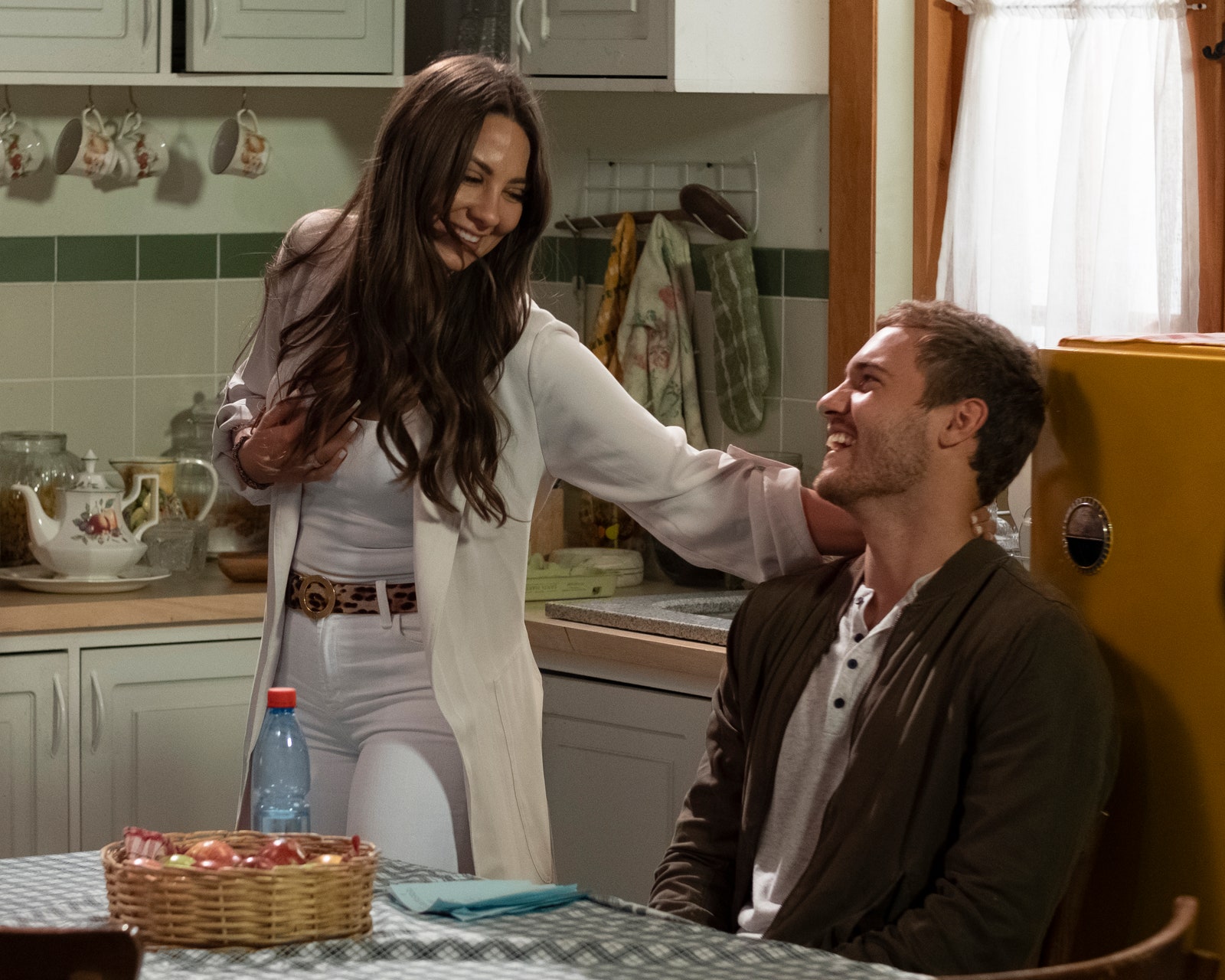
Earlier this week, contestant Kelley Flanagan (who has rekindledsome sort of relationship with Peter Weber during quarantine) spoke to Bachelor alums Ben Higgins and Ashely Iaconetti on their “Almost Famous” podcast to address some behind-the-scenes actions viewers at home didn’t see. Per Us Weekly, she claimed producers “manipulated” Weber and “locked me up in a closet for three hours” so they couldn’t interact. Wait, what?!
Before you freak out, Chris Harrison spoke with Entertainment Tonight on April 10 to clear up the situation. The show’s longtime host told ET reporter Lauren Zima that he called Flanagan to talk about her recent interview. “I said, ‘What was that? We don’t lock people in closets, so clearly you weren’t locked in a closet for three hours,” he recalled of the conversation. Harrison also said her comments were “taken a little out of context.”
“What she meant by that was she was frustrated. She’s a smart girl who I think is used to getting what she wants, and she didn’t get that time with Peter,” the host said, believing that Flanagan may have been referring to a moment in Cleveland when she was being interviewed by a producer. “You’re not in a closet. It’s in a room, and sometimes it takes hours,” he explained. “It depends on what’s going on at the time… I think Kelley was frustrated at the time, and that’s how she articulated that.”
Harrison went on to tell ET that Flanagan apologized for how her statements were perceived. “She said, ‘That was not what I meant to say.’ She’s like, ‘I’m so sorry that it came out that I was locked in a closet,'” he said. “So everybody, it’s okay. Kelly was not locked in a closet, she’s safe and she’s good, and she apologized and I laughed it off. I was like, ‘I get it, I knew what you were trying to say.'”
Getty Images
That same day, Harrison also told Glamour he was surprised by Flanagan and Weber’s newly rediscovered connection. “That one caught me out of the blue,” he said. He also recognizes how much Bachelor news has been flying around during this period of isolation.
“I think once we all come out of this quarantine, there’s going to be a lot of catching up to do to figure out what’s been going on,” Harrison said. We’re sure he’ll keep us posted.
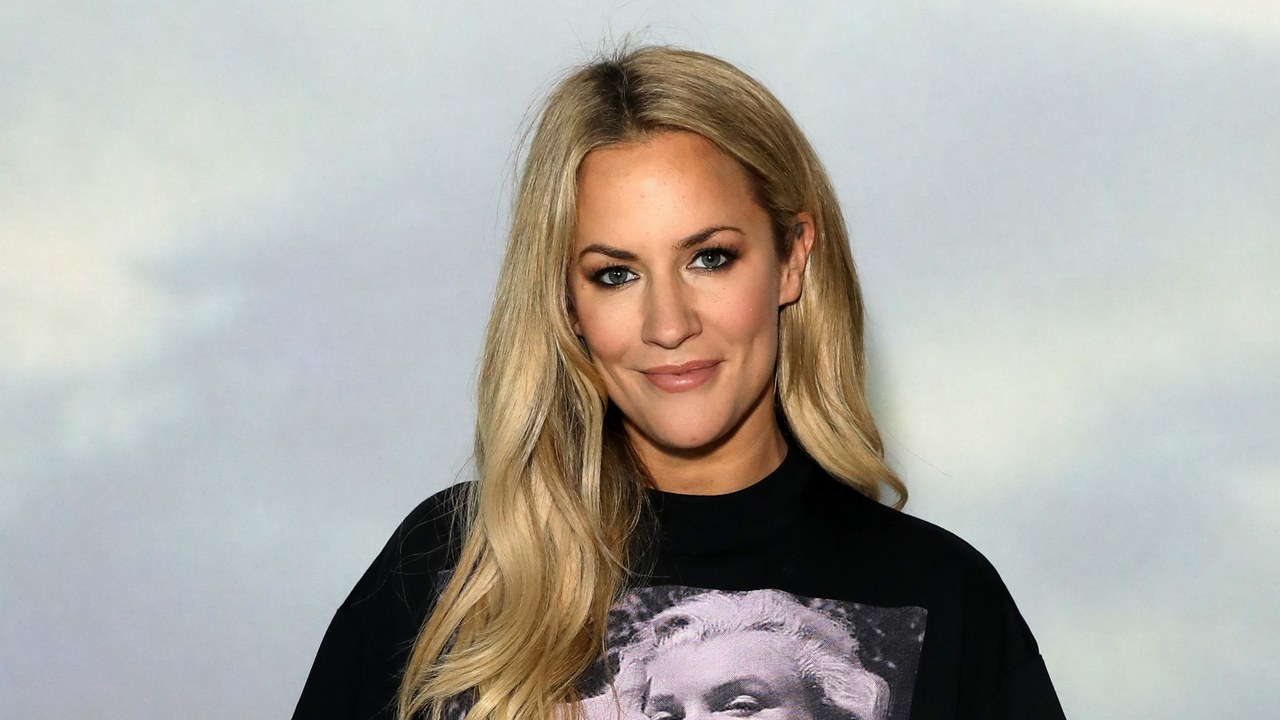
Caroline Flack, the former host of Love Island UK, has died at the age of 40.
According to multipleoutlets, the TV presenter was found dead at her home in London, England on Saturday, February 15. The cause of her death has yet to be determined.
“We can confirm that our Caroline passed away today, the 15th February,” her family said in a statement, according to BBC News. “We would ask that the press respect the privacy of the family at this difficult time and we would ask they make no attempt to contact us and/or photograph us.”
Following news of her death, several former Love Island contestants started sharing touching tributes on social media.
“I’m utterly shocked and heartbroken. Caroline you were such a special woman. Your huge smile will stay with me forever… Rest in peace,” Molly-Mae Hague captioned a photo posted to Instagram.
“Caroline Flack you supported me always, you were so kind to me & my family, I will never forget that. I spoke to you, and gave my support during the recent media intrusion. The media & trolls are killing people. Please THINK before you speak,” Zara Holland tweeted.
“Words can’t sum this up,” Chris Hughes wrote. “So sad. Another amazing person taking from this cruel world. When will people and and press release celebrities are humans, with the same feelings everyone else has. Can’t believe to imagine the pain. God bless Caroline and her family. Rest tight.”
“So so shocked at this news, rest in perfect peace Caroline Flack,” Leanne Amaning added.
“This is horrendous,” Dom Lever tweeted.
Laura Whitmore, who recently replaced Flack as the host of Love Island, tweeted a photo with the caption, “I’m trying to find the words but I can’t.”
See more tributes and reactions, below:
In December, Flack was arrested over allegations that she assaulted her boyfriend, tennis player Lewis Burton, during an incident at her London home. She later stepped down from her role as Love Island host and was replaced by Whitmore. Flack pleaded not guilty and was due to appear in court on March 4.
“Been advised not to go on social media,” she wrote on Instagram that month. “But I wanted to say happy Christmas to everyone who has been so incredibly kind to me this year….. this kind of scrutiny and speculation is a lot to take on for one person to take on their own… I’m a human being at the end of the day and I’m not going to be silenced when I have a story to tell and a life to keep going with …. I’m taking some time out to get feeling better and learn some lessons from situations I’ve got myself into to. I have nothing but love to give and best wishes for everyone.”
She returned to social media on Friday, February 14 to post a series of photos with her dog, with she simply captioned, “❤️.”
Our thoughts are with Caroline Flack’s loved ones during this difficult time.
Here’s some good news that will have you forgetting about Ricky Gervais’s scorched-earth monologue from this year’s Golden Globes and eagerly counting down the days until next year’s telecast.
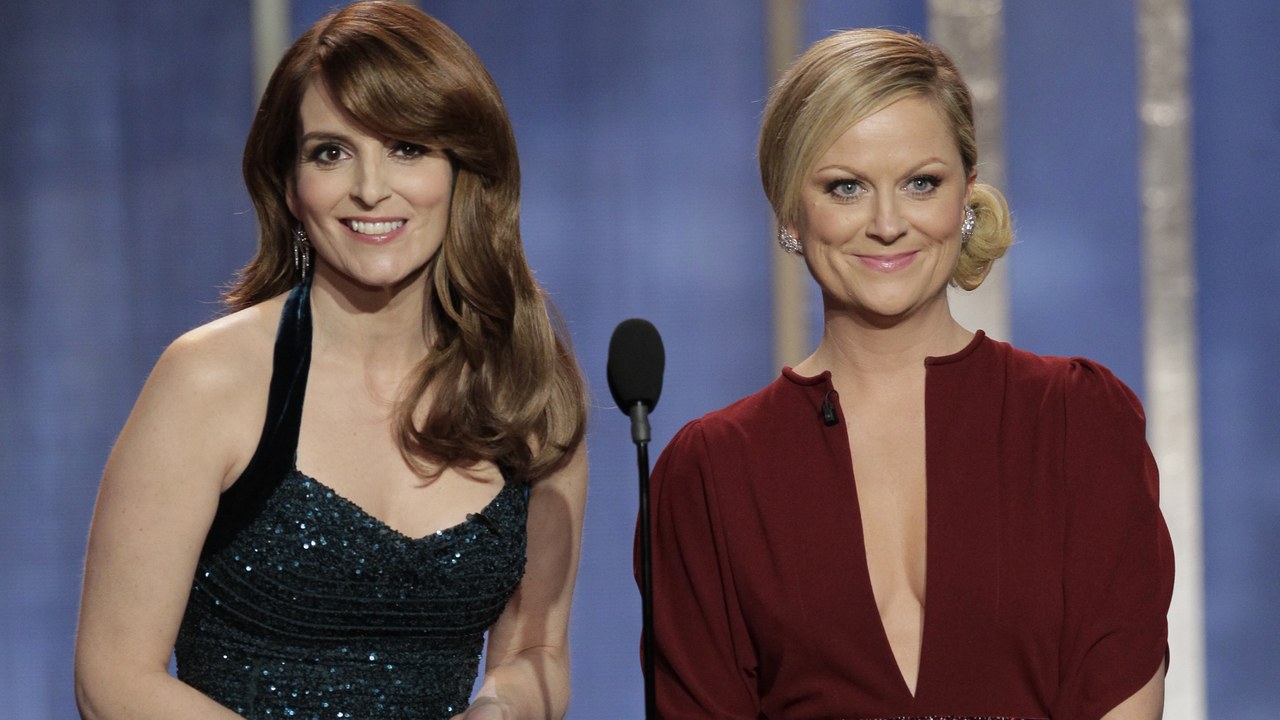
“NBC has long been the home to two of the funniest people on the planet—Tina Fey and Amy Poehler—and we didn’t want to wait any longer to share the great news that they’ll be hosting the Globes once again,” Paul Telegdy, Chairman of NBC Entertainment, shared in a statement during the 2020 TCA winter press tour on Saturday, January 11.
The pair, who worked on Saturday Night Live together, as well as starred in films including Sisters, Mean Girls, and Netflix’s Wine Country, co-hosted the award show three years in a row, from 2013 to 2015, and were widely praised for their amazing chemistry, witty jokes and unforgettable monologues. (Who can forget thatAmal and George Clooney joke? Epic.)
In 2015, Fey and Poehler claimed it would be the last time they hosted. But a public plea to get them back seems to have worked.
“There’s no denying that Tina and Amy’s comedic chemistry is infectious,” Lorenzo Soria, President of the HFPA, said. “We can’t wait to see the dynamic duo return to the Golden Globes stage.”
While Fey wasn’t in attendance at this year’s awards show, Poehler was a presenter alongside Taylor Swift. The duo are taking over from five-time host Gervais, who vowed during the show he would not be returning. Fey has previously won two Golden Globes for 30 Rock and Saturday Night Live while Poehler won a Golden Globe in 2014 for Parks and Recreation.
The date for the 78th annual Golden Globes has yet to be announced.
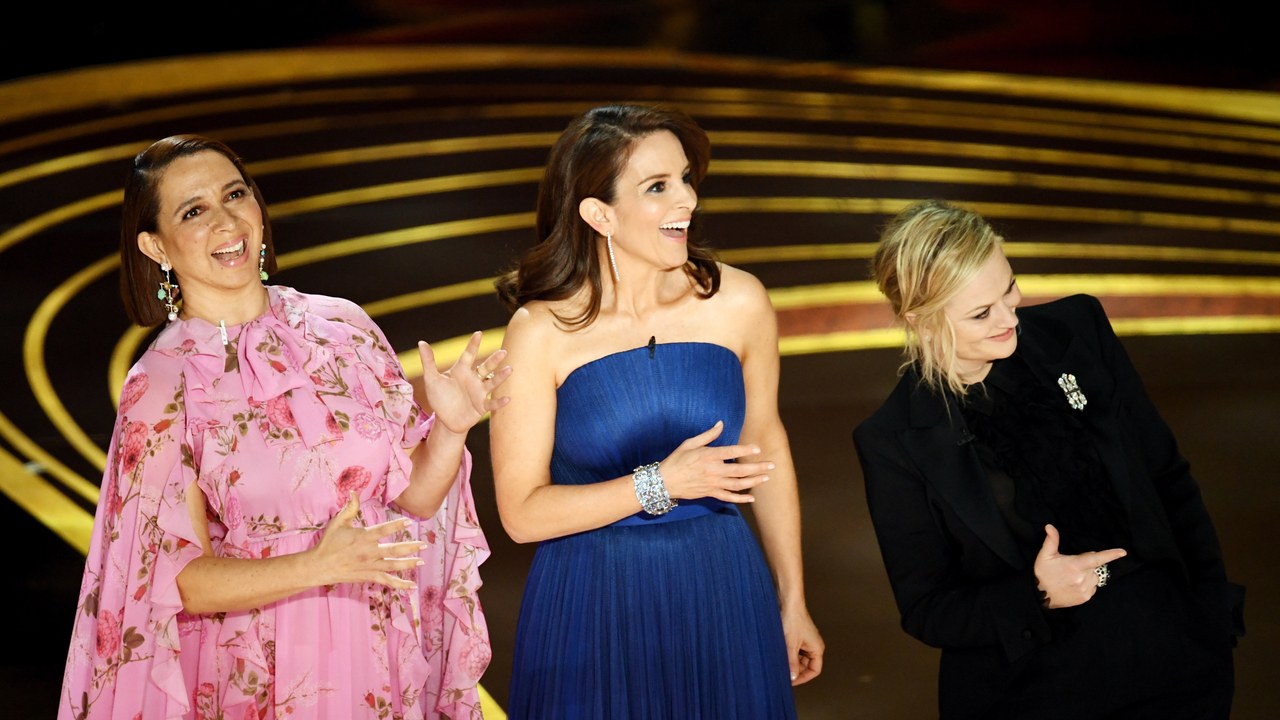
For the first time in thirty years, the Oscars went forward without a host. There was much speculation about what the award ceremony would be like without a traditional emcee, but turns out it was handled: Three legends—Tina Fey, Maya Rudolph, and Amy Poehler—were brought out to set the tone for the evening.
Taking the stage early in the show, Fey joked right away that the three were definitely, 100 percent not the evening’s hosts. “We are not your hosts, but we’re going to stand here a little too long so that the people who get USA TODAY tomorrow will think we hosted.”
This lead to all of us watching at home to wonder the same question: Why the hell weren’t they hosting the Oscars? One viewer even tweeted, “Maya Rudolph, Tina Fey and Amy Poehler should never be at an awards show not hosting it.”
Fey, Rudolph, and Poehler have been slaying the game together since they were all co-stars on Saturday Night Live. (Their famous “mom jeans” sketch from the show is worth a revisit, if you somehow haven’t seen it.) And it’s not like these women don’t have experience—Fey and Poehler have hosted the Golden Globes together multiple times, starting in 2013. Last year, after Rudolph presented at the Oscars alongside Tiffany Haddish, Twitter lead a campaign for the two of them to host the 2019 show together.
Imagine a world where we got more than just three quick minutes of Fey, Rudolph, and Poehler’s banter? Even better, what if that included a few incredible cameos from Haddish? Hello, ratings gold.
Instead, they revealed that they were simply on stage to present the Best Supporting Actress award—no surprise hosting twist here. The three then spoke out about how women always offer a supporting role in their work. While that included joking that they support each other’s boobs (because, of course) and that Rudolph dubs Fey’s lines overseas, their message rang true. After The Oscars suffered from a series of controversies leading up the ceremony—including the removal of original host Kevin Hart—these women still showed up and supported the Oscars, helping the show put its best food forward. Because that’s what women do.
Sandra Oh had a very good night at the 2019 Golden Globes: She kicked off her duties as host with an incredibly heartfelt speech, made some hilarious jokes, and then went on to collect her own trophy for Best Actress in a TV Drama, becoming the first Asian-American woman to win that category in almost 40 years. Throughout all of this, Oh wore a trio of incredible gowns that were quite meaningful themselves.
In an interview with The Hollywood Reporter, Elizabeth Saltzman, Oh’s stylist, explained that they decided to showcase exclusively “strong female designers” through the actress’ wardrobe at the Golden Globes. “I decided to think of things that would make her feel confident and empowered and beautiful,” she said.
The two women who best communicated that, Saltzman added, were Donatella Versace and Stella McCartney. “I don’t know a more fearless, bold person who works harder than Donatella,” she said. “Donatella really gives. She’s super empowering, and super fun, and has been through stuff.” McCartney, meanwhile, helped them create “the most amazing kapow! dress” that “[felt] like something out of the great Hollywood films of yesteryear.”
See all of Oh’s female-designed looks from the 2019 Golden Globes, ahead.
This story is part of a 10-part series profiling the “warrior women” behind the Hello Sunshine x Together Live tour, a band of all-female storytellers who traveled to 10 cities across North America in November. On tour, the women shared their stories and songs, and made 10,000 women across though country laugh and cry. Learn more about Hello Sunshine x Together Live here—and get excited to join the party in 2019.
Hosting a holiday party always seems like a good idea, in theory. A cozy night in with friends—nothing fancy!—with some festive sweaters and Santa-themed Champagne cocktails. What could possibly go wrong? But then, day-of, you find yourself simultaneously cooking and cleaning and yelling “Where’s the effing cookie platter?” while cursing Martha Stewart for ever setting an “easy-but-elegant” table. And suddenly all you want to do is bolt the door and drink the Champagne straight from the bottle.
But there’s good news, beleaguered hostesses: It’s possible to host a party without making yourself with miserable. Inspired by Priya Parker, author of The New York Times BestsellerThe Art of Gathering: How We Meet and Why It Matters, people everywhere are enjoying gatherings more—and worrying less about what direction the knife is supposed to face. Below, find Priya’s advice, in her own words. And then follow it, starting now.
I grew up with images of what I thought the perfect dinner party had to look like: a beautifully set table, gorgeous wine glasses, a vase of flowers set just so. I attended cotillion classes as a pre-teen, where an instructor would roll out a white-clothed table and instruct us on how to properly display a napkin, where to set teaspoons, and what to do if you drop a fork on the floor. (Leave it there.) I’d leaf through my stepmother’s hosting diary from the ’70s, where she meticulously captured which recipe she tried, to whom she served it, and the date. I grew up with the implicit message that there was a right way of gathering and that it took a particular form. And, furthermore, that if you got the “things” of a gathering right–the food, the settings, the wine–the night would be a success. And implicitly, to gather well, one had to eventually obtain those specific things and follow a specific inherited form. And, lucky me, there was an entire industry designed to help me on my way.
Years later, I became a group conflict resolution facilitator and found myself designing experiences for Hindus and Muslims after riots in India trying to rebuild their neighborhoods, for the World Economic Forum trying to find its way to a more authentic culture, and for government agencies trying to figure out how to revamp a national poverty program. What all these gatherings had in common was that no one had any idea what they “should” look like. And because of that, we had freedom to invent. In addition to my own work, I set out to study the world’s most remarkable gatherings, and in speaking with over a hundred gatherers around the world, I learned a mantra that has deeply freed me in my own hosting: It doesn’t have to look a certain way. In fact, gatherings are far more interesting, meaningful, and memorable when they don’t. As you get ready for the holidays, and for a new year, here are some tips to help you host meaningfully on your own terms:
Throw a “Worn-Out Mom’s Hootenanny,” Not a Dinner Party
Spending time and energy on our gatherings isn’t what is making us miserable. Rather, spending time and energy on predictable, routine gatherings is. When our gatherings go into autopilot, it’s hard to connect meaningfully. Instead of starting with the supposed form of something (a dinner party, a workshop, a house party), start with a need in your life you could gather around and then design afresh around it. Take for example, a dinner party Jancee Dunn, a writer, wanted to host at her place. She came to me for advice on how to “Art of Gather-ify” her dinner party. Rather than giving her tips on the form of a dinner party, I asked her instead: What is a need in your life right now that by gathering other specific people they could help you fulfill? She said that she, in addition to being a writer, was a worn-out mom. She realized how worn out she was when a friend cut her a PBJ into triangles, and she felt so deeply taken care of. Jancee wanted a night where she wasn’t only in the care-taking role, and thought perhaps she could host something to gather her other worn-out mom friends. She gave it a name: The Worn-Out Mom’s Hootenanny. She gave it a rule: If you talk about your kids, you have to take a shot. She emailed six mom friends the idea and they all RSVP’d yes immediately. She took a general evening and made it specific, disputable, and exciting.
Don’t Assume a Party Has to Look a Certain Way
A friend of mine was leaving a well-paid job to become a metal artist and wanted to host a gathering to mark the transition. But rather than just hosting a party and inviting everyone in her life to it, she invited a subset of people: those who gave her courage. Like many of us, she had a range of people in her life who had various opinions about her decisions. She certainly had a set of peers and colleagues who thought she was nuts to leave a high-paying, prestigious job to explore something that was effectively more of a hobby. And she also had people in her life that thought it was awesome and admired the decision. She invited a subset of us—who didn’t all know each other—for a dinner to help her commit to her choice, mark it, and go through with it. She asked us each to bring a poem or some words to share with the group that have helped us when we took big risks. After some general hanging out, she gathered everyone into the living room and we sat on the floor around a glass coffee table and munched on some carrots and celery sticks and mozzarella balls. There were a few bottles of wine open. She started the evening by talking about why she was going to leave this job, and why she believed so deeply in pursuing metal artistry. She said that she was also scared about her choice, and asked us each there to help keep her on her decision when she felt wobbly. I felt immediately drawn in, and inspired by both her boldness and her vulnerability. She had made up a structure for the evening that fit her needs: To tap a sub-community in her life to help her uphold a decision when it got scary. And, she let us know that we could actually help her with that. We each had a chance to share our reading and any advice we had. And the evening became a night of stories and risk-taking and community. It was her “farewell party,” but there was no sheet cake.
Don’t Over-Include
If you’re anything like me, you grew up with the age-old adage, “The more, the merrier.” That is certainly true for football games and barn-raising, but it is not true for many of the moments we typically gather. When you know why you’re gathering and what for, it’s the more the scarier. Before my husband and I were married, we had gone home for the holidays and were going to get our parents together for an afternoon tea to get to know each other better. My parents happened to have an aunt visiting, and it happened to be her birthday. At the last minute, she wanted to come, too. To her surprise, we asked that she not come because it was such a rare occasion for our two sets of parents to meet before our marriage. And, effectively, she wasn’t a parent. It wasn’t personal, it was purposeful.
If You Think You’re Over-Doing It, You Probably Are
“People are throwing birthday parties for their 1-year-olds with photo booths and a cake-smash portrait session and a sit-down meal, and the parents are miserable and over-spending, and the kid would rather be home with them and an empty box, anyway,” an editor friend said recently. “Amirite?” She is right. When we get stuck to the form of something, we think reciprocity has to be in the same form (and take the same financial value). They had a bouncy house at their birthday party, how can we not? This is a recipe for collective misery. Instead, assuming each family is different, ask: “What is a need in my kids’ life right now, that by gathering people together in a certain way could help fulfill?”
“Maximize your gathering for the people in the room. And if the magic was hard to capture for someone who wasn’t there, you’re probably moving in the right direction.”
Don’t Aim for Instagrammable. Aim For “You Had to Be There”
One danger of Instagram is that, because it is a visual medium, it rewards moments that are visually captivating to people who are not there. A stunning table setting is easier to capture than a memorable conversation. A group selfie is imminently more postable than a conversation about how to deal with sick parents, or how to choose the right partner, or even, what to do about location monitoring services and the tradeoff between privacy and convenience. The danger of the Instagrammable gathering is that you start making trade-offs between two different audiences: the real-life, flesh-and-blood guests in front of you, and those not there. Sometimes these two audiences have the same needs, but more often than not, they don’t. Think ahead of time about your “phone philosophy” and set some norms around when and how (and if) people can take photos of the gathering, and whether and how to share them. As we’ve seen over and over, when we believe we are being watched or will later be seen by some future audience, our behavior changes. Maximize your gathering for the people in the room. And if the magic was hard to capture for someone who wasn’t there, you’re probably moving in the right direction.
Visit Priya online at priyaparker.com, buy The Art of Gathering here, and follow Priya on Instagram at @priyaparker, where you will not find any overwrought “did it for the ‘gram” party selfies.