
Categories
Health

The Big Problem With the New WHO Screen Time Guidelines


A few weeks ago I was talking with a friend of mine about a new wrinkle in her work schedule. Normally, she worked from home on Tuesdays and was able to crank through most of her emails while her two young children took their afternoon naps. Recently, though, the older child had dropped her nap altogether, and my friend found herself—a woman who hadn’t even owned a TV most of her adult life—turning on Peppa Pig for her daughter every afternoon for an hour and a half. (For the uninitiated, Peppa Pig is a British cartoon about a pig and her animal friends.) “It’s not ideal,” she said. “But what else can I do?”

As it turns out, my friend is violating a recommendation from the venerable World Health Organization (WHO), an agency of the United Nations focused on public health. According to a recent report from the WHO, children between the ages of one and four should spend no more than 60 minutes per day on screens. (“Less is better,” the report cautions.) For children under 12 months, “screen time is not recommended.” A New York Times article about the WHO report acknowledges that “there is limited data on the short- and long-term effects” that exposure to screens even has on children, but cites David Hill, M.D., a pediatrician and the author of a 2018 study from the American Academy of Pediatrics that urges no screen time other than video chatting for kids under 18 months. Hill tells the Times that the WHO appears to be “applying the precautionary principle, and saying: ‘If we don’t know that it’s good, and there’s any reason to believe it’s bad, why do it?’”

Well, I’ll tell you why: To get dinner ready without screaming kids hanging on to your legs. To work, like my friend is doing, so that she can be present with her family for the rest of the day. To tend to a sick relative who lives with you. To take a shower, make coffee, schedule a doctor’s appointment, take a work call, text your best friend, or do absolutely anything that can give you a break from the omnipresent need fulfillment that is parenting young children.

There are hundreds of reasons that can explain why a parent may give their child more than 60 minutes of screen time on a given day, but the bogeyman of the prematurely obese, TV-addicted toddler, who also has the attention span of a small rodent, has developed so fast that few have paused to consider what the people who peddle it are really afraid of. Like the fear of the trumped-up “welfare queen” before it, this new “abundance of caution” has its roots in classism and racism rather than facts.

Of course no reasonable person believes that all constraints on screen time are bad, especially for children. It’s good for kids to get exercise! It’s good for kids to learn to play with others, use their imaginations, and even get bored. When I was a kid, we were limited to an hour per day of daily screen use—and this was back when modems took, like, 10 minutes to connect to the Internet! I’m glad I had to make up activities to fill my time, or I’d have spent it all reading Hanson fan fiction and talking to my crushes on AIM. But now, as a parent myself, I can see why the WHO’s recommendations seem draconian and out of touch with reality. My son is only one, but already his attention is easily captured by screens, which we rarely have on in our home. According to the WHO, he shouldn’t even know what a screen is at his tender young age. Should I be questioning all the episodes of Parenthood I watched while nursing? Or the Golden State Warriors games we occasionally have on in the background?


Source link

Categories
Health

The Royal Family Just Issued Strict Social Media Guidelines for Commenters


The British royal family is always about rules and protocols, both formal and informal. And ever since Meghan Markle and Kate Middleton joined the family, information about things like who has to curtsy to who and whether or not they’re allowed to close their own car doors have become subjects of fascination. Now, in a joint message from Queen Elizabeth II, Prince Charles and Camilla Parker-Bowles, Prince William and Kate Middleton, and Prince Harry and Meghan Markle, the royals are laying down the rules for commenters on their respective social media channels: @RoyalFamily, @ClarenceHouse, and @KensingtonRoyal..

The new social media community guidelines are likely a response to the increasingly negative interactions in the comments section, most prominently around commentary about Middleton and Markle. Even a casual glance at comments on posts about the two show some rather heated exchanges that can often become nasty and defamatory. This new announcement would seem to be an attempt to reign in the trolls.

“The aim of our social media channels is to create an environment where our community can engage safely in debate and is free to make comments, questions and suggestions,” the guidelines read. “We ask that anyone engaging with our social media channels shows courtesy, kindness and respect for all other members of our social media communities.” Basically, they’re looking for a common sense of decorum that is often lost on the Internet by laying out specific rules—and consequences.

They say that comments must not:

  • Contain spam, be defamatory of any person, deceive others, be obscene, offensive, threatening, abusive, hateful, inflammatory or promote sexually explicit material or violence.
  • Promote discrimination based on race, sex, religion, nationality, disability, sexual orientation or age.
  • Breach any of the terms of any of the social media platforms themselves.
  • Be off-topic, irrelevant or unintelligible.
  • Contain any advertising or promote any services.

If you break any of the above, they can hide or delete your comments or block you altogether. On a more serious note, obviously related to the safety of members of the family, they “reserve the right to send any comments we deem appropriate to law enforcement authorities for investigation as we feel necessary or is required by law.”

Hopefully this will squelch some of the nasty commentary happening around the Duchess of Cambridge and the Duchess of Sussex. And it seems a perfect time to remind everyone that you can indeed have a preference for one woman without “hating” or demonizing the other—or just love them both, like we do.


Source link

Categories
Health

Department of Education Releases New Guidelines for Sexual Assault on Campus


“You know you are not on trial,” said Senator Kamala Harris (D–Calif.). “You are not on trial.” It was September, and Sen. Harris was addressing Christine Blasey Ford, who’d come before the Senate Judiciary Committee to testify against then nominee (now Supreme Court Justice) Brett Kavanaugh.

It had already been a heartbreaking few hours—few weeks, really. So much of it blurs together, like a horror movie. But I’ll never forget the relief and pain I saw on Blasey Ford’s face when Sen. Harris reminded us all that holding people to account should never mean putting a survivor on trial. Just as the Senate Judiciary Committee shifted so much of the burden, shame, and scrutiny onto Blasey Ford, systems that are supposed to be created to help survivors seek justice often instead shift a massive burden to the survivor. Doing so keeps survivors from reporting and can retraumatize them in the process.

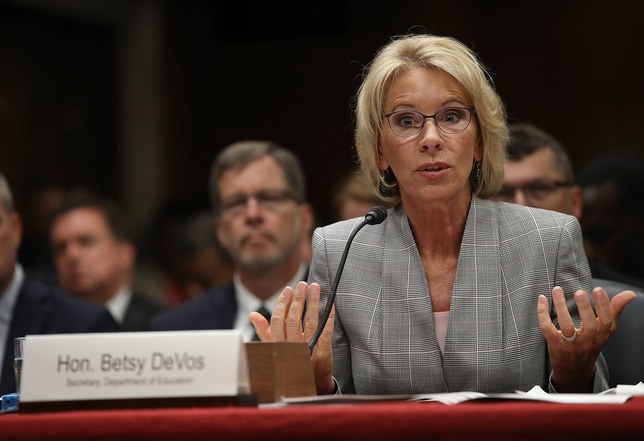
That’s just one reason I’m raising the alarm about the new regulation on Title IX that Secretary of Education Betsy DeVos released last week. If it becomes law, these rules could force millions of student survivors of sexual assault and harassment to endure the same kind of cruel process Blasey Ford did. It’s a sham procedure, not to mention one that puts the survivor on trial and gives the benefit of the doubt to the perpetrator, instead of seeking the truth.

Schools would not be required to investigate assaults that take place in several off-campus locations, shutting out the thousands of survivors who are assaulted at parties, bars, or online.

While Kavanaugh apologists waved off the accusations of misconduct against him, suggesting that violence committed in high school is either somehow irrelevant or outside the jurisdiction of the Senate committee, the new regulation intends to give schools similar latitude, claiming that these institutions should not be responsible for investigating and intervening in many instances of sexual violence that affect their students.

According to the regulation, schools would not be required to investigate assaults that take place in several off-campus locations, shutting out the thousands of survivors who are assaulted at parties, bars, or online. Schools would now be required to investigate only complaints made to individuals who are empowered “to institute corrective measures” like a Title IX coordinator. What does that mean? In short, that schools would have zero obligation to start the formal complaint process if claims of assault are raised with coaches or resident advisers. If it’s hard to picture what an impact that could have, let me put it like this: Under the new rule, Michigan State University may not have been required to intervene in the case of Larry Nassar, because reports of his sexual abuse were made to coaches and athletic trainers. Further, the definition of sexual harassment that schools can now investigate is so limited and narrow that survivors could have to endure severe and repeated harassment before their treatment would “count” toward a Title IX complaint.

This proposed regulation from the Department of Education has been written in a manner that could prevent survivors from reporting their assaults and let schools avoid investigating Title IX complaints (and the bad press and expense that comes with it). Make no mistake: This will not make campuses safer, nor will it end sexual violence. What it will do is cause a huge decrease in reports of sexual violence at schools.

If it takes effect, this rule could make reporting and investigation procedures for survivors cruel, degrading, and difficult to access, in the hopes perhaps that survivors will give up on reporting if the process retraumatizes or marginalizes them enough.

Moreover, the regulation would disproportionately affect students of color, LGBTQ students, students living with disabilities, and low-income students by creating additional traumatic barriers to healing and justice. And in a flagrant misapplication of Title IX, which was implemented to protect and expand opportunities for women in education, the rule allows named harassers to claim sex discrimination if the school opens an investigation into their conduct.

It’s not enough to claim that we “support survivors” if we don’t commit to policies and proposed action that would do just that.

Thanks to the Me Too movement, we’ve all become more attuned to the needs of survivors, and millions of us are committed to ending sexual violence. We have made believing survivors (and seeking justice) a powerful moral imperative for all. But I fear that people in power—like school administrators, senators, and DeVos herself—continue to pay lip service to the importance of taking survivors seriously, while simultaneously making it almost impossible for them to be heard. It’s not enough to claim that we “support survivors” if we don’t commit to policies and proposed action that would do just that.

Everyone who was disturbed by the treatment of Blasey Ford before the Senate should be concerned now. This regulation will make schools more dangerous and, at the height of the Me Too movement, could take us backward.

While these provisions are horrific, this rule is not a foregone conclusion. Unlike our senators who ignored their moral and democratic duties to heed our calls to believe survivors, the Department of Education is obligated to listen to our critique of its rule through the notice-and-comment process. This rule can be stopped if all of us who were outraged on behalf of Blasey Ford submitted a comment that expressed our opposition to this regulation. Submitting a comment that the federal government will “count” must meet certain requirements—but End Rape on Campus and Know Your IX have built tools to ensure that your voice can be heard. Learn more at HandsOffIX.org.


Jess Davidson is a survivor of sexual assault, and the executive director of End Rape on Campus, a national nonprofit dedicated to ending campus sexual assault through direct support, education, and policy reform.


Source link

Categories
Health

'Wonder Woman 2' Will Be the First Film to Adopt New Anti-Sexual Harassment Guidelines


In light of the #MeToo and #TimesUp movements, the Producers Guild of America announced Saturday night (January 20) that it’s implementing new guidelines to combat sexual harassment and misconduct on film and TV sets. This change is long overdue, of course, but luckily these new standards will go into effect soon: They’ll start with the production of Wonder Woman 2, according to Vanity Fair Hollywood Correspondent Rebecca Keegan.

Wonder Woman 2 will be first film to officially adopt new #PGA policies on sexual harassment, PGA presidents announce at #PGAwards,” Keegan tweeted Saturday night, when the Producers Guild of America Awards took place. It’s still unknown exactly when production on Wonder Woman 2 will start, but it’s expected to hit theaters on November 1, 2019.

Brie Larson and Lupita Nyong’o talked about these new guidelines at last night’s Screen Actors Guild Awards, with Larson saying, “We’re so excited to say that—with collaborations with Time’s Up and your union members here in this room—there will be a new code of conduct to ensure that there is safety on set, so we can continue to be vulnerable, continue to be empathetic, and do the strong and great performances that we’ve seen brief glimpses of here tonight.” Nyong’o added, “It gives us joy to celebrate portrayals that show human nature with all its imperfections, and to do so with a union whose job it is to protect actors as they do that job.”

This new code of conduct is a strong indication that the Time’s Up movement is doing more than just raising awareness: It’s pushing the dial forward and effecting real, sustainable change. Hopefully, other industries will follow suit and implement similar guidelines in the workplace.

Related Stories:

Wonder Woman 2 Will Have Another “Great Love Story,” Says Director Patty Jenkins

Gal Gadot Confirms Brett Ratner Isn’t a Part of Wonder Woman 2

Wonder Woman Sequel: Here’s Everything We Know So Far


Source link

Categories
Health

Betsy DeVos Just Officially Killed Obama's Campus Sexual Assault Guidelines


PHOTO: Win McNamee/Getty Images

Education Secretary Betsy DeVos incited an uproar early in September when she announced plans to do away with Obama-era guidelines on how campuses should investigate allegations of rape and sexual assault. Now, she’s officially followed through on her promise.

The Department of Education’s Office of Civil Rights announced Friday that it’s withdrawing two key pieces of Title IX guidance. One is the 2011 Dear Colleagues Letter, a comprehensive directive how schools receiving federal funding should handle sexual violence on campus—everything from evidence-gathering protocol to how quickly cases should be investigated. The other is a 2014 document called Questions and Answers on Title IX and Sexual Violence, which clarified certain elements of the 2011 DCL.

“The 2011 and 2014 guidance documents may have been well-intentioned, but those documents have led to the deprivation of rights for many students—both accused students denied fair process and victims denied an adequate resolution of their complaints,” Candice Jackson, the Department of Education’s Acting Assistant Secretary for Civil Rights, wrote in a new Dear Colleagues Letter. “The guidance has not succeeded in providing clarity for educational institutions or in leading institutions to guarantee educational opportunities on the equal basis that Title IX requires. Instead, schools face a confusing and counterproductive set of regulatory mandates, and the objective of regulatory compliance has displaced Title IX’s goal of educational equity.”

In withdrawing the guidelines, Jackson said the Department of Education will “develop an approach to student sexual misconduct that responds to the concerns of stakeholders and that aligns with the purpose of Title IX to achieve fair access to educational benefits.”

We don’t yet know exactly what that new approach will look like, but Jackson said the department will solicit public comment in establishing its new policies—and “will not rely on the withdrawn documents in its enforcement of Title IX.”

The news was met with criticism from the left, some arguing that rescinding those Obama-era guidelines would make it even harder for sexual assault victims to come forward.

“Survivors of sexual assault have the right to feel safe and to be heard,” California Sen. Kamala Harris tweeted. “This decision is a disgrace.”

DeVos made it well known that she was considering changes to the Obama administration’s efforts to curb sexual assault on campus. In July, she held meetings with rape survivors and men’s rights activists who advocated for those accused of sexual misconduct; when she was finished, she hinted that changes would come soon.

“We need to do this right, we need to protect all students and we need to do it quickly,” she said at the time.


Source link

Categories
Health

Title IX: What to Know About the Campus Sexual Assault Guidelines Betsy DeVos Is Rolling Back


Remember the Obama administration’s efforts to curb rape and sexual assault on college campuses? Thanks to the Trump administration, that progress is now in jeopardy.

Speaking at George Mason University on Thursday about enforcement of the Title IX law, Education Secretary Betsy DeVos announced her plans to do away with Obama-era guidelines on how schools should investigate sexual assault.

“Instead of working with schools on behalf of students, the prior administration weaponized the Office for Civil Rights to work against schools and against students,” she said.

Here’s what to know about Title IX and the uncertain future of campus sexual assault investigations.

What is Title IX?

Title IX of the Education Amendments of 1972 is a federal law banning sex-based discrimination at any school that receives federal funding.

Here’s what it says: “No person in the United States shall, on the basis of sex, be excluded from participation in, be denied the benefits of, or be subjected to discrimination under any education program or activity receiving federal financial assistance.”

In other words, the law upholds gender equality on campuses nationwide.

What does it have to do with sexual assault?

Thanks to various Supreme Court rulings and guidance from the Department of Education, Title IX’s ban on sex-based discrimination applies to sexual harassment, sexual assault, and rape on campus. A school receiving federal funding can face legal trouble if it knowingly ignores reports of sexual violence in its programs or activities.

The Obama administration was serious about cracking down on campus sexual assault, and in 2011, the Department of Education issued a key piece of Title IX guidance called the Dear Colleague Letter. The DCL wasn’t a law, but a directive on how schools should handle sexual violence issues. Here’s an overview of everything the DCL covered.

With Trump in office, those Obama-era guidelines have been in jeopardy.

It’s sad, but true—and sexual assault survivors and their advocates have been worried.

DeVos has been considering changes to her office’s policies on campus sexual assault, meeting in July with rape survivors and men’s rights activists who argued Obama’s guidelines unfairly favored accusers. At the time, she made it pretty clear that she was planning to take action.

“We need to do this right, we need to protect all students and we need to do it quickly,” she said.

On Thursday, that action finally came down.

In her speech at George Mason University, DeVos announced her plans to end Obama-era guidelines on how schools should handle sexual assault investigations.

“The era of ‘rule by letter’ is over,” she said, adding that the 2011 directive was a “disservice to everyone involved.”

As for putting together a replacement for the current rules, DeVos said the Department of Education will solicit public comment and feedback from universities.


Source link