Categories
Health

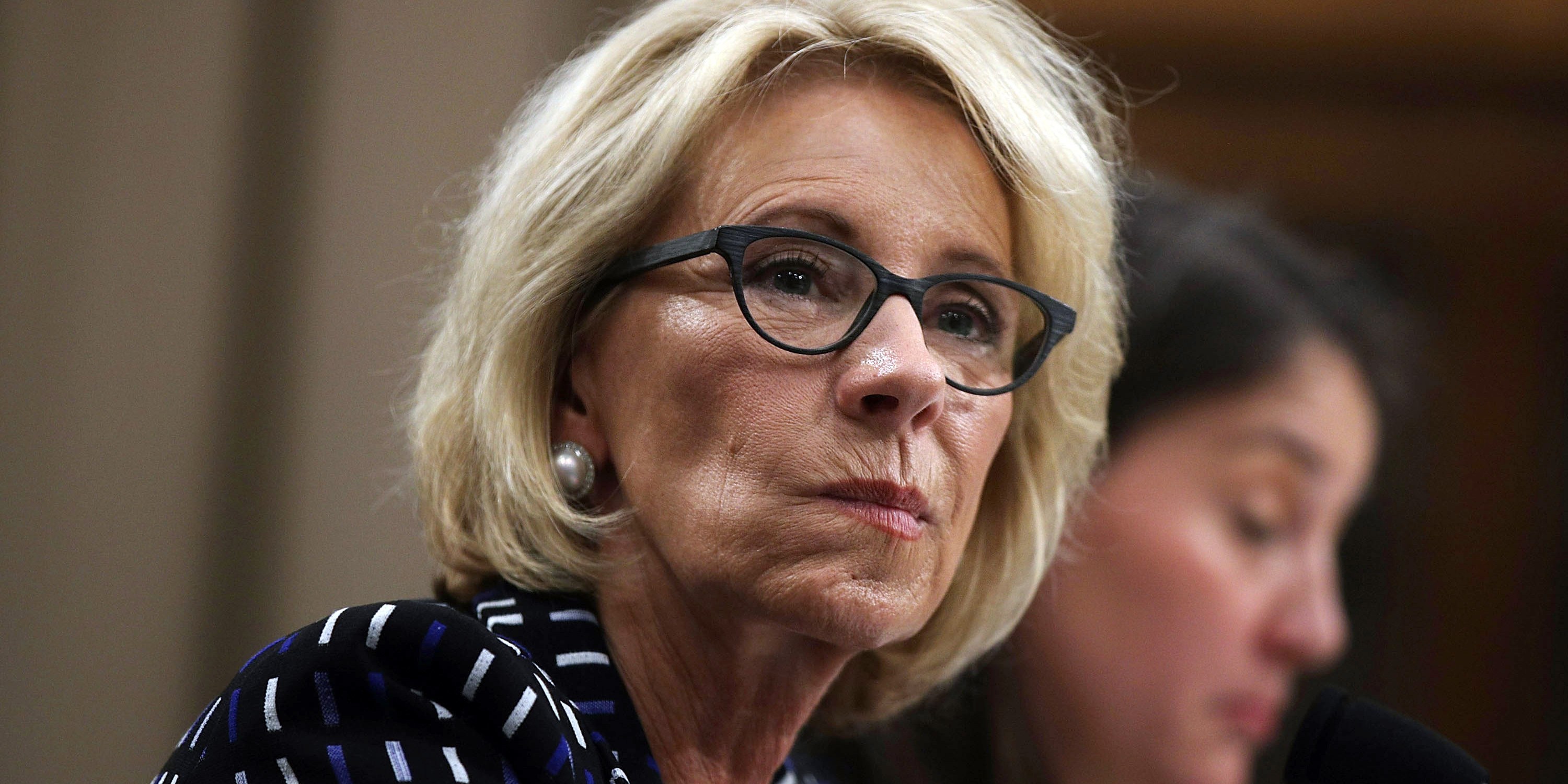
Education Secretary Betsy DeVos Says Trump's School Safety Commission Won’t Focus On The Role Of Fire Arms


In the wake of the Marjory Stoneman Douglas High School massacre that left 17 people dead, the Trump administration announced the creation of a federal commission to find “meaningful and actionable recommendations to keep students safe at school.”

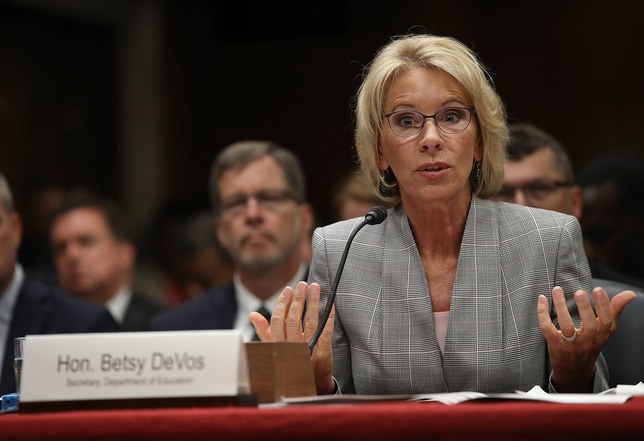
However, while giving testimony before a Senate subcommittee on Tuesday, Education Secretary Betsy DeVos said that although the commission is prioritizing safety for students across the country, it will not be focusing on the role fire arms play in school violence.

In a perplexing exchange, Senator Patrick J. Leahy, Democrat of Vermont asked whether the commission would look at the role of firearms in violence at schools. “That’s not part of the commission’s charge, per se,” DeVos said, according to the New York Times. Leahy responded, “So we’ll look at gun violence in schools, but not look at guns? An interesting concept.”

Keeping the role of fire arms off of the commission’s agenda is particularly confusing as conversations unfurl about how school shootings impact students. According to a year-long analysis conducted by The Washington Post in March, more than 187,000 students attending at least 193 primary or secondary schools have experienced a shooting on campus during school hours since the Columbine school shooting of 1999. The same analysis also found that since Columbine, there have been an average of 10 school shootings annually, with a low of five in 2002 and a high of 15 in 2014.

This year has been especially jarring: There have been 11 shootings less than three months into 2018, making it the worst year on record. (A similar report released by CNN in May takes the number of school shootings in 2018 to 23.) Many students, particularly those from Marjory Stoneman Douglas High and Santa Fe High School, have called out politicians for avoiding the subject of gun control. But DeVos’s comments feel entirely out of step with the national conversation that survivors of school shootings have been sparking by demanding change and organizing through the March For Our Lives movement.

DeVos also seemed to contradict the White House’s initial announcement about the commission where they listed several areas the group would examine, including age restrictions on certain firearm purchases.

So what will the commission look at if fire arms aren’t the charge here? According to The New York Times, “among other areas, the commission is slated to examine ratings systems for video games, the consumption of “violent entertainment” and the effects of news media coverage of mass shootings. The group is also charged with considering whether to repeal a package of Obama-era school policies targeted at addressing disciplinary policies that disproportionately affect minority students.

The commission is also looking to fund and bolster mental health and school infrastructure resources.”

While violent entertainment consumption and video games have been associated with school violence, Psychology Today points out that analyses of school shooting incidents—from the US Secret Service and the Federal Bureau of Investigation National Center for the Analysis of Violent Crime—do not support a link between violent games and real world attacks.

During Tuesday’s hearing, Leahy also seemed to take issue with the commission’s focus on things like video games rather than fire arms: “Well, you’re studying things like how much time they spend on video games and all that, but you can go to a lot of other countries where they spend just as much time but have only a tiny fraction of the shootings that we do,” he said.

Elizabeth Hill, an Education Department spokeswoman, appeared to walk back a few of DeVos’s comments after the hearing by telling the Washington Post, “The secretary and the commission continue to look at all issues the president asked the committee to study and are focused on making recommendations that the agencies, states and local communities can implement. It’s important to note that the commission cannot create or amend current gun laws — that is the Congress’s job.”

She did not respond when asked why DeVos’s statements at the hearing were different.

The commission, which includes Attorney General Jeff Sessions, Health and Human Services Secretary Alex M. Azar II and Homeland Security Secretary Kirstjen Nielsen, held their first public forum on Wednesday to solicit feedback and solutions for school safety. Many participants criticized the group for not considering the role of firearms in gun violence, according to CNN.

“We, the students, experience the American school system every day,” Alessia Modjarrad, a Montgomery County, Maryland high school senior said. “We used to sit in classrooms waiting for something to be done. I don’t want to be scared. I don’t want to think that, at any moment, someone with a gun could walk in and hurt us all.”


Source link

Categories
Health

Betsy DeVos Dressed As Ms. Frizzle for Halloween and Twitter Is Not Happy About It


At Monday night’s annual White House Halloween bash, a handful of administration officials stopped by the South Lawn to take part in the spooky festivities. Press Secretary Sarah Huckabee Sanders posed for photos with the President and First Lady, Secretary of Veterans Affairs David Shulkin donned a classic knife-through-the-headband, and Attorney General Jeff Sessions dressed as…Attorney General Jeff Sessions.

Going all out in her costume, however, was Education Secretary Betsy DeVos, who dressed up as The Magic Schoolbus‘ Ms. Frizzle.

Of course, the dichotomy between DeVos and her costume choice was staggering. After all, Ms. Frizzle is one of the most beloved literary characters of all time. DeVos is a woman who tries to divert money away from public schools, has no prior experience in public education, and recently reversed a slew of protections for survivors of sexual assault on college campuses.

As expected, Twitter was furious about Devos-as-Frizzle, and fired off a wave of angry tweets:


Source link

Categories
Health

Betsy DeVos Just Officially Killed Obama's Campus Sexual Assault Guidelines


PHOTO: Win McNamee/Getty Images

Education Secretary Betsy DeVos incited an uproar early in September when she announced plans to do away with Obama-era guidelines on how campuses should investigate allegations of rape and sexual assault. Now, she’s officially followed through on her promise.

The Department of Education’s Office of Civil Rights announced Friday that it’s withdrawing two key pieces of Title IX guidance. One is the 2011 Dear Colleagues Letter, a comprehensive directive how schools receiving federal funding should handle sexual violence on campus—everything from evidence-gathering protocol to how quickly cases should be investigated. The other is a 2014 document called Questions and Answers on Title IX and Sexual Violence, which clarified certain elements of the 2011 DCL.

“The 2011 and 2014 guidance documents may have been well-intentioned, but those documents have led to the deprivation of rights for many students—both accused students denied fair process and victims denied an adequate resolution of their complaints,” Candice Jackson, the Department of Education’s Acting Assistant Secretary for Civil Rights, wrote in a new Dear Colleagues Letter. “The guidance has not succeeded in providing clarity for educational institutions or in leading institutions to guarantee educational opportunities on the equal basis that Title IX requires. Instead, schools face a confusing and counterproductive set of regulatory mandates, and the objective of regulatory compliance has displaced Title IX’s goal of educational equity.”

In withdrawing the guidelines, Jackson said the Department of Education will “develop an approach to student sexual misconduct that responds to the concerns of stakeholders and that aligns with the purpose of Title IX to achieve fair access to educational benefits.”

We don’t yet know exactly what that new approach will look like, but Jackson said the department will solicit public comment in establishing its new policies—and “will not rely on the withdrawn documents in its enforcement of Title IX.”

The news was met with criticism from the left, some arguing that rescinding those Obama-era guidelines would make it even harder for sexual assault victims to come forward.

“Survivors of sexual assault have the right to feel safe and to be heard,” California Sen. Kamala Harris tweeted. “This decision is a disgrace.”

DeVos made it well known that she was considering changes to the Obama administration’s efforts to curb sexual assault on campus. In July, she held meetings with rape survivors and men’s rights activists who advocated for those accused of sexual misconduct; when she was finished, she hinted that changes would come soon.

“We need to do this right, we need to protect all students and we need to do it quickly,” she said at the time.


Source link

Categories
Health

Title IX: What to Know About the Campus Sexual Assault Guidelines Betsy DeVos Is Rolling Back


Remember the Obama administration’s efforts to curb rape and sexual assault on college campuses? Thanks to the Trump administration, that progress is now in jeopardy.

Speaking at George Mason University on Thursday about enforcement of the Title IX law, Education Secretary Betsy DeVos announced her plans to do away with Obama-era guidelines on how schools should investigate sexual assault.

“Instead of working with schools on behalf of students, the prior administration weaponized the Office for Civil Rights to work against schools and against students,” she said.

Here’s what to know about Title IX and the uncertain future of campus sexual assault investigations.

What is Title IX?

Title IX of the Education Amendments of 1972 is a federal law banning sex-based discrimination at any school that receives federal funding.

Here’s what it says: “No person in the United States shall, on the basis of sex, be excluded from participation in, be denied the benefits of, or be subjected to discrimination under any education program or activity receiving federal financial assistance.”

In other words, the law upholds gender equality on campuses nationwide.

What does it have to do with sexual assault?

Thanks to various Supreme Court rulings and guidance from the Department of Education, Title IX’s ban on sex-based discrimination applies to sexual harassment, sexual assault, and rape on campus. A school receiving federal funding can face legal trouble if it knowingly ignores reports of sexual violence in its programs or activities.

The Obama administration was serious about cracking down on campus sexual assault, and in 2011, the Department of Education issued a key piece of Title IX guidance called the Dear Colleague Letter. The DCL wasn’t a law, but a directive on how schools should handle sexual violence issues. Here’s an overview of everything the DCL covered.

With Trump in office, those Obama-era guidelines have been in jeopardy.

It’s sad, but true—and sexual assault survivors and their advocates have been worried.

DeVos has been considering changes to her office’s policies on campus sexual assault, meeting in July with rape survivors and men’s rights activists who argued Obama’s guidelines unfairly favored accusers. At the time, she made it pretty clear that she was planning to take action.

“We need to do this right, we need to protect all students and we need to do it quickly,” she said.

On Thursday, that action finally came down.

In her speech at George Mason University, DeVos announced her plans to end Obama-era guidelines on how schools should handle sexual assault investigations.

“The era of ‘rule by letter’ is over,” she said, adding that the 2011 directive was a “disservice to everyone involved.”

As for putting together a replacement for the current rules, DeVos said the Department of Education will solicit public comment and feedback from universities.


Source link