Categories
Health

Princess Sofia of Sweden Is Fighting COVID-19 as a Medical Assistant


Princess Sofia of Sweden is temporarily trading in her tiara for scrubs amid the coronavirus pandemic.

The Swedish royal (who married Prince Carl Philip in 2015) announced on Instagram on Thursday, April 16, that she’d gone through training and started working as a medical assistant at Sophiahemmet hospital in Stockholm to help in the fight against COVID-19. As you can see below, her ID card simply reads “Sofia.” The princess is also the honorary chairperson of the hospital.

“I am now placed in one of the hospital’s care departments, where together with other newly trained colleagues, I support and relieve the health care staff with different tasks,” Princess Sofia wrote on Instagram, explaining that her tasks will include cleaning and caring for patients.

“To have the opportunity to help in this difficult time is extremely rewarding,” she concluded. “Thanks!”

So how did she get this job? Well, an emergency program allows 80 people a week to take a three-day course at Sophiahemmet University College to learn how to support medical staff. According to a hospital spokesperson, the volunteers “can disinfect equipment, do shifts in the kitchen, and clean.”

Although the Sophiahemmet hospital has no confirmed coronavirus cases, it’s reportedly overwhelmed due to COVID-19. In a statement on Wednesday, April 15, the royal court said, “In the crisis we find ourselves in, the Princess wants to get involved and make a contribution as a voluntary worker to relieve the large workload of health care professionals.”

Princess Sofia of Sweden with assistant nurse Anna Kyhlstedt during Princess Sofia’s first day at work at Sophiahemmet hospital in Stockholm

Getty Images

Earlier this month, Miss England 2019, Bhasha Mukherjee, returned to work as a junior doctor at the Pilgrim Hospital in Boston, England. “When you are doing all this humanitarian work abroad, you’re still expected to put the crown on, get ready…look pretty,” she told CNN at the time. “I wanted to come back home. I wanted to come and go straight to work.”

As news about the novel coronavirus pandemic rapidly evolves, Glamour is committed to bringing our readers accurate and up-to-date information. As a result, information in this story and others like it may be updated. For the most recent news about COVID-19, please visit the CDC, WHO, and your state’s Department of Health.


Source link

Categories
Health

These Are the Lawyers Fighting for Your Abortion Rights


Despite her gold statement necklace, cat-eye glasses, corner office, and date with the Supreme Court, Northrup says she is “fundamentally a shy person.” The fact that there is a direct line between her and millions of women’s abilities to control their own bodies is stressful, she acknowledges: “100%.” How does she handle it? “It’s actually a churchy concept, which is that we are stewards for an institution,” she says. “I take very seriously, and with great gratitude, the fact that I am able to be in this role as a steward for this institution at this time, and someday it will be someone else who will take the mantle from there.”

But for now, the mantle is heavy around her shoulders—and Tu’s and Rikelman’s. Two weeks before their Supreme Court date, the three of them sat in a conference room at the center for a press conference. An all-women camera crew collected footage for a documentary on the center. Northup introduces everyone, and then invites the Hope Medical Group administrator, Kathaleen Pittman, to speak from Shreveport via conference call. “With the increase in the anti-abortion rhetoric, we’ve seen an increase in protest activity,” she says in a buttery Louisiana accent. “Our concern for our patients, our staff, our physicians, it’s very real…. There is very little we can do to protect ourselves.”

For women in Louisiana, access is nearly impossible. And for physicians, providing abortion access is dangerous. “I get to go to work every day in the relative comfort of an office here in New York,” Tu says. “I know they have to go into a building where they’ve had to brick up all the windows because they’ve been the subject of Molotov cocktails, bomb threats, acid attacks. A man wielding a sledgehammer once came into the clinic.” Rikelman isn’t afraid for her own or her family’s lives, she says, but she’s afraid for the Louisiana workers. “People are protesting at their children’s school or outside their house,” she says. “They really have to feel for their children’s safety.” But providers continue on out of concern for their patients—Pittman told journalists gathered for the press briefing that once, the clinic suffered an acid attack and tried to close for the day because of acid fumes. Even though poison hung in the air, “not a single woman wanted to reschedule,” she says.

The Hope doctors, who serve as plaintiffs in the case, are labeled in the court filings as John Does for their protection. If the Supreme Court rules against the center, all but one of the providers will be out of work. The Hope clinic will likely close, and abortion will be out of reach for over one million women. “Roe becomes meaningless if there is no access to abortion,” Pittman said at the briefing. “These women that we work with now do not have the means to travel, to fly out of state…they have every right to receive their care here in Louisiana.”

Rikelman and Tu have Supreme Court precedent on their side. They have put years of work into this case. They have given their lives to it. They are ready. But the thing is, even an abortion-rights win in the Supreme Court this spring doesn’t assure a happy ending. Even though the Texas admitting-privileges law was struck down by the Supreme Court in Whole Woman’s Health, by that time half the clinics in the state had already closed. Years after that victory, the majority of the Texas clinics that closed haven’t reopened. Even when abortion rights win, anti-abortion lawmakers get consolation prizes. “We believe that we should win this case,” Northup says. “But we’re not folks that say, ‘Well if we lose the case, it’s game over.’”

Image may contain Gold

“We are not going back,” Northup frequently says when she discusses abortion law. She means that no matter what happens with Hope, or with the Women’s Health Protection Act, or even with Roe, “We’re not going to go back to women not being able to control their own reproductive health care.”

But it’s hard not to feel—with the waiting periods, the threat of the shifting Supreme Court, and the seeming infinity of new TRAP laws—that we haven’t lost ground already. Women around the country will have to put their hopes on Julie Rikelman, on T.J. Tu, on Nancy Northup, and on the anonymous, endangered physicians testifying in their case. “I care,” they will remind themselves, as arguments begin. “I have expertise,” they will think, as they set the course for the health and well-being of millions of women.

And as Northrup says, they will remind themselves, “Women are not going back.”

Jenny Singer is a staff writer for Glamour.


Source link

Categories
Health

Amber Heard Is Fighting for Social Justice in Red Lipstick


I just read She Said by Jodi Kantor and Megan Twohey, [the reporters who broke the explosive report about Harvey Weinstein’s sexual harassment allegations], and it was insanely good. Spectacular. It’s detail-oriented, specific, biting, and smart. And it really champions the truth and highlights the crucial role journalism can play in our world, especially when it’s done correctly and not encumbered by the systems in place to protect those who are abusing positions of power. When [those systems] are challenged or circumnavigated and truth can come out, what a difference it makes.

Ronan Farrow’s book Catch and Kill is also equally good—a page-turner like no other. Frankly, I’m a little sad that I finished them. But I just started Sally Rooney’s book Conversation with Friends, and it’s such a good read. I think we need more women to speak from our generation and through our perspectives. Not by politicians, but by activists and thought leaders. I want to see more of our presence in the fiction world and in creative spaces too.

You’re stranded on a desert island. What are the three products you want with you?

Sunblock, sunblock, and sunblock. I mean, look at my skin. I’m going to bring sunblock and reading material. That’s it. Abandon the constraints of a bathing suit, I just need something for my brain and for my skin.

What’s your go-to getting ready music?

It changes a lot, but these days I’m into “dad music,” as they call it. So the old classics. I listen to them loud volume, no shame.

You’ve got $20 and free roam of a drugstore. What do you buy?

I’d definitely buy some lipstick. I love a red L’Oréal Paris Colour Riche. There’s a reason they say lipstick is recession proof. It’s one product that can dramatically change how you look and how you express yourself. And then for the rest: sunblock, an eye mask, and I don’t know how much more my $20 will get me, but maybe bath salts?


Source link

Categories
Health

This Mom Has Terminal Breast Cancer, But She’s Still Fighting for Her Kids


My first diagnosis was stage IIIC breast cancer, which is as close as you can get to stage IV without actually being stage IV, which is terminal. At that point, IIIC, you’re still considered curable.

My oncologist told me that I had triple-negative breast cancer, which can be more aggressive and more difficult to treat than other forms of breast cancer. (Triple-negative breast cancer doesn’t respond to some common breast-cancer treatments, such as hormone therapy.)

I went through chemotherapy and then had a double mastectomy in May of 2018. The lump was in one breast, but I felt like I would always worry that we’d missed something if I hadn’t had both removed. I have three sons—now 12, 13 and 16—and every step of the way, I’ve wanted to do whatever I could to heal myself and be here for them.

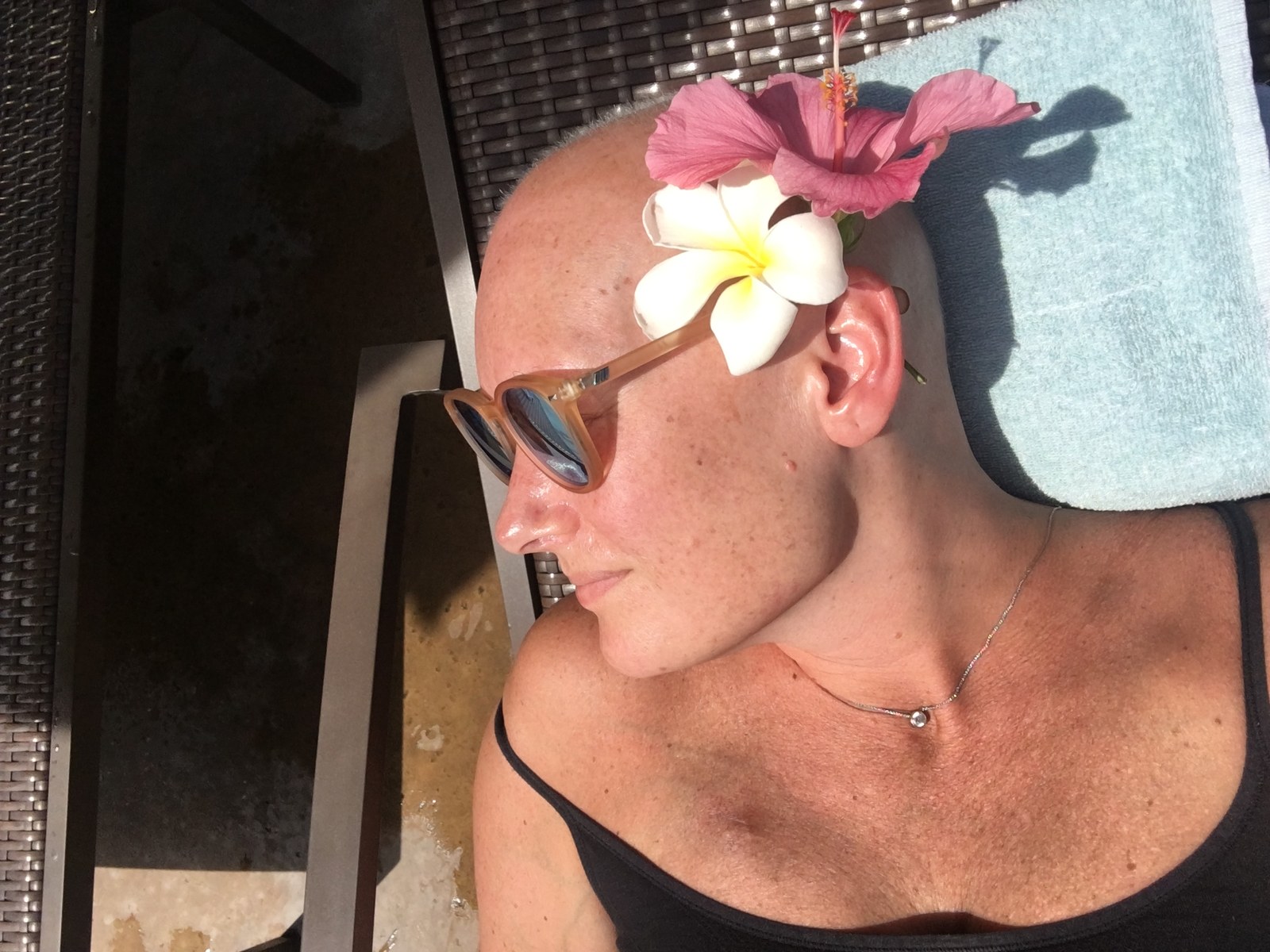
I made the most of my (bald) 44th birthday.

Courtesy of Shumanay Lowry. 

The mastectomy was followed by a second round of chemotherapy, which was followed by radiation. And then my oncologist said, “You’ve done all the treatment that’s reasonable at this point. Now you need to go back to your normal life and watch for any symptoms. We’ll check you out every three to six months.”

After recovering from the radiation I went back to work the first week in December. I worked for a month and then was diagnosed with stage IV cancer the first week of January.

The cancer had metastasized to my liver and lungs. I did even more chemotherapy, but a follow-up scan showed that the tumor in my liver had doubled in size in the three months since my last scan. Following treatment, some tumors will shrink or disappear. The 14-centimeter tumor in my liver didn’t react that way; it’s there, not getting smaller. There really isn’t much room left in my liver. For now, my best-case scenario is that the cancer doesn’t spread further.

It was really hard to tell my kids. I’ve always wanted to be really honest with them. I was honest about what I had and that it was serious. They’re old enough that they can do their own research. There was no point in trying to mislead them from the beginning. Also, I tried to be lighthearted.

My eldest son has thanked me a couple of times for handling things so well. He feels like the fact that I’m not complaining a lot or acting down or sad or depressed has been really helpful. I really try to stay positive and make the most out of all the moments that I still do have with them.

It was hard for them to see me go bald again. Having my hair grow back was a big milestone for my kids. My youngest, especially was so excited when my hair started to grow back. He would measure it and rub my head—he really celebrated me starting to look more normal again.


Source link

Categories
Health

How to Get Rid of a Pimple Fast: 12 Dos & Don'ts of Fighting Acne


There’s nothing like a big angry zit to light a fire under your skin care regimen. Whether it’s chronic picking, trolling Instagram for a cure-all spot treatment, or frantically Googling “how to get rid of a pimple fast,” a breakout always feels like a call to do something. (And of course, the breakout always happens the day before a party where you know you’ll run into two exes and five frenemies.)

If you’re looking for a strategy to make an acne flareup calm down this second, we’ve got you. We talked to top dermatologists to find out exactly what to do when acne strikes and you’re in a major hurry to get rid of it. Read on for the do’s and don’ts of calming the inflammation and healing the irritated skin on the double.

1. Do ice the zit.

If you’ve got a swollen pimple on your face that’s causing pain, reach for an ice cube. Wrap it in a thin cloth and sit it on the offending spot for three to four minutes. Repeat throughout the day to relieve pain and temporarily reduce swelling.

2. Do apply a paste made of crushed aspirin.

Aspirin contains salicylic acid, which is a top-shelf acne fighter by all accounts. Applying a paste made of aspirin immediately removes excess oil and dead skin. In other words, it helps to unclog and dry out your angry pore, while simultaneously reducing swelling and redness. It’s one of the home remedies that dermatologists recommend, and it even helps reduce pain at the application site. To make an aspirin paste, crush an aspirin with a spoon and swirl it with a few drop of water, creating a paste. Then, apply it directly to the pimple.

3. Don’t pick your face.

We know you’ve heard this, and we also know you’re dying to do it. But according to Josh Zeichner, M.D., director of Cosmetic and Clinical Research in Dermatology at Mt. Sinai, picking tends to cause more harm than good. It can cause what Dr. Zeichner terms “trauma” (!) on your skin, which in turn leads to “inflammation, infection, and potentially a scar.” Translation: It’ll take that annoying spot twice as long to disappear. So hands off.

4. Don’t overdry the affected area.

It’s not the chemical you use, it’s the amount you use, says Neal Schultz, M.D., a Manhattan derm. “People think if a little salicylic or glycolic acid is good, more is better,” he says. “It gets to the point that the active ingredient irritates the skin, making it scaly and flaky and red.” To prevent irritation, try a lower concentration of active ingredient once you’ve already broken out. Dr. Zeichner recommends checking your label for a concentration of benzoyl peroxide around 2.5 percent. One that really works: Paula’s Choice Clear Regular Strength Daily Skin Clearing Treatment ($17).

5. Do tone down on toner.

When you have a, shall we say, disturbance in the force, any astringents can “disrupt the skin barrier and cause inflammation and irritation,” says Dr. Zeichner. Unless you have very oily skin, skip the zit itself when you’re doing this step in your skin care routine. (And in that case, a gentle toner like Avene’s Eau Thermale, $20, is your best bet.)

6. Do use makeup with salicylic acid.

Slathering makeup over a breakout seems like a necessary evil: You want to hide the offender in question, obviously, but it can feel like you’re also suffocating it. But certain formulas can actually address pimples while providing coverage. “Salicylic acid is a common acne ingredient that is useful in preventing or treating pimples and can be found in several makeup brands,” says Rachel Nazarian, M.D., a dermatologist at Schweiger Dermatology. Clinique Acne Solutions Liquid Makeup ($29) is a classic for a reason, though ELF Cosmetics Acne-Fighting Foundation ($6) makes for a great budget pick. For touch-ups, try a concealer with it, too, like It Cosmetics Bye Bye Breakout Full-Coverage Concealer ($28).

7. Don’t wear makeup with pore-clogging ingredients.

For all the salicylic acid out there, there are certain ingredients to steer clear of. “People who suffer from acne should avoid makeup that contains mineral oil or lanolin,” Dr. Nazarian says. “These ingredients are comedogenic, meaning they have a high likelihood of clogging pores and triggering acne.” Check the labels to make sure your complexion products don’t contain either.

8. Do layer your beauty products properly.

No surprise if your instinct is to simply cover your pimple with as much concealer as you can get your hands on. But to zap a zit, it’s better if you take a few steps first. “Starting with a clean face, apply a thin layer of oil-free moisturizer [try Neutrogena Oil-Free Daily Moisturizer, $8, and then small amount of acne medication to your entire face,” says Dr. Nazarian. She’s a fan of gels with adapalene, since they regulate skin cells to prevent clogging of pores. Her favorite is ProactivMD Adapalene Gel 0.1% ($36), which, she notes, “can be applied very nicely under makeup.”

9. Don’t lose track of your trigger foods.

Is chocolate your enemy? Are late-night McDonald’s runs getting the better of your skin? These so-called trigger foods don’t affect everyone, but Dr. Schultz warns that you should keep tabs on whether certain foods tend to correspond with sudden onset breakouts. (For example, there’s been a recent connection between skim milk and acne.) The hard part, of course, is avoiding whatever it is that’s making your skin spazz.

10. Do resist the urge to squeeze.

“It’s never a good idea to squeeze a pimple,” says Elizabeth Tanzi, M.D., founder and director of Capital Laser and Skin Care and assistant clinical professor at George Washington University Medical Center. What is okay? Drawing out a big pimple once the whitehead is poking through your skin. Dr. Tanzi recommends using a washcloth with hot—“but not scalding”—water, to excavate the puss before applying your spot treatment.

11. Don’t believe every DIY hack you see.

While it’s tempting to mix up a cure-all witches’ brew of whatever drying agents you have in the house, Dr. Tanzi says she sees a lot of irritation from DIY skin care products. Even toothpaste isn’t the remedy it was when we were teens. According to Dr. Zeichner, triclosan (the ingredient in toothpaste that has antimicrobial properties) is rarely used these days. But if you are in a pinch and need to DIY it, here are some tips that are actually legit—and derm-approved.

12. Don’t opt for a stronger cleanser.

Swapping your usual face wash for something harsher seems like an obvious fix. Not quite. Your cleanser needs to be gentle so topical products can penetrate your skin, says Dr. Schultz. It’s best to stick to your regular skin care routine with a hydrating cleanser, like CeraVe Hydrating Face Cleanser ($15), until the breakout disappears, then see a dermatologist if you think you’re in need of a full-time acne cleanser.

For more advice on treating acne, don’t miss:
The Best Face Serums for Acne, According to Derms
The Totally and Completely Unfair Reason You’re Still Breaking Out in Your 20s and 30s
The Best Ways to Treat Every Single Type of Acne Imaginable
This Genius Concealer Hack Will Keep Pimples Hidden All Day Long


Source link

Categories
Health

How Much Fighting Is Too Much in a Relationship?


When you’re in a relationship, it’s pretty much a guarantee that you’re going to fight with your partner at some point—that’s just life. But when you find yourself bickering more than usual, it’s natural to wonder, “How much fighting is too much?” and “Are we totally screwed?”

Before you freak out and think your relationship is doomed because you had two fights last week, know this: it’s completely normal to have arguments and disagreements with your partner, says Joseph Cilona, Psy.D., a Manhattan-based licensed clinical psychologist. “There is no one correct formula when it comes to frequency of conflict, and there is no one correct way to navigate conflict that’s right for all couples,” he says.

Translation: Some couples argue more than others, but that doesn’t mean they’re doomed.

The occasional argument is actually a good thing, says Ramani Durvasula, Ph.D., a licensed clinical psychologist and author of Should I Stay or Should I Go?. “Fighting means you care about the relationship,” she says. “When fighting goes away completely, sometimes one or both people have checked out.”

To figure out if your fights are healthy (or if they’re raising red flags in your relationship) ask yourself these questions.

1. Do you fight fair?

Rather than tallying up all of your arguments, pay more attention to how you fight. If you can argue in a respectful way—by using phrases like “I feel really angry” or “I feel like I’m not being heard” and avoiding character assaults—you’re in a good place, Durvasula says. But if your arguments often devolve into personal attacks (think: name-calling, criticizing the core of who someone is or how they look), it’s not healthy for your relationship. “Don’t let arguments scare you,” Durvasula says. “Just pay attention to the quality of them.”

2. Do you finish your fights?

How well you and your partner make up is also important. Are you able to resolve fights or do you have lingering issues that you shelve each time to keep the peace? “Couples who are able to go through conflict into harmony end up having productive fights, which leads to greater intimacy,” says David Klow, a licensed marriage and family therapist in Chicago. If you’re constantly rehashing old arguments (healthy arguments focus on the current issue, Cilona says), fighting over the same things over and over with no resolution or compromise, or feeling upset about the fact that you’re fighting all the time, that can be problematic.

3. Do you ever feel threatened?

If a fight with your partner has ever made you feel physically, emotionally, or psychologically unsafe, that’s a major red flag, according to the experts. Fighting is healthy only as long as it stays fair and safe. If you find that you’re arguing a lot, it’s bothering you, and the two of you can’t seem to get it right, it may be time to see a professional for help. “Often a clean pair of eyes can help you see where your communication patterns are going wrong,” Durvasula says. And if you feel like things have crossed a line, talk to a therapist or someone you trust ASAP. “If even one member of a couple has feelings of upset, dissatisfaction, discomfort, fear, or any other significant negative feelings related to the nature, frequency, or intensity of the conflict itself, it’s something that should be addressed,” Cilona says.


Source link