Categories
Health

Twitter Thinks This Chart Helps Explain Why You Didn't Love 'Game of Thrones' Last Season


It’s officially been one week since HBO aired its final episode of Game of Thrones, and if you’re like other disappointed fans out there, you’re probably still trying to make sense of that unexpected ending. Though some aren’t pleased with showrunners David Benioff and D.B. Weiss (and even started a petition begging HBO to remake the last season), there’s some interesting data that might hold some explanation for why viewers were far more interested in the earlier seasons of the hit series.

Vanity Fair writer Joanna Robinson shared a chart on Twitter that tracks the average number of words the characters spoke per minute in each Game of Thrones episode, starting from Season 1. Based on the data, measured by OpenSubtitles.org and charted by Github user mrquart, the number of words in each episode declined throughout the show’s seasons.

You can see the graph fall from approximately 60 in the first season to less than 40 in the last. Meanwhile, season eight’s “The Long Night” episode, which contained the longest and most expensive battle scene in TV history, had the least dialogue with an average of just 15 words per spoken per minute.

As Robinson clarified in a reply to her original tweet with the chart, the data itself isn’t a reflection of quality. “… This isn’t INHERENTLY bad, obviously. I just like the earlier dialogue-heavy stuff so much personally,” she wrote. “… You don’t really need to see this lovely graph if you’ve looked at the scripts themselves—the difference is stunning.”

So if you think that the chattier scenes of earlier seasons were a little better, this might help support that. One user pointed out that the writers ran out of material after season five from author George R. R. Martin’s original books, so things shifted from “being conveyed via words” to, on its own, a more visual approach. Also, as some fans brought up, the show’s average word count could have also decreased in part because of all the battle scenes in later seasons, where there’s not a ton of talking going on.

Of course, fans were quick to chime in about it:

Despite the Game of Thrones‘ lack of dialogue, fans clearly still kept tuning in: In fact, more than 13.8 million viewers watched the final episode live, making season eight’s finale the most-watched of any of the show’s seasons.


Source link

Categories
Health

This Conservative Blogger's Chart Shaming Working Moms Predictably Sparks Outrage


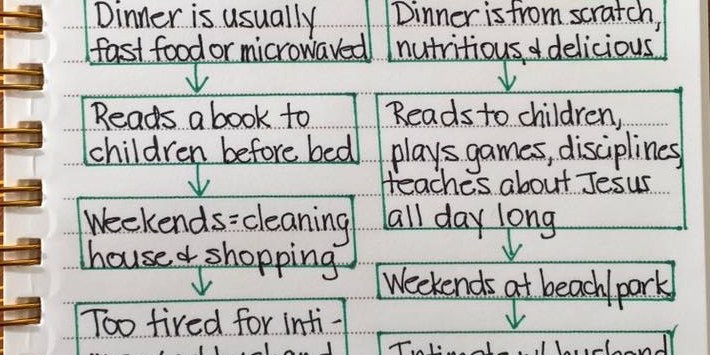
A blog post from a conservative Christian mommy blogger is taking over the parenting corner of the Internet, a place that often has more discord than the halls of Congress. Lori Alexander, a.k.a. The Transformed Wife, posted a chart titled “Should Mothers Have Careers?” in which she compared her thoughts on working moms versus stay-at-home moms—and it’s really something.

Alexander is a full-time homemaker who has been married for 39 years and has four grown children and nine grandchildren. Her About section on Facebook reads, “Learning about marriage, raising children, homemaking, and being a godly woman who desires to be transformed into the image of Christ!”

In the flowchart, she directly compares and contrasts her perception of the lives of working and stay-at-home moms. For example, in the SAHM column she writes of dinnertime, “Dinner is from scratch, nutritious, and delicious” whereas with working moms, “Dinner is usually fast food or microwaved.” She also says working moms lack time for intimacy and that their lives are “falling apart,” whereas SAHMs spend weekends at the beach and are totally fulfilled.

It’s easy to see why people are angry—and the ire coming from both sides of the mommy aisle. (Not to mention that staying at home is not a financial option for many families.) “Motherhood is not a competition. Moms in both groups have challenges to face that are not more important than the other,” wrote one commenter on the Facebook post. “Also, welcome to 2018 where dads are like, fathers and stuff now, who also help with domestic duties such as cooking, cleaning and! (Are you ready for this? Clutch your pearls) help take care of the children. ?” Another said, “I have been a stay-at-home and work-from-home mom for the last 16+ years. This chart is one of the dumbest things I’ve ever seen in my life.”

“Staying home with a three-year-old makes me feel like more of a failure as a mother than working out of my house EVER did! Also, if this stay at home mom is resting when the children do, when is she preparing that from scratch meal and cleaning so she is free to spend weekends at the beach?” another commenter remarked.

People are Twitter were equally upset.

When Glamour reached out to Alexander, she said she did not intend to shame working mothers but “I simply want them to ponder their life paths.” She explained that she is “teaching Christian women biblical motherhood according to Titus 2:3–5 in the Bible, where God commands older women to teach younger women to be ‘keepers at home.'”

“No one can take the place of a mother in a child’s life. I was a career woman for the first two years of my first child’s life, and I could totally relate to the left side of the flowchart,” she told us. “I knew I was the one that was supposed to be at home raising my own children. Most women aren’t even told that this is good! Homemakers are embarrassed when asked what they do. What can be more important than raising the next generation?”

As for the viral backlash, Alexander says she’s had it since she started writing in 2011 and won’t let it “steal her joy.”

“I teach what I am called to teach and leave the results in the Lord’s hands.”


Source link

Categories
Health

This Chart Breaks Down the Lack of Female Best Director Honorees at the Critics' Choice Awards Since 1995


The Critics’ Choice Awards provided an extremely fast follow-up to the Golden Globes, an event where Time’s Up dominated and women’s representation—especially in categories like directing—were hot topics of conversation. The Thursday evening award ceremony, however, lacked a lot of the punch of Sunday evening’s epic kick-off. Gone were the Time’s Up pins and speeches about women’s empowerment—with a few noteworthy exceptions like Gal Godot’s “See Her” award, featuring a rousing introduction by Wonder Woman director (and 2017 Glamour Woman of the Year) Patty Jenkins. There were some uncomfortable moments, like Elisabeth Moss getting played off after accepting her award for The Handmaid’s Tale.

For this award season, we’re eschewing some of the standard fare of previous years—consistent “Best Dressed” round-ups, for example—to focus on spotlighting the ways women are changing Hollywood, from record-breaking awards to the characters redefining how woman are portrayed on-screen. We’re also digging into the data behind key categories at all the major award shows. Just how often do women get nominated? And how often do they win? And are we getting better at being truly representative of the people watching TV and film?

Our reasoning is simple: we believe that better representation—both in front of and behind the camera—means healthier workplaces, and better storytelling.

In the case of the Critics’ Choice Awards, categories like directing are just as lacking when it comes to women as its peers. (The Golden Globes, for example, didn’t nominate a single female director this year, and a woman hasn’t won in this category since 1984.) We break down the honorees since 1995 in this chart. (Note that in some years, there was only a winner that was honored—no nominees—and that years correspond to the year in which film hit screens.) While Greta Gerwig was nominated for Ladybird, the 2017 winner in this category was Guillermo Del Toro. The only female Critics’ Choice Award winner for Best Director since 1995 was Kathryn Bigelow, for The Hurt Locker.

In addition, we looked at the recent data—from 2009-2017—across a variety of gender-neutral categories like Editing and Best Original Screenplay, and found that here, too, women are woefully underrepresented. Categories like Editing, Adapted Screenplay, and Director have had only one winner who identifies a female since 2009; there have been zero female winners for Original Screenplay in that time.

You can filter the results by clicking on any of the categories at the top, and you can also hover over any of the individual squares to see the nominee—male (in gray) or female (in peach)—and the work for which they were nominated.

To be sure, this data is just a limited window into women’s representation in the overall business—and also doesn’t factor in the inequality that women of color, for example, face—but even this limited window offers a stark portrait of how far we have to go. The good news, at least, is that we’re speaking up and getting loud. Change is sure to follow.

Graphic: Condé Nast Data Visualization

MORE FROM HOLLYWOOD’S BIGGEST SEASON:


Source link