Categories
Health

The Supreme Court Backed Trump's Travel Ban. But Judges Sotomayor and Ginsburg Aren't Having It.


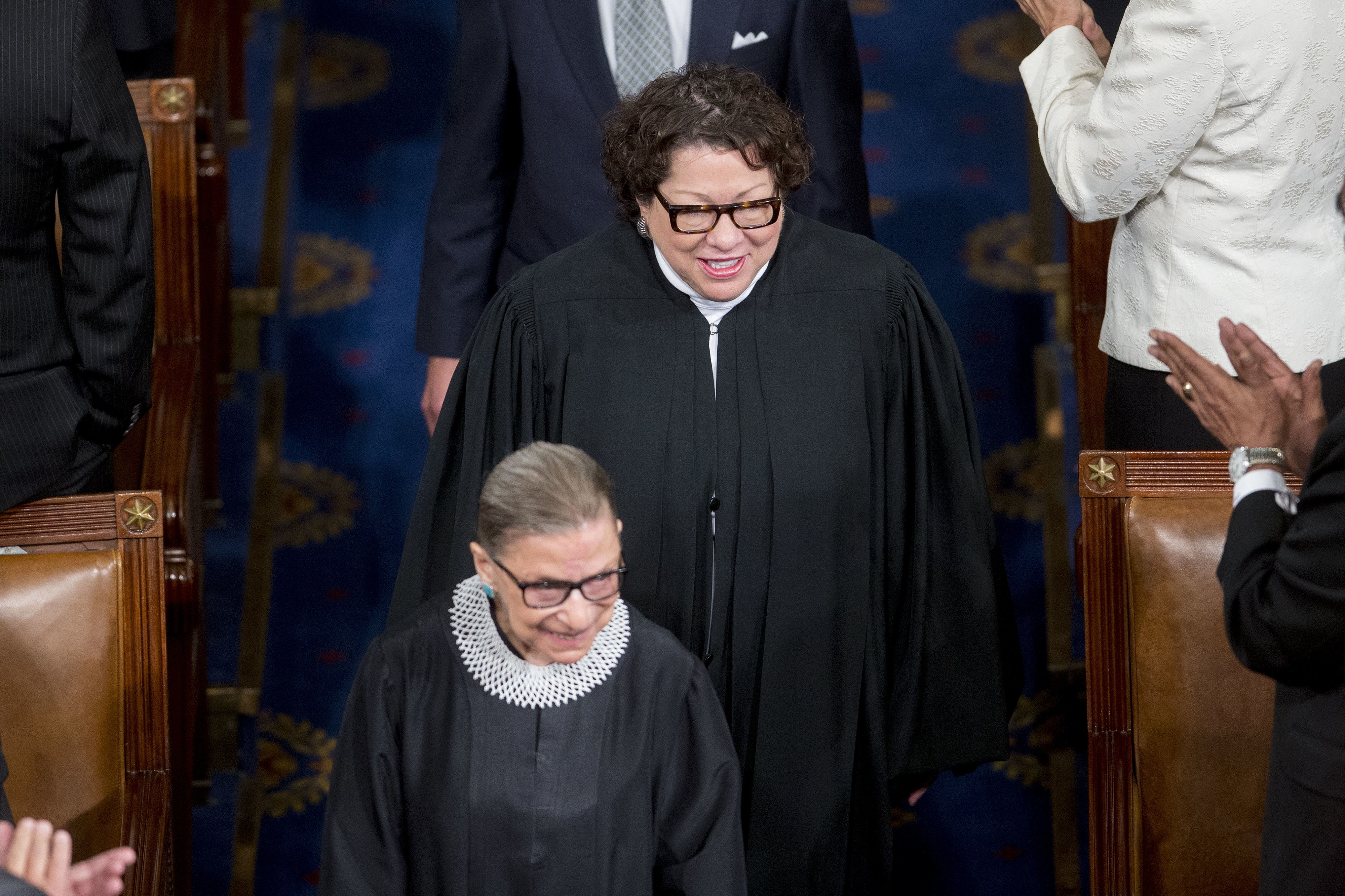
As the Supreme Court upheld President Donald Trump’s travel ban by a margin of 5-4 on Tuesday, it was two of its female justices—Sonia Sotomayor and Ruth Bader Ginsburg—who provided the harshest critiques of both the ruling and the policy itself.

As a refresher, this version of the travel ban (the administration’s third) restricts entry into the United States from seven countries, many of which have majority Muslim populations: Iran, North Korea, Syria, Libya, Yemen, Somalia, and Venezuela. The rules for entry vary by country. For example, immigrants (even those seeking asylum) and non-immigrants from Syria are barred from entering the country, but most Venezuelans will be unaffected. (Per CNN, the ban will mostly affect government officials from that country.)

Citizens from banned countries are able to apply for waivers on a case-by-case basis, like traveling to the US for medical treatment, or to visit a close family member. But The Guardian reports that there are a very limited number of waivers actually being granted.

Sotomayor, who was joined by Ginsburg in her dissent, boldly stated that the court failed to uphold the fundamental right of freedom of religion in her opening remarks. “The United States of America is a Nation built upon the promise of religious liberty,” she wrote. “Our Founders honored that core promise by embedding the principle of religious neutrality in the First Amendment. The Court’s decision today fails to safeguard that fundamental principle.”

She continues by calling the ban one that is designed to keep Muslims out of the country and calls out attempts to repackage it. “It leaves undisturbed a policy first advertised openly and unequivocally as a ‘total and complete shutdown of Muslims entering the United States’ because the policy now masquerades behind a façade of national-security concerns.”

Sotomayor calls out fellow justices in the majority saying they are “turning a blind eye to the pain and suffering the Proclamation inflicts upon countless families and individuals, many of whom are United States citizens.”

And the justices were not afraid to mention the president directly in their formal dissent.

“Ultimately, what began as a policy explicitly ‘calling for a total and complete shutdown of Muslims entering the United States’ has since morphed into a ‘Proclamation’ putatively based on national-security concerns,” the dissent reads. “But this new window dressing cannot conceal an unassailable fact: the words of the President and his advisers create the strong perception that the Proclamation is contaminated by impermissible discriminatory animus against Islam and its followers.”

Sotomayor did not shy away from noting the instances of Trump calling the policy a “travel ban” and his negative remarks about Islam and Muslims. “Despite several opportunities to do so, President Trump has never disavowed any of his prior statements about Islam. Instead, he has continued to make remarks that a reasonable observer would view as an unrelenting attack on the Muslim religion and its followers.”

“History will not look kindly on the court’s decision today—nor should it,” Sotomayor concluded.

While many applauded the justices’ passion in calling out the bigotry in the policy and ruling, the New York Times classified Sotomayor as having “lashed out” against President Trump in a tweet—and Twitter users were not happy about it.

You can read the full dissent here.

Related Stories:

The Hypocrisy in the Supreme Court’s Backing of California’s Anti-Abortion Pregnancy Centers

What Does That Supreme Court ‘Narrow Ruling’ on the Same-Sex Wedding Cake Case Really Mean?


Source link

Categories
Health

Ireland Has Voted to Repeal Its Abortion Ban


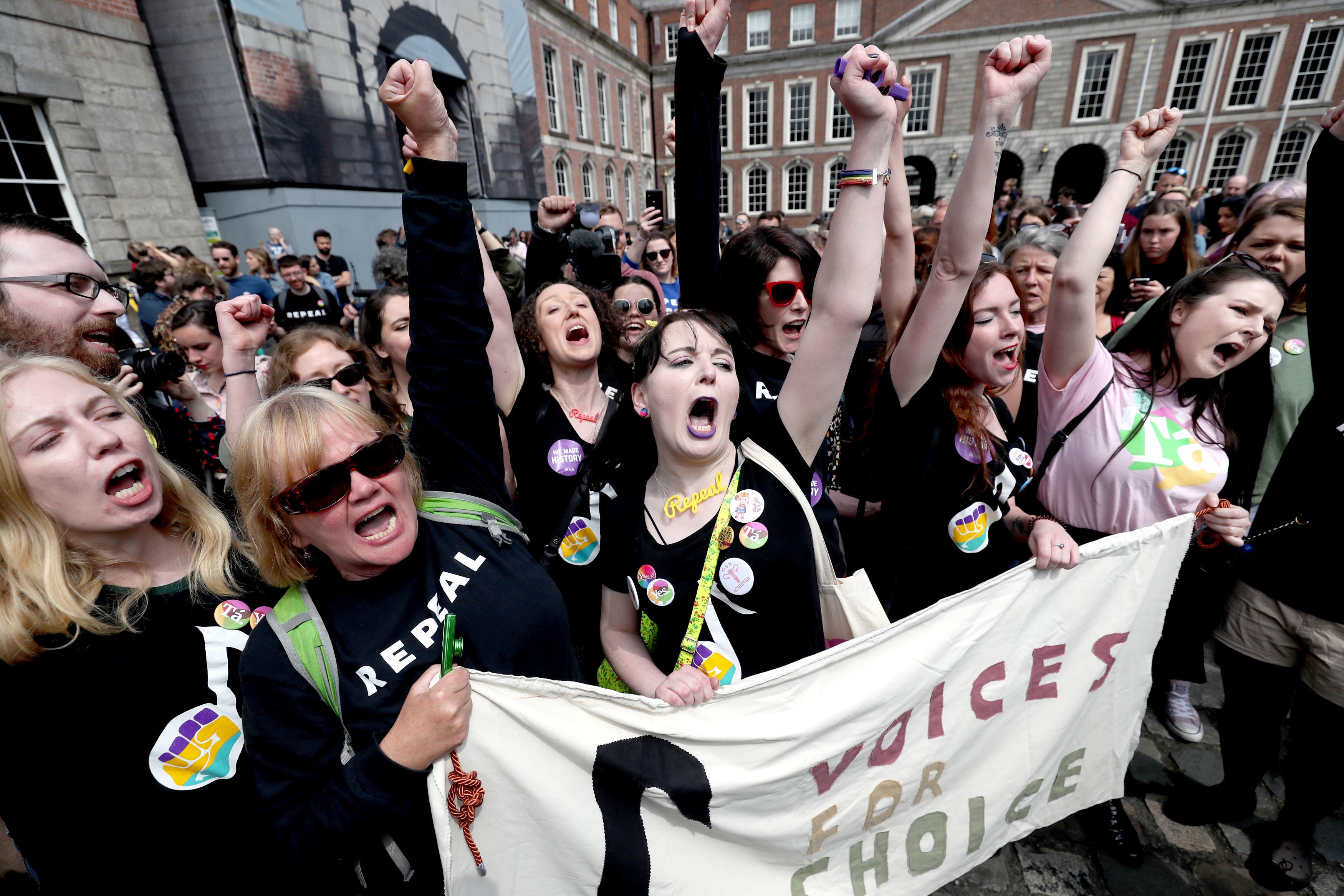
It’s official, and by a landslide: The people of Ireland have voted to repeal the eighth amendment of its constitution, which currently says an unborn child has an equal right to life as the woman carrying it, effectively placing a total ban on abortion.

With 37 out of 40 constituencies reporting as this article was published, 67.3 percent of Irish citizens voted for the repeal, and 32.7 percent against—with just one remaining constituency, Donegal, expected to vote “no.”.

Abortion has been illegal in Ireland since 1861. In 1983, this was written into the country’s constitution with the passage of the eight amendment, which reads: “The State acknowledges the right to life of the unborn and, with due regard to the equal right to life of the mother, guarantees in its laws to respect, and, as far as practicable, by its laws to defend and vindicate that right.” This effectually outlaws abortion completely, including in situations of rape, incest, and if the fetus a woman is carrying has a fatal condition.

According to the most recent data from U.K. Department of Health, more than 170,000 Irish women are estimated to have traveled to the U.K. and the Netherlands for abortions since 1980. It’s also estimated that, every day, nine women make the journey from Ireland to the U.K. to have a legal abortion. Then, there are those who either choose to or must stay home, as not all can afford flights, hotels, lost wages, and childcare while away—an estimated 1,500 women each year take abortion tablets without any medical supervision; if they’re found in possession of said pills, they could face jail time for up to 14 years.

But the Ireland of today is a very different place than the Ireland of 1983, says Glamour’s editor-in-chief, Samantha Barry, who’s a native of Cork

“To Americans it might sound like we’re slow to adopt cultural norms you’re accustomed to, but progress has been made: In 1985 the Irish government approved the sale of contraceptives, divorce became legal in 1995 following another referendum, and Ireland is now the European hub of some of the largest and most innovative tech companies in the world, including Google and Facebook,” she wrote ahead of the repeal. “Our current political leader, Prime Minister Leo Varadkar, is the gay son of Indian immigrants!”

When news of the repeal vote broke, Varadkar posted about it on his Twitter account: “Fantastic crowds at Dublin Castle. Remarkable day. A quiet revolution has taken place, a great act of democracy,” he wrote.

In light of this historic referendum, many Irish ex-pats have traveled home to vote. (Unlike the United States, voting by mail or absentee ballot is not an option for Irish folks living outside the country.) One woman, Elaine Arnold, told Glamour she spent over $1,500 Australian dollars to travel from Sydney to her hometown of Dublin to do so; another Irish native, Sorcha Lowry, used her credit card and her only vacation days at a new job in New York, where she currently lives, to make sure she voted “yes” to the repeal.

“The minute the date was announced for the referendum, I booked my flights,” Lowry told Glamour. “I have to be part of it. Not turning up would essentially be a ‘no’ vote, so I have to do my bit.”

Though after 35 years in effect, the people of Ireland have voted to repeal the eight amendment, abortion won’t be available overnight—rather, it will be replaced by a clause that reads: “Provision may be made by law for the regulation of termination of pregnancy.”

But it seems like that provision is coming: According to Sky News’ senior political correspondent, Ireland’s health minister, Simon Harris, said on Saturday he’ll ask for formal approval to turn a draft of abortion law into “full text.”

Meanwhile, the Guardian reports that Varadkar hopes that laws allowing abortions in the first 12 weeks of pregnancy will be in place by the end of this year.

Related Stories:


Source link

Categories
Health

Hawaii's Sunscreen Ban Doesn't Hit Until 2021, But the Reason For It Is Scary


Sunscreen is the best it’s ever been. It’s lightweight, fast-absorbing, beautifully fragranced, and at long last a pleasure to use. There’s just one problem: Despite 2014’s Sunscreen Innovation Act, the FDA hasn’t okayed any new sunscreen ingredients in 10 years. And now, researchers are finding evidence that some commonly used chemicals pose a huge threat to our marine environments and may have unintended consequences on human health. This month, Hawaii became the first place in the U.S. to turn these findings into something concrete, a first-of-its-kind legislation to outlaw the sale of sunscreens that contain the ingredients oxybenzone and octinoxate starting in 2021. For context, those two actives are in more than 3,500 sunscreens on the market.

Talking to scientists and lawmakers about these two chemicals, it becomes clear that this may be a somewhat dire situation for the environment. Some background on sunscreen: It’s technically a drug, so the FDA has full control over which ingredients we get to use. That’d be fine, except of the 17 sunscreen ingredients on the market, almost all of them were approved back in the ’70s. And according to Craig Downs, Ph.D and executive director of the Haereticus Environmental Laboratory, a non-profit dedicated to the conservation of natural habitats, almost no toxicity testing was done back then, and there certainly weren’t the stringent standards in place that there are today. So oxybenzone and octinoxate, among other chemicals, have been grandfathered in since then.

That doesn’t sound good, but it wouldn’t necessarily be cause for concern. Yet, the legislation is happening now because over the past two years, numerous studies have found evidence that these two chemicals (but especially oxybenzone) may be doing harm to marine life and possibly people. They’re what researchers call “endocrine disruptors.” So when we slather on sunscreen, the chemicals can then make their way into our bloodstream. There, according to recent studies, they may mess with our hormones in various ways. Downs says that several studies have found that oxybenzone in particular can significantly decrease testosterone levels. Hawaiian state Senator Mike Gabbard, (D) who introduced the bill, along with five other Democratic state senators, recounts a laundry list of evidence-supported consequences. In the ocean, it causes deformed coral larvae; in people, he says the chemicals may be associated with breast cancer becoming more aggressive, polluted breast milk, deformities in newborns, women’s uterine diseases, threatened male sexual health, and damaged DNA.

David Andrews, Ph.D. and a senior scientist at the Environmental Working Group, says that in the water off the beaches of Hawaii, where tourists flock and sunscreen flows, the coral reefs are unable to recover from bleaching events, which are like a hit to the reefs’ ecosystem. And oxybenzone is everywhere: Downs describes the chemicals as similar to a virus, with oxybenzone showing up everywhere from the drinking water in Honolulu, to Alaska, to inside the fish we eat. And according to a 2008 study by the Centers for Disease Control and Prevention, it’s found in the blood of 97 percent of Americans.

This is big news, and it’s been a long time coming. “It really points to what’s become a failure of both the sunscreen industry and the FDA to bring new, safer and more effective ingredients to the market,” Andrews says. While new sunscreen formulas have been available for over a decade in other countries, Andrews says that the FDA has left the public with a catch-22. Even outside of oxybenzone and octinoxate, Downs says there’s no firm data to prove whether or not other sunscreen ingredients, like avobenzone, are safe.

“If the toxicity requirements by the FDA were applied now to the 17 chemicals, only non-nanosized zinc oxide and non-nanosized titanium dioxide would be left standing,” Downs says. Knowing how much sunscreen people now expose themselves to, the FDA needs detailed safety information to approve new formulas—but because there’s nothing to stop companies from doing so, Downs says that most have continued to use the same old ingredients, in the same old ways.

On the plus side, the FDA has recently initiated a study testing absorption of ingredients in sunscreens currently on the U.S. market. A spokesperson told Glamour that the study will “measure and evaluate the levels of active ingredients found in the blood of human subjects after exposure when applied under maximal use conditions.” For now, Dr. Andrew Alexis, the Chair of Dermatology at Mount Sinai hospital in New York City, warns against jumping to conclusions. While studies using extremely high doses of oxybenzone show some hormonal side effects, Alexis says we don’t typically encounter those levels in the everyday world. To put the doses into perspective, he explains that using a sunscreen containing 6 percent oxybenzone, it would take 277 years of daily application to reach exposure comparable to what the rats in the studies get. So while oxybenzone can be detected in the blood and urine of sunscreen users and the population at large, Alexis says that doesn’t necessarily mean oxybenzone is causing negative, systemic health effects.

Speaking to the ban, the Personal Care Products Council, which represents the global cosmetic and personal care products industry, released a statement acknowledging the importance of combating coral reef degradation, but arguing that fighting the prevalence of skin cancer is as important. And with the sunscreen ban waiting for Hawaii’s governor to sign it into law, enforced change is at best in the distant future. According to lawmakers, the bill will only take effect in 2021, so at least legally, nothing has to happen until then—and even after 2021, there will be no legal way to keep sunscreens with the chemicals from coming into Hawaii.

Nicole Lowen, vice chair of Hawaii’s House Committee on Energy and Environment, says that’s fine. While they’re giving the sunscreen industry the next few years to come up with formulas that comply (and Gabbard says tons of sunscreens out there already do), a major aim of the legislation was raising public awareness about these toxic chemicals, and sending a message to companies and the FDA that, yes, change is something people care about, and we want it now.

In that respect, women in Hawaii agree that the bill is making them think twice about their sunscreen. Since the legislation came into the spotlight, Hawaii resident Emma Wo says that she’s gone through her medicine cabinet and tossed the sunscreens with controversial ingredients. Longtime Oahu resident Kathy Croman says she used to not be choosy about the sunscreen she used, but “when you grow up here and see the actual damage it’s causing, you become more aware.” It’s likewise struck Oahu newcomer Kait Hanson: “Before I moved to Hawaii, I used sunscreens with [oxybenzone and octinoxate] a lot. That was mostly due to being misinformed, unaware or trusting the labels of products.” After the conversation started around the ingredients, she says she switched to reef-safe sunscreens like Stream2Sea and Badger (Stream2Sea relies on non-nanosized titanium dioxide, and Badger on non-nanosized zinc oxide. Both are confirmed eco-friendly ingredients).

Marine conservationist Lauren Kitayama seconds it: Once you know the effect of these ingredients, you steer clear. “Most of our cosmetics do end up in the ocean, and they wreak havoc. If making small changes in my daily routine can protect the oceans and animals in them, I do what I can,” she says. To that end, Wo’s not waiting for 2021. “Even before the sunscreen ban goes into full effect, I think it’s a matter of social responsibility. One of my favorite quotes by Maya Angelou applies here: ‘Do the best you can until you know better. Then when you know better, do better,’” Wo says. According to Lowen, it’s going to take more of the same attitude to fuel change.

“We have to create a consumer demand for safer products. We’re obviously facing many environmental crises with climate change, so there’s a lot coming that we’re going to have to deal with. And it’s all true—all those things weigh in,” Lowen says.

Related Stories:
How to Cover Sunburn the Right Way—And Actually Make It Heal Faster
Sunscreens That Don’t Suck, According to ‘Glamour’ Staffers
Your Sunscreen Might Not Actually Be Working—Here’s Why


Source link
Categories
Health

Shonda Rhimes Wants to Ban the Phrase 'Strong Female Leads'—and She's Not Wrong


How often do you hear the phrase “strong male characters?” Probably not very much, but the entertainment industry is quick to point out whenever a “strong female woman” makes it on screen. And Shonda Rhimes is sick of it.

Yesterday afternoon, the producer and creator of some of the most beloved female-driven shows, such as “Grey’s Anatomy,” “Scandal,” and “How To Get Away With Murder,” made the case that although using phrases like “strong female character” or “smart female lead” might be well-intentioned, these qualifiers are not just redundant and condescending.

“Okay,” she tweeted on Thursday. “Entertainment industry, time to stop using the phrases ‘Smart Strong Women’ and ‘Strong Female Leads’. There are no Dumb Weak Women. A smart strong woman is just a WOMAN. Also? ‘Women’ are not a TV trend — we’re half the planet.”

Her remarks started a conversation about how these descriptors are a disservice to women, because they imply that brainy, independent women are a rare sight that needs to be applauded or pointed out. As she explains, the industry should assume that women are already strong and smart, the way they generally do with male characters. Twitter users noted that these terms can also be limiting, since being constantly painted as strong doesn’t always leave much room for complexity or nuance, which is often celebrated in brooding, tortured male characters like the Don Drapers and Walter Whites of the TV world.

A few hours after Rhimes initiated the discussion, Oscar-winning actress Jessica Chastain chimed in to say, “Yes to this. I’m always told I play ‘strong women.’ Lets pleasw use the phrase ‘well written women’ in its place ALL WOMEN ARE STRONG WOMEN.”

It’s not the first time Rhimes has spoken up about how the industry characterizes female characters. As part of an interview series for Time back in 2017, Rhimes said, “Every time someone says, ‘How do you write such smart, strong women?’ I find it appalling because it suggests that there are stupid, weak women and that’s who is generally out there.”


Source link

Categories
Health

The 20-Week Abortion Ban: Everything You Need to Know


On Monday, the U.S. Senate is expected to vote on a GOP bill that basically bans abortions after 20 weeks of pregnancy and would threaten doctors who perform them with up to five years in jail. The bill, which has been labeled “The Pain-Capable Unborn Child Protection Act,” passed the House of Representatives in October of last year. While President Trump has said that he plans sign such a bill, it’s unlikely that Republicans, led by senator Lindsay Graham, have the 60 votes necessary for it to pass.

Here’s a guide that outlines the issues at hand:

Why does the ban start at 20 weeks?

Some say, at around 20 weeks post-fertilization, a fetus can feel pain, so Republican lawmakers are using that idea as their main argument in favor of the bill. As one can imagine, this statement is highly controversial and divisive. Most doctors reject this claim, citing a 2005 study that found a fetus was unlikely to feel pain until the third trimester, or around 27 weeks. The New York Times also points out that in 2013 the American Congress of Obstetricians and Gynecologists stated that no subsequent research contradicted the 2005 study.

The bill does exempt women who require an abortion quite literally to save their lives, as well as rape and incest survivors, but the legislation does not include exemptions for health conditions or severe fetal anomalies, which often can’t be detected until the 20-week ultrasound.

Does this type of abortion occur frequently?

No, they do not. According to Planned Parenthood, nearly 99% of abortions happen before 21 weeks. When the procedure is performed later, it’s often due to complications that involve “severe fetal anomalies and serious risks to the woman’s health. An abortion at this stage is referred to as a Dilation and Evacuation.

What would this ban mean, really?

The bill would basically limit access to safe abortions by blocking providers from offering the procedure. There are already restrictions on abortions after 20 weeks in a number of states, with exceptions varying between them. This ban would also criminalize doctors who performed the procedure making them vulnerable to up to five years in prison.

Why are Republicans holding a vote if they don’t have the numbers?

As we all know, the debate around the legality and access to safe abortions has been going on for decades in America. While they may not have the votes, conservatives are hoping to pressure Democrats from red states to either vote for it or risk alienating constituents. Per the Huffington Post, Marjorie Dannenfelser, president of the anti-abortion group Susan B. Anthony List, told reporters on Thursday: “Clearly, we need more votes, but at some point when you start to get closer, and senators in vulnerable states start to feel the heat, then it starts to look very optimistic.”

Who are the major players for and against the bill?

The bill was introduced by Lindsay Graham and has the support of a large number of Republicans, though GOP Senators Lisa Murkowski and Susan Collins have expressed concerns. Democrats Joe Manchin (West Virginia), Joe Donnelly (Indiana), and Bob Casey (Pennsylvania) voted for the legislation in the past and their offices have said they plan to vote for it again.


Source link

Categories
Health

Twitter Just Explained Why It Won't Ban Donald Trump


On Friday Twitter finally explained to the world why it refuses to ever ban President Donald Trump, or other world leaders.

In a blog post that comes just days after Trump went on a Twitter tirade that included comparing the size of his “nuclear button” to that of North Korean leader Kim Jung Un’s, the social media company explained that it can’t delete Trump due to its own terms of service. Furthermore, it stated, deleting his account would have little impact anyway.

“Twitter is here to serve and help advance the global, public conversation. Elected world leaders play a critical role in that conversation because of their outsize impact on our society,” Twitter said. “Blocking a world leader from Twitter or removing their controversial tweets, would hide important information people should be able to see and debate. It would also not silence that leader, but it would certainly hamper necessary discussion around their words and actions.”

From taking time out of his day to attack the free press, or to attack women, and even the aforementioned threats of nuclear war, Donald Trump has shared it all with his 46 million followers. And this sharing has lead many to say that he should be banned from ever using the service in the name of our own national security.

However, according to Twitter, banning the President, and people like him, will do little to stop the dangerous rhetoric from spreading.

The platform, which serves more than 500 million users around the globe, added that it is constantly reviewing tweets by leaders, along with reviewing everyone’s content, to ensure it can enforce its own rules accordingly and fairly.

“No one person’s account drives Twitter’s growth or influences these decisions,” it added. Instead, Twitter said it is working to remain as unbiased as possible with the public interest in mind.

“We are working to make Twitter the best place to see and freely discuss everything that matters,” the statement concluded. “We believe that’s the best way to help our society make progress.”

Although this generic press statement may not be how every Twitter employee feels. In November Trump’s Twitter account was offline for 11 brief and glorious minutes after a customer service employee deactivated it on their last day with the company. While Twitter users appeared to love the 11 minutes of Trump freedom they received, Trump himself took the entire thing as a compliment, tweeting later that night, “My Twitter account was taken down for 11 minutes by a rogue employee. I guess the word must finally be getting out and having an impact.”

Related Content:
A Twitter Employee Deleted Donald Trump’s Account on Their Last Day at Work
The Latest Installment of President Trump and Melania’s Awkward Body Language Is Here, and Twitter Is Cringing
President Trump Tweets He Turned Down Time Magazine’s 2017 Person of the Year Award


Source link