Categories
Health

Fixing Racism Is a Tall Order For Starbucks—But They’re Game to Try


Nothing, it seems, has been more difficult to remedy than the issue of racism and implicit bias in this country, but this week, coffeehouse juggernaut Starbucks attempted to at least begin the conversation when they shut down more than 8,000 of their stores for a day of racial bias training following the April arrest of two black men in a Philadelphia location, sending the internet into a flurry of think pieces and expert quotes that had people wondering: Can a day of company training really fix a problem of this scope?

If the training video Starbucks showed is any indication, they’re at least using historical context to address exclusion. The passing of the Civil Rights Act of 1964 may have outlawed discrimination based on race, color, sex, religion or national origin, but in the video—released to the public Tuesday—the landmark law serves as a framework for understanding just how difficult it is to change hearts and minds, especially when it comes to the implicit biases we hold.

In the film, created by award-winning documentarian Stanley Nelson and underwritten by Starbucks, a narrator explores how access to public spaces has been regulated in this country, and how those areas have been made largely unattainable to black people. When blacks—who are maligned by stereotypes that have been intensified by the historical stink of slavery—enter those public spaces, it has been a punishable offense. That was no more evident than in April when two black men—Rashon Nelson and Donte Robinson—visited a Philadelphia Starbucks to attend a business meeting. While they were waiting for their friend to arrive, and after they’d asked to use the restroom, a Starbucks employee called the police, telling the 911 dispatcher that the men refused to purchase an item or leave. The call resulted in an arrest on suspicion of trespassing—though no charges were filed—and the high-profile incident sparked protests and calls for Starbucks to address what many believed to be racial profiling.

[embedded content]

“It’s time we talk about what it means to not be welcomed as an American citizen,” Sherrilyn Ifill, president and director-counsel of NAACP Legal Defense Fund and senior consultant to Starbucks’s racial bias training says into the camera. And it’s a conversation Starbucks is committed to having, according to Rosalind ‘Roz’ Brewer, Starbucks’ first woman COO.

“We’ve always said that this training is a first step in a long-term journey—we cannot change ingrained behaviors and implicit biases within four hours,” she told Glamour.com, adding that the company will send representatives to a convening this summer hosted by the Leadership Conference on Civil and Human Rights and will take steps toward understanding how they can address other forms of bias.

Additionally, she said, the company’s 100,000 hires each year will be receiving racial bias training upon becoming a Starbucks partner—something experts think is nonnegotiable for the chain.

“This wasn’t just a thing that was nice to do,” said Heather McGhee, president of equal-rights public policy organization Demos and an outside advisor to the training. “The executives had to believe and communicate that they couldn’t succeed as a business without addressing this issue,” McGhee said. “And I think they actually did that.”

Chafing at criticism that the training was more symbolic than effective, McGhee reiterated what the company has been saying since the bias workshop was announced—this isn’t just a one-day fix.

“I think that most of the commentary has really focused on the ‘one day’ because that’s the information that’s mostly out there, but the company has tried to get the message out that they know that one day is just the start,” she told Glamour.com. “They’re looking at ongoing, deeper training as well as reviews of their systems and practices and procedures so that the message is continuously reinforced.”

If Starbucks, which, according to TIME.com, stood to lose up to $12 million in its Tuesday afternoon closings, is investing time and money, and opening itself up to public scrutiny, in proposing racial bias training, it’s expected that the firm would make it an ongoing focus, said Tamisha J. Ponder, director of intercultural engagement at the Community College of Baltimore County.

“We know that these types of trainings need to be reinforced,” she said. “I don’t want to discredit this attempt because it speaks volumes. It’s beneficial because it’s their first discussion of racial bias, ever.” When companies and institutions implement racial bias training with this high a profile, it’s safe to assume it isn’t just for a day, Ponder said. And pulling back the layers of implicit bias and the historical context, much as the Starbucks video shows, is key.

“Before we discuss bias, we discuss the social construction of race,” Ponder said, describing her university’s approach to bias training. “By discussing race as a social construct, it exposes America’s history of legal and systemic racism and access to privilege. It lays the framework for how to discuss bias and how our country has legally supported bias to understand how you, yourself, can be biased.”

To measure the success of these trainings, Starbucks will likely do spot audits of their stores, implement retention and hiring practices to promote diversity, and measure engagement and interest in training from their employees.

Of course, there’s research that shows racial sensitivity training isn’t always effective. But considering Starbucks’s corporate Third Place policy—which aims to “create a culture of warmth and belonging where everyone is welcome” according to the website—chairman Howard Schultz’s recent directive that employees should let anyone (not just customers) use the restroom, and the company’s plan to make accessible all racial bias training material to employees, McGhee is hopeful.

“I think it needs to be a national effort…there’s so much misunderstanding about the way race and bias work in the human mind,” McGhee said. “If we’re going to be a diverse democracy, we’ve got to all—as people in this country—have better skills at interacting across lines of race.”


Source link

Categories
Health

I'm a Student of Color at Syracuse. That Fraternity Video Proves Racism is Pervasive—Even at Progressive Schools


Over the last few days, it’s been painful to watch my university make national headlines for the racist behavior of one of its fraternities. I’m a graduate student in journalism and a woman of color, and while studying at Syracuse University, I’ve been lucky to meet some of the most progressive and thought-provoking people. This isn’t the campus that I know. This isn’t the school that I chose to attend.

If you haven’t read the headlines, here’s a quick summary: Last Wednesday, a professional engineering fraternity known as Theta Tau was suspended for filming a video in which a member, in a room full of several other members, pretended to ejaculate on another fraternity member while professing his hatred for black, Hispanic, and Jewish people.

The language they used is too vulgar and disgusting to print here, and the six-minute video, which was first published on a secret Facebook group and later released by The Daily Orange, Syracuse’s independent student newspaper, has since found its way to just about every major news outlet. [A second video later surfaced of the Theta Tau members miming a sexual assault of a disabled person.]

In response to the offensive videos, protests erupted on campus with many students calling for the university to take action. On Friday morning, the fraternity released a statement saying the video was meant to be a “satirical sketch” roasting a Republican member of the group.

I first heard about the incident through an email I received from the school chancellor. I hadn’t seen the actual video yet, but I felt a sense of dread. To be completely honest, I wasn’t sure I even wanted to see it. But ultimately, I decided it was important to see the faces of every single person in the video—faces of fellow students who are saying they hate people like me. It’s already hard enough being a person of color at a predominantly white institution and trying to navigate college life. Why shame us? Why use our skin color to belittle us?

When I watched the video, I felt many things—sadness, disgust, anger—but I’m sorry to say that surprise wasn’t one of them. Many students of color, like myself, are already aware of just how pervasive racism is in white Greek organizations. I remember vividly when University of Oklahoma fraternity members were captured in a cell phone video singing a racist chant while on a bus to a fraternity event in 2015. Then in 2016, members of a University of Missouri fraternity yelled the n-word and other obscenities at a group of black students on campus. These were public actions caught on tape—it made me wonder how much worse these people behave in private.

It’s one thing to see this stuff on the news; it’s another thing when it’s about your own peers that you walk the halls with.

“I want nothing more than to be able to feel safe and welcome on campus. But these bursts of hate on college campuses seem to show that racism is still a pervasive force among young people—hiding in the shadows, even at the most progressive schools.”

I want nothing more than to be able to feel safe and welcome on campus. But these bursts of hate on college campuses seem to show that racism is still a pervasive force among young people—hiding in the shadows, even at the most progressive schools. I’m lucky to have not experienced racism first hand during my college tenure, but now I know that these attitudes still exist. I just haven’t always “seen” it.

I now find myself constantly wondering if the same peers that smile at me and greet me in the hallways are shaming me behind closed doors. I don’t want this to be my college experience—or the experience of any other student of color at a predominantly white campus. As students, we have to keep calling this ugliness out and demand change from our universities, or it will keep happening.

PHOTO: Courtesy of Subject

Camille Nzengung.

As of Monday, the university has expelled the Theta Tau fraternity from campus, and 18 members have been suspended from school. The university also announced that it will require implicit racial bias and inclusivity training for all Greek and student organization members, as well as advisors.

In a statement, Syracuse Chancellor, Kent Syverud, said the school will conduct “a top to bottom review of all of our Greek life policies, activities and culture, to be commenced this week and completed in time for us to revise all our practices for the start of the fall semester,” which includes “mandatory training for all students, new and continuing, about the values, culture and expectations of our community.”

I don’t think this is enough: I believe that all of the fraternity members involved in the video should also be expelled from the school, because hate should have no place on our campus. Period. As a school we need to set the precedent now that this won’t be tolerated in the future.

What’s going on at my school echoes bigger issues of racism and homophobia we are facing as a nation. If we can’t justly handle some of these issues at the university level, what will happen once we step out in the real world?

Camille Nzengung is a graduate student studying journalism at Syracuse University in the S.I. Newhouse School of Public Communications.


Source link

Categories
Health

The NFL Protests Are About Racism. Don't Let Trump Distract You


Colin Kaepernick’s protest began silently in 2016 and went largely unnoticed. In fact, it wasn’t until a post-game interview when a news outlet asked him why he didn’t stand during the national anthem that everyone became aware he was even protesting. “I am not going to stand up to show pride in a flag for a country that oppresses black people and people of color,” Kaepernick said. “To me, this is bigger than football and it would be selfish on my part to look the other way. There are bodies in the street and people getting paid leave and getting away with murder.”

To be honest, I didn’t have much of a reaction to Kaepernick when I first heard his statement beyond thinking, “Good for him.” It was only in retrospect that I understood how his choice of protest was like shooting an arrow into the American consciousness and hitting the bullseye. The National Football League is, after all, arguably the closest thing the United States has to a state-sponsored religion. Worship services take place all over the nation with at least three live broadcasts on major networks every Sunday. The pre-game national anthem has become a religious ceremony unto itself, with the US military paying advertising dollars to the NFL in efforts to recruit soldiers via highly coordinated displays of a certain kind of patriotism. NFL games reflect the mythos of American meritocracy: a racially diverse group of players on a level playing field battling it out until the best one wins. By taking a knee, Kaepernick disrupted this narrative, forcing the audience into awareness that many of the players were Black and that the playing field in which they lived was not, in fact, a level one.

Like many Black Americans who have protested racism in America, Kaepernick has suffered serious consequences for speaking up. Rosa Parks was fired from her job as a seamstress after refusing to stand and give her bus seat to a white man, and Kaepernick, after refusing to stand for the national anthem in protest of racism, has been blackballed by the NFL. If the NFL’s hope was that the matter would fade quietly after Kaepernick was pushed out of the league, that has decidedly backfired. Protests have grown exponentially to include not only the issue of police brutality, but the NFL’s infringement upon Kaepernick’s right to protest according to his political beliefs. Through it all, Kaepernick has remained mostly silent, seemingly focused primarily on putting his money where his politics are, donating $1 million to various poverty relief efforts.

Trump has insisted the central issue isn’t race as he seeks to reframe the protests to be an issue of patriotism and showing proper respect for the flag. However, he’s now used harsher language in speaking of Black athletes protesting racism than he’s used in speaking of the white supremacist who murdered Heather Heyer in Charlottesville. Given that Trump referred to former POW John McCain as being a loser for getting captured in Vietnam and attacked the Muslim family of a slain U.S. soldier, no serious minded person can believe that his recent targeting of the NFL—a sport where roughly two-thirds of the players are Black—is about patriotism and not racism. The fact that the majority of players protesting have been Black, and that Trump used racially loaded language in referring to them, only makes it clearer.

Like many others, I took to Twitter this weekend to continually drive this point home: that while Trump claims to be defending the honor of the U.S. flag, he’s really just continuing his agenda of white nationalism and voicing opposition to those who protest racism and police brutality, both things he has openly advocated.

Yet, while they may bristle at Trump’s comments, many in the NFL seem more comfortable with Trump being made the central issue instead of racism. Several teams chose to link arms during Sunday’s pregame shows in what they described as displays of unity in the face of Trump’s divisive statements. Though Kaepernick’s protest began over an issue he deemed “bigger than football,” by Monday, discussion had shifted from Kaepernick being sidelined for protesting police brutality to the feud that now existed between the President of the United States and the owners of the NFL.

That issue, it appears, is more comfortable for both the NFL and mainstream media outlets to digest than the core issue of America’s problem with racism. It’s more comfortable to discuss how protests of police brutality impact ratings and profits for the NFL than to discuss the topic of police brutality itself. It’s easier to talk about whether players should kneel or stand during the anthem than to talk about Seattle Seahawks’ player Michael Bennett being racially profiled and held at gunpoint by Las Vegas police. But regardless of where our comfort lies, the core issue remains unchanged. It was the same issue when Muhammad Ali was stripped of his boxing titles for protesting racism and war in 1966 and when white baseball players threatened to strike as Jackie Robinson integrated major league baseball in 1947.

The issue is racism. And until this nation address that issue in earnest, until the NFL and every major American institution addresses how racism manifests in its day-to-day operations, there is no amount of deflection or superficial displays of unity that will resolve it. The protest that Kaepernick began by himself in silence has now grown to a deafening roar with thousands joining him in solidarity. The issue of racism cannot be silenced, it can only be ignored—at the nation’s peril.

Bree Newsome is an artist who drew national attention in 2015 when she climbed the flagpole in front of the South Carolina Capitol building and lowered the confederate battle flag following the murder of nine black parishioners by a white supremacist at Mother Emanuel AME in Charleston.


Source link

Categories
Health

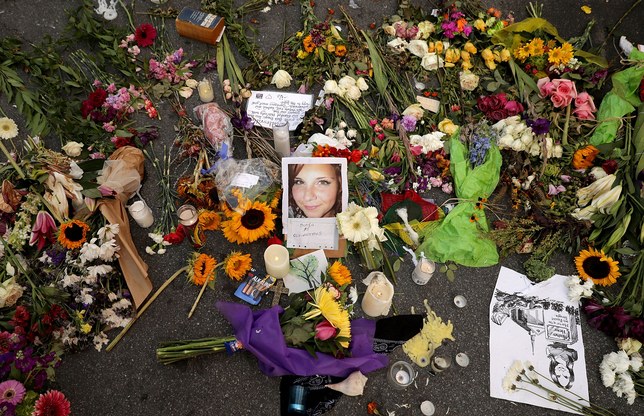
Heather Heyer's Cousin Asks Why It Took the Death of a White Woman for People to Talk About Racism


PHOTO: Chip Somodevilla/Getty Images

At a memorial service for her daughter Heather Heyer—the 32-year-old woman who was killed earlier this month while protesting a white supremacist rally in Charlottesville, Virginia—her mother Susan Bro made clear that the best way to remember her daughter was to take “righteous action.”

“I’d rather have my child, but by golly, if I’ve got to give her up, we’re going to make it count,” she told the crowd at Heyer’s memorial service last week.

Already, Bro and other members of Heyer’s families are putting these words into actions and taking a stand against injustice and racism. Last week, Bro said she’s refused to speak with Donald Trump following a press conference in which he equated counter-protesters like Heyer to the neo-Nazis, white supremacists, and alt-right groups that had flocked to the Virginia city to keep a Confederate monument from being taken down. And over the weekend, Heyers cousin Diana Ratcliff wrote a powerful op-ed for CNN examining her family’s white privilege in the context of what happened in Charlottesville—and questioning why it took the death of a white woman to open many American’s eyes the country’s ongoing racial conflict that millions have experienced their entire lives.

“We never had to worry someone wouldn’t hire us because of the way we look,” Ratcliff wrote. “We never have to worry that our children might become victims of someone else’s prejudice. We’ve never been told we can’t live in a certain neighborhood or attend a certain school because of the color of our skin. Until last week, we had no idea what it feels like to lose someone to hate.”

Ratcliff then reflected on the poignant memorial service but recounted the one thing that struck her the most. “The moment that will forever be burnt in my memory was when a speaker asked the uncomfortable question,” she said. “While she hailed Heather’s courage, she asked something to this effect: ‘Why does a white woman have to get killed for you all to become outraged?’ All I could think was, ‘Heather is sitting in heaven right now, shaking her head in agreement.'”

“Why is it that the death of a white woman at the hands of a white supremacist group has finally gotten the attention of white folk? Why have we been turning our heads the other way for so long?” she added. “How many black families, Latino families, Asian families, Native-American families before us have been left broken from this ugly vein of hatred in our country? Too many. And to my non-white brothers and sisters, I am so sorry that many of us weren’t paying attention before Charlottesville.”

She continued, speaking critically of those who refuse to acknowledge racism and have grown complacent, saying:

“How did America go from a black President to white supremacist
neo-Nazis marching in the street? That is the question we need to be
asking ourselves. And if we take a long hard look at ourselves, we’ll
find out that it’s because we went into denial. We elected a black
person, we made friends with some minorities, and we patted ourselves
on our backs, saying, ‘Well done self, we have eliminated racism.’
Clearly, we have not. It’s been lurking in the shadows, waiting in the
spaces of the words we say and the words we don’t say. The actions we
take and the actions we don’t take.”

Ratcliff then condemned the idea of this tragedy being a result of violence “on many sides.”

“The majority of the counter-protesters were concerned residents of Charlottesville, not a fringe political group,” she wrote. “The so-called “alt-right,” or the white nationalists, have no place in America, and they don’t deserve a place on our political spectrum. There is no space at the political table for them. There is no common ground, and there is no compromise.”

But as a Ratcliff concluded her op-ed she reinforced the same message that Heyer’s mother relayed to the nation: That the country should look to what happened in Charlottesville as a call to action.

“If there is one positive I have taken away from the loss of Heather, it is that it isn’t the length of your life that is important, it’s what you do with your life that matters,” Ratcliff said. “If you truly believe all lives are equally important, then make your life matter.”


Source link

Categories
Health

3 Women Who Quit Their Jobs at Google Share Stories of Workplace Racism and Sexism


Google has had a lot going on lately, and some of its most high-profile news doesn’t look great for women—especially those of color. There’s the fallout of a former engineer’s 10-page anti-diversity manifesto, the threat of a class-action lawsuit by 60 women alleging workplace sexism, and a Department of Labor investigation alleging “extreme” pay discrimination based on gender. Now, a Guardian report has detailed the day-to-day experiences of three women who quit their jobs at Google due to racial and gender discrimination.

In the Guardian article, which was published on Friday, former technical specialist Qichen Zhang; a black female former specialist who spoke out under anonymity; and former engineer Lashmi Parthasarthy shared their harrowing accounts of racial and gender discrimination at the tech giant. All three were in the minority at Google: the company is predominantly white and male, at 56 percent and 69 percent respectively, according to its website.

“I didn’t see a lot of women, especially Asian women, black women or other women of color in the executive ranks,” Zhang told the Guardian.

One pivotal moment Zhang recalled during her one year at Google was a conversation with a white male colleague. “He said, ‘It must’ve been really easy for you to get your job because you’re an Asian woman, and people assume you’re good at math,'” Zhang, a Harvard graduate, said. “It was absolutely stunning. I remember me just emotionally shutting down.”

Zhang ultimately chose to left in 2014 after more incidents that left her feeling isolated—and like there was no future for her at the company. “It’s just these little daily aggressions that really add up over time,” she said. “Having a lack of people who look like you in general is demoralizing.”

“People had this broad concept of ‘racism doesn’t exist at Google and sexism doesn’t exist at Google,'” she added*. “Just because your officemates aren’t saying racial slurs out loud doesn’t mean they’re not racist.”

The former specialist, who is black and asked to remain anonymous, experienced similar moments of discrimination. She told the Guardian that she was frequently asked for her ID on campus when coworkers weren’t; that she overheard racist jokes; and that she was negatively judged for trying to be an advocate for people of color, despite Google’s official interest in the positive PR that diversity initiatives bring to the company.

“They didn’t like the way you’re prioritizing diversity, because that’s not your role,” she said about the company. Like Zhang, she left the company for the sake of her mental health, adding that “there were times I cried at my desk.”

Zhang and the anonymous specialist quit due to their experiences with racism at work—but gender-based discrimination was a factor in another woman leaving her job. Parthasarthy, a former solutions engineer, left was because she lacked a supportive female mentor and manager. Comparing Google to a boys club, she said “it’s difficult for women to see paths for themselves at Google in tech.”

Responding in the Guardian article to these women’s experiences, Google’s director of global diversity and inclusion, Yolanda Mangolini, told the newspaper that she’s “always disappointed” hearing these stories. “We know that it’s not just about recruiting a diverse workforce. It’s about creating an environment where they want to stay.” She added: “Change takes time.”

Of course, racism and sexism are hardly limited to Google, and these experiences—as indicative of a larger problem as they might be—belong to these individual women. But when Google regularly tops the lists of best places to work, and when complimentary articles are devoted to recreating its “great” workplace culture, hearing stories like should prompt Google and other tech companies to do some deep soul-searching—and take swift, effective action.

Related Stories:
Dozens of Women Are Considering Suing Google Over Workplace Sexism
Google Fires Engineer Who Wrote Antidiversity Memo, Internet Rejoices
This Viral Antidiversity Memo by a Google Employee Just Got Shut Down


Source link