Categories
Health

41 Starbucks Secret Menu Items and How to Order Them


Cinnamon dolce syrup (3 pumps for venti, 2 pumps for grande, 1 for tall)

Toffee nut syrup (3 pumps for venti, 2 pumps for grande, and 1 for tall)

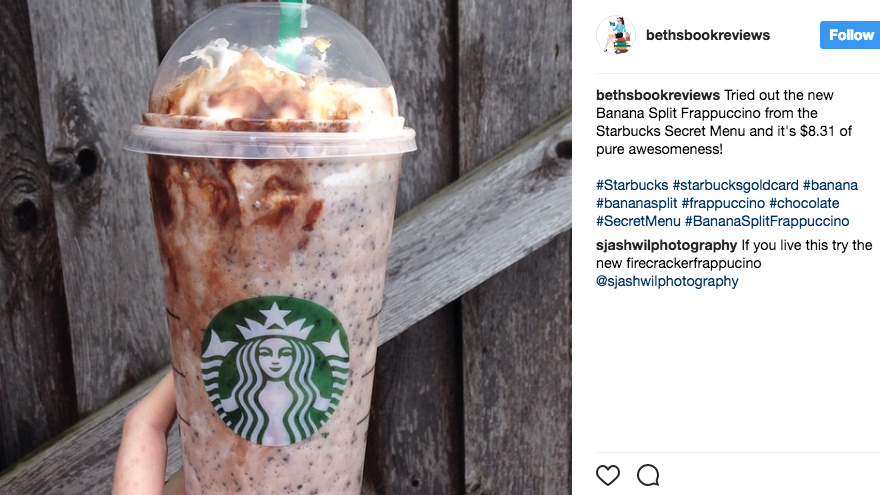
23. Banana Split Frappuccino

Strawberries & Crème Frappuccino

Add vanilla bean powder

Add java chips

Add a whole banana

Top with whipped cream, mocha drizzle, and caramel drizzle

24. Cadbury Creme Egg Frappuccino

Java Chip Frappuccino

2 shots of espresso for venti and grande, 1 for tall

Vanilla bean powder (4 scoops for venti, 3 scoops for grande, and 2 scoops for tall)

Caramel syrup (1 pump for venti drink, and .5 pumps for grande and tall)

Vanilla syrup (2 pumps for venti, 1.5 pumps for grande, and 1 pump for tall)

25. Pumpkin Pie Frappuccino (Only available in October and November)

Pumpkin Spice Frappuccino

1-2 pumps cinnamon dolce syrup

Whipped cream blended in

Cinnamon dolce sprinkles on top

26. Rainbow Sorbet Frappuccino

Strawberries & Crème Frappuccino (made with orange refresher instead of strawberry purée)

A scoop of vanilla bean powder

A pump of raspberry syrup

A pump of peach syrup

Blend over ice

27. Key Lime Pie Frappuccino

Cool Lime Refresher

Whole milk

Cinnamon dolce syrup (1.5 pumps for venti, 1 pump for grande, and .5 for tall)

Vanilla syrup (3 pumps for venti, 2 pumps for grande, and 1 for tall)

White mocha (3 pumps for venti, 2 pumps for grande, and 1 for tall)

Whipped cream blended in

28. Red Velvet Frappuccino

Half white chocolate mocha

Half regular mocha Frappuccino

2 pumps of raspberry syrup

Top with whipped cream

29. Hot Butterbeer Latte

Whole milk steamer

2-4 pumps caramel syrup

2-4 pumps toffee nut syrup

2-4 pumps cinnamon dolce syrup

Whipped cream and salted caramel bits

Optional shots of espresso

30. Banana Split

Strawberries & Cream Frappuccino

Whole banana blended in

Vanilla bean powder

Java chips blended in

Top with whipped cream and mocha drizzle

31. Twix Frappuccino

Caramel Frappuccino

1-2 pumps caramel syrup

1-2 pumps hazelnut syrup

Java chips

Caramel and mocha drizzle

32. The Blue Drink

Passion iced tea

Vanilla syrup

Soy milk

It’s unclear what makes the drink blue—food coloring? the souls of Smurfs?—but we’re willing to order it to find out.

33. Cinnamon Toast Crunch Frappuccino

White Mocha Frappuccino

1 pump cinnamon dolce syrup

1 pump hazelnut syrup

Cinnamon sugar on top

34. Mermaid Frappuccino

Vanilla Bean Frappuccino

Freeze-dried blackberries

Line the cup with green mixed drizzle (white mocha sauce, toasted coconut syrup, and matcha powder)

Topped with whipped cream and additional drizzle or matcha powder

35. Matcha & Espresso Fusion

Mix matcha powder into water and ice

Choice of milk

1-2 Affogato shots

36. Honey Nut Macchiato

Caramel macchiato

Chestnut praline syrup

Top with a packet or two of honey

37. Raspberry Mocha Eggnog

Iced white mocha

Sub eggnog for milk

Add raspberry syrup (1 pump for tall drinks, 2 for grande, 3 for venti)

38. Dragon Frappuccino

Green Tea Frappuccino

Vanilla bean powder

Add a swirl of berry syrup at the bottom of cup

Top with whipped cream and purple sprinkles

Optional: Add coconut syrup

39. Chunky Monkey Frappuccino

Cream-based Frappuccino

Add a banana

2 scoops vanilla bean powder

2 pumps mocha syrup

2 pumps hazelnut syrup

2 pumps toffee-nut syrup

Top with light caramel drizzle and light mocha drizzle

40. Thin Mint Frappuccino

Matcha Green Tea Crème Frappuccino

2 pumps chocolate syrup

1 pump mint syrup

Java chips

Honey

41. Cinnamon Roll Frappuccino

Vanilla Bean Crème Frappuccino

2 or more pumps of cinnamon dolce syrup



Source link

Categories
Health

36 Last-Minute Christmas Gifts You Can Order on Amazon Today and Have in Time


You swore you wouldn’t procrastinate on your holiday shopping this year—but alas, here you are, just days before Christmas, with a to-do list long enough to turn you into a Grinch. That’s where Amazon Prime comes in, to save both your holiday sanity and spirit. With hundreds thousands of last-minute Christmas gifts you can order online and have in time, you can finish all of your shopping in one fell swoop. Here are 34 of our favorite last-minute Christmas gifts that will definitely make it under the tree, as if Santa delivered them himself.


Source link

Categories
Health

All Your Questions About Trump's Executive Order on Family Separation, Answered


In the weeks leading up to summer, it appears as though the entire country has turned its attention to America’s border cities. There, a crisis emerged when the Trump administration ordered a “zero tolerance policy” calling for the prosecution of migrants attempting to enter the country via asylum or otherwise.

The policy change mandated that border agents detain anyone attempting to cross—which is typically treated as a civil misdemeanor offense—and try it as a criminal case. In turn, parents traveling with children were separated at the border and sent to different detention facilities.

Since the practice began, stories have emerged of infants being ripped out of their mother’s arms, fathers who died from suicide after being separated from their families, and the guttural, heartbreaking cries of children begging for their parents.

The pure, unadulterated outrage that followed from the American public, churches and advocacy groups reached a fever pitch before the president signed an executive order that ended the separation of families on Wednesday. However, while signing the order, President Donald Trump made it abundantly clear that his administration’s “zero tolerance policy” toward migrants will remain, which has left followers of this humanitarian and political catastrophe with more questions than answers.

Will families actually stay together?

According to the executive order, which was posted to the White House website, families will remain together “where appropriate and consistent with law and available resources.” However, it additionally noted that children and parents may be separated if the government determines keeping them together “would pose a risk to the child’s welfare,” which gives the government room for interpretation of the law.

Is it actually legal to detain families, even if they are together?

This is where things get very murky. According to a 1997 court ruling known as the “Flores Settlement,” children who are detained at the border with parents must be placed with a family friend or immediate relative “without unnecessary delay,” Vox explained. But, as the ruling states, immigrant children who must remain in custody must be placed in the “least restrictive conditions” possible. Those conditions include food, running water, medical care and separate living quarters from unrelated adults.

The last part—separate living spaces—is what likely will cause major issues in the near future.

In 2014, the Obama administration attempted to keep families together in detention centers following a massive uptick in asylum-seekers from Central America. However, immigration advocates found the practice inhumane. So, a 2015 court set a general standard stating the government could only hold children in custody for up to 20 days, NPR reports. And though the court never specified how long parents could be held, the Obama administration made it practice to release the entire family together, with certain restrictions, such as placing ankle monitoring bracelets on parents to ensure they’d return to court.

There is no word yet if Trump’s administration will do the same, however, he has time and time again ridiculed the practice of releasing the families, often referring to it as “catch and release.” Trump has also instructed Attorney General Jeff Sessions to ask the federal court to modify that agreement so there will be no limit on how long children (and thus their families) can remain in detention, NPR explained.

Where will the families be housed?

Again, this is another question in the air (are you sensing a pattern in this crisis?).

As part of Trump’s instruction to Sessions, the president also called on different branches of his administration to find facilities that could be available for detaining families with children, NPR reports. Trump also asked the Defense Department, to build new facilities “if necessary.”

What will happen to the families already separated?

According to Immigration and Customs Enforcement (ICE), who provided a statement to NPR, it is indeed working side-by-side with the Office of Refugee Resettlement (ORR) to reunite families. “ICE and ORR will work together to locate separated children, verify the parent/child relationship, and set up regular communication and removal coordination, if necessary.”

“ICE will make every effort to reunite the child with the parent once the parent’s immigration case has been adjudicated,” the spokesperson added. However, according to multiple reports, this just isn’t happening.

According to PRI, the process of unification is difficult because the adults and children fall into different legal paths at the border, and are thus the responsibility of different government agencies. The parents and children are often given different case numbers, so it’s hard to track one another down.

“If they don’t reunite these kids and their parents right away, what can happen is the kids will be stuck in the US for years, guardians will be appointed, and their parents will be down in Honduras or Guatemala with no idea where their child is and no meaningful way to reunite,”John Sandweg, former acting director of Immigration and Customs Enforcement under the Obama administration, told MSNBC.

Furthermore, several lawyers and advocates explained to the New Yorker, that the process of finding a child within the system after a parent has been released or deported is nearly impossible. The experts who spoke with the New Yorker explained, in great detail, how the parent is forced to track his or her own child down using a system of non-profits, a 1-800 number set up by ORR, and simply having a bit of luck with finding their loved one.

“I have a master’s degree, and I’m fluent in English,” Emily Kephart, a program coordinator at an immigrant-rights group known as Kids in Need of Defense, told the New Yorker. “And it takes me days to figure one of these cases out.”

Related Stories:

At the Border, Parents Seeking Asylum Are Willing to Risk Separation Rather Than Go Back to Danger

Trump’s Executive Order Means He Won’t Separate Families at the Border, but He’s Still Detaining Children


Source link

Categories
Health

Trump's Executive Order Means He Won't Separate Families at the Border, but He's Still Detaining Children


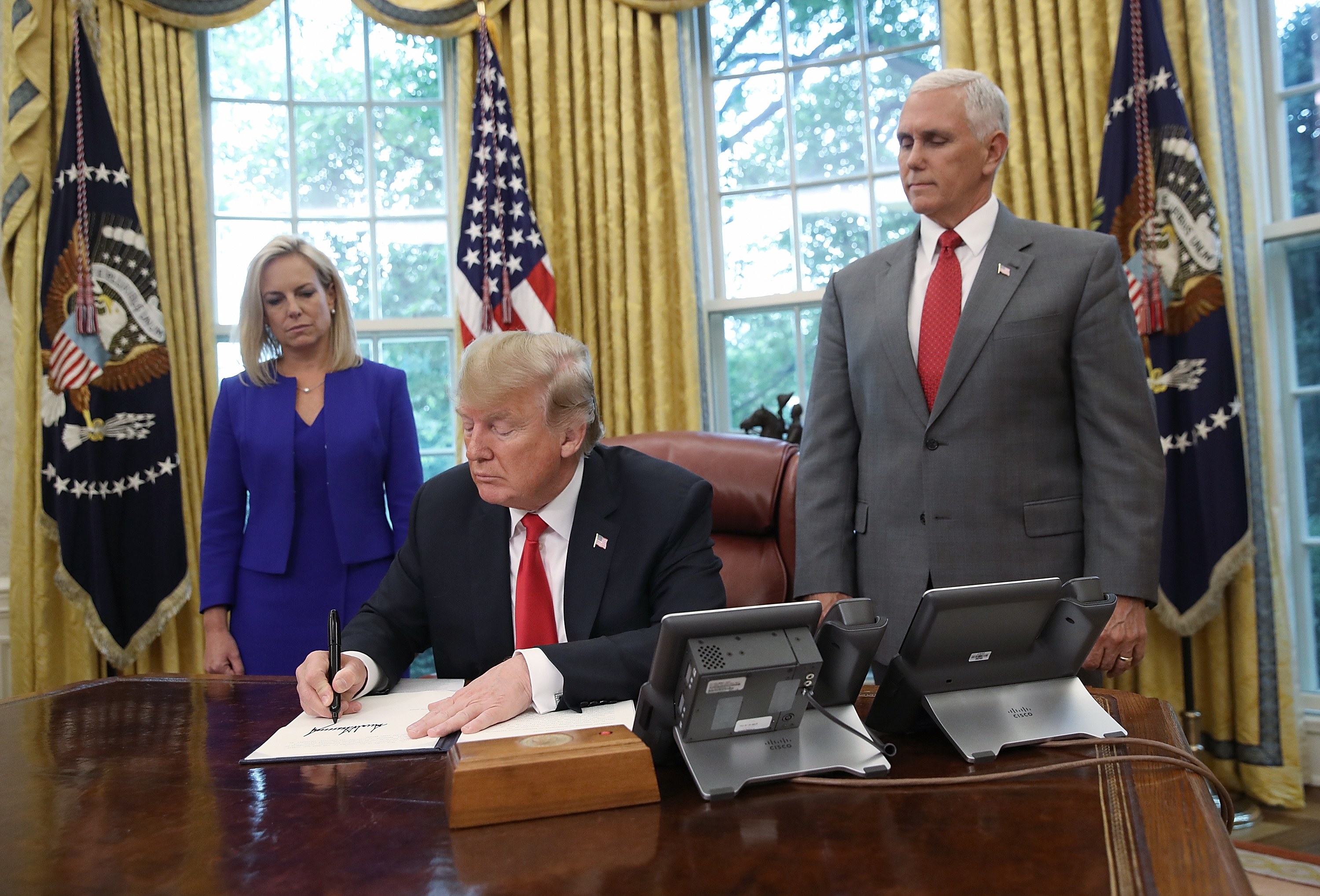
After days of public outcry around the Trump administration’s “zero-tolerance” policy that allowed for the separation of immigrant children from their parents at the border, President Trump signed an executive order that ends that separation.

However, the “zero-tolerance” policy that created the recent crisis remains.

“We are keeping families together and this will solve that problem. At the same time we are keeping a very powerful border and it continues to be a zero tolerance, we have zero tolerance for people that enter our country illegally,” Trump told the White House pool reporters present in the Oval Office, per CBS News.

“I didn’t like sight or the feeling of families being separated,” Trump said.

The executive order notes that it is “the policy of this Administration to rigorously enforce our immigration laws” and that they will initiate proceedings to enforce laws about “improper entry.” But this section also allows for families to be held together during the prosecution process: “It is also the policy of this Administration to maintain family unity, including by detaining alien families together where appropriate and consistent with law and available resources.”

The order further stated, “It is unfortunate that Congress’s failure to act and court orders have put the Administration in the position of separating alien families to effectively enforce the law.”

It is important to note, that according to experts who spoke with Glamour, the separation policy is not a law. It was also up to Trump himself to make the call on ending the family separations.

Earlier today, the New York Times reported that sources close to the president said he believes his immigration policies are “appropriate and necessary,” but that he was frustrated by the criticism he’d been receiving.

Many news outlets report that there could be legal battles ahead for this order due to a 1997 consent decree from a federal court, called the Flores settlement, that says children can be detained for only 20 days, even if they are with their parents.

It is unclear at this time what will happen to the families that are currently separated and being held in detention facilities—or how long detained families can be held.

Trump spoke earlier this morning about the possibility of an executive order. “We’re meeting right now on immigration and we are very strong at the border, we’re very strong on security. We want security for our country,” he said at the White House. “The Republicans want security and insist on security for our country, and we will have that.”

ABC News reports that First Lady Melania Trump may have played a part in the president’s decision to sign the order. She has been pressuring her husband to end the child separation policy, according to a White House official. Their source also claims that Ivanka Trump has shown the president images of children in detention centers and urged him to end the policy.

As of Wednesday afternoon, she had not made any public statements on the issue, although she did tweet after the signing of the executive order.

We will update this story as new details around the policy and executive order emerge.

Related Stories:

Here Are the Facts About Trump’s ‘Zero Tolerance’ Immigration Policy

Here’s How to Help Immigrant Families Who Have Been Separated at the Border


Source link

Categories
Health

Fixing Racism Is a Tall Order For Starbucks—But They’re Game to Try


Nothing, it seems, has been more difficult to remedy than the issue of racism and implicit bias in this country, but this week, coffeehouse juggernaut Starbucks attempted to at least begin the conversation when they shut down more than 8,000 of their stores for a day of racial bias training following the April arrest of two black men in a Philadelphia location, sending the internet into a flurry of think pieces and expert quotes that had people wondering: Can a day of company training really fix a problem of this scope?

If the training video Starbucks showed is any indication, they’re at least using historical context to address exclusion. The passing of the Civil Rights Act of 1964 may have outlawed discrimination based on race, color, sex, religion or national origin, but in the video—released to the public Tuesday—the landmark law serves as a framework for understanding just how difficult it is to change hearts and minds, especially when it comes to the implicit biases we hold.

In the film, created by award-winning documentarian Stanley Nelson and underwritten by Starbucks, a narrator explores how access to public spaces has been regulated in this country, and how those areas have been made largely unattainable to black people. When blacks—who are maligned by stereotypes that have been intensified by the historical stink of slavery—enter those public spaces, it has been a punishable offense. That was no more evident than in April when two black men—Rashon Nelson and Donte Robinson—visited a Philadelphia Starbucks to attend a business meeting. While they were waiting for their friend to arrive, and after they’d asked to use the restroom, a Starbucks employee called the police, telling the 911 dispatcher that the men refused to purchase an item or leave. The call resulted in an arrest on suspicion of trespassing—though no charges were filed—and the high-profile incident sparked protests and calls for Starbucks to address what many believed to be racial profiling.

[embedded content]

“It’s time we talk about what it means to not be welcomed as an American citizen,” Sherrilyn Ifill, president and director-counsel of NAACP Legal Defense Fund and senior consultant to Starbucks’s racial bias training says into the camera. And it’s a conversation Starbucks is committed to having, according to Rosalind ‘Roz’ Brewer, Starbucks’ first woman COO.

“We’ve always said that this training is a first step in a long-term journey—we cannot change ingrained behaviors and implicit biases within four hours,” she told Glamour.com, adding that the company will send representatives to a convening this summer hosted by the Leadership Conference on Civil and Human Rights and will take steps toward understanding how they can address other forms of bias.

Additionally, she said, the company’s 100,000 hires each year will be receiving racial bias training upon becoming a Starbucks partner—something experts think is nonnegotiable for the chain.

“This wasn’t just a thing that was nice to do,” said Heather McGhee, president of equal-rights public policy organization Demos and an outside advisor to the training. “The executives had to believe and communicate that they couldn’t succeed as a business without addressing this issue,” McGhee said. “And I think they actually did that.”

Chafing at criticism that the training was more symbolic than effective, McGhee reiterated what the company has been saying since the bias workshop was announced—this isn’t just a one-day fix.

“I think that most of the commentary has really focused on the ‘one day’ because that’s the information that’s mostly out there, but the company has tried to get the message out that they know that one day is just the start,” she told Glamour.com. “They’re looking at ongoing, deeper training as well as reviews of their systems and practices and procedures so that the message is continuously reinforced.”

If Starbucks, which, according to TIME.com, stood to lose up to $12 million in its Tuesday afternoon closings, is investing time and money, and opening itself up to public scrutiny, in proposing racial bias training, it’s expected that the firm would make it an ongoing focus, said Tamisha J. Ponder, director of intercultural engagement at the Community College of Baltimore County.

“We know that these types of trainings need to be reinforced,” she said. “I don’t want to discredit this attempt because it speaks volumes. It’s beneficial because it’s their first discussion of racial bias, ever.” When companies and institutions implement racial bias training with this high a profile, it’s safe to assume it isn’t just for a day, Ponder said. And pulling back the layers of implicit bias and the historical context, much as the Starbucks video shows, is key.

“Before we discuss bias, we discuss the social construction of race,” Ponder said, describing her university’s approach to bias training. “By discussing race as a social construct, it exposes America’s history of legal and systemic racism and access to privilege. It lays the framework for how to discuss bias and how our country has legally supported bias to understand how you, yourself, can be biased.”

To measure the success of these trainings, Starbucks will likely do spot audits of their stores, implement retention and hiring practices to promote diversity, and measure engagement and interest in training from their employees.

Of course, there’s research that shows racial sensitivity training isn’t always effective. But considering Starbucks’s corporate Third Place policy—which aims to “create a culture of warmth and belonging where everyone is welcome” according to the website—chairman Howard Schultz’s recent directive that employees should let anyone (not just customers) use the restroom, and the company’s plan to make accessible all racial bias training material to employees, McGhee is hopeful.

“I think it needs to be a national effort…there’s so much misunderstanding about the way race and bias work in the human mind,” McGhee said. “If we’re going to be a diverse democracy, we’ve got to all—as people in this country—have better skills at interacting across lines of race.”


Source link

Categories
Health

Audrina Patridge Is Reportedly Divorcing, Filing a Restraining Order Against Her Husband


Audrina Patridge is divorcing her husband, BMX rider Corey Bohan, after less than a year of marriage, both People magazine and TMZ report.

According to TMZ, Patridge filed the papers on Wednesday (September 20). The reason for the divorce is unconfirmed at this time, but TMZ reports a “series” of “menacing and emotionally abusive” incidents may have been a factor. Patridge reportedly also sought a restraining order against Bohan.

“Audrina’s number one concern is for her daughter and she asks for privacy at this time,” a rep for the former Hills star told People magazine. She and Bohan welcomed their daughter, Kirra Max Bohan, in June 2016.

We were first introduced to Bohan on The Hills; he had a recurring role as Patridge’s love interest on the popular MTV show, which ran from 2006 to 2010. Bohan and Patridge have been dating on and off since 2008. He proposed to Patridge in November 2015 at the Summit House in Orange County, California, and they were married about one year later.

“Corey dropped to his knee and said, ‘We have been together for many years now and I love you more than anything. I want to spend the rest of my life with you – will you marry me?’ Patridge told People around the time of the engagement. “I was in shock and kind of didn’t even hear him. But I said yes!”

Earlier this year Patridge opened up about how she faced criticism for having a baby before marriage. “A lot of people gave me a hard time for having a baby before getting married, but who are they to judge?” Patridge told Momtastic. “You always have those few haters who are going to be negative in every situation. At the end of the day, nobody is perfect. You have to do what’s good for you.”

This story is still developing. We’ll update this post with more information as it comes in.

Related Stories:

Audrina Patridge Reveals People Criticized Her for Having a Baby Before Marriage


Source link