Categories
Health

How Frankie Shaw Turned Her Twenty-Something Single Mom Experience Into Hit Comedy 'SMILF'


Frankie Shaw’s new Showtime comedy SMILF about a twenty-something single mother is raw, gritty, and real because—guess what—she’s been through it all. For Shaw, the memory of getting pregnant at 24 with her then-boyfriend Mark Webber is fresh. The two were in Philadelphia shooting his directorial debut film, Explicit Ills, in which she had a role. “I took a pregnancy test, and I remember walking around being like, ‘What am I going to do?’ ” says Shaw, who had only just begun to pursue an acting career. “I got on a train to Boston to see my aunts in Southie. One of my aunts said, ‘Frankie, you have the love, but babies need stability. You need to get a regular job and move back home.’”

Shaw, refusing to give up on her dream, did the opposite: “I decided to keep the baby and move to L.A. by myself when I was 11 weeks pregnant.” She left Webber (“It wasn’t working for various reasons”) and found a roommate from a rental listing. “I show up, and I was like, ‘Hey, I’m pregnant!’ She definitely wasn’t expecting her roommate to be pregnant. I ended up not staying there for long.” And was Shaw ready to be a mother? “No,” she says. “But I knew that if I just kept going, I would be able to make a life for me and my son.”

She got to work, hustling to land anything to keep her and Isaac afloat. “It’s not like I could couch-hop with a baby,” she says. “You can’t be this rambling artist in your twenties if you have a child. I had to be more focused.” Shaw juggled auditions with assistant work and SAT and AP test tutoring gigs for extra cash. “Isaac came with me to everything I did those first few years,” she says. “I remember even bringing him to yoga.” Luckily her mother (who had raised Shaw on her own) came out to L.A. to help with child care. Shaw also tried to keep some semblance of a young life: She dated a little. “I remember right before one guy kissed me good night, he was like, ‘I just want you to know, I’m cool with the kid thing.’ I was like, ‘Uh, thanks?’” To her, Isaac wasn’t something to be cool with: “It was like, ‘Oh, you would be lucky to be in Isaac’s life.’ ”

PHOTO: Danielle Levitt

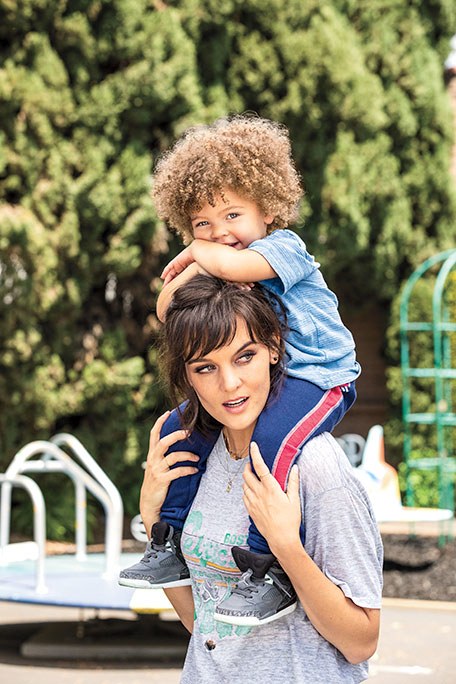
Shaw, with her onscreen son, on Showtime’s SMILF

Eventually she landed a role in ABC’s series Mixology in 2013, which—despite being canceled after one season—earned her enough cash to direct a few shorts she had written on the side. “That is when things started to change,” she says. Writing and directing gave her a way out of endless auditions, and a chance to use writing skills she’d honed as an English student at Barnard. “I thought that if I wrote a pilot, I could get staffed [in a writers’ room] and have a regular job.”

So Shaw camped out in coffee shops with Isaac, writing a show about a young mom—“nonpretty and real to my life.” She called it SMILF (“single mother I’d like to…”—you get it) and spent $3,000 of her own money to make it. Shaw submitted a scene to the 2015 Sundance Film Festival on a whim and won the Short Film Jury Award: U.S. Fiction. Then Showtime snapped up the idea and started developing it with her as a TV show.

On the advice of Jill Soloway, Shaw fought to direct. “We met at a barbecue—we were both single moms with kids named Isaac,” she says. “Jill, who is like a mentor to me, said, ‘Do not let them take directing from you.’” Part of Shaw’s vision includes hiring other female directors, exclusively, to help helm season one.

SMILF, she says, is “really about a young woman figuring out how to make her life work while she has a kid. And even if she didn’t have a kid, she would be faced with many of the same issues.” Issues relating to ambition and sexuality that every twenty-­something faces—all while seeing your body transform before your eyes or navigating the complexities of coparenting with an ex.

And the show is a family affair for Shaw. In addition to costar Rosie O’Donnell and guest star Connie Britton, Isaac’s father plays a sober priest in the show. (Of their relationship now, she says: “We’re coparenting; there’s always been love there.”) And her husband, Zach Strauss, is a writer for the series—the two met in 2013 and married in 2016. Isaac, 9, shows up now and again too, as Britton’s son, and he couldn’t be prouder of his mom. “He likes to tease Zach about the fact that I’m his boss,” says Shaw.

Her hope is that SMILF can accurately capture what it’s like to be a single mom. “You’re responsible for this young life,” she says. “Every thought—where they are, how they’re doing, their well-being—is about them. It’s a constant.” Offscreen, she hopes her story will set an example for her son, her own constant. “I want him to know: Do what you love. Just do what you love. I hope that message will get ingrained in him.”


Source link

Categories
Health

What It's Like to Be a New Mom When You Have Panic Disorder


It happens some time in the third week of parenting a newborn child: the moment when you start to feel like you’re below deck on a quickly sinking ship. With a double-digit number of interrupted nights under your belt, but without a sense of routine, your grasp on time becomes tenuous. Minutes in the middle of the night hold whole reams of barely connected thought streams. Your hormones shift in spurts and gushes, with waves of euphoria following hours of dazed, robotic movements. Visits from well-wishers have died down and a new reality sinks in: You are going to be this baby’s parent forever.

My tumultuous third week came with two particularly difficult addendums. First, it wasn’t just my hormones slip-sliding up and down, I also had to contend with my SSRI-reliant body—I’ve been taking Citalopram for more than five years— adjusting to each new surge and loss of dopamine. And second, quick breaks from peeking at my daughter’s sleeping face and washing breast pump equipment were filled with some extremely alarming news alerts. See, my daughter was born on January 22, 2017—the day after I marched with a half million other women in Washington, D.C., and two days after Trump was sworn in as the forty-fifth president of the United States.

Those weeks were a feverish nightmare of protest, upheaval, and panic. Psychiatric experts were espousing to the world that Trump suffers from “grave emotional instability.” Thousands were gathering to protest at airports as families worried that the hastily composed travel ban would tear them apart. The President was already flexing some autocratic tendencies by firing acting Attorney General Sally Yates and not firing Michael Flynn. Would America slip that easily into an oligarchy? What new other restrictions and nasty surprises did the new administration have in store? Every New York Times push notification brought more nail biting and agita.

I knew even before pregnancy —and Trump’s election—that after childbirth my panic disorder might rouse itself from relative dormancy. After years of sometimes daily or hourly panic attacks, they’d mostly abated, but my psychiatrist warned that even a potent SSRI dose isn’t always enough to combat the changes brought on by a hyperactive endocrine system—the wash of hormones that floods your bloodstream after childbirth can leave even the most emotionally balanced woman struggling. I thought I might be in the clear, because the first five days after my daughter’s birth passed by uneventfully—even her several-day-long stay in the NICU for breathing issues didn’t set off any undue panic—but on our sixth night, home from the hospital, as I snuggled the baby to my breast in the coldest hour of the day, panic started to tiptoe back into the edges of my brain. Panic of the acid-flashback, snarling-monster-under-the-bed, reality-seeping-off-into-the-distance variety.

There isn’t much to do while nursing in the middle of the night. I could watch TV, but I liked to sit in a particular armchair in my bedroom and the noise might wake my sleeping husband. I envy any woman who says she can read a novel at 4 am with a finicky newborn attached to her chest. And so, to the Internet I went. At first, scrolling through my Twitter feed and catching up on the day’s news felt refreshingly normal. See? I’d tell myself. Even with a baby, I’m still me.

But the weight of my news binges caught up to me—quickly. Every time I settled into my armchair and toggled through my New York Times and Facebook apps, a physical jolt of fear lurched through me. North Korea was celebrating successful long-range missile launches and the President was responding with bluster and insults. Trump was hosting weird and wild press conferences, sounding more authoritarian with each turn. The head of the military’s Special Operations Command was professing worry that “our government continues to be in unbelievable turmoil.” Mr. Trump’s Wild Ride came crashing into my bedroom three times a night. I’d clutch the baby against me, try to regulate my breathing, and imagine myself cozily back in bed in an alternate universe that didn’t involve a wannabe despot and a needy infant. It rarely worked.

My anxiety took on a particularly political flavor. What the hell, I would ask myself, were we thinking by having a baby while the world is ending? It feels silly to recall now, but I would replay various scenarios—in which the military took over my home city of Washington, D.C. or North Korea launched a missile at us—over and over in my head, imagining what things I would need to quickly grab for the baby, or wondering how we would fortify the house and keep her quiet so we wouldn’t be found. In a particularly desperate moment I (a virulent gun opponent) asked my husband if we should buy a gun; for thirty minutes I pressed the point so forcefully that he nearly conceded. Because I live only a mile and a half from the White House, these fears felt real, even urgent at the time. If an uprising were to erupt anywhere in the nation, it would be here. And I had gone and nailed myself to the wall by adding a baby to the mix.

I don’t think that these anxieties were only experienced by people with a preceding diagnosis, like me. But do I know that my anxiety took on a life of its own. It crept out of my late-night nursing sessions and into the daylight, usually accosting me in the precise moments when I should have been able to unwind—during corpse pose in yoga class, or just after the baby had drifted off for a nap. The only time I remember truly relaxing was, oddly enough, in the emergency room after I hemorrhaged a not insignificant amount of postpartum blood. Lying there, surrounded by medical professionals and under a heap of warmed blankets, I felt irrationally safe. More precisely, I felt like I had given up control to a group of people who I knew could care for me—I didn’t need to make any decisions, and nothing bad could possibly happen to me.

Panic disorder, like most anxiety-related issues, is an inherently selfish mental disease. The moment of an attack, the rest of life recedes into the background—and if it doesn’t happen automatically, you push it there. The most urgent need becomes survival. Of course, your life is never in any danger, but with your brain quickening to a frantic pulse, and your skin flashing hot and then cold, death feels like it’s sitting on your shoulder, waiting to reach in and stop your heart. And if we subscribe to the most dominant notion about parenting, it’s that selflessness is required in all things; your life, post-child, ought to be entirely in service of that child. But panic attacks upend that natural order—the only thing more powerful than our parenting instincts is our survival instinct. And panic attacks trick our brains into believing that survival is at stake.

One late spring day, on a little trip to some botanical gardens with my husband and the baby, I had a particularly egregious panic attack. It’s no exaggeration to say that we somehow were given the perfect baby—she eats like a dream, has slept twelve hours a night since 12 weeks, and whole days go by without anything resembling a cry—but that day her mere existence scratched at my skin. Every moment that I was in her presence felt like torture. With her around, I couldn’t focus entirely on me—and in the midst of panic, when your body systems are quite literally in fight or flight mode, self-care feels dire. A baby, with its abundant needs, demands far too much attention for a panic-addled brain to . I remember fleeing to my bedroom like a sulky teenager and telling my husband that under no circumstances was he to bring “that baby” in until I was ready to see her. I pulled the covers over my head and cried for three hours.

Even then I recognized the inherent contradiction in my psyche. The panic induced feverish worry that some apocalypse-sized event would threaten my daughter’s safety—but it also made me push her away, to prioritize myself before her.

At the end of the crying jag I made a deal with myself. Each week I could give my panic one hour of time. One hour to hoard old glass bottles in case I needed to preserve water in the event of a government overthrow. One hour to Google “Why are so many helicopters flying over D.C.?” One hour to just sit and pick my cuticles while I let scary thoughts flutter across my eyelids. One hour to sit and stew in my guilt over worrying about such absurdities when some mothers don’t know where their next meal will come from, or how they’ll pay the rent, or whether their partners will come home too drunk to control their emotions. That hour eventually became less and less integral to my week: by setting up a system where I knew I could worry about something later, I eventually just plain forgot to worry about the thing. But more than anything, it was the knowledge that my daughter, even in her infancy, could sense the emotions swirling around her that helped me curb many—though certainly not all— of my impulses.

I come from a long, illustrious line of worriers—worriers who don’t merely fret, but wake for long stretches of the night, stiff and unsteady, cycling through minor fears about cavities or unbought sheets or upcoming long drives. Worriers who fit the mold of a classic anxious person. In fact, my sister is such an accomplished worrier that we ask her to worry about things for us so they won’t happen. “I need you to worry about something for me,” is an all too common text on our family thread.

It’s only logical to assume that my daughter might inherit some of those tendencies, too. With a panicked mother hovering above her, that risk will only increase. Now, when that New York Times alert that North Korea has announced that it has a nuclear missile capable of reaching the East Coast pops through but I’m stacking blocks with my daughter on our living room floor, I breathe and tuck away the worry for later in the day. She may end up inheriting my anxiety, but I’d also like her to learn from my newly zen approach to dealing with it. Tending to my anxiety has become an act of preservation—not just for me, but for both of us.


Source link

Categories
Health

Ask Emily: How to Date as a Single Mom


Hello Emily!

I’m a single mom and my daughter is 2 years old. I’ve told my friends that dating for me will be harder because I’m a mom, and my daughter is still very young. I’ve tried online dating apps, but the guys I’ve matched with fade off after a couple of days. What should I do? Do guys get intimidated when they meet single mothers?

I’ve lost hope in finding a relationship. Please help me, Emily!

Thanks—and love your podcast!

Nadine, 24, Texas

Nadine,

I think it’s awesome that you’re a mom, and it’s also great that you want to start dating again. Having a child doesn’t mean you’ll never find love again, so don’t lose hope!

It’s true, there are some men—especially of the younger variety—who aren’t ready to date a woman who is also a mom. However, there are plenty of men out there who won’t be phased by it, and will be more than happy to embrace the fact that you’re a parent.

Here are a few tips to ease you back into the dating pool:

Do be upfront. It’s obviously important to let the person you’re dating know that you have a daughter well before things get serious. Being a mom is obviously your focus, but that doesn’t mean your daughter has to dominate all of your conversations and activities. Always take the time to get to know someone before you introduce them to your child until you know you want to keep them around.

Don’t forget that you’re still a woman. Sure, being a mom is one of the biggest roles you could have in life, but that doesn’t mean you’ve suddenly lost your needs or desires. Channel the person you were before your daughter came along, and be your confident, sexy self.

Do tell your friends and family to be set you up. Let your friends or family be your wingmen. They can be the ones to let your future date know you have a kid, giving that person the chance to decide whether or not they can handle it before you even meet.

At the end of the day, guys get intimidated by a lot of things. Women who work a lot or hold a high-powered position, independent ladies, or even just have a strong sense of self can leave plenty of men feeling less, well, manly. All you can do is get out there and be on the lookout for that guy who isn’t going to cower in the corner just because you’re a parent. Being a single mother is a sacred thing—someone special will know that.

XX,
Emily


Source link

Categories
Health

I Lost My Mom at Sandy Hook. We Can Prevent Another Las Vegas—But We Have to Fight for It


After my mom was shot and killed at Sandy Hook elementary school in Connecticut, along with five other educators and 20 children, I was sure that Congress would act. They didn’t. And now 58 more people are dead following a mass shooting in Las Vegas—to say nothing of the more than 100,000 other Americans killed with guns since that December day five years ago.

The shooting at the Route 91 Harvest country music festival on the Las Vegas strip was the largest and deadliest mass shooting in our country’s recent history. For now. Until the next one. Because it’s not a question of if there will be another mass shooting, it’s a matter of when. How is it that our country has come to accept the regularity of these horrific acts of violence? This isn’t normal.

What should have been a fun night filled with dancing, singing, and laughing with friends instead has left dozens of people dead and more than 500 hospitalized, many with life-altering injuries. And that’s just the physical toll. No one walks away from a horrifying scene of that magnitude ever feeling safe again. For the victims and their families, there is no light, no hope. They will try to find a way out of this darkness, but I can tell you, the darkness does not leave you.

My mom, Dawn Lafferty Hochsprung, was my best friend in the entire world. She was the principal of Sandy Hook School, and she died running toward the shooter that awful day, trying to protect her kids.

I thought Sandy Hook would be a wake-up call to our leaders in Congress. There was no way they could allow 20 children and six educators to be gunned down in classrooms and offer no more than “thoughts and prayers.” But that’s exactly what happened.

Today my voicemail is full. My inbox is overflowing. The messages on Facebook are pouring in. For those wondering how I’m doing—I’m angry. I’m triggered. I miss my mom. I hurt for her. I feel like I’ve failed her. Above all, I am sick over how often this happens. And I don’t want to hear one more person say it’s too early to talk about solutions to our gun violence epidemic. It’s not too early—it’s way too late.

We don’t have to live like this.

It’s time for politicians to stop cowering behind the gun lobby and start standing with families. I wish Congress could show just half the courage my mother did on December 14, 2012.

This is a defining moment for our country. Do we want to continue living in the NRA’s dystopian society of guns everywhere, for anyone, no questions asked? Do we want to continue being held hostage by the gun lobby? Or do we want to live in a country where we feel safe going to schools, concerts, shopping malls and places of worship?

I could easily let days like this knock me down. It’s all too familiar and it’s all too painful. It takes me right back to the day my mom was killed. But no matter how hard it gets, I’m going to continue fighting for stronger gun safety laws. Time after time we see that it’s far too easy for people with dangerous histories to get their hands on guns in this country.

Right now, the gun lobby is pushing legislation to gut silencer safety laws and make it easy for anyone, including convicted felons and domestic abusers, to buy a gun silencer without a background check simply by going to an unlicensed dealer. I don’t even want to think about how much worse the shooting in Las Vegas could have been if the thousands of people attending the music festival didn’t recognize the sound of gunfire coming from above them, or if first responders weren’t able to determine where the gunshots were coming from.

And that’s not all. The NRA and its allies are also pushing for so-called “Concealed Carry Reciprocity” legislation, a dangerous proposal that would gut states’ gun laws, and allow countless people to carry concealed weapons across the country with no additional background checks or gun safety training beyond what goes into an initial purchase.

For those asking what they can do—get off the sidelines. Gun violence tears families apart every day in America. Most often, it doesn’t even make the headlines—there’s simply too much to report.

If you’re not actively trying to be a part of the solution, you’re part of the problem. Get up and do something. Make a call to your Congressperson or Senator. Show up to a rally. Sign a petition. Donate to local organizations that support survivors of domestic violence. Just do something.

Erica Lafferty is the daughter of Dawn Lafferty Hochsprung, the principal murdered in the Sandy Hook School shooting on December 14, 2012. She is partnerships manager for Everytown for Gun Safety.


Source link

Categories
Health

Take it From a New Mom: Universal Health Care Would Mean Freedom, Especially for Women


Since my baby was born a year and a half ago, my husband and I have watched the majority of our recent employers in the media industry either shut down, get sold, or drastically decrease their staff. We have switched back and forth to each others’ health insurance a few times, trying to maintain stability for our family.

Still, I go to bed every night worrying about insurance, especially that I am now a C-section mom, which means I have a pre-existing condition.

For women—and for all parents and primary caretakers—having the freedom to move careers or locations without losing our health care means something really big: we can choose when, if and how to start families—in ways we might not be able to imagine otherwise. And that’s something we should be talking about more.

These days when we talk about health care, we hear a lot about what is wrong (and scary, and terrible) about the status quo. We listen to frightening stories of sickness and tragedy, stories that don’t seem to melt any powerful hearts or change any influential minds—the Affordable Care Act repeal efforts are a zombie that won’t die. It’s critical that we have those conversations and shine a light on the people who need the most help.

But we’re so busy defending our position, that we don’t talk enough about what a different world could look like. Sometimes it feels impossible to even think that way. But it’s worth trying, for the glimmer of hope and the shot of positive energy it can give us.

But when I think about the concept of universal health care, I see a doorway to more freedom. It feels like a ray of sunshine has suddenly descended on my family’s future, and all of ours.

Bernie Sanders’ Medicare for All bill, introduced this month, and which is getting support from all the major Democratic contenders for the 2020 race, offers us all this chance—a moment to think expansively, to imagine something radically different.

It allows us to ask the big questions: If you had guaranteed access to decent health care, what would you do differently with your life? Would you become an entrepreneur? An artist? Go live on a farm? Have a baby sooner, or later? Work on that rock opera or science experiment you’ve been dreaming about?

Or just do exactly what you do now, but with a little less anxiety?

Medicare for All, as it’s called by Sanders, is really what’s known as a single-payer plan. As NPR explains‑it would phase in a single system by lowering the eligibility for an expanded version of Medicare every few years until everyone is covered. The plan as proposed isn’t expected to pass—and the question of how it will be paid for remains a big one—but at least it’s offering us something we need: a vision that could really change our lives.

If you had guaranteed access to decent health care, what would you do differently with your life?

Think about the major shift that happened for the generation who lived during the legalization of birth control, and then of abortion: they were suddenly able to pursue careers and adventures and plan for a family at the time that felt right to them. That revolution in reproductive health care made the same kind of sea-change for them that universal health coverage could do for women now. New ways to join the workforce. New chances for equal partnerships at home. The ability to really consider when and how and in what order they wanted to have kids.

Medicare for All would give a new generation a whole new level of freedom and opportunity; last time I checked, those are two ideas that are part of a very American ethos of taking charge of your destiny.

Health care untethered from or employers would give America’s women a chance to follow their dreams. Maybe that’s why it’s so threatening to some men in power—like the congressmen who questioned why men should have prenatal care included in their insurance plans.

Today, most of us rely on employer-based health care, which was fought for and won when a government-run health care proposal faltered in the 1940s—when many women were still expected to be totally dependent on their husbands. If you think about it, it makes no sense. Why should the suits who judge the quality of, say, your spreadsheets, your lesson plans, your PowerPoint presentations or your carpentry skills have power over whether or not you have health care? There is no really logical connection between these two things. It puts us all at the mercy of the companies that employ us, and that’s not exactly comforting in these volatile times.

The status quo is bad for our souls, as well as our bodies. In my busy, over-scheduled life as a fairly new mom, I’ve started look at self-help book titles and be tempted by them: They all exhort me to “Live the life you’ve always wanted! Be the CEO of your future!” and “Choose to Succeed!” It’s so appealing. I mean, I’d love to kill my inner fears and eat them for breakfast every morning. I’m sure we all would. But then I look around me.

Many modern fears are not the kind you can vanquish with a new outlook on life. It’s rational—wise, even—to leave your daring, awesome, magical dream-project in a drawer, if doing so means your kid can go to the doctor instead of the E.R.. No mantra can change that. That’s why it’s crazy to me when people act like government involvement in health care would mean less freedom. It could mean so much more, for all of us—especially for lower-income women, who already receive huge benefits from Medicaid during their childbearing years, from family planning to postnatal checkups.

I mean, I’d love to kill my inner fears and eat them for breakfast every morning. I’m sure we all would. But then I look around me.

We’ve seen in the past decade the sense of freedom that comes from the idea of expanded health coverage. I remember the sigh of relief that ran through my group of friends when Obamacare passed. My peers, then in their 20s and beginning to think about families, began to relax, to freelance, go back to school—because their health care was no longer tied to one job. They had more than a single path forward. But as the options under the ACA got pricier and coverage slimmer, and as politicians played ping-pong with our health care this summer, a nagging voice has come back into all of our lives: what about insurance, what about insurance?

It’s amazing how this affects me. Every time I hear that a new health care repeal effort has failed, I feel tension leave my body. I try not to make it feel personal, but of course it is personal; I’m a mom who had a pregnancy complication and a C-section, a walking pre-existing condition with a little person to protect and provide for—and in 2017, providing for means health insurance.

This is what life is like for so many of us. We are exhausted and sore from living in defensive mode, struggling to anticipate the next disaster: job loss or a health problem, a relative getting sick, steeply rising rents in our neighborhood, a scary diagnosis for our kid—some unexpected twist that could push us to the edge.

But it doesn’t have to be this way. So next time the health care debate comes up in your life, ask the people around you this question: If we knew that losing our jobs didn’t mean having to settle for pricey insurance or no insurance at all, would we behave differently? Would we come up with more bold ideas? You know, think outside the proverbial box? Would we speak up about sexual harassment? Complain about equal pay? Unionize? Use the craziest fonts ever on our slideshows? Start our own company like Jerry Maguire? Take more time off to care for our kids? Breathe a sigh of relief to know that our babysitters and other caregivers have their own care, too?

And ask yourself what you would do if you knew health care was a guarantee for everyone. What dreams would you chase?

Sarah Seltzer is a writer in New York City. She edits the parenting website Kveller.com.


Source link

Categories
Health

This Mom Wants You to Know You're Not Alone If Breastfeeding Hurts


An Instagram photo of a mom named Angela Burzo crying as she breastfeeds recently went viral. “It has been an emotional and painful struggle,” she wrote. Other moms applauded Burzo for reminding us it’s normal not to always love breastfeeding—or any aspect of motherhood, for that matter. But should moms really have to cry their way through nursing, or can pain be avoided? And when does it require medical attention?

Discomfort during breastfeeding is normal, but outright pain is not, says ob-gyn and Maternal Fetal Medicine Specialist Kecia Gaither, MD. Developmental and Behavioral Pediatrician Eboni Hollier, MD, agrees. “When your baby has a proper latch, mothers often report that they may feel some discomfort for up to one minute after the baby starts to nurse,” she says. “If pain continues for much longer, there may be some other cause.”

Nipple discomfort is especially common in the beginning, says lactation specialist and Milkies Milk-Saver inventor Helen Anderson, but it usually goes away after a week or two. After that, the skin becomes less sensitive as it adjusts.

If you experience more than mild discomfort for a minute and it continues after two weeks, it’s possible there’s an issue. One of the most common problems is that the baby doesn’t have a deep enough latch, says Hollier. If that’s the case, your nipple might look pinched or have a white band around it when you’re done. Try moving the baby away and then back to see if they latch on better the next time.

Another cause of pain during breastfeeding could be engorgement, which happens when your breast doesn’t fully empty, Hollier adds. Breastfeeding more frequently or using a breast pump to get rid of excess milk can help with this. Mastitis, a mammary glad infection, is also a common culprit. “Signs of mastitis can include sharp or shooting pain during or after breastfeeding, fever, chills, and flu-like symptoms,” says Hollier. Call your doctor if you see this signs, because you may need antibiotics. “Any breast pain in association with fever, lumpy/swollen breasts, reddened breasts, or cracked nipples require medical attention,” says Gaither.

But discomfort isn’t always the result of a medical problem, Gaither adds. If you have larger nipples or inverted nipples, breastfeeding might naturally be more of a challenge for you. Sometimes, the cause is as simple as the fact that the baby’s biting.

If you’ve investigated and dealt with any underlying causes but are still experiencing discomfort, there are a number of at-home remedies you can try. Leslie Elia, a mother of four, says she’d pump in addition to breastfeeding. When she got mastitis and breast infections, she’d drink three cups of marshmallow root tea a day to keep the pain down. She’d also change her son’s position so that the same part of her breast wasn’t always getting worn down. “I remember even lying on the bed and having him nurse upside down so that his feet were lying by my ears,” she says.

Varda Meyers Epstein, a mother of 12 and parenting expert at Kars for Kids, experienced pain for the first six weeks to three months every time she nursed. What got her through was using HPA lanolin cream and Vitamin E oil on her breasts, alternating breasts for each feeding (keeping track by putting a safety pin on her bra), getting air and sun on her breasts between feedings, taking painkillers 15-20 minutes before feedings (ones that were safe for nursing moms), and expressing or pumping the milk if it didn’t come down on its own.

Mommy blogger Veronika Obeng also experienced pain in the beginning of breastfeeding her five kids, though the pain usually subsided after a week. “During the darkest hours of pain and uncertainty of breastfeeding, I slathered my nipples with Vaseline to keep them moisturized,” she says. “I used warm towels to soothe the aching caused by engorged [breasts].”

Gaither says these women’s solutions sound reasonable, though there hasn’t been any research on marshmallow root tea, and you should remove Vaseline before breastfeeding. Hollier also recommends using nipple cream or olive oil on dry or cracked breasts, holding an ice pack or a warm compress over sore breasts, or massaging your breasts during a hot shower. While you’re nursing, pressing down on your breast to help the milk come down can cause the baby to suck with less pressure, which will also alleviate pain, says Anderson.

If these remedies don’t do it and you want to keep breastfeeding, Hollier recommends going to a lactation consultant. Anderson recommends seeing one regardless if breast discomfort doesn’t lessen after two weeks. And if the pain is severe or accompanied by other symptoms, go to a doctor to investigate a potential underlying problem.


Source link