Categories
Health

A Female Judge Just Blocked Trump's Attempt to Rescind the Birth Control Mandate


For a lot of women—particularly those of child-bearing age—one of the best parts of former President Barack Obama‘s Affordable Care Act is the fact that employers are required to offer free birth control to employees through their health insurance policies. Keeping in mind the high cost of the Pill, IUDs, and other forms of contraception, the news that they would now be totally covered came as a huge breath of fresh air, reducing stress for women worried about how they’d scrape together another $100 for next month’s Pill pack or dissuaded by the cost of longer-term options—even if those ultimately worked better for them. (Reminder: There is no one-size-fits-all option for contraception.)

The one type of employer currently excluded from this mandate are religious organizations. However, President Donald Trump, via the U.S. Department of Health and Human Services, attempted to undo the entire requirement by issuing a change in policy in October—until a female judge on Friday put a temporary stop to it.

Word that Trump would try to undo Obama’s birth control mandate has been floating around since the end of May, when Vox got a leaked document saying that all employers—not just religious organizations—would be able to apply for a religious or moral exemption. Trump administration lawyers say that the change in policy protects “a narrow class of sincere religious and moral objectors from being forced to facilitate practices that conflict with their beliefs.”

Luckily, a federal judge in Pennsylvania stopped Trump’s attempt in its tracks by issuing an injunction on Friday that orders the administration not to enforce the change in policy. Appointed by Obama, the judge, Wendy Beetlestone, wrote in her ruling that Trump’s rules “conjured up a world where a government entity is empowered to impose its own version of morality on each one of us. That cannot be right.”

The downside is that her injunction is only temporary, but the upside is that for now, our free birth control is safe.

Related Stories:
–Here’s How to Send Donald Trump Your Birth Control ‘Bill’
–The Trump Administration Just Quietly Cut $214 Million From Teen Birth Control Programs
–Get Ready: President Trump Is About to Make Birth Control a Lot More Expensive


Source link

Categories
Health

Serena Williams Makes Her First Appearance Since Giving Birth at Glamour's Women of the Year Awards


Serena Williams has been nothing short of ecstatic when it comes to sharing every aspect of her life as a new mom. The only thing that can even come close to matching that excitement? Apparently, it’s Gigi Hadid.

In her first public appearance since giving birth to daughter Alexis Olympia Ohanian Jr. on September 1, Williams stepped out at Glamour‘s 2017 Women of the Year Awards to introduce honoree Hadid. “Gigi, you’re one of the few people on this planet I would leave my baby for one night,” the tennis champ told the packed crowd at Brooklyn’s Kings Theatre on Monday night.

The feeling, naturally, is mutual. “Serena, I just want to say you have been such a beautiful light in my life for so many years, and I can’t tell you how happy I am to call you my friend.” Hadid said after she took the stage to accept her award. “I love you so much, so thank you.”

And while this is our first glimpse of the new mom in person, Williams has been relatively visible on social media over the first two months of Alexis’ life. The athlete, who posted frequent updates throughout her pregnancy, has been equally vocal now that her daughter has made her world debut about everything from buying diapers for the first time to her hopes and dreams for her baby girl, detailed in an emotional open letter.

Serena, might we request some social meeting documentation of little Alexis’s first time meeting her Auntie Gigi, too?


Source link

Categories
Health

Here's How to Send Donald Trump Your Birth Control Bill


Following the repeated failures to officially repeal and replace the Affordable Care Act, Donald Trump has taken the task of unraveling his predecessor’s signature legislation into his own hands—and has been looking for ways to incrementally undermine health care for millions of Americans.

One of the most drastic measures came earlier this month when the President took action to roll back the ACA’s birth control mandate and make it easier for employers to exempt contraception from their health insurance offerings on the grounds of religious or moral exemption. In their quest to make make birth control less accessible, the administration has said that it’s unsure if birth control decreases unplanned pregnancies (it does), it’s concerned that BC promotes “riskier” sex (it doesn’t), and warned of the negative side effects of certain contraception (which have been greatly exaggerated).

Through this murky reasoning, the White House has put coverage for the 55 million women who depend on the birth control mandate in jeopardy. Ninety-nine percent of women have used at least one type of contraception in their life, but out-of-pocket costs can prove to be a major financial burden. According to a 2010 study completed by Planned Parenthood, about a third of women struggled with covering these co-pays.

If you, like millions of other women, realize just how detrimental Trump’s actions could be, all hope is not lost. Before Trump’s proposed plan can go into effect, the Department of Health and Human Services is required to have an open comment period and give the public a chance to share their thoughts on the new rule. And this is where you (with some help from the Women’s Equality Center) come in.

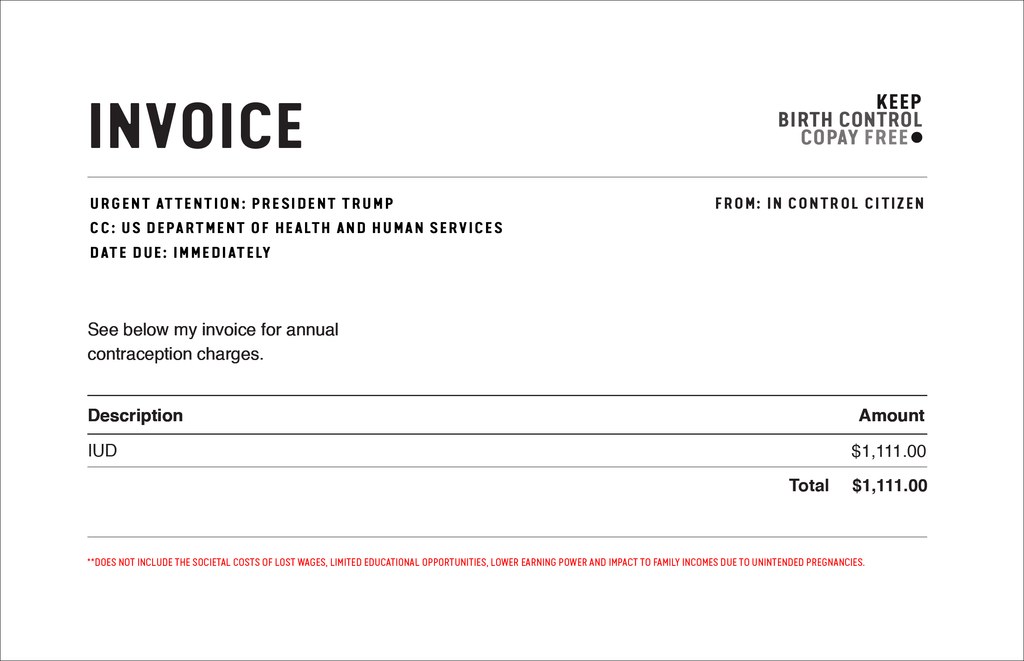
WEC just launched their Keep Birth Control Copay Free campaign to flood HHS with plenty of opposition to Trump’s rule. Not only can you send the department a pointed, pre-written note outlining how bad this proposal would be, you can send Donald Trump the bill for your own birth control with a handy invoice generator. The tool automatically pulls in the average cost of whatever birth control you use—there are seven options to choose from, including the pill and IUDs—and gives you a chance to send it along to the President along with a message telling HHS not to go forward with the plan.

Right now, the teen pregnancy rate is at an all-time low. Unintended pregnancies are at a 30-year low. Abortion rates have hit a 40-year low and are continuing to decline. All of these stats can be linked to more accessible birth control—and these trends will likely reverse if contraception is made less attainable.

Beyond this, Trump’s actions could have wide-reaching socioeconomic ramifications. When women have more control over their own reproductive health care–including having access to birth control—they take better care of themselves and their families. They can pursue higher education. They can advance in their careers. They can be more active participants in the economy. If they’re denied access to affordable birth control, the effects could be overwhelming.

“Women are tired of footing the bill for male politicians’ attacks on essential reproductive health care,” Amy Runyon-Harms, the Keep Birth Control Copay Free campaign coordinator, told Glamour in a statement. “Together, we are pushing back against President Trump’s dangerous political decision to reduce access to birth control and today we are sending him the bill. Copay-free birth control saves Americans at least $1.4 billion each year. And we figure, with Donald Trump’s frequent proclamations that he’s ‘very rich,’ he shouldn’t have a problem absorbing the cost.”

Comments will be accepted until December 5, so go ahead, send Trump your thoughts—and make sure to send him your bill, too.


Source link

Categories
Health

Senator Elizabeth Warren: Attacks on Birth Control Access Are Attacks on Women's Freedom


If anyone told a young woman today that she was expected to quit school after eighth grade or leave her job once she got married, most Americans would be outraged. Not fair! Women should have the same range of economic choices as men.

Through the years, one door after another has opened, as women have become astronauts and neurosurgeons, run Fortune 500 companies and nonprofit organizations, and started their own businesses. Sure, there’s still a lot of ground to make up, but the country has headed in the direction of greater equality for decades now.

Despite this progress, near-constant attacks on safe and cost-effective women’s health care have become a regular part of our political debates. The latest front in this battle? Access to contraception. The Affordable Care Act required employer-sponsored health insurance policies to cover birth control without additional costs. On October 6, in one of his series of reckless attacks on health insurance in America, President Trump ended that protection.

These fights are often framed as ideological discussions. But for millions of women, access to health care isn’t about ideology at all—it’s about economics.

Americans, at least in private, agree that using birth control is a no-brainer. The vast majority have used it, including ninety-nine percent of women (and by extension, their partners) who have had sex between the ages of 15 and 44.

Some of the reasons for this are obvious. Contraception prevents unintended pregnancy and reduces the abortion rate. Certain forms of birth control prevent sexually transmitted infections, and others help control debilitating health conditions. But contraception is not only about health; it is about economic security as well.

Americans, at least in private, agree that using birth control is a no-brainer.

As every parent knows, the decision to have children is momentous—and carries massive economic consequences. Because the United States does not ensure that parents have access to paid family leave or affordable childcare, new costs add up quickly. The totals are striking: middle-income parents with two kids will spend an estimated $230,000 to raise a child born in 2015 from birth through age 17, amounting to roughly $13,000 per year. Starting a family is a big commitment, and millions of people use contraception until they decide to do so.

But the out-of-pocket costs for baby cribs and car seats are only the tip of the iceberg. A mother experiences a measurable decline in earnings immediately after having a child—a decline that continues throughout her lifetime. And women don’t have to be mothers to benefit economically from contraception—just ask college students, or women with crippling endometriosis, how contraception helps them land and hold down jobs.

The arrival of the birth control pill in 1960, later joined by other effective contraceptives, gave Americans more control over if, when, and how they chose to grow their families. That control, in turn, helped fuel economic opportunity for American women, American families, and the American economy. After the widespread introduction of birth control, the number of women in professions once closed to them increased dramatically. And without the movement of women into the workforce since 1970—a trend partly enabled by the availability of effective birth control – our country’s GDP would only be three-quarters the size it is today.

Contraception helps level the economic playing field for women.

Contraception helps level the economic playing field for women. With birth control available, women have more chances to go to school, get jobs, create businesses, and grow our economy. They can more reliably plan their economic futures. But birth control offers these benefits only when women can access it—and when their bosses can’t dictate what types of birth control it’s appropriate for them to use.

While 99% of women have used birth control at least once, cost is a big factor restricting consistent access. Prior to the ACA, one in three women struggled to afford the out-of-pocket costs of prescription birth control. These costs put additional strain on the finances of workers already struggling to make ends meet—and also reduced contraceptive use. According to a 2010 Centers for Disease Control report, hundreds of thousands of women who tried various forms of contraception gave up because the methods were “too expensive,” “insurance did not cover it,” or because contraception was “too difficult to obtain.” The ACA’s birth control protections helped level the playing field: women in America saved an average of $255 a year on birth control pills and saw cost reductions for other contraceptive methods.

For millions of women, President Trump’s edict isn’t some abstract, ideological debate. For a working couple with modest wages and piles of student loan debt, the ability to decide when to have children is an economic issue. For a student working towards her college degree and financial independence, access to birth control is an economic issue. For a woman working two jobs with two kids in daycare, affordable contraception is an economic issue.

This isn’t the Trump Administration’s first attack on women’s health. Efforts to defund Planned Parenthood, repeal the ACA and Medicaid, and block access to safe, legal abortions have put women on the economic defensive. But those efforts require Congress—and so far, despite the best efforts of Mitch McConnell and Paul Ryan, they have failed. Now, President Trump has turned to a decision he can make without Congress: make it harder to access birth control. With the stroke of a pen, the President shrunk the economic futures of millions of women. He should reverse this decision—and if he won’t, Congress should force him to.


Source link
Categories
Health

Sarah Hyland Had the Perfect Response to This Troll Who Thought Birth Control Is Just for Sex


Sarah Hyland has never been afraid to serve up some righteous justice/logic on Twitter. Case in point, her spot-on response to paparazzi who were trying to get her to bash Modern Family co-star Ariel Winter. “y’all digging for something you’re never going to get,” Hyland tweeted as a response, adding in the laugh-cry emoji for a splash of extra defiance. Then, there was that time this summer when she burned Vice President Mike Pence after he touched a casual bit of space equipment at NASA that clearly had a “DO NOT TOUCH” sign in front of it (the capital letters were real). So when a Twitter troll showed up on her feed in support of President Trump‘s egregiously awful rollback on the Affordable Care Act’s birth control mandate, she was not about to let him get away with it.

It started on Friday, when Hyland tweeted some outrage about the stripped contraception protections into the Twitterverse:

Of course, those on both sides of the issue had plenty to say, but one fan in particular really got her goat. His tweet has since been deleted, for reasons that will shortly become clear. But Hyland’s response hammered home an important point: birth control is not just for women looking to prevent pregnancy when they have sex. It’s for women looking to control abnormal or irregular periods, endometriosis, and numerous other medical conditions that all relate to the lovely functions performed by cisgender women’s reproductive parts.

The ability to afford birth control—or, thanks to the Affordable Care Act, the guarantee that it will be free through insurance—is necessary for some women who experience chronic suffering when it comes time for their periods. The user who sent the tweets later said that he tweeted apologies twice (and maybe he’s shifted his perspective on the matter after a torrent of tweets directed at his misfire).

Unfortunately, however, the fact that birth control has important, critical purposes beyond preventing pregnancy is something that the men who still largely control women’s healthcare just don’t get.

Related Stories:
–Sarah Hyland Had a Great Response to the Paparazzi Who Pressured Her to Bash Ariel Winter
–Sarah Hyland Just Burned Mike Pence on Twitter for His NASA Blunder


Source link

Categories
Health

Ian Somerhalder and Nikki Reed Have Just Apologized for That Cringe-y Birth Control Anecdote


Remember that massively uncomfortable moment last week when news broke that Ian Somerhalder had flushed wife Nikki Reed‘s birth control pills down the toilet in Barcelona? Without telling Reed? Ah, sangria: it is the gateway to very poor decisions, like taking away your wife’s reproductive agency. Apparently it happened after the couple had decided to start a family together (though Reed said they knew they were ready after Somerhalder “threw out all my birth control pills”), but Somerhalder’s blasé retelling of the matter, on Dr. Berlin’s Informed Pregnancy, didn’t really cast him in a great light:

“But unbeknownst to poor Nikki, she didn’t realize that I was going to go in her purse and take out her birth control,” he recounted. “By the way, it was the beginning of the pack, so I had to pop all those suckers out. It is a lot of work, especially after a little bit of sangria.”

Ew.

This sent the progressive Internet into a frenzy for obvious reasons, and Reed issued a statement in the aftermath to try to make it clear that the interview was them poking fun at each other.

However, it didn’t do enough to block the dam. So, on Saturday, the couple apologized on their respective Twitter accounts for the furor with identical statements. Apparently it was all peachy keen between the two and the interview was done light-heartedly. However, they expressed awareness that some have been affected by reproductive coercion—and mentioned that if this had opened the door to that issue becoming a topic more talked about, then at least there’s a silver lining there.

Related Stories:
–Ian Somerhalder Threw Out Nikki Reed’s Birth Control Pills When They Decided to Have Kids
–Nikki Reed Responds to Backlash Over Ian Somerhalder’s Comments About Hiding Her Birth Control
–Ian Somerhalder Broke His Post-Baby ‘Month of Silence’ to Gush About Nikki Reed


Source link