Categories
Health

The Supreme Court Backed Trump's Travel Ban. But Judges Sotomayor and Ginsburg Aren't Having It.


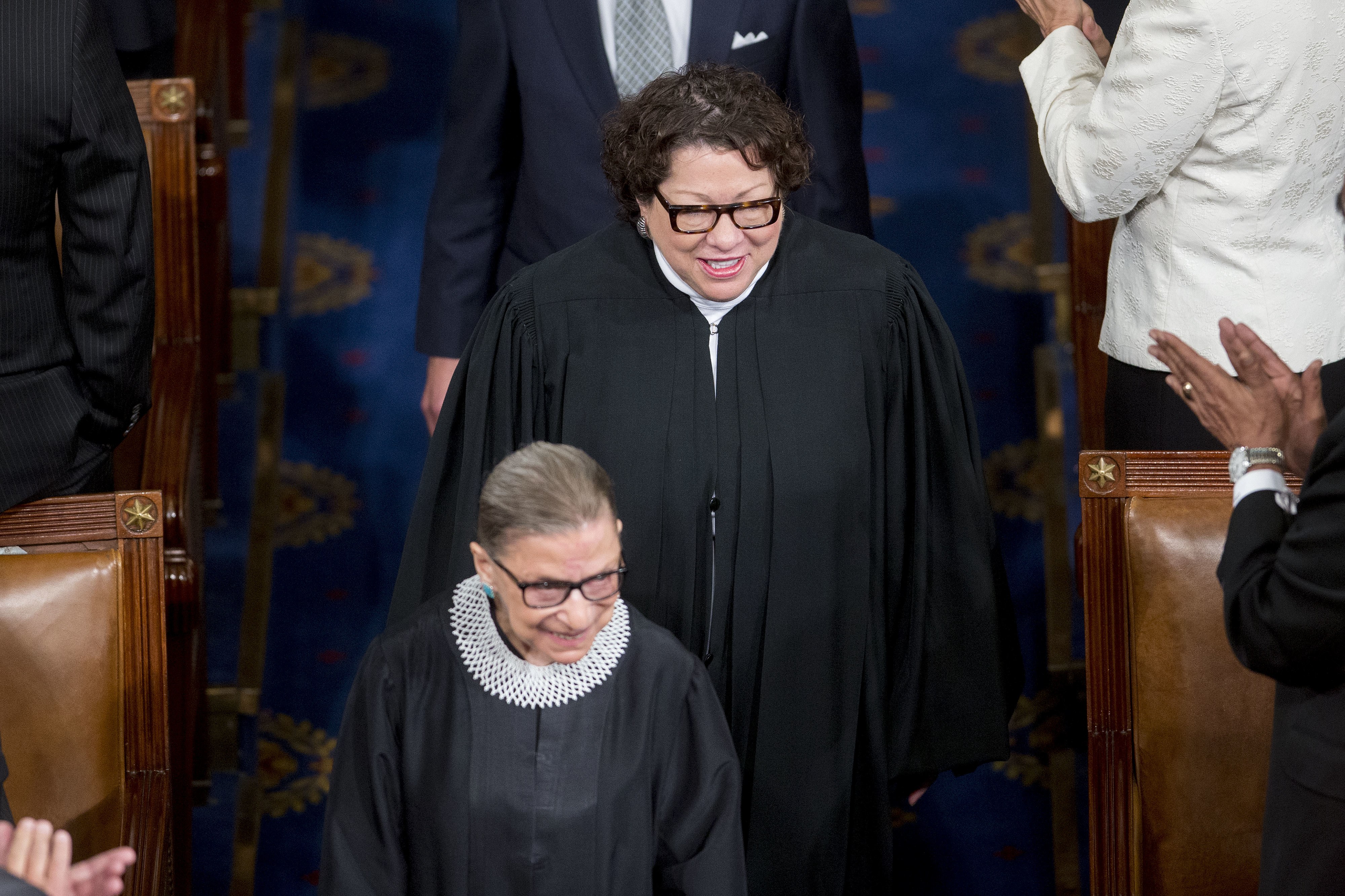
As the Supreme Court upheld President Donald Trump’s travel ban by a margin of 5-4 on Tuesday, it was two of its female justices—Sonia Sotomayor and Ruth Bader Ginsburg—who provided the harshest critiques of both the ruling and the policy itself.

As a refresher, this version of the travel ban (the administration’s third) restricts entry into the United States from seven countries, many of which have majority Muslim populations: Iran, North Korea, Syria, Libya, Yemen, Somalia, and Venezuela. The rules for entry vary by country. For example, immigrants (even those seeking asylum) and non-immigrants from Syria are barred from entering the country, but most Venezuelans will be unaffected. (Per CNN, the ban will mostly affect government officials from that country.)

Citizens from banned countries are able to apply for waivers on a case-by-case basis, like traveling to the US for medical treatment, or to visit a close family member. But The Guardian reports that there are a very limited number of waivers actually being granted.

Sotomayor, who was joined by Ginsburg in her dissent, boldly stated that the court failed to uphold the fundamental right of freedom of religion in her opening remarks. “The United States of America is a Nation built upon the promise of religious liberty,” she wrote. “Our Founders honored that core promise by embedding the principle of religious neutrality in the First Amendment. The Court’s decision today fails to safeguard that fundamental principle.”

She continues by calling the ban one that is designed to keep Muslims out of the country and calls out attempts to repackage it. “It leaves undisturbed a policy first advertised openly and unequivocally as a ‘total and complete shutdown of Muslims entering the United States’ because the policy now masquerades behind a façade of national-security concerns.”

Sotomayor calls out fellow justices in the majority saying they are “turning a blind eye to the pain and suffering the Proclamation inflicts upon countless families and individuals, many of whom are United States citizens.”

And the justices were not afraid to mention the president directly in their formal dissent.

“Ultimately, what began as a policy explicitly ‘calling for a total and complete shutdown of Muslims entering the United States’ has since morphed into a ‘Proclamation’ putatively based on national-security concerns,” the dissent reads. “But this new window dressing cannot conceal an unassailable fact: the words of the President and his advisers create the strong perception that the Proclamation is contaminated by impermissible discriminatory animus against Islam and its followers.”

Sotomayor did not shy away from noting the instances of Trump calling the policy a “travel ban” and his negative remarks about Islam and Muslims. “Despite several opportunities to do so, President Trump has never disavowed any of his prior statements about Islam. Instead, he has continued to make remarks that a reasonable observer would view as an unrelenting attack on the Muslim religion and its followers.”

“History will not look kindly on the court’s decision today—nor should it,” Sotomayor concluded.

While many applauded the justices’ passion in calling out the bigotry in the policy and ruling, the New York Times classified Sotomayor as having “lashed out” against President Trump in a tweet—and Twitter users were not happy about it.

You can read the full dissent here.

Related Stories:

The Hypocrisy in the Supreme Court’s Backing of California’s Anti-Abortion Pregnancy Centers

What Does That Supreme Court ‘Narrow Ruling’ on the Same-Sex Wedding Cake Case Really Mean?


Source link

Categories
Health

Trump's 'Be Careful' Tweet Prompts Calls of Security for Maxine Waters


In what many observers are calling a thinly veiled threat, President Donald Trump on Monday afternoon took his feud with California Congresswoman (and Glamour Woman of the Year) Maxine Waters to a new level with a tweet telling her to “be careful” what she wished for.

So what sparked this latest outburst? That would be the comments made by Waters during a weekend rally in Los Angeles where she called on members of the public to confront Trump administration officials if they encounter them.

“Let’s make sure we show up wherever we have to show up,” she said. “And if you see anybody from that Cabinet in a restaurant, in a department store, at a gasoline station, you get out and you create a crowd. And you push back on them. And you tell them they’re not welcome anymore, anywhere.”

[embedded content]

Waters’ remarks came after White House Press Secretary Sarah Huckabee Sanders tweeted that she had been refused service at a restaurant because of her position in the Trump administration.

Now President Trump has responded via Twitter, writing, “Congresswoman Maxine Waters, an extraordinarily low IQ person, has become, together with Nancy Pelosi, the Face of the Democrat Party. She has just called for harm to supporters, of which there are many, of the Make America Great Again movement. Be careful what you wish for Max!”

Waters has yet to comment on the most recent tweet, but she previously spoke to Glamour about her thoughts on Trump’s character. “The most upsetting part is discovering that the person who won the election and became the president of the United States of America is a man who has no good values. His character astounds me,” Waters said in 2017. “I can’t believe that we have a president who would lie, who would distort, and who does not appear to have an appreciation for government and how it works.”

Rep. Yvette Clarke, a New York Democrat who holds a leadership position on the Congressional Black Caucus, told Glamour in a phone interview that the president’s Twitter attack on Waters struck her as “malicious” and “over the top.”

Clarke said that by her reading of Trump’s message, “It is very evident from what he said that he is wishing her ill… There is an implied harm that could visit her because of her statements.”

The congresswoman called it “beneath the office of the presidency to [imply] that someone could be harmed because they make a statement about what is taking place in this administration,” she said.

Clarke said she planned to discuss the Trump tweet with the CBC as well as the Congressional Caucus on Black Women & Girls: “We all have to sit up and take note. Women need to sit up and take note. He’s found ways to silence women throughout his candidacy and his presidency.”

Asked if she’d ever seen a president make a comparable statement in the past, Clarke replied, “Never, never — we are in uncharted territory where the breaking of norms [is] becoming the norm. The lack of civility, the lack of true respect for one another is leading to the point where the antagonism and the hostility is palpable.”

Additionally, Clarke said, “We have to talk to Capitol Police to ensure that there is security for Maxine Waters” given that “we’ve already seen unhinged individuals in this climate” who are willing to commit acts of violence. In one example, Clarke noted that Florida Rep. Frederica Wilson got extra security in response to death threats she received after a public disagreement with Trump last year.

As many rush to Waters’ defense, others have condemned her statements about confronting members of the Trump administration, calling it “harassment.” Prior to Trump’s latest comments, Democratic congressional leader Nancy Pelosi tweeted out a story about Waters’ comments and—without naming her directly— wrote, “In the crucial months ahead, we must strive to make America beautiful again. Trump’s daily lack of civility has provoked responses that are predictable but unacceptable. As we go forward, we must conduct elections in a way that achieves unity from sea to shining sea.”

Sen. Cory Booker of New Jersey made similar comments in a Monday interview with NPR when asked about Waters encouraging Americans to protest the Trump administration at every turn.

“You know, protest is good, and I’ve been encouraging people there be a lot of protests at the Mall and cities all across America protesting this really – these morally despicable actions by the Trump administration separating folks from families,” he said. “But this is also a time, I believe, as Americans who seek to create a beloved community, who believe in a more what I consider a radical love, love thy neighbor – no exceptions. And whether that person is coming over the border or whether that person is somebody who votes differently than you, we’ve got to be a nation that treats each other with our highest ideals.”

As for Trump, this is not the first time he has used Twitter to warn someone to “be careful,” Yahoo! News managing editor Colin Campbell points out.

However none of those instances used the word “harm” in the framing of the tweet, (it should also be noted that Waters did not implicitly call for any harm to come to administration officials in her speech), one denotation that many say is the clear difference between a petty insult and an actual threat.


Source link

Categories
Health

A History of Melania Trump's Most Talked-About Fashion Moments


Avoiding public criticism as the First Lady of the United States would be a near-impossibility: Not only are you, essentially, the most visible woman on the planet, but you’re also held to standards that might not reflect your own views, but rather those of the man you call your husband. And since assuming the position in January 2017, Melania Trump has certainly experienced her fair share of controversy. Call it sexist or just call it the reality of assuming the post of First Lady, but a great deal of the wrath directed at Mrs. Trump—like others before her—has been centered around her fashion choices.

Former First Lady Michelle Obama endured her share of public punches over eight years, with pearl-clutchers crowing about propriety because—horror of horrors—the woman wasn’t shy about exposing her arms and legs in sleeveless tops and shorts. In 2009, it was considered a scandal when she wore a pair of $540 Lanvin sneakers to a food bank event. Nancy Reagan courted drama when it was revealed she frequently borrowed clothing and jewelry from top couturiers without disclosing it—an unethical move. Even Mary Todd Lincoln got dragged for buying extravagant ball gowns during the Civil War.

Point is: it’s nothing new to pay extra-close attention to what women in highly-visible political positions buy—or don’t buy—and wear. Yet Melania’s choices have held a particular weight because, well, look who her husband is. And while the speculation around some of her fashion choices felt a bit forced, if definitely juicy (see: the one about her secretly supporting Hillary by wearing a white pantsuit to the 2018 State of the Union), other sartorial decisions have justifiably drawn global attention and public outrage.

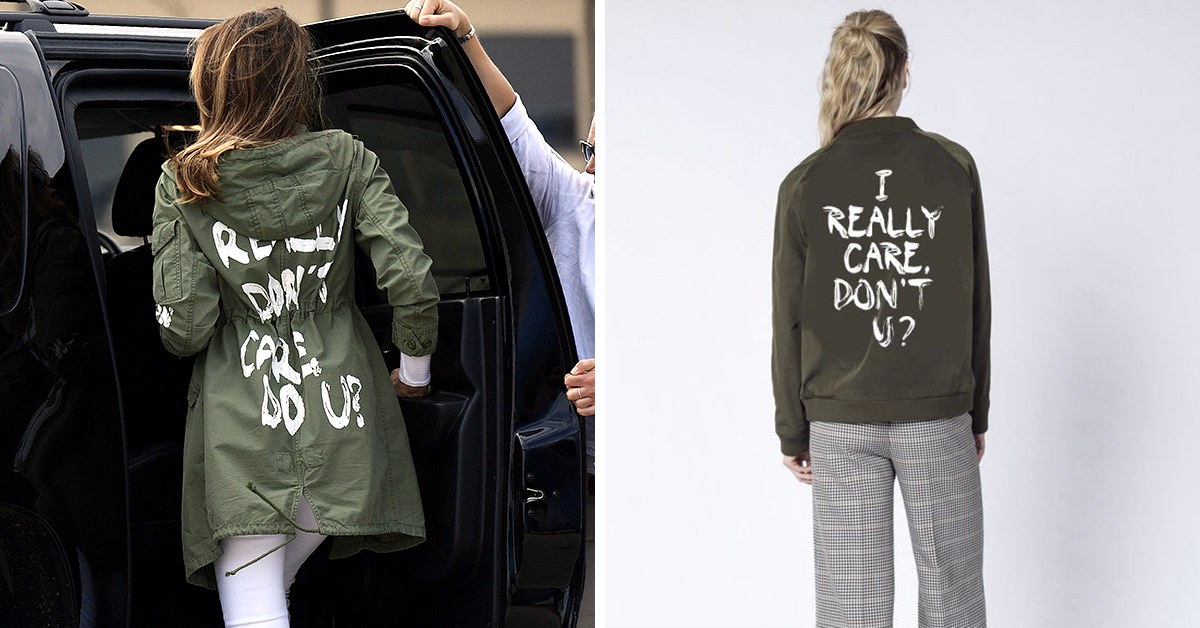
The 48-year-old’s most recent gaffe, for example, was a shocker: While traveling to Texas for an unannounced visit to a shelter housing children separated from their parents at the U.S. border on Thursday, Mrs. Trump wore a $39 Zara jacket with a message on the back: “I Really Don’t Care, Do U?”

Needless to say, many Americans were highly disturbed by the choice, and the jacket—which FLOTUS wore to board and disembark her plane at Andrews Air Force Base in Maryland—ignited a fierce debate online and across cable news. A spokesperson for the First Lady essentially said the reaction was blown out of proportion, and that it was just a jacket, but it was difficult to see it that way given the tensions surrounding the visit, and the fact that Melania surely has advisors who easily could have said “Hey, maybe that slogan parka isn’t the best idea today.”

Because FLOTUS’ jacket choice might have just become the most glaring political fashion “don’t” of all time, keep reading for a look at her other style moments that have gotten America talking since she stepped into the national spotlight.


Source link

Categories
Health

All Your Questions About Trump's Executive Order on Family Separation, Answered


In the weeks leading up to summer, it appears as though the entire country has turned its attention to America’s border cities. There, a crisis emerged when the Trump administration ordered a “zero tolerance policy” calling for the prosecution of migrants attempting to enter the country via asylum or otherwise.

The policy change mandated that border agents detain anyone attempting to cross—which is typically treated as a civil misdemeanor offense—and try it as a criminal case. In turn, parents traveling with children were separated at the border and sent to different detention facilities.

Since the practice began, stories have emerged of infants being ripped out of their mother’s arms, fathers who died from suicide after being separated from their families, and the guttural, heartbreaking cries of children begging for their parents.

The pure, unadulterated outrage that followed from the American public, churches and advocacy groups reached a fever pitch before the president signed an executive order that ended the separation of families on Wednesday. However, while signing the order, President Donald Trump made it abundantly clear that his administration’s “zero tolerance policy” toward migrants will remain, which has left followers of this humanitarian and political catastrophe with more questions than answers.

Will families actually stay together?

According to the executive order, which was posted to the White House website, families will remain together “where appropriate and consistent with law and available resources.” However, it additionally noted that children and parents may be separated if the government determines keeping them together “would pose a risk to the child’s welfare,” which gives the government room for interpretation of the law.

Is it actually legal to detain families, even if they are together?

This is where things get very murky. According to a 1997 court ruling known as the “Flores Settlement,” children who are detained at the border with parents must be placed with a family friend or immediate relative “without unnecessary delay,” Vox explained. But, as the ruling states, immigrant children who must remain in custody must be placed in the “least restrictive conditions” possible. Those conditions include food, running water, medical care and separate living quarters from unrelated adults.

The last part—separate living spaces—is what likely will cause major issues in the near future.

In 2014, the Obama administration attempted to keep families together in detention centers following a massive uptick in asylum-seekers from Central America. However, immigration advocates found the practice inhumane. So, a 2015 court set a general standard stating the government could only hold children in custody for up to 20 days, NPR reports. And though the court never specified how long parents could be held, the Obama administration made it practice to release the entire family together, with certain restrictions, such as placing ankle monitoring bracelets on parents to ensure they’d return to court.

There is no word yet if Trump’s administration will do the same, however, he has time and time again ridiculed the practice of releasing the families, often referring to it as “catch and release.” Trump has also instructed Attorney General Jeff Sessions to ask the federal court to modify that agreement so there will be no limit on how long children (and thus their families) can remain in detention, NPR explained.

Where will the families be housed?

Again, this is another question in the air (are you sensing a pattern in this crisis?).

As part of Trump’s instruction to Sessions, the president also called on different branches of his administration to find facilities that could be available for detaining families with children, NPR reports. Trump also asked the Defense Department, to build new facilities “if necessary.”

What will happen to the families already separated?

According to Immigration and Customs Enforcement (ICE), who provided a statement to NPR, it is indeed working side-by-side with the Office of Refugee Resettlement (ORR) to reunite families. “ICE and ORR will work together to locate separated children, verify the parent/child relationship, and set up regular communication and removal coordination, if necessary.”

“ICE will make every effort to reunite the child with the parent once the parent’s immigration case has been adjudicated,” the spokesperson added. However, according to multiple reports, this just isn’t happening.

According to PRI, the process of unification is difficult because the adults and children fall into different legal paths at the border, and are thus the responsibility of different government agencies. The parents and children are often given different case numbers, so it’s hard to track one another down.

“If they don’t reunite these kids and their parents right away, what can happen is the kids will be stuck in the US for years, guardians will be appointed, and their parents will be down in Honduras or Guatemala with no idea where their child is and no meaningful way to reunite,”John Sandweg, former acting director of Immigration and Customs Enforcement under the Obama administration, told MSNBC.

Furthermore, several lawyers and advocates explained to the New Yorker, that the process of finding a child within the system after a parent has been released or deported is nearly impossible. The experts who spoke with the New Yorker explained, in great detail, how the parent is forced to track his or her own child down using a system of non-profits, a 1-800 number set up by ORR, and simply having a bit of luck with finding their loved one.

“I have a master’s degree, and I’m fluent in English,” Emily Kephart, a program coordinator at an immigrant-rights group known as Kids in Need of Defense, told the New Yorker. “And it takes me days to figure one of these cases out.”

Related Stories:

At the Border, Parents Seeking Asylum Are Willing to Risk Separation Rather Than Go Back to Danger

Trump’s Executive Order Means He Won’t Separate Families at the Border, but He’s Still Detaining Children


Source link

Categories
Health

Brands Respond to Melania Trump's Jacket With 'I Really Care' Clothing


To travel to Texas for an unannounced visit to a Texas shelter housing children separated from their parents at the U.S. border on Thursday, First Lady Melania Trump wore a Zara jacket with an eye-catching message written across the back: “I Really Don’t Dare, Do U?,” it read. Many were disturbed by the optics of the situation, and the style—which FLOTUS wore to both board and disembark her plane at Andrews Air Force Base in Maryland yesterday—has ignited a fierce debate online. It has also inspired a handful of fashion brands to take action and release their own versions of the olive-green jacket to benefit the communities affected by the ongoing border crisis.

Overnight, Portland-based brand Wildfang released a limited capsule collection titled “I REALLY CARE,” with 100% of proceeds going to RAICES Texas, which offers legal services and resources to immigrants.

The product description reads: “Hey Melania. WE REALLY DO CARE! That’s why we made this jacket. To say we stand with immigrants. To say WE CARE.” An original launch sold out within an hour, according to the brand, but has since been restocked.

“Within a few hours, we decided as a team we wanted to do something,” Emma Mcilroy, CEO of Wildfang, tells Glamour via e-mail. “This could not go unnoticed, so we put our heads together and went with impact.”

“We started with a limited edition run and it sold out, twice,” she continues. “Because we now make the majority of our products, we are able to turn things around like this so when we’re passionate about something, we take control of the situation. Our customers have gone bananas over this—the support is overwhelming, and we couldn’t be more proud to align with them in support of these families.”

PSA (or Public Service Apparel), the brand co-run by Upworthy and GOOD, also launched its own take on the graphic, as part of its Rapid Response/Limited Edition line. The “I Really Do Care” T-shirt is currently available for pre-order, and will benefit the immigrant youth network United We Dream.

Lingua Franca, the ethical luxury knitwear label that has become known for its politically–aligned pieces, made its own hand-stitched sweater. It’ll donate $100 of each sale to a charity of the customer’s choice.

Stephanie Grisham, FLOTUS’ Communications Director, said of Trump’s much-discussed Texas wardrobe: “It’s a jacket. There was no hidden message. After today’s important visit to Texas, I hope the media isn’t going to choose to focus on her wardrobe.”

President Donald Trump later tweeted about the incident, seemingly contradicting the spokesperson’s claim that there was no meaning behind the jacket.

He wrote: ““I REALLY DON’T CARE, DO U?” written on the back of Melania’s jacket, refers to the Fake News Media. Melania has learned how dishonest they are, and she truly no longer cares!”

As to what they hope to achieve with these reactionary capsule collections, McIlroy explains: “We hope to see kids reunited with their parents, that is the goal here. We want to spread awareness, we want people to take action we want you to give all your money to RAICES—they do amazing work!”

Related Stories:

Melania Trump Wears Jacket That Says ‘I Really Don’t Care, Do U?’ Before Border Visit

At the Border, Parents Seeking Asylum Are Willing to Risk Separation Rather Than Go Back to Danger

Twitter Has Strong Feelings About TIME’s Powerful ‘Welcome to America’ Cover Amid Border Crisis


Source link

Categories
Health

Trump's Executive Order Means He Won't Separate Families at the Border, but He's Still Detaining Children


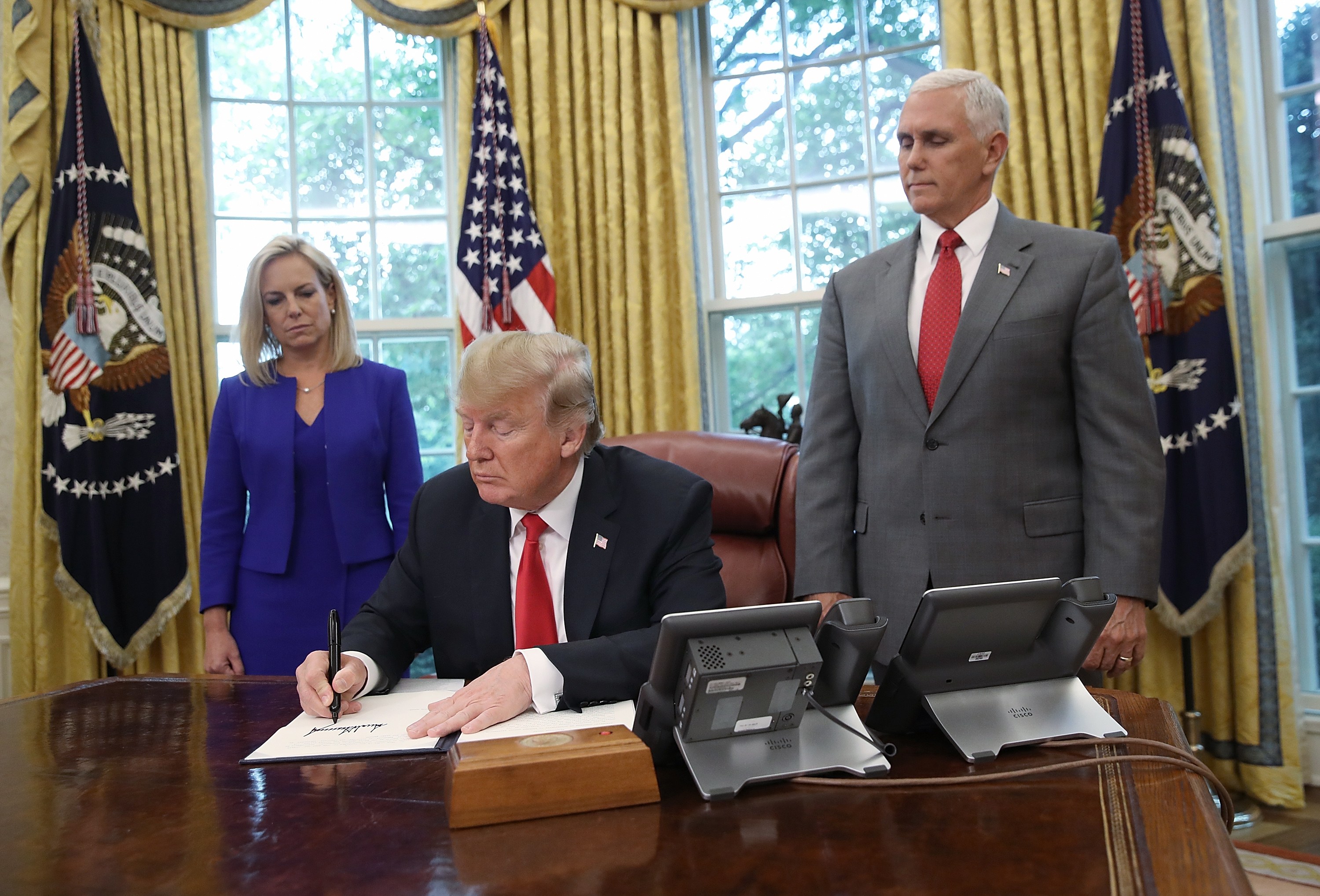
After days of public outcry around the Trump administration’s “zero-tolerance” policy that allowed for the separation of immigrant children from their parents at the border, President Trump signed an executive order that ends that separation.

However, the “zero-tolerance” policy that created the recent crisis remains.

“We are keeping families together and this will solve that problem. At the same time we are keeping a very powerful border and it continues to be a zero tolerance, we have zero tolerance for people that enter our country illegally,” Trump told the White House pool reporters present in the Oval Office, per CBS News.

“I didn’t like sight or the feeling of families being separated,” Trump said.

The executive order notes that it is “the policy of this Administration to rigorously enforce our immigration laws” and that they will initiate proceedings to enforce laws about “improper entry.” But this section also allows for families to be held together during the prosecution process: “It is also the policy of this Administration to maintain family unity, including by detaining alien families together where appropriate and consistent with law and available resources.”

The order further stated, “It is unfortunate that Congress’s failure to act and court orders have put the Administration in the position of separating alien families to effectively enforce the law.”

It is important to note, that according to experts who spoke with Glamour, the separation policy is not a law. It was also up to Trump himself to make the call on ending the family separations.

Earlier today, the New York Times reported that sources close to the president said he believes his immigration policies are “appropriate and necessary,” but that he was frustrated by the criticism he’d been receiving.

Many news outlets report that there could be legal battles ahead for this order due to a 1997 consent decree from a federal court, called the Flores settlement, that says children can be detained for only 20 days, even if they are with their parents.

It is unclear at this time what will happen to the families that are currently separated and being held in detention facilities—or how long detained families can be held.

Trump spoke earlier this morning about the possibility of an executive order. “We’re meeting right now on immigration and we are very strong at the border, we’re very strong on security. We want security for our country,” he said at the White House. “The Republicans want security and insist on security for our country, and we will have that.”

ABC News reports that First Lady Melania Trump may have played a part in the president’s decision to sign the order. She has been pressuring her husband to end the child separation policy, according to a White House official. Their source also claims that Ivanka Trump has shown the president images of children in detention centers and urged him to end the policy.

As of Wednesday afternoon, she had not made any public statements on the issue, although she did tweet after the signing of the executive order.

We will update this story as new details around the policy and executive order emerge.

Related Stories:

Here Are the Facts About Trump’s ‘Zero Tolerance’ Immigration Policy

Here’s How to Help Immigrant Families Who Have Been Separated at the Border


Source link