Categories
Health

Brands Respond to Melania Trump's Jacket With 'I Really Care' Clothing


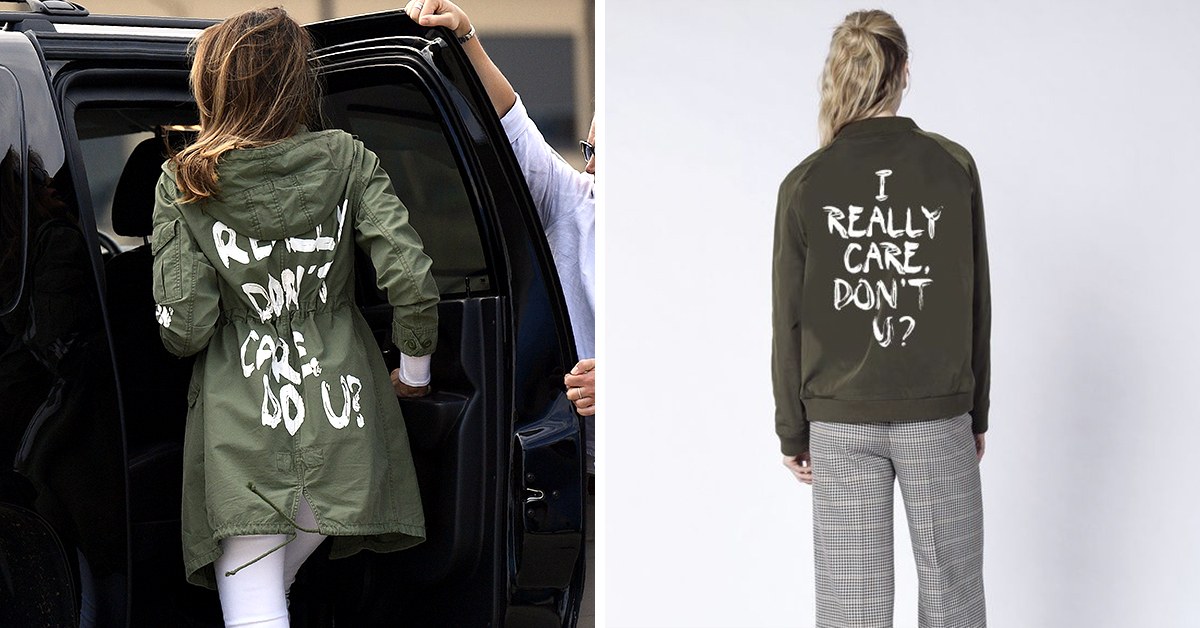
To travel to Texas for an unannounced visit to a Texas shelter housing children separated from their parents at the U.S. border on Thursday, First Lady Melania Trump wore a Zara jacket with an eye-catching message written across the back: “I Really Don’t Dare, Do U?,” it read. Many were disturbed by the optics of the situation, and the style—which FLOTUS wore to both board and disembark her plane at Andrews Air Force Base in Maryland yesterday—has ignited a fierce debate online. It has also inspired a handful of fashion brands to take action and release their own versions of the olive-green jacket to benefit the communities affected by the ongoing border crisis.

Overnight, Portland-based brand Wildfang released a limited capsule collection titled “I REALLY CARE,” with 100% of proceeds going to RAICES Texas, which offers legal services and resources to immigrants.

The product description reads: “Hey Melania. WE REALLY DO CARE! That’s why we made this jacket. To say we stand with immigrants. To say WE CARE.” An original launch sold out within an hour, according to the brand, but has since been restocked.

“Within a few hours, we decided as a team we wanted to do something,” Emma Mcilroy, CEO of Wildfang, tells Glamour via e-mail. “This could not go unnoticed, so we put our heads together and went with impact.”

“We started with a limited edition run and it sold out, twice,” she continues. “Because we now make the majority of our products, we are able to turn things around like this so when we’re passionate about something, we take control of the situation. Our customers have gone bananas over this—the support is overwhelming, and we couldn’t be more proud to align with them in support of these families.”

PSA (or Public Service Apparel), the brand co-run by Upworthy and GOOD, also launched its own take on the graphic, as part of its Rapid Response/Limited Edition line. The “I Really Do Care” T-shirt is currently available for pre-order, and will benefit the immigrant youth network United We Dream.

Lingua Franca, the ethical luxury knitwear label that has become known for its politicallyaligned pieces, made its own hand-stitched sweater. It’ll donate $100 of each sale to a charity of the customer’s choice.

Stephanie Grisham, FLOTUS’ Communications Director, said of Trump’s much-discussed Texas wardrobe: “It’s a jacket. There was no hidden message. After today’s important visit to Texas, I hope the media isn’t going to choose to focus on her wardrobe.”

President Donald Trump later tweeted about the incident, seemingly contradicting the spokesperson’s claim that there was no meaning behind the jacket.

He wrote: ““I REALLY DON’T CARE, DO U?” written on the back of Melania’s jacket, refers to the Fake News Media. Melania has learned how dishonest they are, and she truly no longer cares!”

As to what they hope to achieve with these reactionary capsule collections, McIlroy explains: “We hope to see kids reunited with their parents, that is the goal here. We want to spread awareness, we want people to take action we want you to give all your money to RAICES—they do amazing work!”

Related Stories:

Melania Trump Wears Jacket That Says ‘I Really Don’t Care, Do U?’ Before Border Visit

At the Border, Parents Seeking Asylum Are Willing to Risk Separation Rather Than Go Back to Danger

Twitter Has Strong Feelings About TIME’s Powerful ‘Welcome to America’ Cover Amid Border Crisis


Source link

Categories
Health

How to Respond When Someone Says, 'I Don't See Color'—And 6 Other Cringe-Worthy Remarks


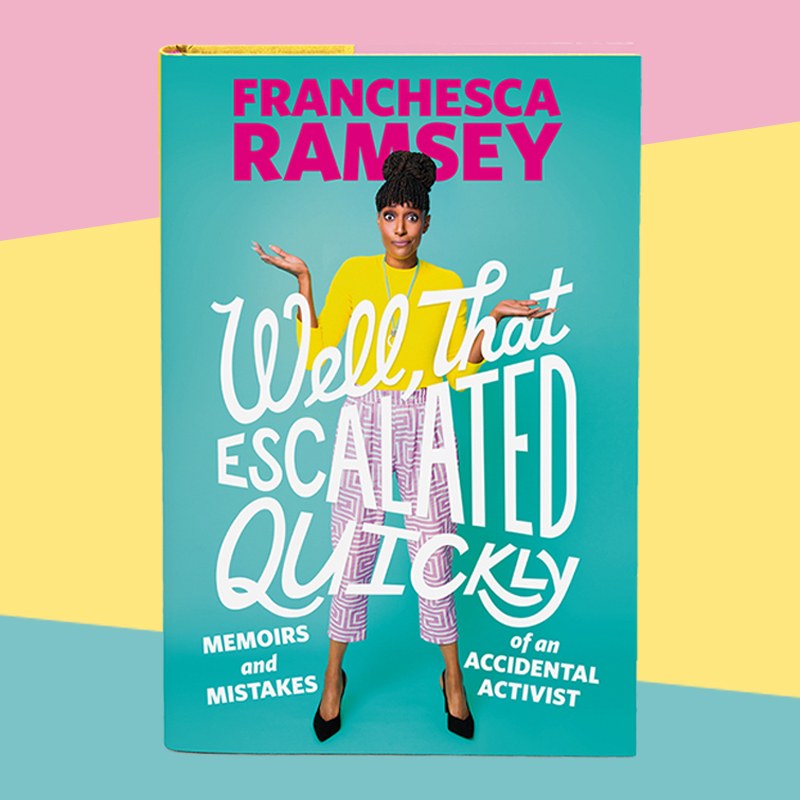
Franchesca Ramsey is an actress and comedian, best known for her YouTube channel, chescaleigh, and for hosting MTV’s Decoded. In this exclusive excerpt from her upcoming book, Well, that Escalated Quickly: Memoirs and Mistakes of an Accidental Activist, she shares her best comebacks observations too offensive to ignore .

We are gathered here today to say goodbye to seven unbearably irksome comments that just won’t accept that their time has come. If you’ve been on the receiving end of oppression, racism, sexism, homophobia, transphobia and plain old ignorance, you’ll recognize these lines. Let’s bury them, shall we?

1. Comment: “Sorry if you’re offended.” This is a non-apology masquerading as a real apology. The word “if” corrupts the entire thing. Much like the “RE: URGENT DEAR SIR OR MADAM” email that manages to slip past your spam folder, “sorry if” is highly suspicious. We’re proud creatures by nature—we hate to admit wrongdoing—so some of us try to have our cake and eat it too by adding that pesky “if.”

Comeback: “There’s no need for ‘if’—I am offended. So are you sorry?”

2. Comment: “Why are you so angry?” See also: “You’re making a scene,” “You’re being hysterical,” and “You need to calm down. ” These responses are all part of a broader phenomenon known as tone policing, whereby someone provides unsolicited advice on how to express your feelings. They may claim expertise on topics they observed on The Wire, and they are likely to question the intensity of others’ reactions to these topics. The Tone Police tend to move the conversation away from the systemic wrong you were discussing and toward the validity of your particular response to that wrong. They don’t understand that anger is a valid emotion, or that emotional distance isn’t an option for many marginalized people.

Comeback: “I think people should be treated fairly. When they’re not, it makes me angry. Why aren’t you angry at all?”

3. Comment: “Stop playing the victim.” Unless you’ve been cast in a community theater production of Law & Order: SVU, I’m not sure why anyone would choose to play victim. The word “play” implies fun; and what’s fun about being mistreated? This command is yet another example of someone feeling threatened by feelings. Just as you’re allowed to be angry about injustice, it’s natural to express feelings of sadness or fear, especially if you’re exhausted by the prospect of trying to keep a brave face.

Comeback: “Victimhood is not a game. I don’t get a prize for talking about my experience.”

4. Comment: “It’s just a joke.” People feel like using the word “joke” removes responsibility for the hurt their words may cause. It doesn’t; in fact, it may make things worse. A Western Carolina University study found that when prejudiced attitudes around a marginalized group are shifting, negative jokes about that group can suggest discrimination is justified to people who may be on the fence. “Ironic” stereotyping—where the joker says something designed, allegedly, to mock sexists or racists or transphobes or homophobes—counts, too, so if anyone ever serves you with, “Political correctness is ruining comedy,” the same stuff applies. It’s just not funny to disrespect other people’s beliefs, backgrounds, cultures, or identities when those are deeply rooted in longstanding oppression. Jokes that punch down on marginalized people require no creativity because they’ve existed since the beginning of time. It’s like telling a knock-knock joke and believing you’re Richard Pryor.

Comeback: [crickets] “Then why wasn’t it funny? Maybe you can explain the joke.”

5. Comment: “I don’t see color.” People who say this usually mean well—they want you to know they’re sooo not racist that they can’t even conceive of a reality in which racism exists! But what they’re actually saying is that racial identity is bad—not that racial oppression is bad. If someone is talking about their experiences as a person of color, “I don’t see color” suggests their experiences aren’t valid—or flat-out aren’t real. If you wear glasses and I say, “I don’t even see your glasses,” that doesn’t mean you suddenly have twenty-twenty vision—it just means I’m in denial. Or maybe that I need glasses myself.

Comeback: “Well, even in black and white, I’m still a person of color.”

6. Comment: “Why don’t they just come here legally?” If this question is being asked in earnest, the person you’re talking to clearly has no idea how immigration works. It’s expensive, confusing, and prohibitive even for people who speak English as their native language, and who aren’t dealing with the trauma of repressive governments and persecution. Besides, do you remember how this country was founded? Did Christopher Columbus come here legally? Did the Pilgrims have to make sure they had their passports open to the photo page so the line would move quickly at Plymouth Rock? Yes, there are immigration laws in place, but laws aren’t perfect. Part of our work is to determine what laws need to be refined and what new laws need to be created, and then to pressure our elected officials to act.

Comeback: “Why don’t we just fix our broken immigration system so the people who want to come here legally can do so?”

7. Comment: “All lives matter.” I’ve saved the best (by which I mean worst) for last. “All lives matter” is the racist version of “I know you are but what am I.”The Black Lives Matter movement was created in 2013 by Alicia Garza, Patrisse Cullors, and Opal Tometi in response to the acquittal of Trayvon Martin’s killer, George Zimmerman. The movement is about creating a world where all lives—including black lives—matter equally. That’s not the world we live in now, especially when we look at police violence and how it disproportionately affects black people. “All lives matter” is an empty retort designed to shut down conversations about black people and the issues they face. I think the “all lives matter” folks know that—they just refuse to admit it.

Comeback: “It’s okay for a movement to be focused on a specific group or cause. ‘Save the rainforest’ doesn’t mean ‘Fuck all the other trees.”

Excerpted from Well, that Escalated Quickly: Memoirs and Mistakes of an Accidental Activist. Copyright © 2018 by Franchesca Ramsey. Reprinted with permission of Grand Central Publishing. All rights reserved.


Source link

Categories
Health

Ashley Judd Just Shared Her Go-To Way to Respond to Sexual Harassment


Ashley Judd—like many women—is no stranger to instances of sexual harassment. The actress was one of those on record in the bombshell New York Times investigation that revealed decades of alleged sexual harassment and assault by former Hollywood producer Harvey Weinstein. This week, she opened up on Good Morning America about the encounter she had with him early in her career, saying that “there has to be a real profound understanding on the part of the sexual predator that what he was doing was wrong and criminal.” She also accepted the “Speaking Truth to Power” award at the Women’s Media Awards on Thursday.

Now, in a Teen Vogue interview published Saturday, Judd shared how she responds to sexual harassment—particularly the sort encountered on the street. Yelling, “Stop! That is inappropriate and unwelcome,” Judd “holds her hands up like catcher’s mitts, telling her potential harasser to stop what they’re doing and, at the same time, making her hands like a shield between her and the hurtful comments.”

Judd adds that expecting to be harassed isn’t something we should have to do, but “disrupting the structures” that allow it to occur is really important. So practicing what to do when it happens—getting comfortable with making the gestures and speaking loudly, in her case—is important for her to be able to respond in a way that she’s comfortable with and feels empowering.

For those who don’t feel like they can respond, Judd says, just being able to extricate themselves from the situation—in whatever way is safe—is important.

“Feeling safe is everything,” she told Teen Vogue. “That’s essentially what is taken from us when we experience sexual harassment and microaggressions.”

She added that two things that can’t be taken away are your power and instinct. “You are ineffably powerful,” she told Teen Vogue. “If it feels wrong, it is wrong.” And it’s more than OK to make that known.

Related Stories:
Ashley Judd Thinks There’s Still ‘Help’ for Someone Like Harvey Weinstein


Source link