Categories
Health

Beyoncé, Hillary Clinton, and Serena Williams Tree Toppers Now Exist, So Christmas Is Saved


Beyoncé owns land at the top. It’s her home. And I’m not talking about anything specific when I say “the top.” I just mean “the top”—of the charts, of the fashion world, the Super Bowl, the Grammys…you name it. Queen Bey’s natural place is on a diamond-encrusted perch, overlooking her kingdom of fans and followers. The same goes for Hillary Clinton and Serena Williams, too. These three women are so successful, famous, and revered that it’s almost too overwhelming putting their names in one sentence. The shine is just too bright.

So it’s only natural they be at the top of your Christmas trees this year—literally. A brilliant U.K-based nonprofit organization named Women to Look Up To decided to add a twist to the normal star and angel Christmas tree-toppers. Now you can decorate your tree with actual stars and IRL angels. And thus Beyoncé, Clinton, and Williams toppers were born. They sell for about $107 each, and Women to Look Up To reinvests all of its profits into “furthering female equality,” so your money’s going to a worthwhile cause. Plus, this means Beyoncé will be on top of your Christmas tree! Name something more exciting than that.

Check out the Bey, Clinton, and Williams decorations for yourself, below:

Williams is playing tennis in hers, naturally.

And Clinton’s never looked more regal than with angel wings.

If $107 is too steep for you, though, Women to Look Up To also sells card packs with other powerful female faces on them, including Angelina Jolie and Adele. ‘Tis the season to be feminist, am I right?

H/T: HelloGiggles

Related Stories:

Beyoncé Went to Target With Blue Ivy, and the Internet Is Having a Field Day

Beyoncé Got the Sweetest New Tattoo, and It Has to Do With Her Kids

Lady Gaga Showed Off a Gift From Beyoncé That’s Helping Her Through a Painful Day


Source link

Categories
Health

Hillary Clinton Just Got Real About What She Wishes She'd Said to Trump During That Second Debate


One year and a few months after the 2016 presidential election, Hillary Clinton is getting real about her experience running against now-
President Donald Trump—and on Saturday at the Teen Vogue Summit, she opened up about one moment in the second debate that no one’s likely to forget.

As Clinton and Trump faced off on October 9, 2016, and tackled subjects like ISIS and taxes, the then-Republican nominee personally attacked Clinton, saying she was the “devil” with hate in her heart and downplayed his lewd comments about women as “locker room talk.”

On top of the personal attacks, Trump snakily moved around the stage and aggressively stood too close behind Clinton as she spoke. Many women watching at home—who were well familiar with that feeling of discomfort when an aggressive male deliberately inserts himself in your space—wanted her to stand up to Trump right then. Instead, Clinton kept things professional.

Back to the present: On Saturday, Clinton told young audience members at the Playa Vista, California, summit what she really wanted to say at that debate and why she kept her mouth shut instead.

Given the timing of the debate, which came just after the infamous Access Hollywood tapes were leaked, Clinton knew Trump would be on edge and desperate to win the debate.

“So I said, ‘We have to be calm,’ and I maintained my composure,” Clinton said to Black-ish and Grown-ish star Yara Shahidi, who moderated the panel.

But the double standard that caused her to keep her mouth shut didn’t hit her until after the debate.

“I thought about that, and what would have happened if I spun around and said, ‘You love to intimidate women, but back up, you creep!’ I think it would have been really satisfying. But I also think given the way women are covered..they would have said, ‘She can’t take it,’ or, ‘We don’t want an angry woman in the Oval Office.’”

Clinton also briefly touches on the topic in her book, What Happened, and frequently contemplates what would’ve happened if she stood up for herself at the debate.

“It sure would have made for better TV,” she wrote. “Maybe I have over-learned the lesson of staying calm, biting my tongue, digging my fingernails into a clenched fist—smiling all the while, determined to present a composed face to the world.”

At the summit, she drew from her experiences during the debate—and over the course of her life—to dish some wisdom to those in the audience.

“We have to make it not only safe for women, we have to make it possible for us to express a full range of human emotion…without being so negatively judged,” she said. “Remember when he called me a nasty woman? All of that stuff he did didn’t end up hurting him that much because men are given a much broader range of emotions to demonstrate their authentic feelings.”

“Be part of the changing culture so it’s not viewed as disqualifying if you’re standing up for yourself and speaking up for yourself,” Clinton added.

Related Stories:
–Hillary Clinton’s New Book ‘What Happened’ Proves She’s Not Going Away—That’s a Good Thing
–Hillary Clinton Says Her ‘Skin Crawled’ When She Was Debating Donald Trump
–Watch Hillary Clinton Hilariously Practice How to Avoid a Hug From Donald Trump


Source link

Categories
Health

Rachel Platten Talks Taylor Swift, Harvey Weinstein, and Hillary Clinton's Reaction to 'Fight Song'


Rachel Platten, 36, wants to be a uniter, not a divider. Although you may know her from her smash hit, “Fight Song,” (Hillary Clinton’s campaign anthem), the mission of her music isn’t to appeal to just one party—she’d rather bring them together. “When music can make us understand that we’re all similar, that’s the most powerful thing in the world,” Platten says. And her commitment to that goes beyond music: It’s also the aim of her new social media campaign #WomenCreatingWaves. “Even though we put on these fronts on social media and pretend our lives are so perfect, we’re actually all hurting and we’re all uncomfortable and we all have fears,” Platten continues. It’s the same philosophy she brings to her sophomore album, Waves (out October 27), which is the rawest and most vulnerable we’ve ever seen her. Here, Platten opens up about everything from drinking tequila in her onesie to why she stands by Taylor Swift and all women using their platform to speak out.

You just launched your #WomenCreatingWaves Instagram campaign. What made you want to start it?

Rachel Platten: I’ve been working with a lot of girl power organizations this year. I just launched Day of the Girl with the Girl Scouts. Also, “Broken Glass,” my first single, was all about breaking down barriers that we think women have. I have so many incredible women in my life that I’m supported by and I wanted to shine a light on them and encourage other women and girls to do the same. We’re often encouraged by the media to compete with one another, to bring each other down, or to feel small when seeing the success of someone else, and I just wanted to flip that script and challenge us to do the opposite. Instead, feel inspired and ignited by someone else’s success.

Who are some of the women your followers have been posting as their #WCWs?

RP: They’re doing a lot of their own friends and family members, which is perfect. We all look up to these strong women that we see in magazines and on TV, but it’s even more empowering to realize that change comes at the smallest level. It starts with us. It starts with me and my best friend, who I’m out on a walk with today, hearing about the amazing things she’s doing for her kid’s school. It can be everyday heroes and everyday women who work 9 to 5 and have kids and still balance a healthy social life. Or, it can just be your best friend from school, who stands up and makes a difference and runs for student council and wants to make change in our community.

You mentioned your single “Broken Glass,” which I know was inspired by your experience at the Women’s March, but also what it means to be a woman in 2017. Can you tell me more about what this year has been like for you, and why you felt compelled to write about it?

RP: Going back to last summer, when “Fight Song” was used by Hillary Clinton, it was inspiring—but I also got a lot of hate from it. [I received] hate mail and death threats on Twitter. It was terrifying. I understand that politics can divide, but I want my music to unite. So even having that small taste of getting attacked like that opened my eyes to how other women must feel who aren’t just singing top songs, but who are really inciting change around the world and standing up for something and speaking out. It opened my eyes to the fact that we have a long way to go in [terms of] equal rights. “Broken Glass” is inspired by all of that. The emotion of the year, what I was seeing, what I was feeling. Also, the Women’s March was so cool. It was electric. It was the first time in my lifetime that I felt that the world was shining a light on girl power and saying it was finally a cool thing for women to speak up and say, “we demand change,” “we deserve better than this.”

You also just released the song “Perfect for You”. What can you tell me about its message?

RP: When I released “Broken Glass” I realized I had to look at the world and say, ‘Hey, what do you think?’ It was this horrible awakening that I was going to go right back into this place of getting judged. I wasn’t ready for it. The song came out, and I was terrified. Instead of feeling glad and psyched, I was feeling insecure. Three days before the record was due in September I wrote “Perfect for You,” and the chorus is basically a fuck you to the world, to everything and everyone that I ever felt I had to be better than I am for. It’s basically saying, “I’m enough as I am, I’m good as I am, I can’t be perfect for you.” It feels so good to sing, and I want girls to hear that you don’t have to worry about what people think of you because then you can move mountains.

Waves is more of a cathartic album than Wildfire was. So I’m curious, what sort of things were you grappling with and working through on this album?

RP: I was responding to the emotion of the world, but I also had a lot of personal stuff I was working through. When I finished my two years of being on the road, I realized I hadn’t been writing songs, which is how I process my emotions. I was just trying to keep my head above water, catching up to the success of “Stand By You,” which was also brand new for me, all of that kind of stuff. So when I finally got to start writing again, it was like this faucet turned on. I quickly was able to let whatever music needed to come through come. I didn’t judge it. If it was me feeling angry at a friend because I had some experiences that were painful this year, I wrote about it. If it was about me feeling totally in love with my husband and kind of sexy, which I never really talk about or acknowledge, I wrote about that. If it was me making everyone in the studio wear onesies and drink tequila, we wrote a party song. If it was me waking up in the middle of the night crying at 3 a.m. asking for answers because I didn’t recognize the person, I wrote about that too. I was really honest and vulnerable on the album, and it was a blast to write. It made me feel how I used to feel before I cared what anybody thought. I was just creating for creation’s sake.

Going back to the beginning of your journey, one of the first big moments for you was when you performed “Fight Song” on Taylor Swift’s 1989 tour. This year, when Taylor took her assaulter to court, you were really active on Twitter supporting her. What has Taylor taught you about strength?

RP: I think that she was really brave to speak up; she got a lot of shit she shouldn’t have. She was using her voice and calling attention to something that’s terrifying, no matter how successful you are. To say that you have been touched or assaulted, it brings shame to you. It’s what happens to the person who’s been abused, we think that it’s our fault. It doesn’t matter who you are or how successful you are, that feeling doesn’t go away. I was really inspired by her speaking up, but even more so about the women speaking up in the past couple days about Harvey Weinstein. Those are such small examples we get to hear about because those people are famous. But can you imagine how many experiences happen around the world that women don’t feel they have the power to call attention to? Because they’re terrified for their lives and their reputations. It’s really important that when we do have a microphone and a platform that we set an example for girls who don’t have access to money or people believing us. So I’m proud of Taylor, I’m proud of the women who have come forward lately, and I’m proud of every woman who speaks up about something they’re terrified about.

In Hillary Clinton’s new memoir, What Happened, she talks about how she can’t hear “Fight Song” now without crying. I was wondering if it has a similar impact on you, or if you still hear the positive message in it?

RP: Oh my god, that’s really sweet, and it touched me, but we don’t feel at all the same on it. For me, that song was never anymore Hillary’s song than it was the little kids who used the song while fighting cancer’s song, or the US women’s soccer team’s song. It’s amazing that all these people embrace that message, but I wrote it over the course of a year and a half in all these different stages: in my bedroom by myself and in thousands of journals with so many different verses and thousands of combinations. That song was my release, my affirmation that I was going to believe in myself no matter what. That doesn’t change when I play it today, even if I play it to thousands of people now in an arena. I’m still brought back to the same feeling of determination and also the pain I felt when no one believed in me. Honestly, I don’t think that will ever change. No matter how successful I get, or how many times I sing it, [I don’t think] that it will ever change for because it’s just so deeply personal and healing for me.

Rachel is urging her fans to help uplift other women by uploading a photo of someone in their lives who is creating waves using #WomenCreatingWaves on social.


Source link
Categories
Health

A Little Girl Wore a Pantsuit to Meet Hillary Clinton and Now We're Crying


Name a more iconic duo than Hillary Clinton and this pint-sized fan who came to meet her. We’ll wait.

At an event in Brooklyn promoting her children’s book, It Takes a Village, Clinton came face to face with a little girl in an incredible white pantsuit—an homage to the former presidential candidate’s signature campaign outfit. If you’re prepared to cry out an ocean of tears, feast your eyes on the photo:

Clinton shared the tweet on her own timeline, writing, “Great to be back in Brooklyn sharing #ItTakesAVillage with readers of all ages!”

It Takes A Village is a 28-page picture book adaptation of Clinton’s 1996 book of the same name. In it, a group of people set out to build a playground on an empty plot of land. “We all have a place in the village, a job to do, and a lot to learn,” Clinton writes in the book.

It was released the same day as Clinton’s much-anticipated election memoir, What Happened.

If this photo is any indication, one thing is certainly clear: Clinton may have lost the race for the White House, but her fans are still as supportive as ever.


Source link

Categories
Health

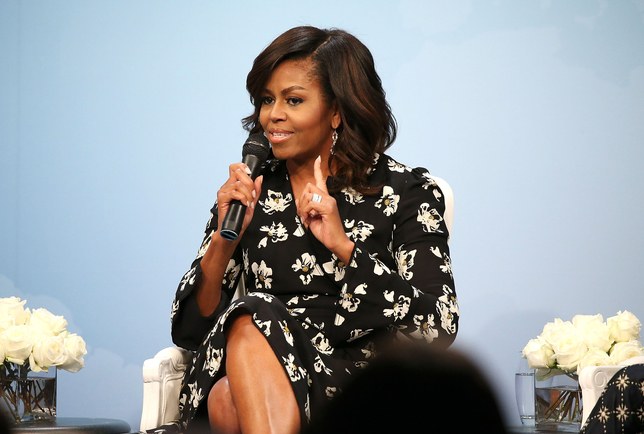
Michelle Obama Says Any Woman Who Voted Against Hillary Clinton Voted 'Against Their Own Voice'


PHOTO: Paul Morigi/Getty Images

Former First Lady Michelle Obama has some pointed words for women who voted for Donald Trump. During a conversation with author Roxanne Gay at Boston’s Inbound marketing conference on Wednesday, Obama told the audience that “Any woman who voted against Hillary Clinton voted against their own voice.”

Despite assuring America that he would be terrific for women, Donald Trump attitude, actions, and comments toward women throughout his pre-presidential life seem to contradict his claims. And since taking office, the President has taken numerous steps to roll back women’s rights (case in point: last month he reversed an Obama-era policy meant to promote equal pay).

Nonetheless, the former first lady made clear that both she and Barack are still hoping for the best when it comes to Trump. “We want him to be successful,” Obama said. “He was elected.”

And as someone who has first-hand experience living in the White House—and whose husband dealt with Congress that was determined to make his time in office as unproductive as possible—Obama understands the stress that comes with the job.

“We’ve chosen to be supportive of this administration,” she added. “There was an entire party that didn’t support my husband.”

Moving on from Trump, Obama hit back at Republicans in Congress who have repeatedly tried—and failed—to repeal the Affordable Care Act.

“The Affordable Care Act isn’t Barack’s legacy,” she said. “It’s the country’s legacy.”

She also told the crowd that, despite missing “the people and the work” in the White House, she does not miss being first lady. Saying the experience was like “being shot out of a cannon…with a blindfold and the spotlight on you,” Obama said that being out of the office feels like she and her family are “breathing for the first time.”

As the Q+A drew to a close, the first lady’s conversation with Gay ended on a lighter note. When asked what her favorite song on Beyonce’s Lemonade is, Obama answered “all of them,” before adding that “Love Drought” was the one she played “over and over.”


Source link

Categories
Health

Hillary Clinton's New Book *What Happened* Proves She's Not Going Away. That's a Good Thing


On the morning of the 2016 election, I slipped on some of the only pants that accommodated my pregnant belly and a “Hillary” T-shirt. Climbing up the steps after I checked off a box for my namesake, I stopped for a moment and put my hand on my stomach, right near the kicking foot of my unborn daughter. I had just voted for a highly qualified, highly intelligent, highly suitable woman for President of the United States of America, and she was going to win. Her inauguration would come just days before my daughter was due to arrive in the world.

Instead, I cried for most of the next week. And my story is no different than that of millions of other women across America who felt like they too had personally had a rug ripped out from under them on November 9.

On that post-election morning, as Hillary delivered her concession, I sputtered out loud, “How the hell is she doing this?” Imagine losing the presidency to an admitted sexual predator with the personality of a petulant Big Mouth Billy Bass.

What the hell happened?

In Hillary Clinton’s new book, aptly titled What Happened, she digs into the question, even if she doesn’t offer any comforting explanations. She discusses how she spent the day after her concession (“I don’t remember much about the the rest of that day. I put on yoga pants and a fleece almost immediately”), throws barbs at some of her critics (claiming that Bernie Sanders “impugned” her character), and puzzles over why exactly so much scorn has been fired at her over the decades (“What makes me such a lightning rod for fury? I’m really asking. I’m at a loss.”)

The book itself has already become a lightning rod (it just came out Tuesday), especially for Democrats who want to tuck Clinton into a special lined and scented drawer for failed candidates and never let her out again. Who think that her book distracts us from the future of the Democratic party because it’s wrapped up in the past. Who offered up such opinions as the former Clinton surrogate who proclaimed, “I wish she’d just shut the fuck up and go away.”

Apparently everyone in this country gets to dissect the 2016 election—except the woman who lost.

We don’t typically ask losing candidates to imprison themselves in their homes for all eternity—Al Gore recently completed the talk show circuit for his new film, John McCain is still mavericking through the Senate, and Mitt Romney is sitting on a beautifully appointed sofa somewhere. But Hillary? She should gracefully bow out of public life, her critics proclaim. Apparently everyone in this country gets to dissect the 2016 election—except the woman who lost.

A woman’s role in the world is exactly what a large portion of What Happened delves into. In three chapters—the least discussed bits of the book so far, of course—Clinton outlines her own history as a woman in politics and the contours of the still raging fight for gender equality. It’s clear Clinton is relieved to get this off her chest, to rant about the young man at the law school admissions test who told her “If you take my spot at law school, I’ll get drafted, and I’ll go to Vietnam, and I’ll die.” About the bizarre spectacle that surrounded the “tearful moment” (she says, “I didn’t even cry, not really”) she had on stage at the 2008 New Hampshire primary. About the impossibility of pleasing people as a woman in politics: “If we’re too tough,we’re unlikable. If we’re too soft, we’re not cut out for the big leagues. If we work too hard we’re neglecting our families. If we put family first, we’re not serious about the work.”

There is nothing new or exciting in what Hillary Clinton offers from her own biography—but that’s precisely the problem. These issues aren’t new, but they aren’t going away. One of the most accomplished women in the world still doubts whether she did the right thing when she was literally stalked onstage by her opponent during a nationally televised debate! The exchange has been widely reported (“Donald Trump was looming behind me … My skin crawled”) but the followup hasn’t. Clinton did not, as she considered, turn to him and say, “Back up, you creep, get away from me.” But she wonders to herself now, “Maybe I have overlearned the lesson on staying calm—biting my tongue, digging my fingernails into a clenched fist, smiling all the while, determined to present a composed face to the world.”

He stalked her and she’s still left doubting if her reaction cost her crucial votes. That’s the state of gender relations in our country today.

And Clinton doesn’t just hash out the details of her own issues. “Something I wish every man across America understood,” she explains, “is how much fear accompanies women throughout our lives. So many of us have been threatened or harmed.” And interrupted, and castigated, and told our voices are too shrill and our opinions too forceful. Clinton traces all that. “It’s maddening,” she writes, “that the basic fact that sexism is alive and well should be up for debate.” And yet it is—and it is specifically up for debate when you question the role sexism played in the 2016 election. It seems the country doesn’t want to re-litigate that question—just try telling a man that you think misogyny was a large factor in Trump’s rise and Clinton’s defeat.

It’s nearly impossible to discuss the election without being offered an explanation of Hillary’s failures as a candidate (Those pantsuits! That cold demeanor! Those celeb endorsements!) as if her opponent were Franklin Delano Roosevelt and not a real estate tycoon who was caught on camera boasting about committing sexual assault. We’re still free to hate on Trump—but not to love on Hillary.

We’re still free to hate on Trump—but not to love on Hillary.

I can feel myself rehashing the election right now. You’ve done it, too. How could this happen? How could democracy fail us on such a fundamental level? Clinton deserves her chance to work through that question, too—publicly if she chooses. She campaigned publicly. She battled publicly. She can certainly now wonder publicly about the day she lost the presidential election. Think about it: If it happened to you, wouldn’t you want your say?

The book, then, is an act of women’s liberation. A woman who failed in public wants to work towards course correction. And yet here comes the parade of people prepared to tell her that her voice—the one for whom all this has mattered the most—should go for a literal hike in the woods of Chappaqua and keep her feelings to herself. She should keep to the Netflix binges she writes so fondly about in this book, apparently, and ignore that the failed election was only one smaller portion of a decades-long career in public service.

But that makes Clinton just another woman in a long string of suppressed voices. Yes, she lost. But that doesn’t mean she’s less equipped to tell the country where we all went wrong. In fact, it may make her better informed.

It’s not going too far to say that a lot of women have been traumatized over the past year. If a former Secretary of State, Senator, First Lady, accomplished attorney and Yale Law graduate is repeatedly dismissed as a “flawed candidate” because she boasts policy over reality TV theatrics, then what does that say about our country’s attitudes towards women? That’s not the kind of wound that heals in 10 months–for the populace or Clinton herself. Why shouldn’t she tell her side in gritty detail? And why shouldn’t we take that particular narrative as a welcome reminder of how important the fight for women’s equality has become?

Related Stories:

Let’s Keep “I’m With Her” and Make It a Rallying Cry for All Women


Source link