Categories
Health

I Survived Cancer Once—Then I Was Diagnosed with Triple Negative Breast Cancer


Staring at my ever-growing to-do list, I contemplated canceling—or at least postponing—the appointment for my annual mammogram. Next month, I reasoned, things would be a little less hectic. Why not save myself some stress?

Like most, I have a fear of cancer. In 1999, I lost my 37-year-old husband in a fast battle with Hodgkin’s disease, leaving me to raise our three young children—6, 4 and 2 years old at the time—alone. A year later, I was diagnosed with papillary thyroid cancer after my doctor found a small nodule in my neck during a routine visit for a sore throat. I endured several years of tests and treatments before the doctor declared me cancer free.

I’d tried not to think about cancer in the 16 years after that, always trying to push it from the corners of my brain. But when my annual mammogram rolled around cancer seemed to be all around me: Several close friends were being treated for breast cancer and a close neighbor was battling leukemia. Cancer seemed to be closing in—again.

A year earlier, I started having what felt like small electrical charges in my left breast. Zippy little jolts that felt like a nerve misfiring all day long, setting me on edge with each zap. Test results showed that there was nothing to worry about and within a few weeks the “charges” had subsided. I figured things were fine and went back to trying not to think about cancer. But a few months before my scheduled mammogram, they came back.

As I sat in front of my calendar, debating whether or not to put off my mammogram, I couldn’t get the thought of cancer out of my mind. I thought about my kids, now adults, and everything they’d already been through. They’d watched both of their parents battle cancer, and mourned the loss of their dad. I was eager to tell them I had a clean bill of health again so I kept my appointment on the books.

“This is your mass,” the radiologist said, drawing an imaginary circle around a black spot on my X-ray as I sat in his office after my appointment. “My mass?” I kept asking over and over again as if repeating the question would make the answer change. It didn’t. There was a mass in my left breast.

My mass was tiny—it was possible it was only Stage 0 if it was cancerous at all. I needed to have a biopsy to confirm but somehow I already knew what was coming. A biopsy, a partial lumpectomy, a CAT scan, and several blood tests later, I learned that I had triple negative breast cancer. It had already spread to some lymph nodes in my armpit, kicking my cancer diagnosis up to Stage 2.

As far as cancer diagnoses go, triple negative breast cancer is a particularly bad one to get: it’s aggressive, more likely to spread and more likely to recur. TNBC is less common—about 10-20% of breast cancers are triple-negative, according to BreastCancer.org—and gets its name from the fact that it tests negative for estrogen receptors, progesterone receptors, and excess HER2 protein. Translation: Triple-negative breast cancer doesn’t respond to hormonal therapy medicines or medicines that target HER2 protein receptors.

It does respond well to four rounds of what’s known as “Red Devil” chemotherapy followed by 16 weekly treatments of Taxol chemotherapy and then 33 rounds of radiation.

While it might sound silly, my first question to the breast surgeon was, “Is this lose-your-hair chemo?” I had read about some chemotherapy treatments that didn’t cause hair loss but this unfortunately wasn’t one of them. After finally growing my hair to the longest it has ever been—a feat I’ve been trying to accomplish for years—I was going to lose it all. I started bawling in the doctor’s office, bitter over the symbolic loss and the thought of battling cancer yet again.


Source link

Categories
Health

I Was Diagnosed With Breast Cancer at 34


I will never forget where I was when I received the results of my first breast MRI screening. It was June 2016, and my dad and I were in his car in a restaurant parking lot after having dinner in the suburbs outside of Philadelphia, where I had recently relocated in an effort to be closer to my family. When I saw the missed call from the hospital, I felt my heart pounding in my throat. As the voicemail loaded and my anxiety heightened, it became apparent why the genetic counselor had said some people prefer to go the preventative route. The panic is maddening.

Just weeks before, at the age of 30, I’d learned that I was a BRCA1 carrier by way of my dad. He was diagnosed with lung cancer the previous fall and had recently undergone genetic testing so his doctors could better understand his cancer after it spread. My paternal grandmother passed away from breast cancer in her early 40s, so the news that I was a BRCA1 carrier didn’t come as a total shock. But gaining clarity on the past didn’t take away what it meant for me and my risk of breast and ovarian cancer in the future—72% of BRCA1 carriers will develop breast cancer, and 44% will develop ovarian cancer in their lifetime.

On that summer day four years ago, I cried tears of relief as I listened to my doctor share the news that my MRI had come back normal and there was no detection of anything suspicious. I’d made it through my first screening, but I was far from out of the woods. To keep from getting breast cancer, as a BRCA1 carrier, I basically had two options: have a preventative double mastectomy or get screened yearly, hoping we’d catch anything suspicious in time.

I continued screenings for the next three years, alternating breast MRIs and mammograms, anxiety surrounding each appointment followed by relief when my results came back clean and clear. I wasn’t ready to have the mastectomy yet—it felt drastic, and I was holding out hope that I would find my future partner who would know me and my natural body before I had to make these changes and decisions.

But in the summer of 2018, my dad, who was already battling cancer, suffered a series of strokes. It was gut-wrenching to watch as the father I knew, loved, admired, and adored begin to fade away. It was time to start being more proactive about my own health—I wanted to do everything in my power to make sure my loved ones wouldn’t have to suffer over me. So I promised myself that once things settled down, I would pursue a preventative mastectomy.

I never got around to that meeting with my oncologist. My father passed away this winter after months of deterioration caused by strokes and cancer.

My yearly screening was scheduled for the day after my dad died. I cancelled with no immediate plans to reschedule, the following weeks filled with funeral and financial planning. A nudge from my mom reminded me to get it back on my calendar in March.

Back at home after my mammogram, I felt raw with grief. I didn’t know how to process my cancer risk in the wake of my dad’s death, so I made a very millennial decision and took to Instagram: I posted a photo of my dad with my brother (who passed away when I was 27). Something about making my heartbreak public felt like a release. I had been holding in my grief for weeks, and I finally allowed myself to feel the pain. There is something irrational about hurting so badly that it feels good, but finally feeling the fear and sadness felt like a wave of relief.


Source link

Categories
Health

My Dad Had Just Died from Cancer—Then I Got Diagnosed with Breast Cancer, Too


When Homa Sadat’s father was diagnosed with pancreatic cancer in 2010, her family, including her mother and seven siblings, watched him shrink from 187 pounds to 118. Every day after work she would put on a brave face and visit her dad to lift his spirits. Then she’d head to the bathroom, close the door and cry from feeling so helpless. “With pancreatic cancer, you usually find out at the last stage,” says Sadat, a 33-year-old former property manager who lives in Los Angeles. “There was nothing we could do.”

Her dad passed away in 2011. “Seeing him go through that was really hard on me—we were really close,” says Sadat. “I saw what cancer and chemotherapy could do to someone.”

Because of her father’s illness, Sadat was persistent about checking her own body for signs anything was off, including her breasts. About six months after her father died, she felt a lump.

At her gynecologist, they decided to take a watch and wait approach. “I put it out of my mind,” she says. “I was so busy with my life with work and school. I didn’t think that it would be anything serious.” By the time a shooting pain in her breast brought her back to the doctor, it had been another six months. Testing eventually revealed she had triple negative breast cancer, which had spread to her lymph nodes.

Homa did a lot of research on where she could get the best treatment, eventually deciding to participate in a clinical trial at City of Hope, a cancer treatment and research center in Los Angeles. “I felt really comfortable there,” says Sadat, who went through 16 weeks of chemotherapy followed by surgery and radiation.

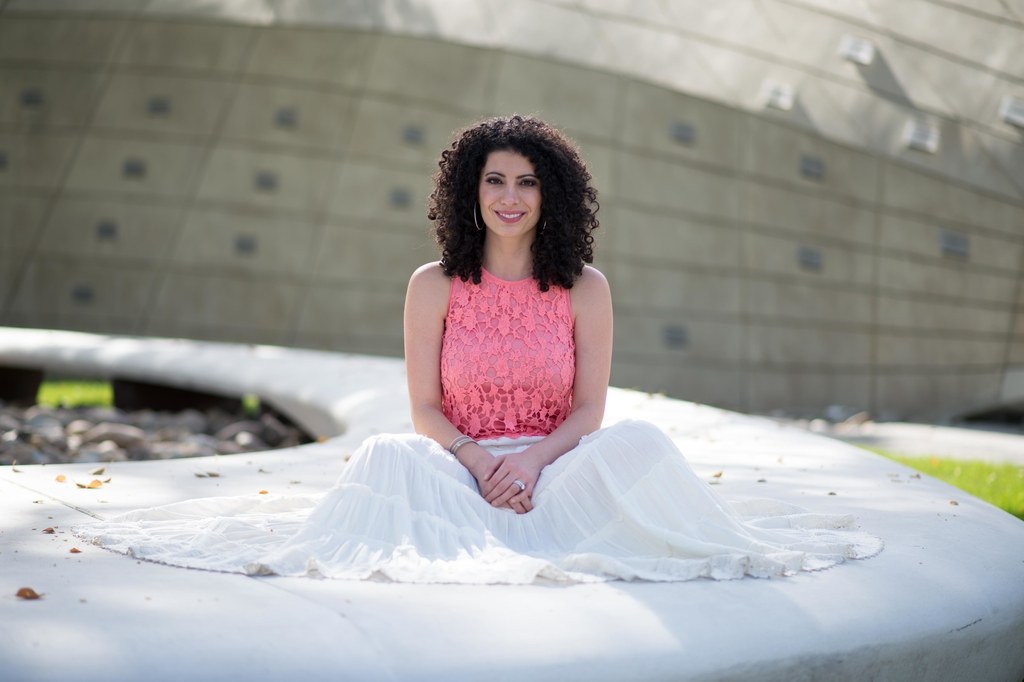
Homa Sadat in Los Angeles.

“I was pretty strong about it because I witnessed my dad go through it. I was like, “Okay, I can do it, too,” she says. But she also knew that her mother and siblings had just faced the loss of an integral part of their family to the same disease, and that made her want to shield them from her treatment at times. While her family was an incredibly strong support system, Sadat felt inclined to stay away from them at times and relied heavily on friends, living across the street from her mother’s house after recovering from surgery.

“I didn’t want to be in their face going through the same thing again. My mom was just trying to deal with the loss of my dad. It had only been a year since we lost him. I didn’t want to be a reminder,” she says. “But no matter how strong I acted around my family, they knew my pain and what I was going through. I couldn’t hide it from them.”

Part of trying to stay strong meant normalizing her life as much as possible and not looking like a “sick person,”—especially after her little brother broke into tears one day when she took off her wig in front of him. As a part of this, working was incredibly important to her. “Just because I had cancer didn’t mean my life stopped,” says Sadat, who continued to try to work throughout her treatment. “I’d go out, have dinner—keep living my life.” In the end, Sadat, who is now cancer-free, says this approach helped her. “Fighting and acting like I didn’t have cancer really got me through it,” she says.

She also focuses on a new philosophy of spending as much time as you can with loved ones and stressing less. “One thing I didn’t have before that I do now,” she says, “is balance.”


Source link