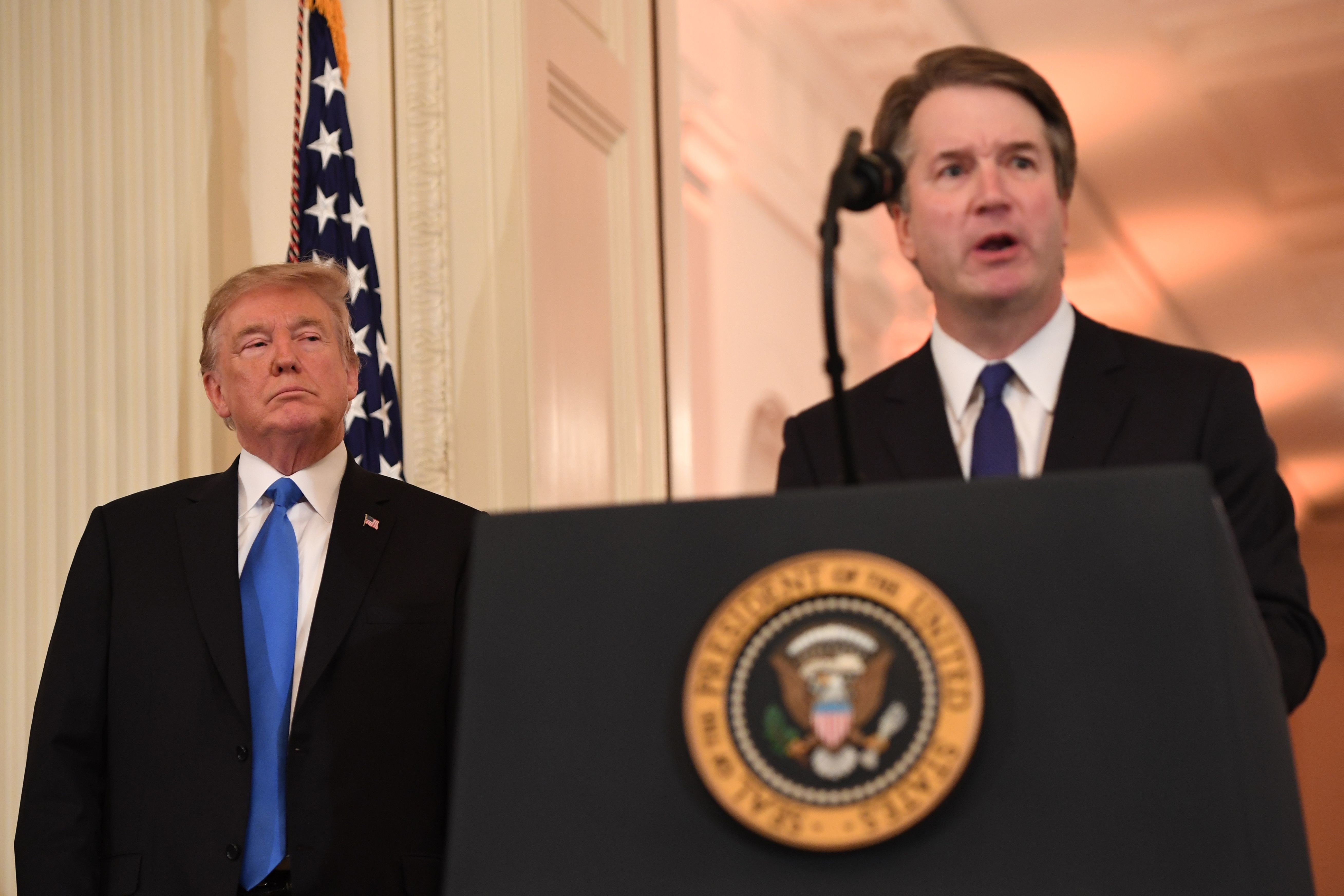
President Donald Trump on Monday night nominated conservative Brett Kavanaugh to serve on the Supreme Court, tilting the top tier of the American judiciary to the right without changing its gender balance.
Kavanaugh, a 53-year-old federal judge on the D.C. circuit, is the president’s choice to replace retiring Justice Anthony Kennedy.
“There is no one in America more qualified for this position, and no one more deserving,” Trump said before introducing Kavanaugh.
Kennedy’s departure raises new questions about the future of American abortion law. While he had a conservative record coming into the job, Kennedy went on to side with liberals in key cases that reaffirmed the legal right to abortion enshrined by the court’s watershed 1973 ruling in Roe v. Wade.
“Mr. President, I am grateful to you and I’m humbled by your confidence in me,” Kavanaugh said. Trump’s new pick spoke at length about his warm relationship with his mother and his two daughters, as well as his wife, whom he met when they both worked at the White House.
Trump campaigned on a vow to tap pro-life judges for the Supreme Court. Shortly after taking office, he successfully nominated conservative Neil Gorsuch to fill the vacancy created by the death of Justice Antonin Scalia.
The president’s second SCOTUS pick is even more politically charged, coming amid a midterm election widely seen as a national referendum on how Trump is doing as president.
Trump chose Kavanaugh, of Maryland, from a roster of conservative judges that included Amy Coney Barrett, 46, who would have been the fourth woman seated on the current court and the only female conservative. He also considered, among others, Raymond Kethledge, a judge on the U.S. Court of Appeals for the Sixth Circuit for the past decade who was viewed as a potential “consensus choice,” and Thomas Hardiman, a strong proponent of gun rights and a finalist for the SCOTUS berth that ultimately went to Gorsuch.
After earning undergraduate and law degrees from Yale, Kavanaugh clerked for Justice Kennedy. He later worked for Kenneth Starr, the independent counsel who famously investigated President Bill Clinton, and as a top aide to President George W. Bush.
Sally Kenney, a Tulane political science professor and an expert on the judiciary, told Glamour in an email immediately following the announcement that Trump had nominated a judge “chosen” by the conservative Federalist Society “to replace the swing justice on the Court a few months before an election while many in his administration are under investigation.”
Kenney added, “Judge Kavanaugh is no consensus candidate, but rather a Republican partisan associated with the most divisive conflicts of our times. It is hard to see how this appointment advances the rule of law, protects constitutional rights, or guarantees equal justice under law.”
Cardozo Law School Professor Kate Shaw said Kavanaugh might refuse to say in Senate hearings if he favors overturning Roe v. Wade.
Other nominees have avoided giving a position on Roe, but Shaw, a former associate White House counsel, said lawmakers would be “justified” in pressing Kavanaugh on “what confirming him could mean for reproductive rights” given the 2017 case of an undocumented teen who sought an abortion while in federal custody.
Kavanaugh’s dissent in that case sounded an alarm about giving detainees a new right to abortion “on demand”—a phrase abortion-rights advocates call “coded” language that indicates support for overturning Roe.
Dawn Laguens, executive vice president of Planned Parenthood Federation of America, condemned the president’s choice: “We oppose the nomination of Brett Kavanaugh to the Supreme Court, and call on the Senate to do the same,” she said in a statement. “There’s no way to sugarcoat it: with this nomination, the constitutional right to access safe, legal abortion in this country is on the line.”
But some hardline abortion opponents have reportedly used the very same case to question whether Kavanaugh would truly be the kind of “solidly pro-life” justice they want on the bench.
Marjorie Dannenfelser, president of the pro-life group Susan B. Anthony List, praised the decision. “President Trump has made another outstanding choice in nominating Judge Brett Kavanaugh to replace Supreme Court Justice Anthony Kennedy, keeping his promise to nominate only originalist judges to the Court,” Dannenfelser said in a statement. “Judge Kavanaugh is an experienced, principled jurist with a strong record of protecting life and constitutional rights.”
Additionally, as NPR reported, Kavanaugh “also dissented in a case involving a challenge brought by religious groups to the contraception provision of the Affordable Care Act.” The rule, which “required religious groups to certify that they were exempting themselves from providing contraceptive services,” was eventually withdrawn by the Trump administration.
If confirmed, Kavanaugh promised to “keep an open mind in every case” and “always strive to preserve the Constitution of the United States and the American rule of law.”
Now that he’s made his pick, Trump’s nominee goes on to confirmation hearings held by the Senate Judiciary Committee. After that review, committee members make a recommendation on the candidate and send it to the full Senate.
Related Stories:
Trump’s Supreme Court Pick May Come From This List—Here’s Where They Stand on Women’s Issues.
Pro-Choice Organizations Launch the #OneInFour Campaign Ahead of President Trump’s Supreme Court Nomination
Source link

.jpg)