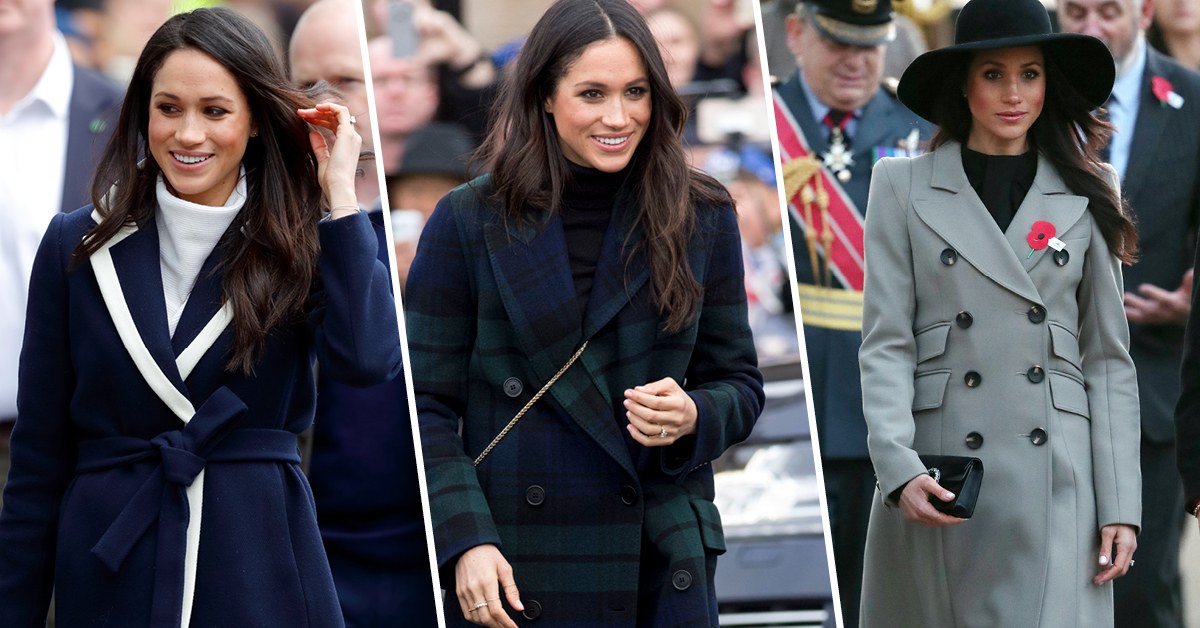
During the last few months, Meghan Markle has inspired plenty of fashion trends—from the Trooping the Colour off-the-shoulder blazer that would get the Zara treatment to a renewed interest in bateau necklines. Another recurring staple in her royal wardrobe has been polished, sophisticated outerwear. She made her debut as a future duchess in a wrap coat, layered drapey Aritzia coats over her outfit for casual appearances, and even compelled J.Crew to restock a two-tone coat she wore once. After perusing the new arrivals sections of our favorite retailers, we’ve come to the conclusion that Markle’s taste in outerwear—from double-breasted to checked coat styles—make for great fall shopping inspiration. We’ve identified the most wearable of the Duchess-approved silhouettes to build your seasonal wardrobe around. Check out our picks, ahead.
We bring you the trends. You make them your own. Sign up for our daily newsletter to find the best fashion for YOU.
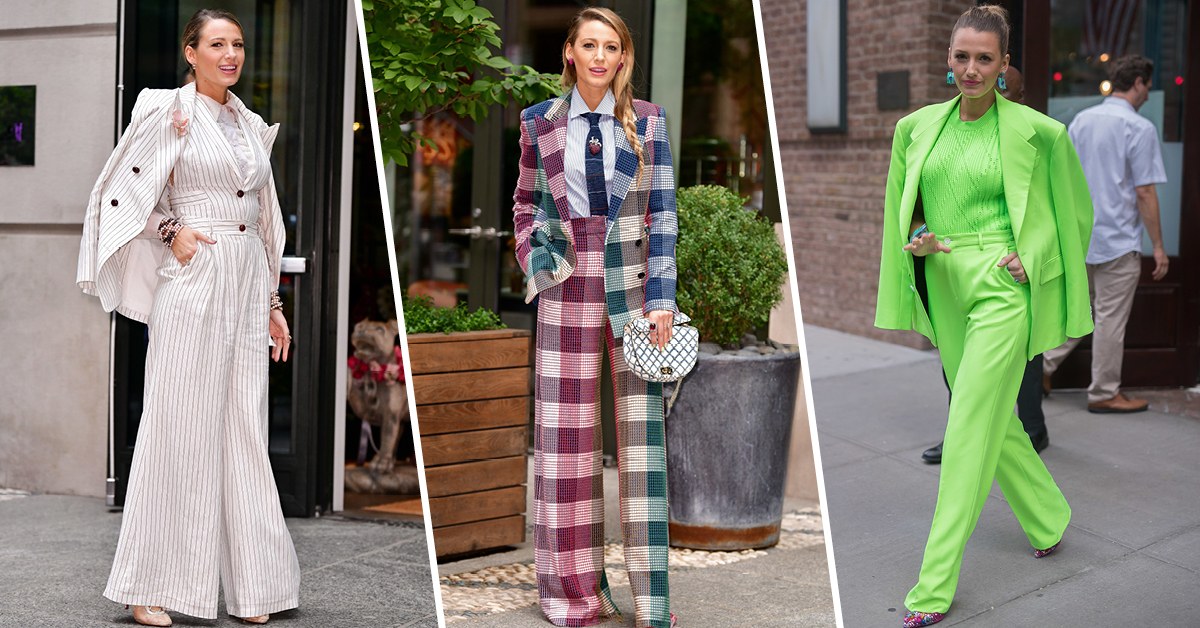
When Blake Lively has a project to promote, she does so with impeccable style. She’s been known to plan multiple outfit changes for a single day, dress according to theme, and go for extravagance with her fashion—all of which is her own doing, because she doesn’t employ a stylist. Such is the case for her latest press tour, for A Simple Favor. This time around, though, Lively is zeroing in on a specific silhouette: the suit.
Over the past few weeks, Lively has been photographed in velvet suits, neon suits, couture suits, among others. The styling choice is likely a nod to her A Simple Favor character. (In the first trailer for the film, she’s seen wearing a polished suit.) Even if it’s a clever promotional tie-in, Lively makes a pretty strong case for investing in a new suit for fall. So whether you’re more of a polished or a patterned person, let her convince you that it’s worth the investment.
We bring you the trends. You make them your own. Sign up for our daily newsletter to find the best fashion for YOU.
Like chalky sunscreen and limited foundation shades, hair removal lasers didn’t use to work well for women with medium to dark skin. But thanks to the growing awareness around inclusivity, along with advances in technology, those of us who were told for years that laser hair removal was a no-go due to our skin tone are now finally able to get the treatment.
First, the lowdown on lasers: They beam intense light at the follicle, causing permanent damage so hair no longer grows. But because they work by targeting the pigment in the hair—it’s the contrast between darkness in the hair and lighter skin that helps the laser focus on its bullseye—the ideal candidate has traditionally been someone with fair skin and dark hair.
For women of color, laser hair removal has been a gamble: devices weren’t sophisticated enough to completely distinguish between the pigment in the skin and the hair, meaning that they could potentially cause dark and light spots, blisters, and even scarring, in the skin surrounding the follicle, says Robyn Gmyrek, MD, dermatologist at Union Square Laser Dermatology. But now, there are smarter lasers that can be used in a much more precise—and safe—way, making getting rid of unwanted fuzz a reality for a wider range of skin tones. Here’s how to get it right.
Which Lasers to Look For
The first and most important thing you need to know is how Nd:YAG and diode lasers work for darker skin. In recent years, the Nd:YAG (or just “YAG”) has become increasingly popular, as it’s as foolproof as it gets. “The wavelength of this laser goes deeper into the skin than a diode,” says Gmyrek. “So it more successfully bypasses the pigmentation present in the skin.” Because the YAG basically bypasses the melanin in your skin, it’s the safest option for dark skin. It’s one of two lasers Shobha Tummala, founder and CEO of Shobha hair removal, offers in her salons. (She’ll also use it for fair-skinned clients who’ve recently gotten a tan.)
But the diode has its perks, even though it might be more complicated for anyone above a 4 on the Fitzpatrick scale (the standard measure of skin type used by dermatologists, with 1 being the lightest and most sun-sensitive and 6 being the darkest). “In darker-skinned patients, the diode laser energy has to be delivered in a slower manner per pulse, leaving more time for skin to cool,” explains Gmyrek. “It also has an instant cooling device that protects pigment from overheating and being damaged.” The Lumenis LightSheer laser, one of the most popular diode lasers out there, even has a suction mechanism to distract your attention from the pain. “I would overall say that it’s the least painful,” says Estee Williams, MD, a dermatologist in New York City.
You’ll want to minimize the chances that you’ll develop the most common laser-related side effects for dark skin: hyperpigmentation, or dark spots, and hypopigmentation, in which the skin pigment lightens. According to Williams, hypopigmentation can be harder to treat (although Gmyrek notes that it can sometimes resolve on its own), so ask your laser removal expert to do a test patch if you think you might be prone to it—just to be on the safe side.
What You’ll Spend
Expect to need at least six sessions. Although darker skin can sometimes require more treatments than fair, “everyone’s different,” says Tummala. The downside is that the cost can add up quickly, as many providers charge by the session. According to the American Society of Plastic Surgeons’s 2017 stats, the average cost per session was $293—but it varies wildly depending on what part of the body you’re targeting. (Generally: The larger the area, the higher the price.)
At many practices, there’s no difference in cost between the YAG and diode. Some research shows that the diode might be slightly more effective at actually removing dark hair on dark skin—it could also be worthwhile if you’re closer to 3 on the Fitzpatrick scale and have a low pain tolerance. But Gmyrek believes that the Nd:YAG is the safest bet overall.
How to Prep Properly
Now is not—we repeat, not—the time to get a coupon through a discount site. The provider (and their expertise) matters. “I was willing to pay a premium and see a professional with great reviews,” says Marlene, 28, who had laser hair removal on her underarms. A pro who has extensive experience with women of color is essential.
Not only should you expect the same type of screening and forms as you would from any medical professional, it should also include your ethnicity, as different ethnicities—regardless of skin tone—react differently to lasers. Your skin may appear to be a 3 or 4 on the Fitzpatrick scale but if you’re, say, Latin or Asian, it could react to the laser as a 6 would.
Once you’re scheduled, coddle your skin. Stop using skincare products with harsh ingredients, including glycolic and salicylic acids, benzoyl peroxide, and any retinoids (including tretinoin and adapalene), at least five days before your treatment. “These can all make your skin more sensitive to the laser energy,” says Gmyrek.
Go full vampire and keep out of the sun—or, at the very least, use proper protection. (That’s broad spectrum SPF 30 or more; tinted moisturizer or foundation with SPF doesn’t count.) A tan equals more pigment, which can spur a different (and potentially dangerous) reaction to the laser. “If you’re even slightly tanned, inform the laser provider so that the treatment energy can be lowered or the treatment, rescheduled,” says Gmyrek.
What to Do Post-Treatment
Side effects can still happen—but you’ve got options. “For irritation or redness, hydrocortisone can help to resolve the inflammation,” says Gmyrek. “For an acne-like eruption, or folliculitis, use topical antibiotics.” For any hyperpigmentation, try a topical cream for dark spots, which your derm can prescribe.“It’ll help normalize the skin color,” explains Gmyrek.
But the low-stubble life is worth the risks. For women who once felt the need to shave daily, they say the minimal upkeep has been well worth it. “My overall experience was great,” says Marlene. The best part? She didn’t experience burns or pigmentation problems, proving just how far lasers have come.
Meghan Markle has spent the past few months hopping between polo matches, benefit dinners, official appearances (and, you know, getting married)—and offering outfit inspiration with every outing. The Duchess of Sussex has appeared at her recent engagements wearing, to little surprise, impressive additions to her expanding dress collection, each one a polished update to familiar silhouettes, like the LBD or the classic shirtdress. And even if you don’t have a royal wardrobe budget, you can let Markle guide your transitional dressing purchases: The asymmetric skirts, polished denim, and trench silhouettes she’s favored recently let you get a jump-start on fall—and there are plenty of affordable options on the market you can shop right now. Check out some of our Duchess-inspired favorites, ahead.
We bring you the trends. You make them your own. Sign up for our daily newsletter to find the best fashion for YOU.
There once was a time when we had to devote a huge amount of effort to uncover the truth about our beauty routines. Now we’re in a golden age of transparency. You can google just about any ingredient or Yelp whatever service and a wealth of reviews are available at the ready. And with social media holding brands accountable, they’re listening to our pleas and have begun providing the information we need to make informed decisions about the products we purchase. But there’s still one place where that ease of knowledge hasn’t extended: the salon.
Even for those of us who have been getting our hair cut and colored for decades, there’s still so much confusion around tipping. Unlike some restaurants, where your receipt gives you a gentle nudge toward gratuity by listing the exact dollar amounts for a 15, 20, or 25 percent tip, the salon is much trickier, with no indication of who (if anyone) gets extra money and how much to give. Are you supposed to tip the owner? And what if multiple assistants helped with your blowout or shampoo? There’s also the issue of knowing where your money is going: There’s much more discussion around servers’ salaries than there is around our stylists’. All these factors make the equation that much more difficult.
To shed some light on what’s really going on at the salon, Glamour talked to stylists, assistants, and owners around the country to find out. From where your hard-earned cash goes to what (and who) you really should be tipping, read on for their unfiltered opinions and advice.
What Stylists Actually Make
Salons run on a few business models—most commonly commission-based and booth rentals (more on those later).
Commission, explains Siobhán Quinlan, a colorist at Art + Autonomy Salon in NYC, means that employees are paid for the services performed, of which they only keep a portion, usually somewhere between 40 to 60 percent of the price. The remaining percentage goes to the salon for overhead costs like utilities, product used (color, shampoo, conditioner, etc.), and amenities for both staff and clients.
Nicole Krzyminski, a stylist at Fringe salon in Chicago, breaks it down: “Say you’re getting a beautiful new color—your balayage, conditioning, and toning takes about three hours and costs around $250,” she says. “After accounting for the overhead fees and product costs, the stylist gets about $100 of that pretax.”
In some cases, stylists can also make money by convincing clients to buy a product that was used on them during their service. However, this represents a minuscule amount of revenue says Shira Devash Espinoza, a freelance stylist based in New Jersey. “When working in a salon, you’re constantly pushed and ‘rewarded’ to sell, but only earn maybe 10 percent of it if you’re lucky,” she says.
How They Spend It
So what happens to Krzyminski’s hypothetical $100? The majority of it, she says, goes toward licensing fees, personal supplies, and tools (blow-dryers, flatirons, curling irons), and continuing education classes. That means even on a jam-packed day, a stylist may only make enough take home pay to cover the essentials of food, shelter, and clothing.
Tips, on the other hand, help pay for the supplemental benefits that those not in the service industry take for granted. Says Stephanie Brown, a colorist at Manhattan’s Nunzio Saviano Salon, “It’s a physically demanding job, and most salons are too small to provide health benefits or paid vacations and sick days.”
Ladda Phommavong, a stylist at Third Space Salon in Austin, Texas, says that those gratuities are what helped her become the in-demand stylist she is today. “The tips I received from clients meant being able to take outside courses to hone my craft,” she says. “If clients knew I was saving up to take the master colorist course and that their tipping was directly contributing to me becoming a better stylist for them, I think they would definitely want to be a part of that.”
Freelance Isn’t Free
Many stylists choose to forgo the commission-based life and instead strike out on their own by renting booths in salons. This basically means paying a weekly or monthly fee—our stylist sources said they generally pay around $120 a week or $880 a month, depending on where they are based—to reserve a semipermanent spot to see clients. In these cases, stylists keep 100 percent of their service fee as well as their tips. The downside? “We pay for absolutely everything—refreshments, cups, capes, color bowls, foils, brushes, scissors, styling products,” says Jennifer Riney of Brushed Salon in Oklahoma City. They are also on the hook for paying liability insurance and credit card fees.
Freelancers like Sarah Finn, who rents a chair at The Ritz Day Spa & Salon in Watertown, New York, say that one big perk of being on their own is an uptick in tips. “I’ve worked at salons where my clients paid at a cash register and their tips went through many hands,” says Finn. “I don’t know if it’s just because they’re paying me face-to-face or if tips went missing at other places, but I definitely make more as a booth renter.”
Another option for freelancers is the coworking salon. Arturo Swayze, the founder and CEO of ManeSpace in NYC, is a pioneer of this relatively new setup. He provides short-term rentals for stylists who don’t need or want a regular stint in a salon. Stylists reserve a time slot, use an app to unlock the space, and see their clientele as needed. But even in this scenario, says Swayze, there is still uncertainty.
“Because the coworking model is so new, people really don’t know what proper tipping etiquettes are,” he explains. “Tipping is still an important aspect for these hairstylists. They are independent, but essentially have all the expenses of a salon owner, but they’re not drawing income from other stylists.”
“Each stylist is running their own small business in a way,” says Nicole Wilder of Paragon Salons in Cincinnati. “We have relied on tips as a part of our salaries for decades. We kind of signed up for that as part of it. But we work hard on our feet to make you feel beautiful.”
Helping Hands
Assistants are the unsung heroes of the salon industry—and some of the most neglected. They are involved in almost every aspect of your service. “Our duties as an assistant helping a stylist are to shampoo all clients for haircuts, apply toners, blow-dry, and mix color,” says Ocean McDaeth, one of the assistants at Art + Autonomy. “We’re also in charge of setting up the stylists for each service, keeping their stations as well as the salon clean, doing laundry, and greeting clients and making sure they are comfortable throughout [their visit].”
Since assistants don’t perform technical services, they’re usually paid a day rate by the salon owner. Many times the stylists they assist will also tip them out with a small percentage of the day’s take. “Being a hairdresser has a huge financial obligation. I think it’s fair to say we as assistants really do rely on our tips. Without them I have no idea how I’d survive in NYC,” McDaeth admits.
It’s important to note that assistants aren’t the norm in smaller salons and outside of big cities. High-end salons with a large clientele tend to hire assistants as a way to let a stylist book more appointments. If the assistant is washing your hair, this allows the stylist to have another client in their chair. When done well, you might not even notice your stylist or colorist is working with one or two other people in addition to you. This maximizes the stylists’ time and earning power, making assistants integral to a prestige salon’s operation.
While having assistants is a lifesaver for hairdressers, it can be a nightmare for clients if you’re trying to figure out who to tip. In large salons, you can have up to 10 different people touching your hair, notes Jon Reyman, a master stylist and co-owner of Spoke & Weal salons. He says that some (but not all) salons have what they call a tip pool for just that reason. “We have it set up so that whatever tip a stylist gets, a portion of that is distributed to the assistants at the end of the day. So if you tip your stylist, you tip everybody.”
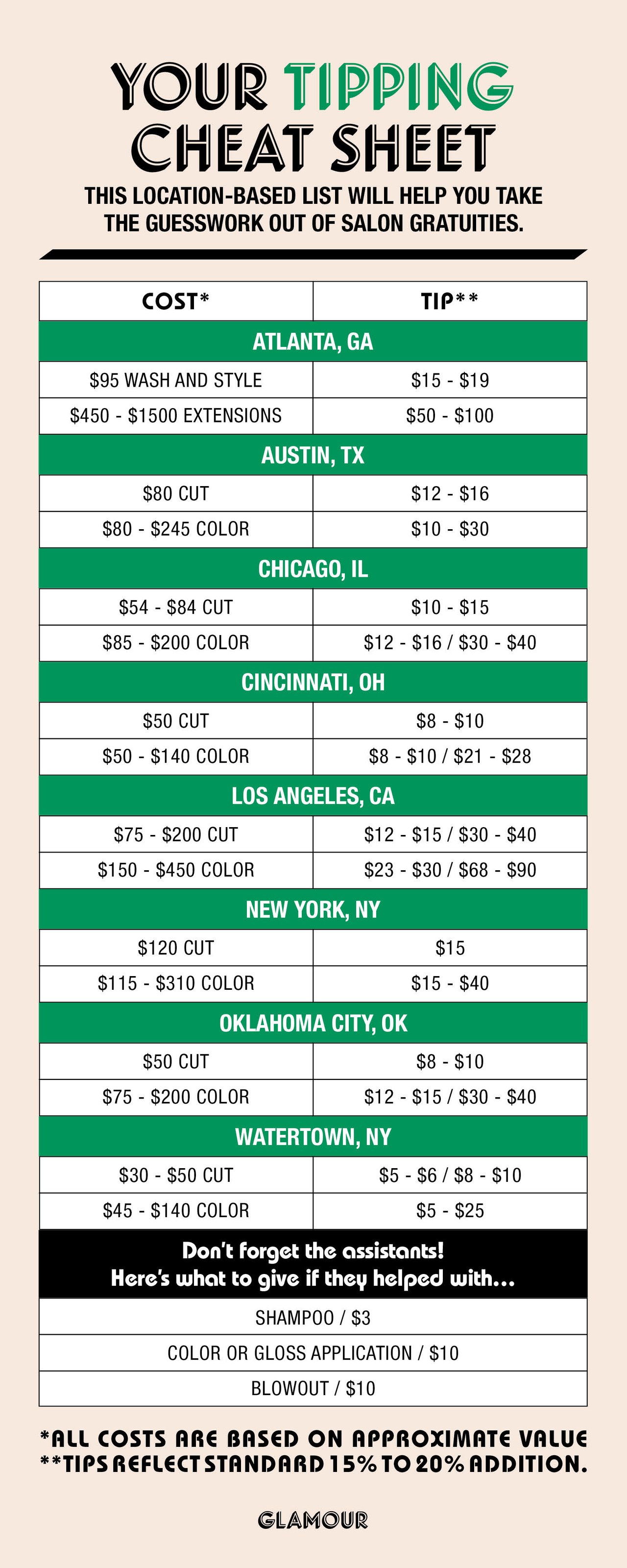
Of course, there’s no way to know if that is your salon’s economic ecology, so in general, think about what the assistant has done for you. If they are shampooing, applying gloss, and/or doing your postcut blowout, it’s a good idea to throw something their way. (See our cheat sheet, below, for more on what exactly to give.)
The Owner Dilemma
While tipping your stylist seems like a no-brainer at this point (hopefully), owners are a whole different ball game. “It’s an antiquated practice to not tip owners,” says Michael Davis, owner of Smith & Davis Salon in Chicago. “We’re still providing a service and actually are no longer receiving a commission. All money we bring in goes into the operation of the business and paying the non-income-earning staff.” Adds his co-owner Stevie Smith, “After operating expenses, taxes, benefits, and general overhead, the profit margin for the salon is generally about 8 to 10 percent.”
Paul Norton, a celebrity stylist in West Hollywood, puts it a bit more bluntly: “Running a salon is expensive, and generally if the owner is still choosing to take clients, I can’t imagine that they thought, Finally, a chance to work just as hard if not harder and earn even less money!”
What’s In It for You?
Besides building a strong relationship with your stylist, being a good tipper also gives you access to a few perks. “Just as much as they show their appreciation, we like to show it back,” says Derek J, owner of the J Spot Salon in Atlanta. “When a client wants an extra-early or late appointment, we always keep what type of client it is in mind that’s asking.”
Adds Finn, “Those who are good tippers will be the ones a stylist will go above and beyond for; we’ll come in early or stay late or go in on a day off. If you don’t want to tip that’s fine, but let’s be real—if someone does tip more than expected, we will typically do more than expected for them too.”
Just don’t think that because you don’t tip that you’ll get subpar cut, says Reyman. “I’m not going to give you a different service because you did or didn’t tip me—I’m a professional,” he says.
Tipping Made Easy
If you’re unsure on exactly how to show your stylist how much you value them, we asked our panel to break it down to the basics. The usual gratuity for your stylist or colorist (yes, even if they are the owner) should be 15 to 20 percent of the service fee. And while assistants are sometimes tipped out by their stylists, it’s still a nice gesture to pass a little something their way. Davis says that if they simply got you settled and washed your hair, $3 to $5 is sufficient. However, if they were a little more involved, say blowing out your hair or doing a gloss service, $10 is more appropriate.
Another good rule to live by? Cash is king. Many salons don’t allow tipping with credit or debit cards since it’s harder to divvy. “When I was at my old salon where this was the policy, I often had days where I wouldn’t get tips at all because the clients would forget and not have cash or checks on them,” says Phommavong.
When all else fails, just ask. There’s no sense feeling awkward about not knowing what’s right for your situation. Not everyone is made of money—something stylists understand all too well—so don’t be embarrassed to ask them what’s kosher. “If you want to have a healthy relationship with your stylist, have the awkward conversation,” advises Reyman. “I would say, ‘I want to take care of you because you take care of me. What do you think is an appropriate tip?'”
At the end of the day, the most important thing to remember is that you and your stylist are on the same team—one that wants you to look and feel your best when you walk out the door. Says Brown, “No stylist ever wants you to leave unhappy; that’s bad for our business.”
There’s a seemingly infinite number of spring dresses out there, which is great for people who love options, and not ideal for those of us who need more style direction. Well, over the past few weeks, Meghan Markle has been inadvertently providing fans and cursory shoppers alike plenty of insight into the silhouettes that belong at the very top of your list, from pinafore-inspired midis to flowy florals.
Over the long arc of her style evolution, Markle has developed a proven track record for classic styles with contemporary touches. And in her recent public appearances leading up to the royal wedding, she’s had numerous enviable dress moments, which the public has obsessed over. Because the Meghan Markle effect is a very real phenomenon, we’re resigning ourselves to the fact that we’ll find ourselves wanting to copy the duchess-to-be’s look soon enough—so we rounded up some of the best spring dresses on the market right now, inspired by Markle’s wardrobe. Her exact threads can veer on the pricey side, but fear not: Many can be very closely mimicked with affordability in mind.
Check out how to get that Meghan Markle springtime look for $150 or less, ahead.
We bring you the trends. You make them your own. Sign up for our daily newsletter to find the best fashion for YOU.