
Categories
Health

'Riverdale' Star Camila Mendes Opens Up About Struggling With an Eating Disorder


PHOTO: Robby Klein/Getty Images

Riverdale star Camila Mendes plays the mysterious, confident Veronica Lodge onscreen, but she isn’t afraid to let her guard down in real life—even when it comes to talking about the tough, personal stuff. On Friday, Mendes revealed that she has struggled with symptoms of an eating disorder in the past, and that her sister suffered with an eating disorder for years as they grew up. In a powerful Instagram post, she explained that she’s partnering with Project HEAL to help raise money for others seeking to help with their own eating disorders.

Project HEAL was founded in 2008 by Liana Rosenman and Kristina Saffran, who met each other during treatment for anorexia. They came together to start the nonprofit to help others who were suffering but couldn’t afford treatment—sadly, many insurance plans don’t provide adequate coverage for eating disorders. (Rosenman and Saffran, by the way, were 2011 honorees in Glamour’s young women of the year list).

“I can say from experience that eating disorders are serious mental illnesses,” Mendes wrote in her post. “Growing up, I watched my big sister suffer from one for many years, and I’ve experienced periods in my life when I’ve suffered symptoms as well. I’m joining Project HEAL to help break the stigma associated with eating disorders.”

Mendes will attend the [Project HEAL San Francisco Gala] on Saturday night to auction off a day on the Riverdale set. The money will go to those in need of treatment.

There’s been a recent cultural shift when it comes to talking about eating disorders, especially in pop culture, with high-profile projects and celebrities helping to shape an honest and empowering cultural concersation. This year’s To the Bone starred Lily Collins as a young woman struggling with anorexia. The film also led Collins to open up about her real life struggles with the illness.

Demi Lovato also got candid about disordered eating in her documentary, Simply Complicated. And Pretty Little Liars star Troian Bellisario wrote, directed, and starred in her film Feed, which tells her own story about her experience with anorexia.

These hard-hitting, personal depictions of what it’s actually like to deal with an eating disorder are helping to shine light on a formerly taboo subject—and it’s wonderful that these celebrity women are using their platforms to lead the way in continuing to break down the stigma surrounding them.

Related Stories:
Demi Lovato Reveals She Relapsed from Her Eating Disorder Post-Split with Wilmer Valderrama
Getting Pregnant Might Have Freed Me From My Eating Disorder
‘Riverdale’ Stars Lili Reinhart and Camila Mendes Scored a Fashion Campaign, and It’s Obviously Friendship Goals


Source link

Categories
Health

Demi Lovato Posted a Side-by-Side That Shows How Far She's Come in Her Eating Disorder Recovery


In Demi Lovato‘s new YouTube documentary, Simply Complicated, she reveals that she relapsed from her eating disorder after breaking up with her longtime boyfriend, Wilmer Valderrama. “It’s an everyday battle,” Lovato told Glamour about recovering from the disorder, which she originally sought treatment for in 2011 (along with substance abuse and self-harm issues). “[But] the struggle is still very much there…What’s most important to me is that I just keep fighting, and I keep aiming for a goal of complete freedom. Even if that may not be possible, I’m going to aim for that goal.”

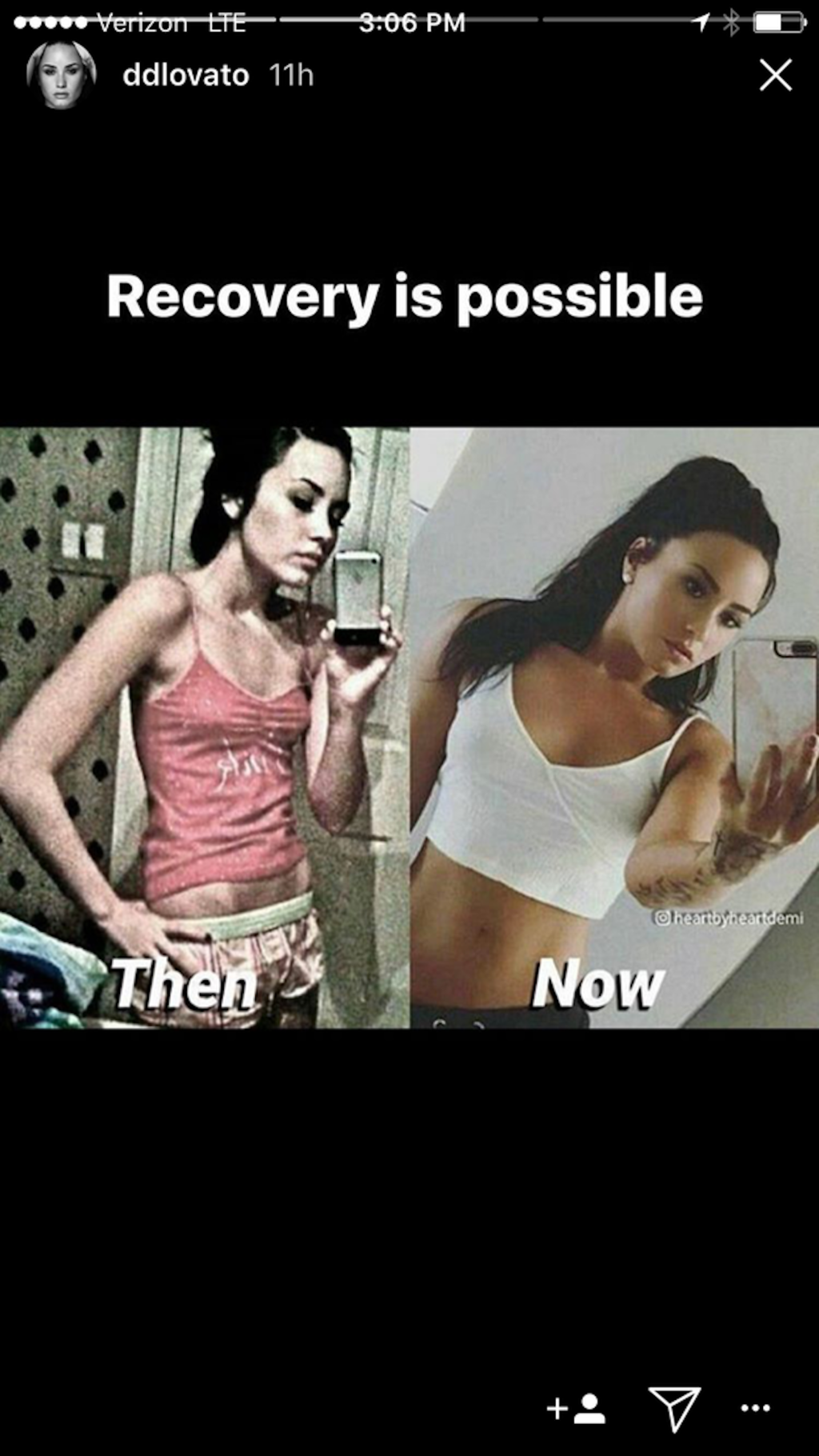
And a new photo Lovato posted to her Instagram Stories on Wednesday (October 18) shows just how far she’s come. The “Body Say” singer shared two snaps of herself side by side—one during what looks to be the height of her illness, where she’s noticeably frailer, and a second, more recent one from after her treatment—along with the message, “Recovery is possible.”

“I think [my eating disorder is] something that I’ll probably have to deal with for the rest of my life,” Lovato told Glamour while promoting the documentary. “Others in recovery for eating disorders say that too.” But Lovato’s side-by-side images are a powerful reminder of her strength and willingness to keep fighting. And the stunning visual will hopefully inspire other eating disorder survivors to stay on their own recovery paths.

Lovato’s documentary isn’t the first time she’s discussed her eating disorder and addiction issues. She opened up about being sober in in her November 2016 Glamour cover story issue.

“I feel healthy, I feel happy,” she said. “Back then I felt an emptiness inside of me, and I reached for so many things—a person, a substance, a behavior—to fill that void. And now there’s not a void anymore. The void is filled by me taking care of myself.… Getting sober was difficult. I went into rehab, I came out, and I didn’t stay sober. I still had issues occasionally. Now some days it’s difficult; some days it’s easy. “

Lovato’s proved she can stay the course, though: she celebrated five years of sobriety in March 2017. And this post proves she can access that same strength to fight her eating disorder, too.

Related Stories:

Selena Gomez Gushes Over Demi Lovato’s ‘Bold’ and ‘Real’ Documentary: ‘Love You’

Demi Lovato Addresses Her Sexuality in Her New Documentary


Source link

Categories
Health

You Can't 'Look' Like You Have an Eating Disorder


“You look really good.” That’s what my college advisor said when she learned I needed regular nurse and nutritionist visits because I was recovering from an eating disorder. She clearly had trouble believing I had one. At the very least, she believed my eating disorder must not be that severe because I was a “normal” weight—which I interpreted to mean that maybe, I didn’t need much help after all. Maybe it was dramatic of me to believe I was suffering from a mental illness.

Her comment was irresponsible, because I very much was suffering. I had only reached a healthy weight just before that conversation, and still had body dysmorphia and some disordered eating symptoms. One of them was the belief that since I was at a healthy weight, I didn’t need to stick to a plan when it came to food or see a therapist. Interactions like this reinforced this—erroneous–belief.

I’m not alone. Jenni Schaefer wrote in Life Without Ed that even when she fit the weight criteria for anorexia, a doctor specializing in eating disorders told her she didn’t “look” like she had it. (Whatever that means.) On the flip side, a Twitter troll recently told Lucy Hale that she was anorexic. Hale, also an ED survivor, clarified that she was “healthy and happy.” And anorexia survivor Gina Susanna recently tweeted about a doctor who told her she was “very thin” despite her explaining that she was in recovery. “I went to see my usual GP almost a year into my recovery for bone density meds,” someone replied. “He said ‘you don’t look anorexic.'”

So let’s clear things up: There’s no such thing as looking like you have an eating disorder—or looking like you’re in recovery, for that matter. Disordered eating can affect your looks in many different ways, whether that’s weight loss, weight gain—or, believe it or not, no weight change at all. A recent Instagram post by fitness blogger Carissa Seligman (below) illustrates this: She was heavier when she had her eating disorder than she is now. “The girl with the eating disorder isn’t always the one who looks ‘scary skinny,'” she wrote. “In fact, she may not even be the thinnest in the room. But what you see on the outside doesn’t always translate to what is going on inside.” Mic drop.

Like Seligman, I was not at my lowest weight when I was at my sickest. After a few years, once I wasn’t losing weight as easily from restricting alone, I started purging. At several points when my symptoms veered more in the direction of bulimia, my weight was considered “healthy”—but my behaviors and mind were anything but. Still, it was only when my eating disorder led to weight loss that people seemed to care.

Equating eating disorders with looks can also promote unhealthy ideas about recovery. I was told by multiple people while I was sick and recovering that I should eat more— not for my health, but because “men like curves” or “guys want something to grab on to.” Saying these things just reinforces the objectification that contributes to eating disorders.

After going to two treatment programs, I’ve met a lot of people who have internalized the attitude that the less you weigh, the more severe your eating disorder is. It may sound strange, but in an eating disorder sufferer’s mind, weight loss can feel like a competition. You see people who “look sicker” than you and feel like you’re less deserving of care. Like you don’t even belong there because you’ve just got some sort of eating-disorder-lite.

When I talked to people about this feeling, though, it turned out pretty much everyone had it. Once I got past this imaginary divide, though, I realized people in all different kinds of bodies are experiencing common struggles—and that we could help one another through them.

But in order to reach that point, we need to understand that eating disorders come in every shape and size.


Source link