In a world short on joy, humor can be a unifier and a survival tool. In that spirit, we bring you our Comedy Issue, a month-long celebration of funny (and fearless) women and the enduring power of a good laugh.
I’ve spent a lot of time at borders, in the space between two countries or two places. Recently, as I stood in the Pakistani consulate, applying for a visa to visit my father’s family, a man stared quizzically at me. “Where’s your husband?” he demanded. I explained that I wasn’t married; I am a woman, alone. “You’re 28? You should be married,” he responded with the same judgment as my aunties’ at family barbecues; then he consulted his supervisors about what to do with me. On another day I might have corrected him, explaining how I don’t need to be with someone to be a full human; or how, because I am queer, my spouse wouldn’t necessarily be a man anyway. But because I needed a visa, I held my tongue.
Interactions like this are common: people demanding to know what man claims me. I get it from strangers who slide into my DMs to family members who ask whether I’m ready to get married. A few weeks ago, my uncle called to tell me about an engineer in Pakistan I should marry. When I declined, my uncle asked if I had ever used a neti pot; he had recently used one and it changed his life. The call ended with him saying, “OK, just take some time to think about the marriage? And think about using a neti pot.”
[embedded content]
Asghar’s web series, *Brown Girls,* now in development for HBO.
The surreality of these exchanges and their extreme casualness makes them hilarious. As a screenwriter I pepper them into my scripts because they’re part of the fabric of my life. I’m not a sitcom writer; I prefer dark comedy, diving into microaggressions and cultural misunderstandings. I’m also a poet, whereby I explore the bleaker undertones of these moments: what it’s like to have my queerness negated, to have my religion questioned in queer spaces, to always have to explain myself, and to not be honest about both my religion and sexuality. It is the feeling of being forever stuck at the border, of never knowing why your identity might spark some trouble: because I’m Muslim? American? queer? brown? a woman?
Once, when I was traveling from Jordan to Syria at night, a border control agent took my passport, locked it in a drawer, and said he would consider giving me a visa in the morning. Passportless, I played cards with my friends all night as we slept in shifts. Another time I was detained at the Israeli border and put into an isolated room for four hours as border agents questioned me about the nature of my visit. While these interactions are tense and riddled with fear, they also contain a strange beauty: In in-between spaces, things cease to have definition; you don’t belong to one country or another. It’s a strange and poetic land of possibility where I get to define myself on my own terms.
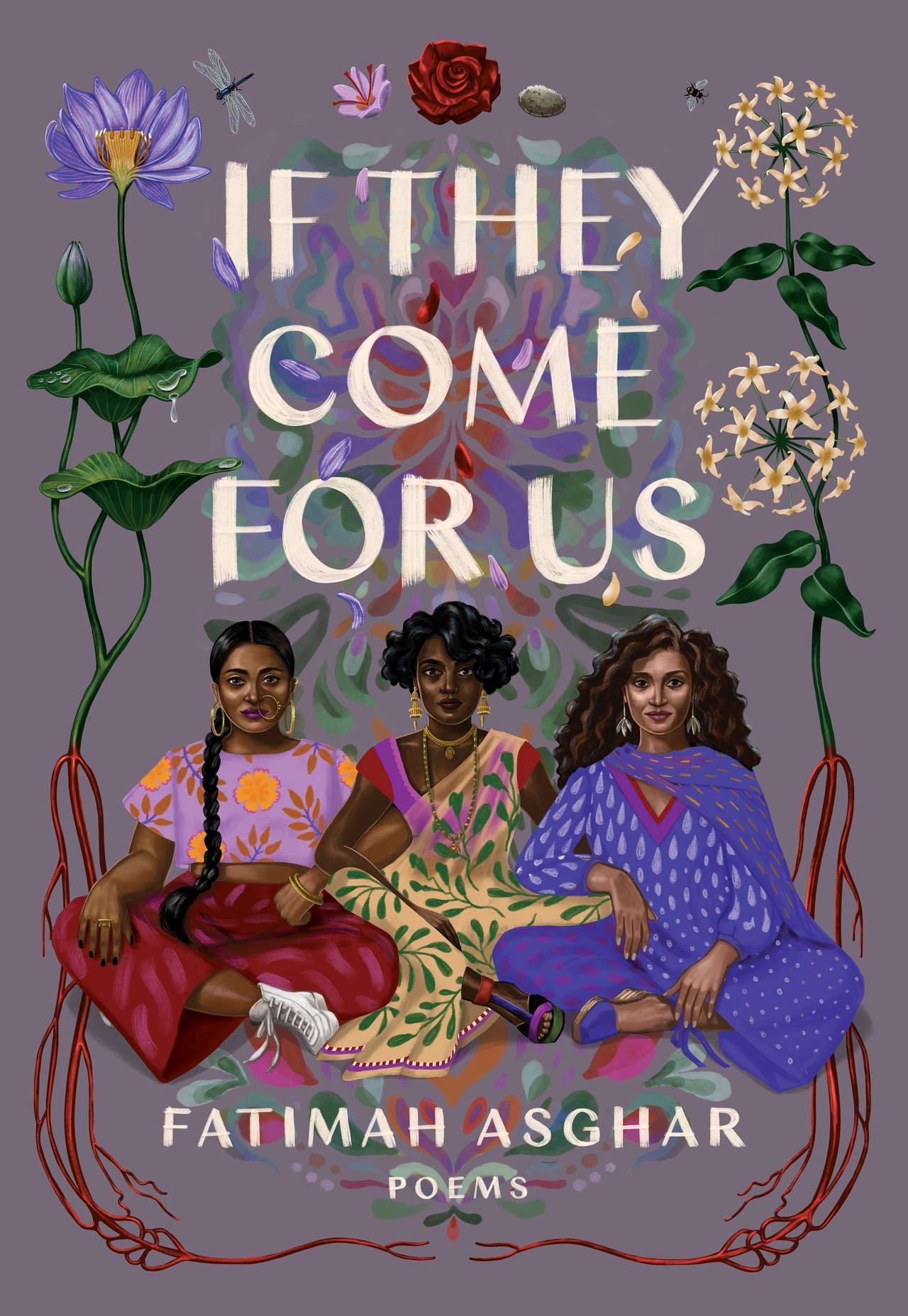
Courtesy of Random House
I’ve found my chosen family in queer communities of color and with other queer Muslims. What I long for most are spaces where I don’t have to explain myself, in which my identities are not contradictory, places where I get to be my full self. Where I—not a man or husband—decide who I am.
Fatimah Asghar, 28, is the creator of the Web series Brown Girls, now in development for HBO. Her book of poems,If They Come for Us, is out August 7th.
In a world short on joy, humor can be a unifier and a survival tool. In that spirit, we bring you our Comedy Issue, a month-long celebration of funny (and fearless) women and the enduring power of a good laugh.
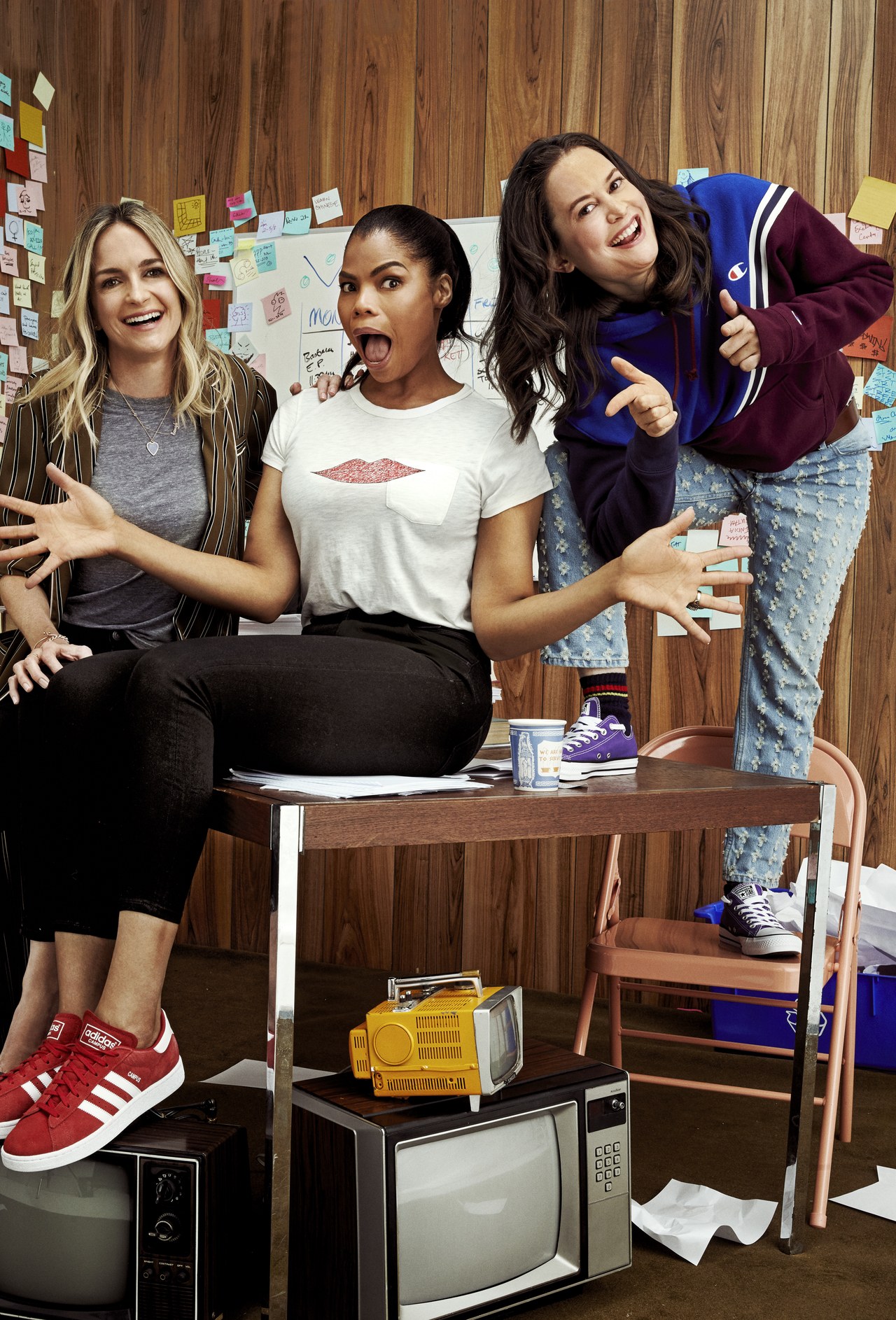
Much has been made of the political tenor dominating the land of late-night talk shows these days. And for good reason: In addition to cracking jokes, hosts are now expected to take a hard stance on the day’s divisive headlines. Unfortunately, with a few notable exceptions, the talent fronting late-night is still white, still male. (Among the top late-night shows we looked at, rarely are more than 30 percent of the writers women; only about 11 percent are people of color.) This means every whistle-blowing monologue or feminist sketch that makes it to air is more than just comedy—it’s a shot across the bow from the underrepresented. To find out what it’s really like in the late-night trenches, Glamour gathered top female writers from six shows to talk about how they check the guys, the highs and lows of being comedy’s secret weapons, and why, if we want our girls to be funny, we have to get to them early.
GLAMOUR: Let’s get right to it. Regarding diversity in the writers room, how are today’s shows doing?
JASMINE PIERCE, staff writer, The Tonight Show Starring Jimmy Fallon: I mean, we’ve made a ton of progress, even in the last year or so, regarding diverse rooms and diverse shows. But there is still a long way to go.
KAT RADLEY, staff writer, The Daily Show With Trevor Noah: I would say it’s still, what, 20 to 25 percent for women in the room? Does anyone have a 50-50 writers room?
PIA GLENN, staff writer, The Opposition With Jordan Klepper: [Raises hand.] Boom! Yes. We’re the newest of the bunch, so there might be a correlation. But when we go one tier above…to the decision makers? We are right back at largely white men.
MELINDA TAUB, head writer, Full Frontal With Samantha Bee: Tina Fey said something about how some shows view women like cappuccino makers, like, “We have one. What would we do with another?” And while that’s still an issue—not just with women but also with other marginalized groups—I think shows are realizing that even if you don’t want to [equalize rooms] out of the goodness of your heart, it makes your show better.
ARIEL DUMAS, writer and digital content producer, The Late Show With Stephen Colbert: We just hired our fourth female writer, which is really exciting. But what’s more exciting, for me, is that people aren’t saying “women in comedy” so much anymore. I never think about being a woman in comedy. I’m just in comedy.
JASMINE: Yeah, I’m not a comedienne. I’m just…a comedian.
ARIEL: I mean, do we sit around wanting to know what it’s like to be a man in comedy?
PHOTO: Danielle Levitt
From left: Molly McNearney, Pia Glenn, and Melinda Taub
KAT: Um, I definitely feel like I know…. [All laugh.] While there is work to be done, everyone thinks that means actively going out and finding more women to write for you. Which is one way to do it, sure, but it’s also systemic, because fewer women are trying to be comedians. You have to start with the five-year-olds. Tell them they’re funny. Encourage them to express their comedy. Because it’s not occurring to so many until they’re 25 or 30 that they can do comedy.
MOLLY McNEARNEY, co–head writer, Jimmy Kimmel Live!: Most of the application packets that are coming into any show are still white men. And it’s our job to reach out [to women]. We have to get into different communities, to people who might not think they can do our job because they never saw someone that looked like them doing it. Twitter has helped a lot.
JASMINE: Yes! It’s a great tool for encouraging young writers. I used to write for Reductress, and now I make an intentional effort to support their new, good writers. I always tweet a writer’s stuff and then message her and tell her, “You are so good. Keep going!” We have to be active about it. Otherwise it’s so scary.
GLAMOUR: Do you have to actively navigate being the gender minority?
KAT: It’s really just about working together. For us, it’s never been like: The men write the man stuff and the women write the woman stuff. Everyone can and does do everything.
JASMINE: It’s the same for us.
ARIEL: Us too. If I want to pitch a thing about IUDs, a super-female womany-woman story, I don’t feel like I am the one that has to write it. The guys can write that too.
KAT: But we do have to be conscious of checking in. I noticed the other day in the rehearsal script someone had written “congressman.” I texted our head writer, “We need to change it to ‘member of congress’ or ‘congress people.’” He changed it immediately.
ARIEL: I think that’s what’s really helped by having women in the room. Our writers are all so feminist and antiracist, but everyone has the ability to say something if they need to.
MELINDA: You have to be as honest as you can with your staff. I think that helps me, and helps all of us, to find the most dangerous, true version of what we want to say, even if it means texting Sam in the middle of the night—which, for her, is like 9:00 P.M.—when you’re having feelings.
PIA: In our room I think there is a real validity to everyone’s lived experience being different. I don’t ever blame anyone for things they might not know or have not been exposed to. It’s what you do once you’re made aware that matters more. I think about the sexual assault stories that came up and how we talk about it in the room—there’s a visceral anger that comes up when the women speak about it. And the guys know to shut up and take it in.
PHOTO: Danielle Levitt
From left: Kat Radley, Jasmine Pierce, and Ariel Dumas
GLAMOUR: How can writing for a host give agency to your perspective?
MELINDA: It’s so different when it’s women-dominated from the top. I didn’t really realize how hard I was fighting to write in other people’s voices until I got to Sam and I was like, Oh, I can just be me.
PIA: Jordan absolutely amplifies my voice in terms of point of view, because I am such an advocate for black female representation, and in the comedy world [makes sad trumpet noise]. So, much of the time, even as filtered through this extremely white man, I can take credit for our angle on Trump’s America or dog whistles about racism. It might not sound like my voice coming out of his mouth, but it definitely is.
MOLLY: I have a unique situation in that the host of my show is also my husband, so he’s uniquely qualified to amplify my voice as a comedian and writer. Like when our son went through his heart condition—his open-heart surgeries—Jimmy allowed me to tell a story that I never could have. I was feeling those same things but didn’t have the strength to go on national television and talk about it. I would have made Jimmy’s crying look like nothing.
KAT: Trevor always asks questions, like with the Harvey and Me Too stuff. He’d ask if the approach was right, if we wanted to lead the discussion.
ARIEL: Same with Stephen. He is so attuned to the hypocrisy women experience. Like how the Trump administration is pushing “abstinence education” by teaching women sex-refusal techniques. Stephen lost his mind and just let me riff around Trump’s 19 accusers and how he was helping them learn sex-refusal techniques with a real hands-on approach.
KAT: Ha! It’s like, we already know the sex-refusal techniques.
JASMINE: We’ve all tried them.
KAT: We invented them.
GLAMOUR: Was there a time when you had to say to a male writer, “No way. That won’t fly”?
MOLLY: I remember when Hillary was coming on a year ago, people were still making pantsuit jokes. I was like, “What the fuck are you doing? You’re minimizing this woman to her clothes?” We’d never talk about a man’s outfit. Everyone heard me and they did cut it, but there is learning to be had. These men don’t know, ya know? So it’s our responsibility to teach them. In the same way, I would hope that we’d all be open to learning about things that might offend straight white guys! [All laugh.]
MELINDA: Funny, I…don’t care about that?
PIA: I am totally fine offending them.
Seth Plattner is a freelance writer and editor in New York City.
In a world short on joy, humor can be a unifier and a survival tool. In that spirit, we bring you our Comedy Issue, a month-long celebration of funny (and fearless) women and the enduring power of a good laugh.
Until the age of 17, I was a hyper-Driven student: 4.1 GPA, high SAT scores, and way too many extracurriculars. I had a plan to go into the Marine Corps, like my father, and become a veterinarian, which I’d been diligently working toward as long as I could remember. Anyone who knew me could see: I was going places.
But by 19 I hadn’t laughed for two years, and my free time read like a DARE program’s worst-case scenario. I was drinking myself into blackouts every night, regularly dropping acid or taking Molly (often alone), smoking up to eight joints a day, and refusing to go to college. I was depressed and dragging myself through a hopeless existence with drugs and alcohol to pass the time.
That shift from ambitious student to desperate escape artist happened after I lost my little sister to suicide during my senior year of high school. My family will never know why she made that decision, and it certainly left us with a plethora of mindfucks to sort through.
[embedded content]
To deal, we mainly cohabited in denial. Though we have a family history of both addiction and depression, mental health was not something we talked about. (Years later, when I first went on Lexapro at 26, my parents handed me a bag of vitamin B3 and said, “Depression goes away with old age.” Oh. OK.) My point: I had the odds stacked against me and zero coping skills.
But I needed a sense of purpose, bad, and I went looking for it on Comedy Central. I was high (as usual), and Margaret Cho came on my TV. For the next 30 minutes, I forgot my sister was dead. I forgot that my family was fucked up. I forgot who I was, how sad I was, and how painfully hopeless life felt. For that half hour, I laughed and escaped in a way that felt a million times better than any high I’d been chasing. It changed everything.
And so I decided I wanted to do that. I pursued stand-up with the same tenacity I’d previously tackled academics: performing and watching several open mics a night; inhaling special after special, from Whitney Cummings to Rodney Dangerfield; scouring Comedy Central and Netflix archives for more. I dug into obscure routines posted on YouTube and spent hours writing jokes, rewriting jokes, and rewriting them some more. As I dived headlong into comedy, one thing became clear: Many of the people around me were depressed and struggling too. The stories of my fellow comedians blew me away. Some had cancer; some were orphans—some were orphans who had cancer! We each had a sob story, and we were trying to turn our tears into other people’s laughter. Because nothing felt as good as those laughs from the darkness. That was hope. That was love.
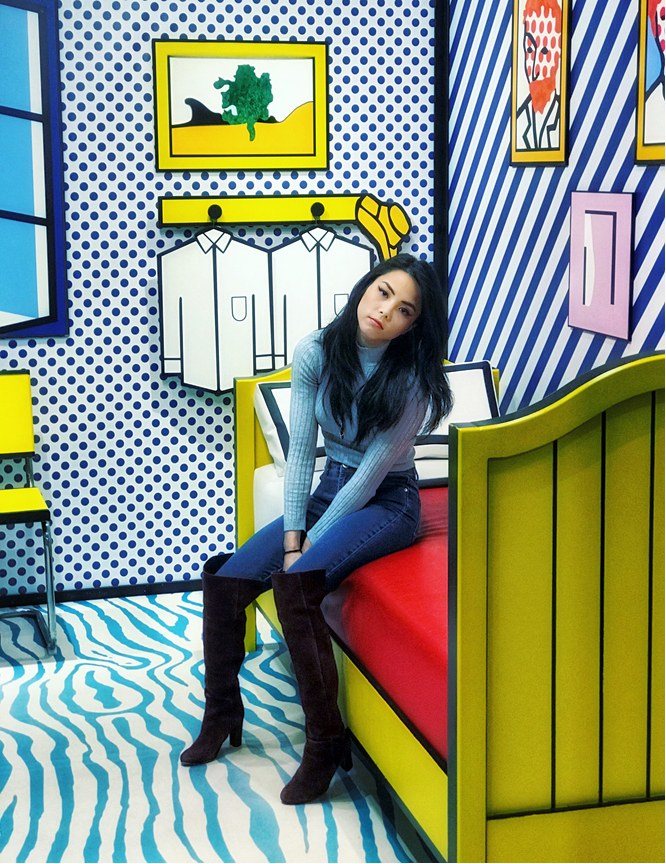
Photo by Cat Calico
Some might say it was also a drug. Sure, I may have replaced one high with another, but this one makes the pain in my life seem manageable. To write punch lines about your darkest moments means you have to find what’s funny about them. You have to find a new perspective, a unique angle; you have to take an honest look at the worst seconds you’ve ever seen. Writing jokes about my sister’s suicide (yeah, I go there) forced me to have a new relationship to it. It made me laugh about it, something I never thought I could do, and look at it head-on and explore it with an open, curious mind. Whereas I once cringed whenever someone casually said, “Ugh, I wanna kill myself,” I was now trying to make others comfortable enough to laugh at that exact pain.
Instead of running away from my sister’s death, comedy asked me to walk slowly, to look around and take notes. It asked me to work through what I was going through and find—not necessarily a bright side—but a side that, when looked at in the right light, could make you shrug and laugh. And I did.
Onstage I’ve joked openly about my depression, losing my sister, and the aftermath of our shattered family. I’ve relayed the story of when I told my best friend that my sister had died and he blurted out: “Oh no! Is she OK?!” Well, no. She wasn’t. Nine years of exploring that loss in front of an audience has finally made me OK with it.
[embedded content]
Comedy also let me internalize my struggle with depression as a part of my identity in a positive way: I’m no longer a victim. I no longer see my life as a tragedy. Labels like “clinical depression” or “suicidal” no longer scare me. They are simply part of my story. All of this makes me who I am, which I finally understand is someone worthy. The hard stuff? I now have the emotional endurance to poke fun at it, to look it right in the face.
More important, I’m able to tilt my head to see it in just the right light—and laugh.
Anna Akana is a comedian, author, and executive producer and star of the YouTube Red series Youth & Consequences.
Kanye was, obviously, gathered up for his reductive remarks, first by TMZ Newsroom staffer Van Lathan, who told the rapper “I think what you’re doing right now is actually the absence of thought.”
It didn’t take long for Twitter to jump on board, highlighting the sheer absurdity of Kanye’s words in hilarious ways (let’s be real—Black Twitter can find a way to bring humor to almost any situation—I’m sure we’ll tweet through the apocalypse). Late Tuesday night the hashtag #IfSlaveryWasAChoice took over our Twitter feeds, and let’s just say, it’s the laugh we all needed. Behold:
West has since tried to clarify his statement by comparing himself to both Harriet Tubman and Nat Turner. We’ll just let you ponder that one.
Completely canceling Mr. West this week has been a tough pill to swallow, but it’s comforting to know that we can always count on Twitter to lessen the blow of our faves’ sorely disappointing us.
It’s unfortunate that the man who once took to national television to declare that “George Bush doesn’t like Black people” after Hurricane Katrina in 2006 is now blaming that same community for 400 years of oppression, and journalist and academic Marc Lamont Hill said it best when he joined the discussion last night: There has NEVER been a moment in history when Black people didn’t resist slavery.
Frankie Shaw’s new Showtime comedy SMILF about a twenty-something single mother is raw, gritty, and real because—guess what—she’s been through it all. For Shaw, the memory of getting pregnant at 24 with her then-boyfriend Mark Webber is fresh. The two were in Philadelphia shooting his directorial debut film, Explicit Ills, in which she had a role. “I took a pregnancy test, and I remember walking around being like, ‘What am I going to do?’ ” says Shaw, who had only just begun to pursue an acting career. “I got on a train to Boston to see my aunts in Southie. One of my aunts said, ‘Frankie, you have the love, but babies need stability. You need to get a regular job and move back home.’”
Shaw, refusing to give up on her dream, did the opposite: “I decided to keep the baby and move to L.A. by myself when I was 11 weeks pregnant.” She left Webber (“It wasn’t working for various reasons”) and found a roommate from a rental listing. “I show up, and I was like, ‘Hey, I’m pregnant!’ She definitely wasn’t expecting her roommate to be pregnant. I ended up not staying there for long.” And was Shaw ready to be a mother? “No,” she says. “But I knew that if I just kept going, I would be able to make a life for me and my son.”
She got to work, hustling to land anything to keep her and Isaac afloat. “It’s not like I could couch-hop with a baby,” she says. “You can’t be this rambling artist in your twenties if you have a child. I had to be more focused.” Shaw juggled auditions with assistant work and SAT and AP test tutoring gigs for extra cash. “Isaac came with me to everything I did those first few years,” she says. “I remember even bringing him to yoga.” Luckily her mother (who had raised Shaw on her own) came out to L.A. to help with child care. Shaw also tried to keep some semblance of a young life: She dated a little. “I remember right before one guy kissed me good night, he was like, ‘I just want you to know, I’m cool with the kid thing.’ I was like, ‘Uh, thanks?’” To her, Isaac wasn’t something to be cool with: “It was like, ‘Oh, you would be lucky to be in Isaac’s life.’ ”
PHOTO: Danielle Levitt
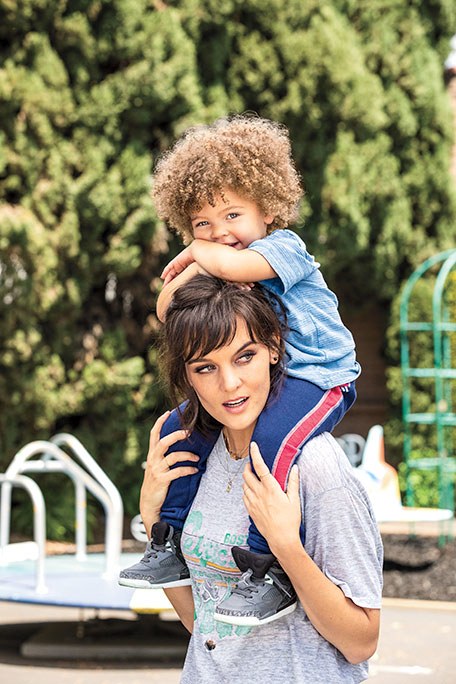
Shaw, with her onscreen son, on Showtime’s SMILF
Eventually she landed a role in ABC’s series Mixology in 2013, which—despite being canceled after one season—earned her enough cash to direct a few shorts she had written on the side. “That is when things started to change,” she says. Writing and directing gave her a way out of endless auditions, and a chance to use writing skills she’d honed as an English student at Barnard. “I thought that if I wrote a pilot, I could get staffed [in a writers’ room] and have a regular job.”
So Shaw camped out in coffee shops with Isaac, writing a show about a young mom—“nonpretty and real to my life.” She called it SMILF (“single mother I’d like to…”—you get it) and spent $3,000 of her own money to make it. Shaw submitted a scene to the 2015 Sundance Film Festival on a whim and won the Short Film Jury Award: U.S. Fiction. Then Showtime snapped up the idea and started developing it with her as a TV show.
On the advice of Jill Soloway, Shaw fought to direct. “We met at a barbecue—we were both single moms with kids named Isaac,” she says. “Jill, who is like a mentor to me, said, ‘Do not let them take directing from you.’” Part of Shaw’s vision includes hiring other female directors, exclusively, to help helm season one.
SMILF, she says, is “really about a young woman figuring out how to make her life work while she has a kid. And even if she didn’t have a kid, she would be faced with many of the same issues.” Issues relating to ambition and sexuality that every twenty-something faces—all while seeing your body transform before your eyes or navigating the complexities of coparenting with an ex.
And the show is a family affair for Shaw. In addition to costar Rosie O’Donnell and guest star Connie Britton, Isaac’s father plays a sober priest in the show. (Of their relationship now, she says: “We’re coparenting; there’s always been love there.”) And her husband, Zach Strauss, is a writer for the series—the two met in 2013 and married in 2016. Isaac, 9, shows up now and again too, as Britton’s son, and he couldn’t be prouder of his mom. “He likes to tease Zach about the fact that I’m his boss,” says Shaw.
Her hope is that SMILF can accurately capture what it’s like to be a single mom. “You’re responsible for this young life,” she says. “Every thought—where they are, how they’re doing, their well-being—is about them. It’s a constant.” Offscreen, she hopes her story will set an example for her son, her own constant. “I want him to know: Do what you love. Just do what you love. I hope that message will get ingrained in him.”
Tiffany Haddish is having a great run lately: Girls Trip, brilliantly hosting SNL, gearing up for a national standup tour, publishing a memoir. But it hasn’t been a totally smooth journey to get to where she is now. In her new book, The Last Black Unicorn, she opens up about obstacles she faced in a chapter about sexual harassment in the comedy world. It’s a timely excerpt, given the dominant cultural conversation around sexual misconduct, harassment, and assault in the entertainment industry that’s taken down a few former power players recently. However, it must be noted that this is a conversation that’s disproportionally stemmed from the experiences of white women, even though black women, like Anita Hill and #MeToo founder Tarana Burke, have often—and thanklessly—been at the forefront of the movement.
Haddish’s new memoir details her experience trying to make it in the male-dominated world of comedy. Unsurprisingly, there was a hell of a lot of harassment that went on.
“I can’t tell you how many promoters tried to tell me that to get on stage, I had to get on my back,” Haddish wrote, according to People. Her reply? Always “Hell no!”
In a conversation with People about her memoir—and about being a woman in the comedy world—Haddish revealed, “It seemed like everybody wanted to get in my panties. It was constant defending and battling. These men will try you every single time.”
More troubling? Things still haven’t gotten much better. “It’s like hazing,” she added. “Once they figure out you’re strong and you don’t roll like that, then they start treating you like a colleague.”
It’s just yet another example of the sexism and harassment that women face across all industries. Here’s to hoping that dudes in comedy realize sooner rather than later that all of their colleagues—yes, female colleagues are colleagues too!—deserve to be treated with respect and decency. And hazing is never OK.