Categories
Health

It Chapter Two Review: How Jessica Chastain Made Sure a Key Scene From the Book Was Included


When It hit theaters in 2017, a new generation of fans—ones who hadn’t read the Stephen King novel or seen the 1990 miniseries—may have expected a simple horror movie about a kid-murdering clown. Instead, they got an unsettling look at the intense pain and fear that develops from childhood trauma via the Losers’ Club, a group of kids (Bill, Richie, Ben, Mike, Eddie, Stanley, and Beverly) who face their personal demons head on in the form of “It,” a creature that shape-shifts itself into its opponents’ worst nightmares.

The sequel It Chapter Two, now in theaters, picks up 27 years later. The Losers’ Club may have defeated Pennywise two decades ago, but they’re still dealing with the effects. Bill (James McAvoy), a successful-ish author, is haunted by guilt over his brother’s death. Ben (Jay Ryan) has transformed into a hot architect still pining over his childhood crush. Though Richie (Bill Hader) turned his wise-cracking personality into a stand-up career, he’s without love, family, or friends who aren’t employees. Mike (Isaiah Mustafa) gave up his dreams to stay in Derry and obsess over Pennywise. Eddie (James Ransone) remains a hypochondriac, but he’s replaced his overbearing, emotionally abusive mother with an overbearing, emotionally abusive wife. Only Stanley (Andy Bean), now a wealthy accountant with a happy marriage, seems to be centered…that is, until Mike calls with the news that Pennywise is back.

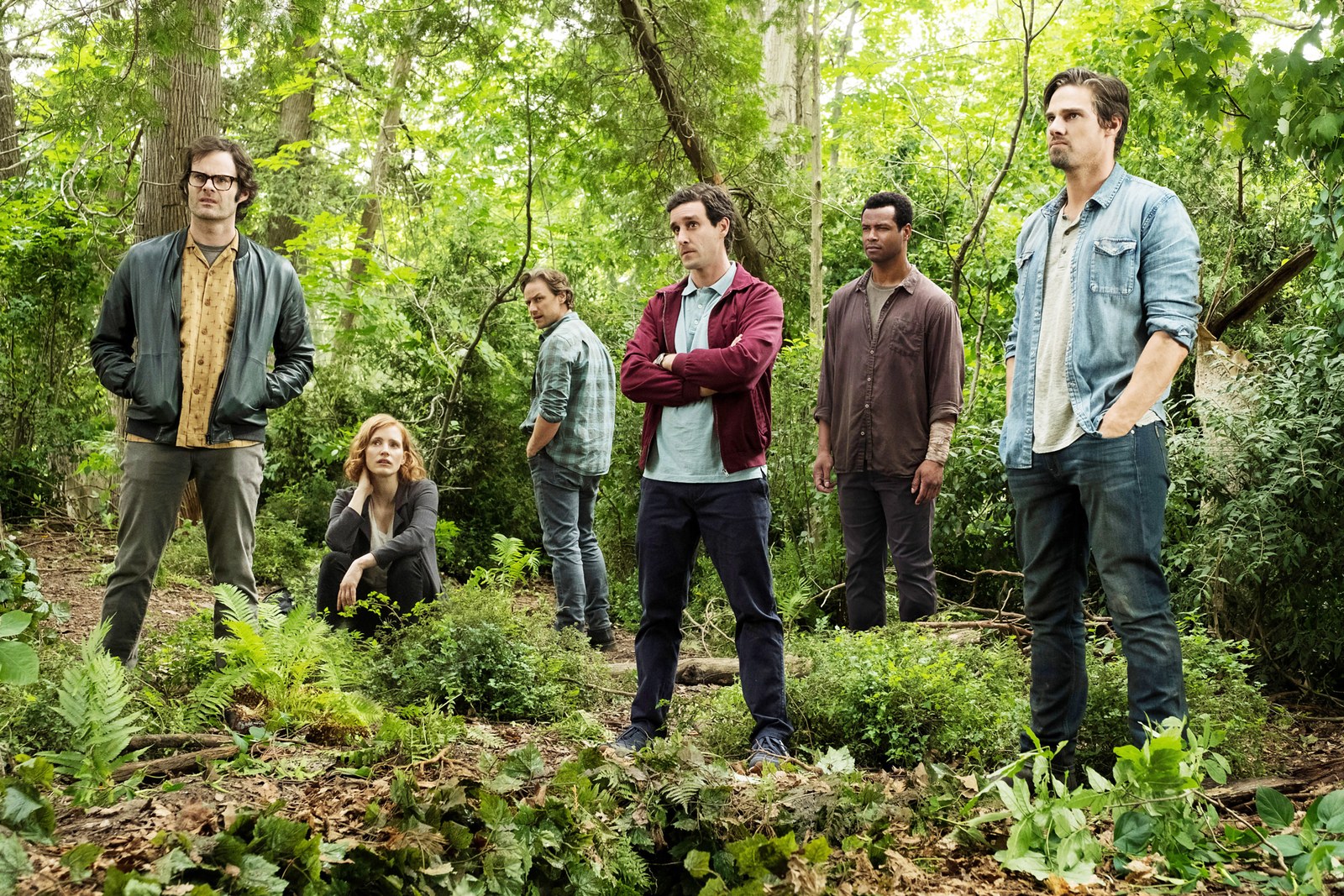
Bill Hader (Richie), Jessica Chastain (Beverly), James McAvoy (Bill), James Ransone (Eddie), Isaiah Mustafa (Mike), Jay Ryan (Ben) in It Chapter TwoBrooke Palmer / © Warner Bros. / courtesy Everett Collection

And then there’s Beverly, the only female member of the Losers’ Club. She was abused by her father growing up; now, she’s in an abusive marriage. When Mike calls about Pennywise’s return, though, something switches. Beverly packs a bag, ready to book the first flight to Maine. Her husband catches her in the act, accuses her of cheating, and physically assaults her. It’s clear this isn’t the first attack—but this time Beverly fights back. On her way out the door, as her husband nurses his wounds and shouts after her, she pointedly leaves her wedding ring on the front porch.

For Jessica Chastain, who plays adult Beverly, this scene was important to get right. It’s the first time we’re re-introduced to Beverly, and Chastain had to convey what might have happened to the character in the 27-year gap since we’ve last seen her.

“I had to think about Beverly’s journey, in terms of the pattern that she kept repeating,” she tells me about preparing for It Chapter Two. “In terms of what she thought love was supposed to be—that it was something that was supposed to be conflicted and difficult and painful and abusive in some sense. She didn’t really understand what love truly could be. That’s where I started with this character. Twenty-seven years of repeating the same pattern.”


Source link

Categories
Health

Watch Jessica Chastain Perfectly Illustrate Why Hollywood Needs Better Roles for Women


Jessica Chastain knows there’s a problem for women in Hollywood. Well, besides the sexual harassment. And the pay disparities. And the inane red carpet questions. OK—Jessica Chastain knows there are a lot of problems for women in Hollywood.

But this week on The Tonight Show Starring Jimmy Fallon, she wanted to talk about one in particular: underwritten female roles. Like the distraught wife of the hero who saves the day. Or the distraught girlfriend of the man who would and does risk everything. To illustrate just what actresses are dealing with in terms of a lack of depth of the characters they’re asked to play, Chastain asked Fallon to help her read some scenes, with the late-night host taking the female parts while Chastain read for the men. The result was obviously hilarious—and very telling.

Fallon didn’t have to stretch himself much to read for the leading lady in a rom-com, when a meet-cute had the guy waxing poetic about the unpredictable nature of the universe and the possibility of fate, while his female companion…just giggled mostly. He was completely silent during Chastain’s action hero monologue (though, on set he’d probably need to do at least some pained expressions when the hero said, “You wait here”). He did get an actual chunk of very technical dialogue for an imaginary sci-fi script, with his heroine outlining her perfectly calculated plan to save the ship, but it’s still not exactly a shining beacon of feminism at work—her plan was quickly and simply dismissed by her male counterpart.

At the end of the sketch, Chastain and Fallon made sure to plug Time’s Up, the initiative to fight gender inequality that’s been rampant in the world of Hollywood and beyond, making it clear that just poking fun at problems in the industry isn’t going to cut it; there need to be clear indicators that positive changes are truly coming.

Watch the sketch for yourself, below:

[embedded content]


Source link

Categories
Health

Jessica Chastain Responds to Backlash From That All-White 'L.A. Times' Magazine Cover


Over the past couple of days, the Los Angeles Times’ Envelope magazine, which is dedicated to awards season, has managed to piss off a lot of people on Twitter, thanks to its December 21 cover, which featured a group of all white (and overwhelmingly blond) actresses. The women pictured in the group portrait—Margot Robbie, Diane Kruger, Saoirse Ronan, Annette Bening, Kate Winslet and Jessica Chastain—were placed above the coverline, “A Shift in Focus: Actresses Call for a Change in the Way Many Stories Are Told.”

The article was a roundtable-style story discussing working in Hollywood and how women are treated onscreen. The topic was definitely timely, but again, there were no women of color featured—at all. And a conversation about diversity and equality in storytelling can’t happen if you’re not representing all the stakeholders.

The backlash on social media pointing out the lack of women of color on the cover and in the feature was quick—and heavy. “It’s time white actresses speak up when their WOC colleagues are ignored,” one user wrote.

“I don’t understand how after all the conversations on #OscarSoWhite, White Feminism, etc a cover like this could be approved with this headline,” another tweeted. “And did any of these A-List actresses demand that actresses of color and other diverse demos be included?”

Jessica Chastain, who stars in Molly’s Game, responded to her participation in a series of tweets on Saturday evening and clarified in some responses that the cover focused on celebrating female-lead films. She admitted that it wasn’t a good look for the Los Angeles Times to omit women of color on its cover and called for more inclusive storytelling. She then prompted her followers to tell her their favorite WOC female-lead 2017 films. In her next tweet, she incredulously told her followers that she can’t even name five 2017 films that featured WOC leads. And it’s not for a loss of memory: That’s how much women of color and their experiences continue to be underrepresented, ignored, and erased in the film industry.

After she responded, many on Twitter continued to call her out for knowingly being part of a cover shoot that featured only white women and blatantly contradicts the values she promotes—and suggested that she could have used her platform to change the conversation instead. (The other actresses on the cover still haven’t commented at the time of publish.)

It’s incredibly important in the male-dominated industry of Hollywood to advocate for telling women’s stories. But they need to be inclusive of all women—not just white women—and this cover illustrates the absolutely urgent need for that.

Related Stories:
Twitter Is Not Pleased About This Magazine Cover—With Good Reason
Jessica Chastain Calls Out the ‘Disturbing’ Portrayal of Women in Cannes Movies
Jessica Chastain Reveals Exactly How She Negotiates for Equal Pay


Source link