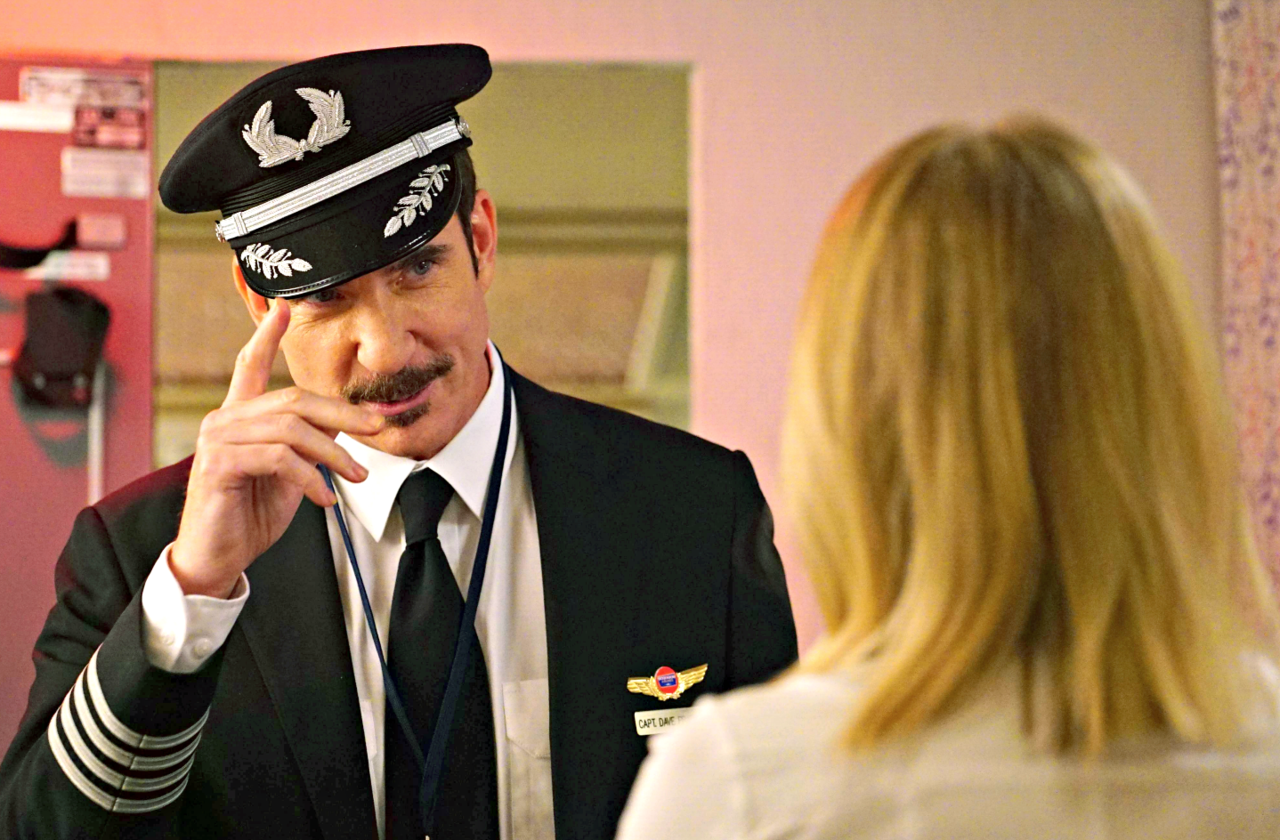
If you’ve seen the trailers for the new FOX comedy LA to Vegas and summed it up as a bro-comedy about Dylan McDermott as an airline pilot, you’re not entirely wrong. The series does boast Will Ferrell and Adam McKay as executive producers. But if you thought, eh, I could do without it—well, think again. The airline workplace comedy—from L.A. to Vegas, of course, and back again—is actually told through the lens of its female lead, Kim Matula. The 29-year-old UnREAL alum, who plays Ronnie, is the real discovery of the show. With all due respect to McDermott and fellow co-stars Ed Weeks, Peter Stormare, and Nathan Lee Graham (all superb), this is Matula’s show.
“I just think there’s a lot more to it,” Matula tells us. “When you actually sit down and watch it, you’ll realize that all these characters are utilized so beautifully, and it’s way more than a bro culture. I know there are obviously elements of that, and they are hilarious to me, even as a woman. But it is taken a lot from a woman’s point of view.”
[embedded content]
Although Matula’s character works with a bunch of men, she’s the one who keeps the ship running. “If it weren’t for Ronnie, it would all fall apart,” she explains. “Everyone comes to her for what to do. Reese Witherspoon gave that [Glamour Women of the Year] speech in 2015 where she talked about how in every movie, the women are like, ‘What do we do now?’ and how she said, ‘What woman do you know that would be like, What do we do?!’ Women have plans A, B, and C worked out. I’m so happy to play a character that doesn’t have to say, ‘What do we do now?’ Ronnie says, ‘Here’s what we do now.’”
For years, Matula fought against those same stereotypes in her career. “I typically got called in to play the dumb blonde, and then the casting director would say, ‘Oh, that’s not who you are at all.’ So to be playing someone who isn’t afraid to vocalize her opinions, go after what she wants, and be very honest about what she wants is very refreshing. Ronnie keeps every single man on this plane in line.”
That character trait also extends to the passengers on the often rowdy flight. On a future episode of the series, Matula says there was a line where Ronnie talks about a passenger grazing her butt, and that’s the only action she’s had in the last six months. “I said, ‘Can we please add a line where Ronnie says she doesn’t stand for that and that it’s not OK? I want to address that.’ She’s not a woman who would just let that kind of stuff slide,” she says. “We were able to do that and throw in a line where she was like, ‘That gets hot coffee thrown on your junk.’ That meant a lot to me that that was acknowledged.”
PHOTO: Kevin Estrada/FOX
It’s one of the many reasons why Matula is thrilled to have this career opportunity—and why the show deserves your attention. “My favorite thing is that I’m not playing a character who has to be sexy or stupid,” Matula says. “She’s a woman who is so in control of her environment. Sure, sometimes her personal life is a mess, but there are aspects of everyone’s life where they feel really strong, and then other aspects where you don’t why you’re making certain decisions. That is what I love so much about her.”
Matula is also hoping that should the show take off (no pun intended), the role will make another small dent in shifting Hollywood’s outdated view of what it means to be a modern woman. “Women aren’t just sex symbols,” she explains. “We are so much more. It’s a tide that’s turning right now, but it’s sad that that’s still something that’s being fought for.” Matula then offers up this example: “I’ve had very long hair my whole life, and I finally chopped it off. Immediately, I started booking strong female roles. The really upsetting part is that [there’s been this narrative for so long] that you can’t have beauty and brains; that you have to pick one. No, women can be both. We can feel sexual and vulnerable at the same time, but we also know exactly what we’re doing and can get the job done. Just because women look a certain way doesn’t mean they belong in a box. Too often we’ve been told we’re one or the other, and that’s just not the case. It’s never been the case. But we’ve been marginalized and put in these boxes of what we’re expected to be. We’re in this incredible movement of women just breaking down these barriers and saying ‘Screw that. I’m exactly who I want to be, and I feel so powerful and so confident in that, and I’m going to go get the world.’ It’s so empowering.”