The Nobel Prize–winning novelist Toni Morrison died last night (August 5) at the age of 88, according to CNN. The cause of death has not been announced.
Morrison, the author of such acclaimed books as Beloved (for which she won both the Pulitzer Prize and the American Book Award in 1988), The Bluest Eye, Sula, and Song of Solomon, has been a celebrated force in American literature for decades, helping to document the black experience in the United States from her unique perspective.
In 1993 she became the first black woman to be awarded a Nobel Prize in literature and, in 2012 then President Barack Obama honored her with the Presidential Medal of Freedom. Describing her impact ahead of her Nobel acceptance, the Swedish Academy, which bestows the prize, said her work “gives life to an essential aspect of American reality.”
The author was born in 1931 in Lorain, Ohio, where she was raised and lived until she enrolled at Howard University in 1949. Morrison went on to earn a master’s degree from Cornell University and became a professor before becoming a book editor at Random House, where she helped to elevate a number of black writers like Chinua Achebe and Angela Davis.
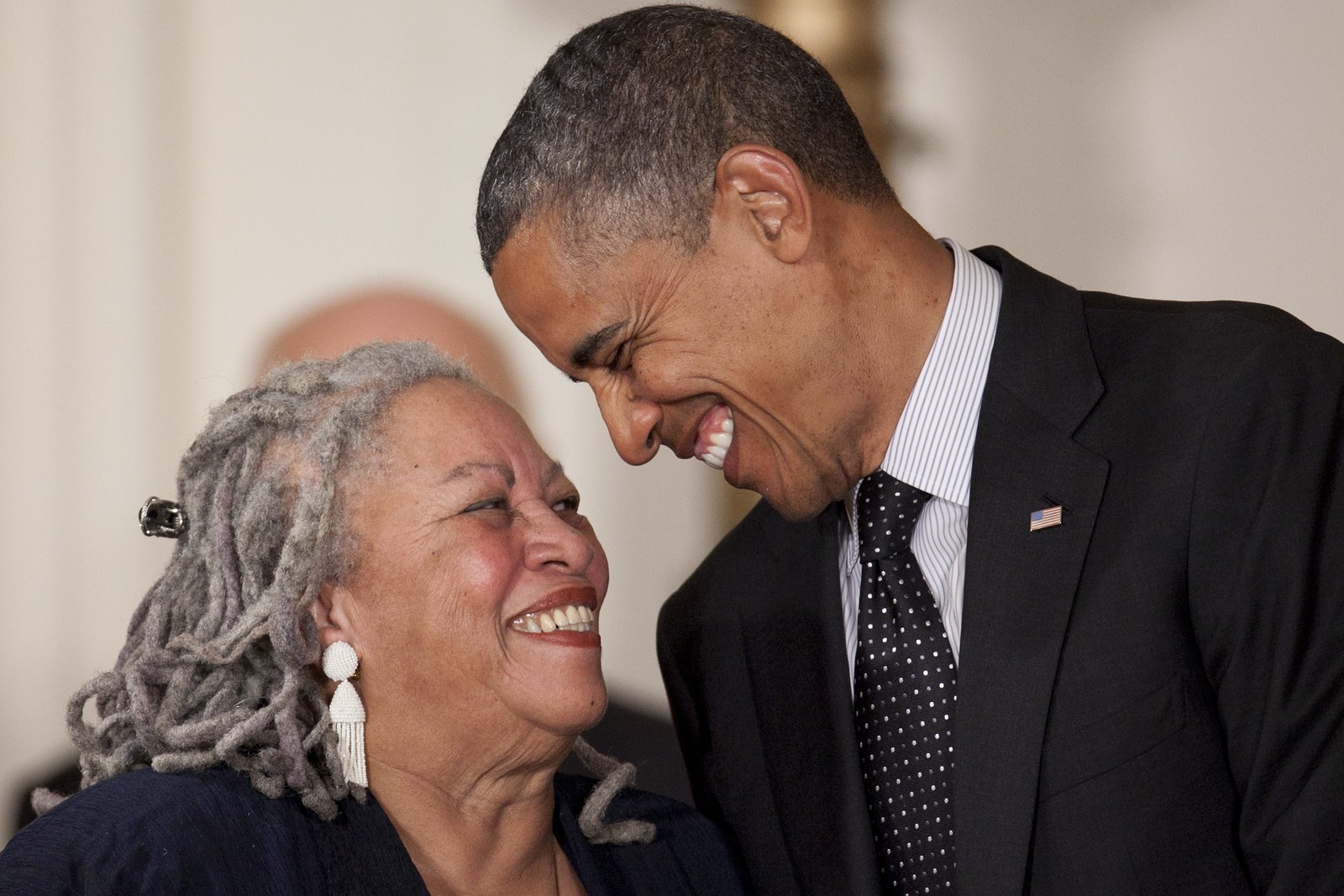
Toni Morrison with President Barack Obama before being awarded the Presidential Medal of Freedom in 2012.Andrew Harrer/Getty Images
She didn’t publish her first novel, The Bluest Eye, until the age of 39 in 1970. Oprah Winfrey selected both Song of Solomon and The Bluest Eye for her famous book club during her talk-show era, which helped bring Morrison’s work to a new generation of readers. Winfrey also coproduced a film adaptation of Beloved. “It’s impossible to actually imagine the American literary landscape without a Toni Morrison,” Winfrey said of Morrison in 2018. “She is our conscience, she is our seer, she is our truth-teller.”
In 2007, Glamour named Morrison one of its Women of the Year. In talking about her work, she said, “There were a lot of books by black writers that were very political and confrontational and all about guys. What about young black girls who had never been the center of anybody’s literary intention?
“No one had written them yet,” she said, “so I wrote them.”
Morrison also wrote a number of children’s books, and her last novel, God Help the Child, was published in 2015.
“We die. That may be the meaning of life. But we do language. That may be the measure of our lives,” Morrison said in her Nobel acceptance speech.
Nobel Watch 2019 continued on The Big Bang Theory this week as Amy and Sheldon were forced to do damage control following their outburst (well, Amy’s) in front of laureates, peers, and imposters (Pemberton and Campbell, for those keeping track). It’s no Game of Thrones cliffhanger, but it’ll do, especially since we’re down to the last five episodes. Shamy has to win the Nobel eventually, right?
If it’s going to happen, President Siebert and Ms. Davis (Oscar winner Regina King, praise be) tell Sheldon and Amy that they’re going to have to run a near flawless campaign the rest of the way. That means keeping their mouth shut and not throwing accusations at anyone. “The science world is a small community. People talk,” Siebert says. The only thing to do is lay low and cancel all further speaking engagements.
But then, as if Sheldon and Amy don’t already know this (I mean, why do you think Amy had her outburst?), Ms. Davis says that “winning the Nobel is very important to us, and not just the university. Dr. Fowler, you would only be the fourth woman to win a Nobel prize in physics.” I have trouble believing that Amy isn’t aware of this, but apparently it’s news to her. Ms. Davis piles on the pressure by also pointing out that a win for Amy would be inspirational to an entire generation of young women. Hey, Ms. Davis and President Siebert, here’s a news flash: Why don’t you tell that to the fellow Nobel winners voting for them? Amy already knows she has to be on her best behavior, so what’s this added pressure going to do?
Well, for the sake of the next 18 minutes of the episode, it drives the story forward. Amy is so overwhelmed by potentially being only the fourth woman to win a Nobel in physics that she goes through an entire stick of antiperspirant in an hour. Leonard—clearly worried about the amount of sweat that Amy is producing—suggests that she and Sheldon (who’s also panicking) self-soothe in a sensory deprivation tank.
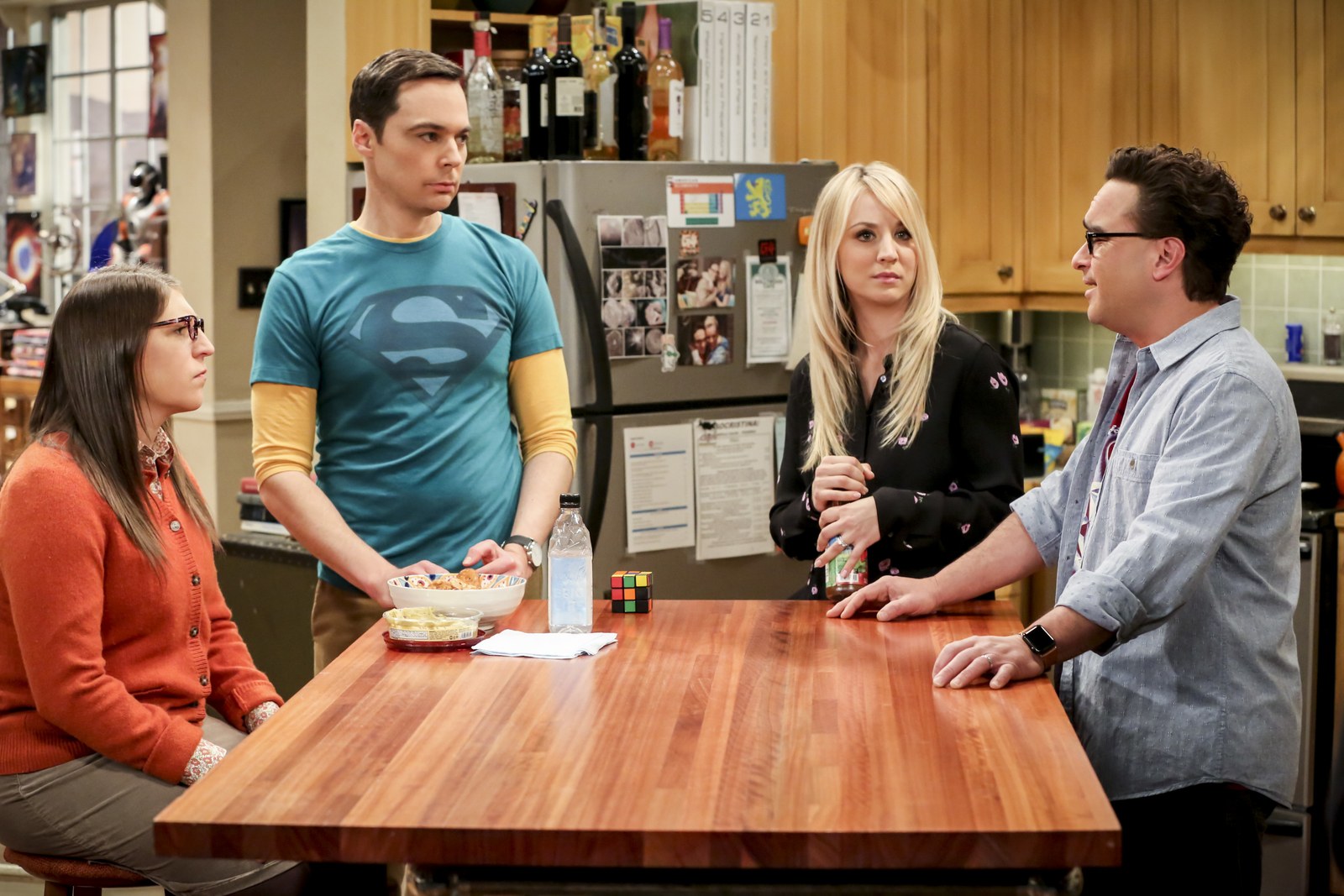
Michael Yarish/Warner Bros. Entertainment
Shamy decides that self-care can’t be that bad and end up soaking in a tank that looks more like the egg-shaped vessel that Lady Gaga rode in on at the 2011 Grammys than anything else. I’m claustrophobic just looking at it.
Anyway, while Amy’s inside the vessel she sees an image of Ms. Davis talking to her and reiterating the dismal stats of female Nobel winners. That’s followed by images of young women blaming Amy for ruining their chances to win a Nobel. “I was going to be a scientist, but since you lost, I’m just going to have to give makeup tutorials on YouTube!” says one young woman. “Thanks for letting us down,” says another. “You’re such a disappointment!” adds someone else. Maybe this should be the punishment for all the parents involved in Operation Varsity Blues, but what on earth did Amy do to deserve this?
When the hour is up, Sheldon is calm as can be while Amy panics and calls herself a failure.
That afternoon, Amy’s more anxious than ever. She tells Sheldon it was bad enough when she was letting the two of them down; now if she doesn’t win the Nobel she’ll be letting all women down. Sheldon doesn’t know what to do except to Google “what to do when someone’s freaking out.” It says a walk can be calming, so Sheldon does that. It’s rude, but funny.
When he gets back, Amy is still upset so Sheldon asks Leonard and Penny for some advice. Leonard says the only thing he can do is just be there for Amy, but Sheldon doesn’t seem to know what that means. Penny points out that Amy’s always taking care of him, so perhaps that’s why it’s so hard with the roles being reversed. I don’t agree. Even though Sheldon will always think about Sheldon, he’s grown a lot in this area over the last few years. He knows what to do. The whole thing is kind of been there, done that.
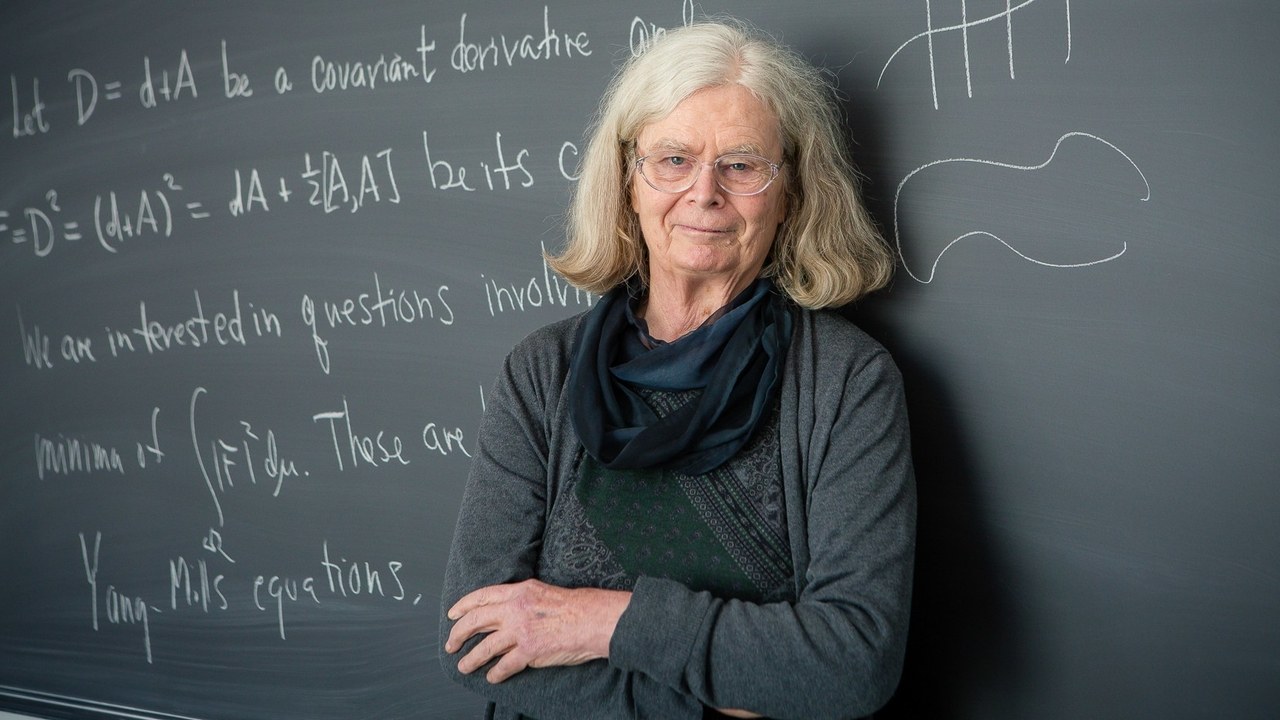
For the first time ever, the most prestigious mathematics prize in the world was awarded to a woman. Karen Uhlenbeck, 76, an emeritus professor at the University of Texas at Austin and current visitor at the Institute for Advanced Study, was honored with the Abel Prize for mathematics. Known as the Nobel Prize for math, the Abel comes with a cash prize of about $700,000. (NBD: It’s up to the King of Norway to give it.) The award was established in 2003, and all previous winners have been men.
Dr. Uhlenbeck was recognized for, “the fundamental impact of her work on analysis, geometry and mathematical physics.” according to the New York Times. When Dr. Uhlenbeck found out she’d won, she was leaving her Unitarian Universalist Church when she received a text message from a colleague telling her to look out for a call from Norway. “I pressed the button and called [the Abel committee] back and they told me I’d won—and I had to sit down,” Dr. Uhlenbeck told Glamour.
When Dr. Uhlenbeck began teaching mathematics in the 1960s, she had to fight tooth and nail to even procure a professorship. “It was really only at the period of time that I got my degree, that the jobs in academia—and probably elsewhere—were slowly being opened up to women,” she says. “I was right on the edge of that. There were certainly universities that would not consider hiring me. There were universities that said, ‘Oh well why don’t you go teach at a woman’s college.’ I was told things like that, but I guess I have a rebellious streak so I persevered.”
Since there weren’t a huge number of women who had come before her to look up to in STEM, Dr. Uhlenbeck maid attention to women who’d pioneered other fields for inspiration. Famed chef Julia Child was a particular role model. “She was 6’2, a big woman with this immense presence and there was this great incident that I distinctly remember where she dropped a turkey on her television show. And she picked it up, brought it to the back, and came out and said, ‘Luckily we had another one!’ She had presence and wasn’t perfect. The feeling was if Julia Child could do it, maybe you could too,” says Dr. Uhlenbeck.
Dr. Uhlenbeck has emulated Child’ style of being an approachable and human role model to the many women she’s mentored over the years—as well as those who have simply come in her wake. “Since winning the award, I’ve gotten innumerable emails from women telling me how important my being there is, and it’s a great feeling,” says Dr. Uhlenbeck. But this isn’t a coincidence. Dr. Uhlenbeck made it her mission to encourage more women to enter the field. “I have to say that it struck me at some point that if I were to look around and see no women coming up through mathematics behind me, how would I feel? I would feel terrible. Now, I see these lively, enthusiastic, brilliant, wacky young women coming up and doing mathematics. When I was young I couldn’t afford to be wacky. I had to be careful. I couldn’t dye my hair purple and get up and teach calculus class ,but I love seeing it; it’s wonderful to see.”
With a new efforts to get girls into STEM from a young age, Dr. Uhlenbeck is hopeful that we’ll see even more women work in mathematics. “Certainly the problem [of girls not pursuing STEM] starts very young,” she says.” I don’t know how many young girls are still being told that they don’t have to bother taking advanced placement math because they’re a girl and they don’t need it—but I know it still happens. However, all I can say is that it’s getting better [from this push.]”
After last week‘s weird episode, The Big Bang Theory is back on track with the return of “Fun with Flags,” no mention of Leonard donating his sperm, and Sheldon powerfully sticking up for Amy (you tell ’em, Dr. Cooper). The episode also introduces Sean Astin and Kal Penn as physicists who could make or break Shamy’s Nobel prize hopes, though the Muppet’s Statler and Waldorf, two cranky obnoxious dudes, could have easily played the same parts.
Anyway, “The Confirmation Polarization” starts out on a high note when Amy receives an encouraging email from Dr. Pemberton (Astin) and Dr. Campbell (Penn) during a taping of “Fun with Flags.” They seem to confirm Sheldon and Amy’s theory about Super-Asymmetry, which sends Sheldon and Amy into a state of delirium. (They’re so excited that Penny, Leonard, and the rest of the gang hear them from across the hall and assume they must be having sex.)
Sheldon and Amy tell Professor Siebert their news, and he suggests they could be looking at a Nobel-winning achievement. If they do win, they’ll be the 39th and 40th Nobel Laureate winners from Cal Tech. Surprisingly Sheldon doesn’t ask for a statue of himself immortalized on the campus, but you know that’s coming. Later, Shamy meets with Drs. Pemberton and Campbell, who reveal this happened so fast because their experiment accidentally confirmed Super-Asymmetry. Sheldon and Amy are not amused. Pemberton and Campbell don’t even understand Super-Asymmetry, but they don’t care. They’re just excited to be in Los Angeles and have tickets to a taping of Ellen. “Look at the four of us,” Dr. Pemberton says, “changing the face of physics!”
Um, “the four” of you? Yep, apparently Pemberton and Cambell need to attach themselves to Sheldon and Amy’s theory if there’s any hope to win a Nobel.
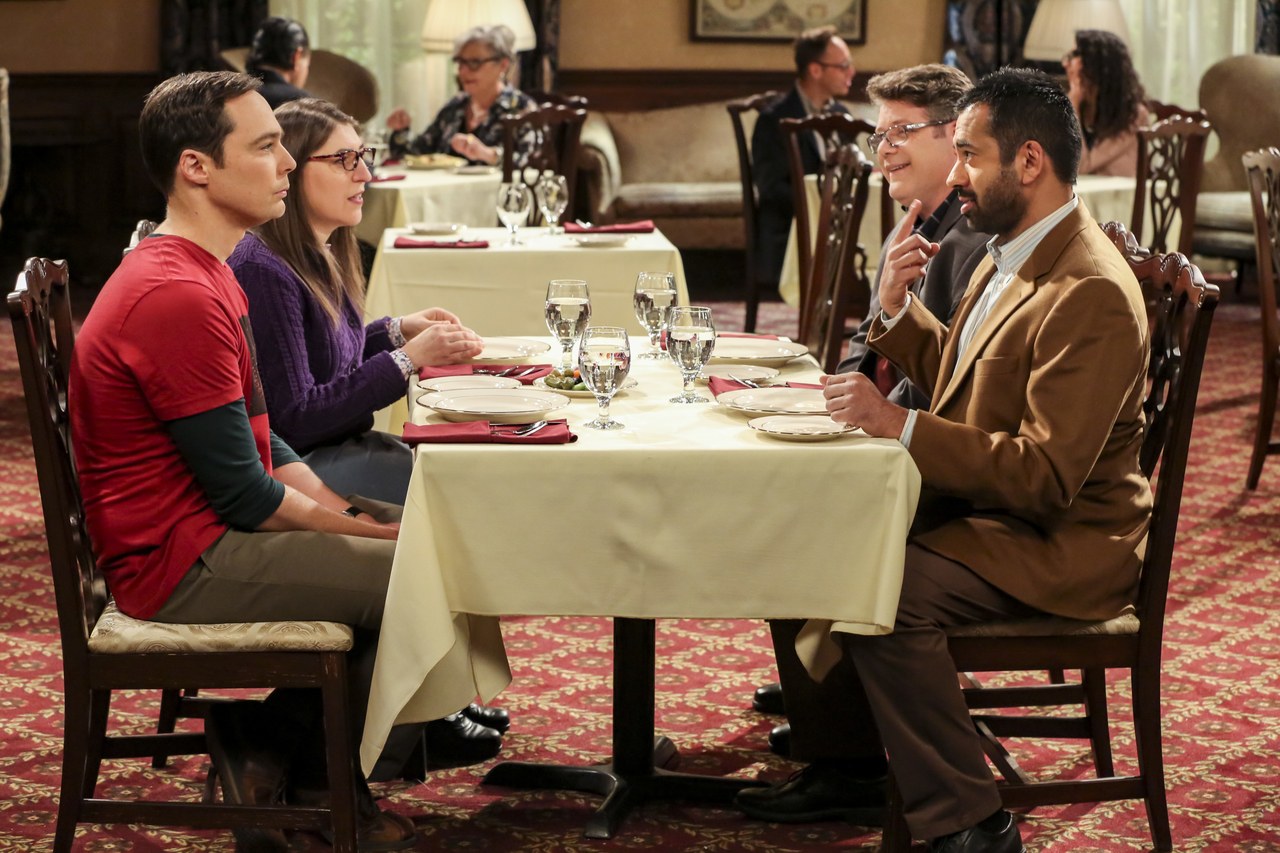
PHOTO: Michael Yarish/Warner Bros. Entertainment
Later, Sheldon meets up with Leonard, Howard, and Raj to complain. Raj says he shouldn’t worry because, “Super-Asymmetry is your paper. Everyone knows you discovered it first.” Raj is right, Leonard says, but the Nobel committee has often favored scientists like Pemberton and Campbell. Either way, the whole thing is infuriating. (Not as infuriating, of course, as Leonard thinking of donating his sperm to Penny’s ex-boyfriend.)
Sheldon then tells Pemberton and Cambell not to steal his idea; they can come up with their own. Campbell’s all, “Yeah, that’s not gonna happen.” Pemberton snidely says, “Wouldn’t that be something though!” Forget what I said about these two acting like Statler and Waldorf. They don’t belong in a nice theater balcony. They deserve to live in Oscar the Grouch’s trash can.
They eventually say they understand where Sheldon is coming from, but they’re going to be part of this submission anyway. Sheldon’s not thrilled—but if that’s what it takes to win a Nobel, he’s not going to say no. But that’s when Pemberton and Campbell drop another bombshell: Only three of them can be named to the discovery, not four. (Side note: When did this thing turn in to a ride at Disneyland, where there’s only room for a set amount of people in a row? Glad I never had Nobel ambitions.)
Sheldon wants Pemberton or Campbell to leave their name off the discovery, but neither’s willing to budge. They reason that they’re all physicists; since Amy is a neuroscientist, she doesn’t belong. Sheldon storms out, but first he makes Pemberton and Campbell think he’s on their side. Little do they know there’s still 10 minutes left in the episode, and Sheldon’s not going down without a fight.
Sheldon returns home for dinner with Amy and reluctantly tells her that only three people can share a Nobel prize. He explains that Pemberton and Campbell’s university is recommending the two of them and Sheldon, and they want Cal Tech to do the same. If they present a united front, they’ll have a better shot at winning. Amy reacts as if she’s had the wind knocked out of her. “That makes sense,” she says, still in shock.
Sheldon says he won’t leave her off the submission, but Amy says maybe he should. Now Sheldon’s shocked. “This has been your lifelong dream, and maybe you won’t get another chance,” she says. “I don’t want to be the reason you don’t win a Nobel.”
Then, in the blink of an eye, Sheldon turns into Mr. Romance and tells Amy she’s the only reason he even deserves a Nobel. Amy is touched but says if his best shot is to partner up with those idiots (my words, not hers), he should take it. “I just want you to be happy,” she says. Amy, we do not deserve you.
Sheldon makes it seem as if he’s going to move forward with this plan, but there’s one more surprise left. In the next scene he storms into Professor Siebert’s office and demands that Amy’s name be included on the submission. “I will not be part of an award that does not recognize the value of her contributions,” he says. “You either include both of us in the recommendation letter or don’t bother writing one.” More of this Sheldon, please!
PHOTO: Michael Yarish
Surprisingly, Siebert doesn’t stand in Sheldon’s way. Siebert acknowledges that it might cause a fight with the other team, but he also respects Sheldon’s decision. “You and Dr. Fowler have my full support.”
Sheldon’s shocked, but also impressed with himself. I’m impressed with him, too. Amy can fight her own battles, but Sheldon’s looked up to superheroes his entire life—it’s nice to see him kind of turn into one, too.
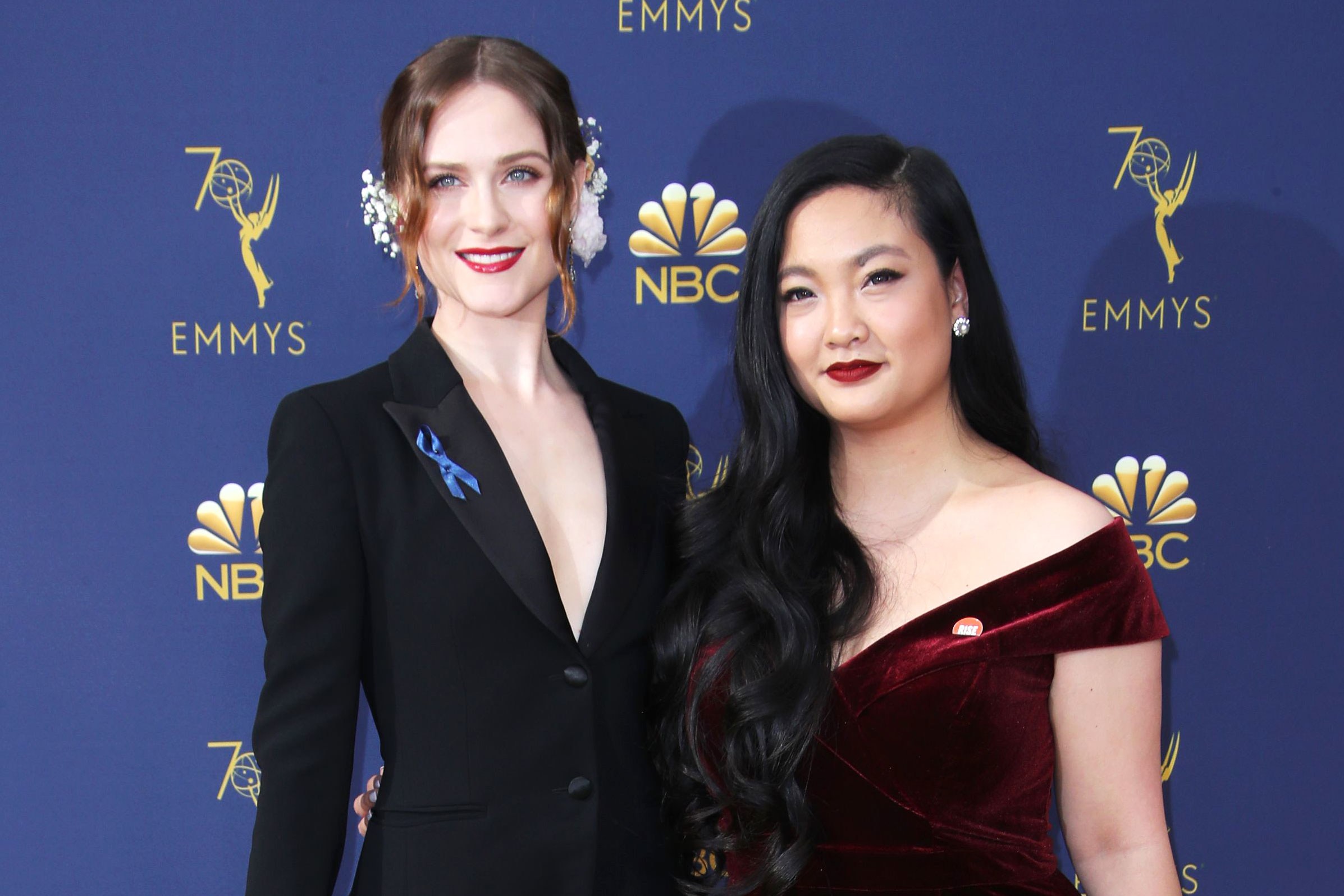
There wasn’t an organized Time’s Up or #MeToo protest at the 2018 Emmy Awards like there was at this year’s Golden Globes, but Evan Rachel Wood still found a way to speak out. While attending the ceremony on Monday night, Wood brought as her plus-one Amanda Nguyen, who was nominated for the Nobel Peace Prize in June for her work on behalf of survivors of sexual assault.
It’s especially notable given that many celebrities brought activists as their plus-ones to other award shows earlier this year, at the very forefront of the Time’s Up movement, but Wood was the only one to do so at the 2018 Emmys.
In an interview with E! News‘s Giuliana Rancic on the red carpet, Wood and Nguyen spoke about their work together; earlier this year, they both testified in front of Congress in support of the Sexual Assault Survivor’s Bill of Rights. “I think we’re at a crucial time in history right now for women, and especially for civil rights. You know, if I have even a little bit of power right now, I want to use it for good,” Wood said.
“I’m also here supporting the ACLU and the fight to reunite immigrant families separated at the border — that’s why I’m wearing the blue ribbon,” she added. “I just feel like it’s important. It’s what I’m called to do. Amanda’s certainly been someone who’s inspired me to do more.”
Nguyen also explained how she and Wood first met. “I gave the speech at the Women’s March and Evan was there. I saw Evan speak, of course, and then we just connected,” she said. “I’m so grateful, again, and it just makes such a difference when we get platforms like this to discuss issues.”
Nguyen, 26, is the founder of Rise, a nonprofit organization that works to expand the rights of assault survivors. In 2016, she helped to draft the Sexual Assault Survivor’s Bill of Rights, which sought to establish a universal standard for care for survivors and subsequently passed unanimously through Congress.