Some people’s fantasies feature rippling muscles, four poster beds, chocolate dripping in unsanitary places. Others fixate on leather, bad boys, the satisfying feeling of doing something a little bit wrong.
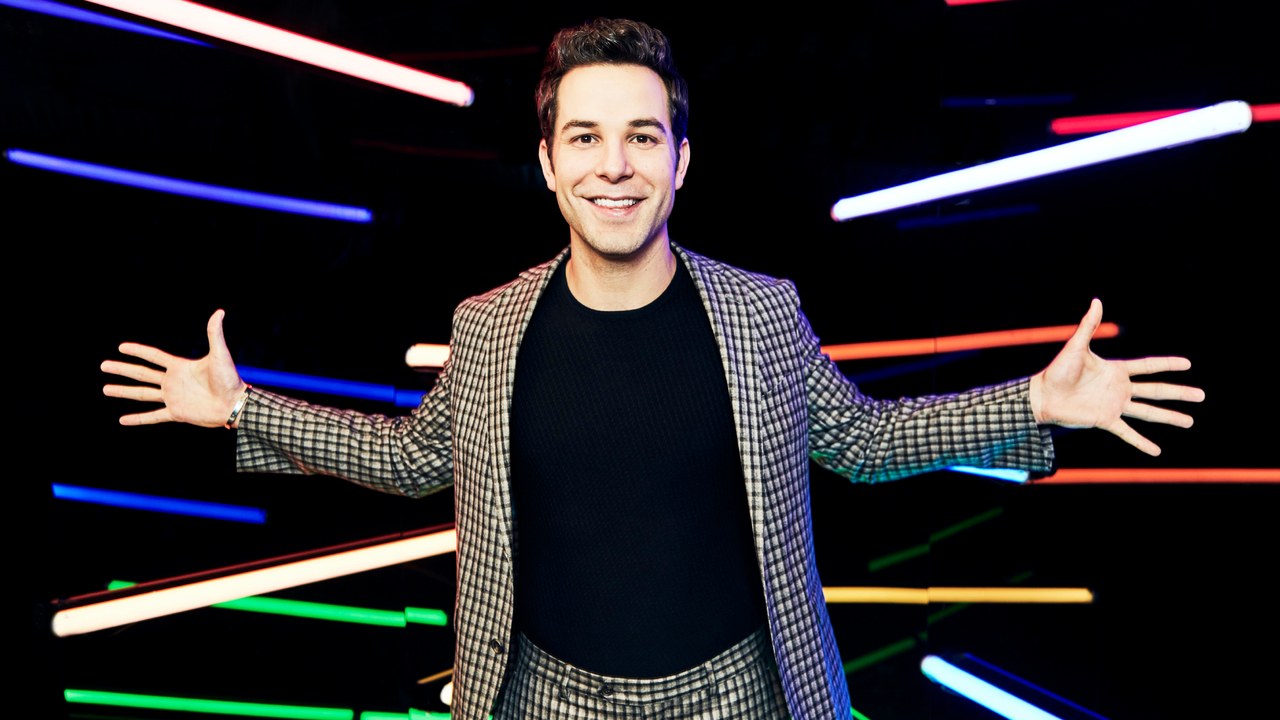
Astin, who starred in the Pitch Perfect movies and Crazy Ex Girlfriend, will once again bring to the screen his specific skill set of looking and sounding as smooth and comforting as a spoonful of peanut butter, straight from the jar. In the new NBC musical TV show Zoey’s Extraordinary Playlist, Zoey (Jane Levy) gains the ability to hear people’s thoughts…expressed through musical numbers. Astin, as Zoey’s best friend, plays the role he’s perfected: He’s not a “nice guy,” that creepy archetype every woman has experienced, a dude who secretly feels like you owe him sex because he half-listens to your problems. He’s more like a “good person guy,” a genuinely nice man who encourages his female colleague to go for the promotion and expresses his innermost thoughts through Jonas Brothers songs.
That’s hot. So we invited Skylar to answer our Inappropriate Questions, Glamour’s column that asks all the cheeky, slightly off-kilter stuff best saved for a second (or better yet, third) date. Read on for his take on who should pay for dates, his extreme glow-up, and the messiest thing he does in bed…
Glamour: You stop by a convenience store on your way to a party. What are you buying to bring?
Skylar Astin: Probably booze, right? Definitely Tequila if they have it, or if not, a 12-rack of beer, probably Dos Equis.
What was the worst thing you’ve ever done on a date?
I forgot my wallet once. I’d made the person come to my side of town, and we’d been making jokes about how I would definitely pay. I knew she would pay, but I was so embarrassed. I had to say, “I’m mortified about this, but is there any chance you’ll stay here for 20 minutes and I’ll just go back and get it?” Thank god I was very close to my house.
What is the most inappropriate thing a fan has ever said to you?
Oh, comments like, “You look better on camera,” or, “You look better in person.” Either of those is like….well, what are you saying about the other thing? Also mistaking me for someone else, that happens a lot. I’ve gotten Joseph Gordon-Levitt, the guy from How I Met Your Mother, Zachary Levi, Dane Cook. But really, I tend to be just fine!
What’s something that everyone seems to love but you dislike?
I never got into the Kardashians. But I really understand why people do! But it never struck me.
What’s the sexiest thing about yourself?
I like to think that I don’t take myself too seriously, and I have a pretty healthy balance of drive and humor. I’m a Libra, through and through.
You believe in astrology?
I do! I do. I don’t live my life by it completely, but I think it’s fascinating. There’s definitely many truths to it. I felt more compatible with certain friendships. Even in some relationships, I’ve felt like, “Oh that’s weird, I’ve dated the most of this kind of sign.” And like, “Oh, my mother and my brother are both this sign.” It’s little stuff like that.
What’s your type?
I’m open to any kind of connection. But generally I don’t really like anyone who has any narcissistic tendencies. Someone who is open, friendly, kind, but also self-assured, without being cocky. Someone who’s got their own thing going on. And someone who I respect and admire. That, generally, is a turn-on for me.
Free to Be…You & Me, a recorded album, children’s book, and later ABC special, celebrates its 44th anniversary this month. The brainchild of actress and producer Marlo Thomas (That Girl), the special focused on individuality, tolerance, and comfort with one’s identity. And, most important for young women coming of age in the 70s and 80s, the lesson that they can achieve anything regardless of gender.
Actress and director Gillian Jacobs (Community, Love) credits Thomas—and Free to Be…You & Me—with inspiring her own career trajectory. Here, she talks with Thomas about the battles the latter fought to bring her vision to television and why its message is worth revisiting today.
I’m one of many kids who grew up on Free to Be…You & Me. I listened to the record, read the book, and even performed “Boy Meets Girl” in one of my first acting classes. My mom wanted me to know I was free to be anything I wanted to be, but she was battling traditional gender stereotypes from both society and the media…Marlo Thomas helped drive that message home.
Not long ago I re-listened to the album. As I reflected and laughed, I also felt a twinge of sadness. For as much progress as we’ve made since 1972, children still face a lot of the same issues today. To be totally honest, I still grapple with a lot of the ideas in the album. We need Free to Be to remind us of our potential and commonality.
PHOTO: Everett Collection
Marlo Thomas in ‘Free to Be…You & Me’
Gillian Jacobs: Free to Be…You & Me was one of the reasons I became an actor. We did sketches from it when I was a kid, I listened to it all the time, and it was an attempt by my mom to make sure I wasn’t limited by any gender norms or stereotypes.
Marlo Thomas: You were lucky to have such an enlightened mother!
Gillian: Sadly I still fell into some of [those gender norms], but the messages of that album really resonated with me and stayed with me my whole life. But first, let’s talk about That Girl. I didn’t realize you produced the series when you were 24.
Marlo: I got a part in a pilot at Universal called Two’s Company, but it didn’t sell, which is no big surprise because most pilots don’t. But the head of the network called to say they still wanted to find a show for me. They sent me a bunch of scripts, but they were all kind of…not very forward-thinking. In every one of them the girl is either the wife of somebody, the daughter of somebody, the secretary of somebody. So I said, “Have you ever considered a show where the girl was the somebody?” And the network head said, “Would anybody watch a show like that?” I brought him a copy of The Feminine Mystique by Betty Friedan, and I said, “You should read this, because this is where it’s going. Women are not going to be their mothers. They want a career. They want to live on their own before they get married.” He wasn’t really sure I was right, but he gambled on it and it was a big success. That was a shock to everybody.
Gillian: I read that there was a debate over the finale episode of That Girl. They wanted it to end with a wedding, and you pushed back on that.
Marlo: Right. By then, I was producing the show, and I felt a wedding would be a real betrayal to all the girls who watched the show to say that the only happy ending is a wedding. And wedding [episodes] do really well as a last show. They begged me to do one, but I wouldn’t do a wedding. The producers wanted a wedding, the network wanted a wedding, advertisers wanted a wedding. I was the only one who didn’t want a wedding.
Gillian: The remarkable thing is that women are still fighting these battles to this day. As much as the culture has shifted, I think that’s still a debate to not have female characters be defined by mens interests in them and to not view marriage as the ultimate goal or a validation of their worth.
Marlo: Well, the good thing about today is that there are more women making decisions. In my day, I was the only woman in the room, so that was harder. And I was happy to have the men that worked with me. But I would often say to them, “A girl wouldn’t say that to her father.” Or, “A girl wouldn’t say that to her boyfriend.” And they would say, “But it’s funny.” And I would say, “But it isn’t true.” In the second year of the series, I got smart [and hired] a female story editor, so then there were two of us. I always said, “One is a pest, two is a team, and three is a coalition. That’s what you need: a coalition.” [Laughs]
[embedded content]
Gillian: I often feel I have to push past my own discomfort at work when I feel like something isn’t right. Did speaking up come easy to you?
Marlo: No, it was always hard—especially if you’re the only woman. You always have to have somebody who is on your team. My idea was I wanted to play a girl like myself who graduated from college, who wanted to be an actress, whose parents wanted her to get married, but she wanted to move to the big city. That was what my life was. I didn’t think I would get married. And my parents weren’t ready to hear all of that. My dad wasn’t so rough on it, but my mother was very reluctant to have me move out on my own. I lived in a sorority house in college and was with a house mother and a lot of girls, and now I was wanting to move into an apartment on my own. My mother was terrified.
Gillian: I moved to New York to go to college, and my mom thought I was going to have a curfew like she had because her mother had made her go to essentially a finishing school. When she found out I’d be living in New York City without a curfew, she almost didn’t want me to go! She would say, “So you can come and go as you want and no one is going to know where you are?!”
Marlo: Oh, I’m sure! It’s hard for them. They’re very worried about us!
Gillian: And I was very good, she had nothing to worry about!
Marlo: Me either! I was always a good kid. That’s the thing about mothers, they’re in your head all the time.
Gillian: Speaking of, there are so many messages from Free to Be…You & Me that have stuck with me, like the re-telling of the story of Atalanta, which in your version does not end in marriage. It’s about a girl taking agency over her own life and making decisions for herself.
[embedded content]
Marlo: She fought for her rights. When we were putting that album together, I said, “If we could re-write our childhoods, what would we like to know? What would we have like to heard?” And my friend Herb Gardner said, “I would have liked to have known that it’s OK for a boy to cry.” And Carol Hall wrote that wonderful song, “It’s All Right to Cry.” I said, “I would have liked to have one fairytale to end where the princess does not marry the prince. And she’s not a blonde!” So we got Betty Miles to re-write Atalanta so Atalanta ran in the race and made the decision herself. And, as you know, Atalanta was a brunette. So many women wrote me to say thank you for not copping out at the end of Atalanta. By the way, not copping out at the end of Atalanta is very much like not copping out at the end of That Girl. My character on That Girl didn’t get married, and Atalanta didn’t get married because that’s not the only happy ending. It was important for me to say that. I mean, I’m married now for 38 years, and I’m crazy about my husband. It is my happy ending, but it isn’t what I needed for a happy ending. It became a happy event that I found a man that I loved and wanted to live with forever. But I don’t think that should be the goal of every girl.
Gillian: I agree.
Marlo: And every story doesn’t have to end that way, because that’s a terrible pressure to put on every girl…that the only way to be happy is to be married. That’s crazy.
Gillian: My mom really wanted me to hear that it was important for me to have something that I’m passionate about and have my own career. She didn’t want me to have the message that she grew up with, which was not only do you get married, but you find a man who is going to take care of you. Because if it doesn’t work out, you have to start over, and a lot of times you were dependent on your husband. So that was a message that I heard strongly in my childhood.
PHOTO: Gillian Jacobs
Gillian Jacobs at a young age.
Marlo: Exactly. I’m glad it meant so much to you. That makes me feel great.
Gillian: That’s why in the last few years, if I have an impulse to do something or a curiosity about something, I’m trying to pursue it rather than dismiss it. So I’m interviewing people, I’m writing essays, I’m starting to direct. I am learning to push past my own feelings of inadequacy. Did you have that same feeling that if you have an interest in something, you’re just going to make it happen?
Marlo: I don’t know the answer to that question. Probably for me, I never really had a career plan, which I probably should have. I’m kind of like a kid where if you wave something shiny in front of them that’s what attracts them. I did an interview show on AOL for five years called Mondays with Marlo, and I interviewed over 200 people from Jennifer Aniston to Suze Orman. I wanted to do something where I could help women figure out their own lives. It was really interesting to learn things I never would have known, whether it was about 401Ks from Suze Orman or something else. It was providing a service, and it really turned me on.
[embedded content]
Gillian: It seems that being of service has been very important to you.
Marlo: It’s more about noticing stuff. I notice things. I think I got that from my parents, especially my father. He noticed people and gaps in things that weren’t working. He built St. Jude Research Hospital because as a child he never went to a doctor, neither did any of his nine siblings. Kids in his neighborhood died from [conditions they shouldn’t have] like appendicitis and influenza, so he wanted to do something that would take care of that for people. [He built a] hospital where nobody paid. I think, in a way, my sister and brother and I all have that. We notice if somebody is hurting. I don’t know if I’m a do-gooder as much as a noticer.
Gillian: Well, I’m going to call you a do-gooder. I admire what I’ve seen you do over the decades. Speaking of which, let’s talk about the Thanks and Giving program that St. Jude does during the holidays.
Marlo: The Thanks and Giving program goes from now until Christmas. My brother and sister and I created this program 15 years ago; by the end of this campaign year, we will have raised one billion dollars in 15 years. The whole idea was to give thanks for the healthy kids in your life and give to those who are not. It costs $2.8 million a day to run St. Jude’s because nobody pays for anything. They don’t pay to travel there. They don’t pay for treatment or medicine. They don’t pay for food or housing. That was my father’s promise in 1962, and we’ve kept that promise all these years.
Ed Note: You can donate to St. Jude by adding on any amount to your final bill at these stores during the holiday season.
On Wednesday, 13-year-old Benje Choucroun made a special appearance at a White House press briefing for his role as a writer for Time for Kids magazine. And, as any good reporter would do, Choucroun came prepared with a few questions, one of which left White House press secretary Sarah Huckabee Sanders nearly in tears.
During the briefing, Sanders smiled, pointed to the back and called on Choucroun to ask his question. The middle schooler, who currently attends Marin Country Day School in California, proudly stood up and explained, “At my school, we recently had a lockdown drill. One thing that affects mine and other student’s mental health is the worry that we or our friends could get shot at school.” He then asked, “Specifically, can you tell me what the administration has done and will do to prevent these senseless strategies.”
Sanders immediately jumped into an answer — as press secretaries tend to do — but this time, her voice shook as she appeared to be holding back tears.
“I think that as a kid and certainly as a parent, there is nothing more terrifying than for a kid to go to school and not feel safe, so I’m sorry that you feel that way,” Sanders replied. “This administration takes it seriously and the school safety commission that the president convened is meeting this week, again, an official meeting, to discuss the best ways forward and how we can do every single thing within our power to protect kids within our schools and to make them feel safe and to make their parents feel good about dropping them off.”
Following the briefing, CNN’s Dana Bash commented that “It looked like it was going to potentially be a light-hearted moment. And he had the toughest question in the room.” MSNBC’s Hallie Jackson called it “an unusual moment from a very articulate young man.”
Since January, there have been at least two dozen school shootings across the nation, which according to CNN equates to at least one school shooting per week so far. But, in the wake of these tragedies, it appears to be the voices of children, not adults, that ring out the loudest. Following the February school shooting in Parkland, Flordia, students affected by the senseless violence have come together to push lawmakers to take action. And their efforts appear to be working.
According to the Sun Sentinal, since the Parkland shooting that claimed the lives of 17 people, “14 states have changed their laws, while six major actions have been undertaken by cities and counties. Meanwhile, 10 companies tweaked their policies related to guns and 19 businesses have cut ties with gun lobbying groups.”
President Donald Trump is expected to visit the survivors of the latest school shooting in Santa Fe, Texas on Thursday. That shooting, which took place on May 18, claimed the lives of 10 people, including both students and teachers. However, on May 4, Trump walked back on his promise to the Parkland students that he will be tougher on the National Rifle Association. Instead, while speaking at an NRA conference, Trump enthusiastically told the crowd, “Your Second Amendment rights are under siege. But they will never, ever be under siege as long as I’m your president.”
I like my mascara to be big, flashy, and easy on the eyes. Those are the three goals, and while it seems like that’s what every new mascara release promises to deliver, very few follow through on that last, crucial stake. Blame my dry eyes, allergies, and the office AC—I blame them all, ruthlessly. But the fact remains that while I love trying new mascaras, by the end of the day I’ve smudged it, I’ve rubbed it, I’ve put eye drops in underneath it, and that leaves just the slightest trace of mascara still hanging around.
Which sucks, especially because my specific problems aside, this summer has been good to us in mascara options. From Dior’s fun and efficient squeezy tube, to Urban Decay’s sex-proof mascara, and L’Oréal’s excellent drugstore stunner, we’ve got choices. Then again, so did Carrie Bradshaw for six seasons and look how that turned out. (Fine, that was regarding men, not mascaras, but as often as she stared at a computer screen too, I bet she also knew this struggle.)
After trying endless reccs from friends and every new launch that caught my eye, I couldn’t help but wonder where was my match? My one loyal mascara I could trust to stay with me on my lashes day in and day out? Was I destined to settle? This, of course, is hyperbole, but to both my elation and dismay (#TeamBerger) I actually did find “the one” that met all my needs. Mr. Big. Or rather, because it’s a Lancôme mascara and the brand is French, Monsieur Big.
Unlike its namesake (who was flaky at best), this Big comes through. With just a few strokes, my lashes become dark, thick, and long enough to graze my browbrone. It doesn’t even leave those annoying smudges behind that other mascaras do, because the best part is, it stays where you want it. I have my morning regimen down to a science, so I can say with some certainty that I apply my mascara at around 7:42 A.M. every day. By the time I call it quits and wash my face around 11 it’s still there, curl perfectly intact. Coming from the brand behind the cult favorite Definicils mascara, I shouldn’t have expected any less.
I almost judged a book by its cover; a product by its silly (yet also entirely brilliant) name. But this is a great mascara.