
Categories
Health

I Walked Down the Aisle At My Wedding With My Life Partner: Grief


My husband and I drive down a highway, David in the driver’s seat, me on the passenger’s side going through the preset radio stations for the second time. A large four-door white truck cuts David off in the middle lane. David speeds up behind him. He tailgates the truck for at least a mile, so close to the truck’s bumper, I can see the truck driver’s brown eyes through his rearview mirror. I tell David to stop, but he pretends not to hear me. He then jerks into the left lane and speeds by the truck, making sure to glare the driver down and flip him off. I tell David to stop once more, to keep his eyes on the road, to stop playing games.

“Why don’t you ever let me play?” he says. “Because people die in car accidents!” I snap.

I don’t expect my voice to get so loud and neither does he. We drive in silence for a while, but I feel the echoes of my words reverberating off of the windows, the door handles. I think about what I’ve said—the stark reality of it—and start to panic. Tears well up in my eyes and I can’t force them back.

“I’m sorry,” David says softly, and reaches his hand to grab mine. I pull away.

It’s been thirteen years since the final days of my family’s vacation in the Azores turned into a nightmare. Thirteen years since a drunk driver took a turn too sharply; since a guardrail sliced my father’s chest in two. Thirteen years since his body was transported to Boston, to a lonely spot where his coffin would go underneath the earth, the grass, the stone.

During the first few years after the accident, I got through the five stages of grief like a rocket—turbulent, explosive, and with flying colors.

I clung to denial with a fervor only the shock of an unexpected loss can create. So many people seemed to disappear—close friends who I saw every day. I made excuses for their absence the same way I pretended my father’s disappearance was only temporary.

I burned with anger. I was angry that my father was dead but I was angrier at my family and friends for constantly telling me things would get easier. Everyone told me the funeral would be the hardest day, but that was far from the truth. I couldn’t stop crying. I cried so much I discovered a whole new meaning to the word “cry,” one that had nothing to do with tears, but deep guttural howls from my insides. I There was nothing that would fill the hole I felt deepening inside of me, though I tried. Food, sleep, alcohol, drugs—all failed. There was only one thing I thought could make me feel better: sex. I went in search of it by cornering ex-boyfriends and making fleeting new ones. The sex always started out well. It was hot; I was hot. I was feeling. But in the moments after orgasm, I’d be overwhelmed with this crushing emptiness and there was nothing I could do but cry and scream and scrunch my body until all the hurt was gone.

Over the next few months, I watched my family crumble around me. My mother clung to her faith as she sank deeper into the recesses of our living room watching Portuguese soap operas while clutching a rosary in between her hands. My younger brothers found their own obsessions—one finding solace video games, and the other escaping into his art. I fixated on success.

I’d read a study which showed a correlation between having an increased chance of success when faced with a parent’s death early on in life. That was my motivation, my bargaining chip. If I could just get one more degree, one more award, or one more publication, I would feel better.

Source link

Categories
Health

How Home Improvement Helped Me Work Through Grief


I am not one of those people who constantly updates her home’s décor. I keep it clean and child-friendly for our seven grandchildren, and cozy, I hope, for everyone who walks through our door. I have never dreamed about gut renovations or even rotated furniture. I have seldom fretted over paint colors. Our downstairs has an open floor plan, and for six years all of the walls were a shade that my friend Jackie once described as “meconium stain.” I didn’t like the color, but I couldn’t seem to find time to do something about it.

Someday, I told myself. Someday I’ll get around to seeing my favorite colors on these walls.

But after my brother’s death, something shifted. I felt so depleted, and I worried that I was losing the sense of optimism that had always kept me afloat, even in the toughest times. I stood in the middle of my dining room, suddenly aware of the warning in those dingy walls. They reflected how I felt, and that was not a good thing.

I glanced down at our dog, Franklin, who was sitting on the floor at my feet, and raised my arms in the air. “What am I waiting for?” On cue, he stood up and turned to face the living room windows, his tail thumping against my calves.

For the first time since my brother’s death, I felt a stirring of something other than sadness. Over the next few weeks, I recognized this flutter as a call to action. What, indeed, was I waiting for?

Two months later, our first floor is now a palette of cream, blue, yellow and, on one wall, a daring shade of burnt orange. “I wish I’d done this sooner,” I told Jackie’s wife, Kate.

“You’ve changed it now,” she said. “It was time.” The look on her face told me she was talking about more than a fresh coat of paint. People who love me had been worried about me. I have always been the strong one—by upbringing and by choice. But this time my stoicism was fake and useless. I needed to invite my friends back into my life.


Source link

Categories
Health

This Is Us Gets So Many Things Right—But I Think It Takes the Easy Route With Grief


There’s a large canvas print, circa 1998, of me and my two younger brothers, Lino and Lucas, in the hallway of my mother’s house. As a proud nine-year-old, I stand in the middle in a blue sporty bathing suit. Lino stands in front of me, his legs spread wide, neon swimming goggles on his head; his arms cross over his chest as he tilts to one side like the cool four-year-old he is. Lucas, one, is in my arms in a purple oversized life jacket, squinting his eyes against the blinding sun.

I’ve come back to this picture a thousand times to admire the power in my legs, the strength of all our smiles. Like many people, I see pictures of the past and yearn for the carelessness that exudes off younger faces. Faces undaunted by tragedy.

In the summer of 2007, my father died in a drunk driving accident while we were visiting family in the Azores in Portugal. In the beginning, my brothers and I leaned on one other when no one else could hold the weight of our grief. We were a tripod—if one leg fell, we all did.

So when This Is Us first premiered on NBC almost a decade later, I cried a hundred times over. Not because the show capitalized on tear-jerky moments (as most dramas do), but because I saw my family’s suffering actualized in real time. The main characters Kevin, Kate, and Randall—the Big 3—lose their father in a house fire just months before their high school graduation. The level of intelligence and grace the writers used to create scenes that portrayed such complex layers of grief knocked me to my knees in sobs.

But now in its third season, the show has shifted. We’ve seen the growth of each character as they struggle with demons in their adult lives that may have been birthed—or at least heightened—following their father’s death. Randall’s anxiety. Kate’s complicated relationship with food. Kevin’s alcoholism. Through all of these challenges, though, the Big 3 remain strong in solidarity. As Randall once said, “As long as we stick together, everything will be OK.” Time and time again, we see his words ring true.

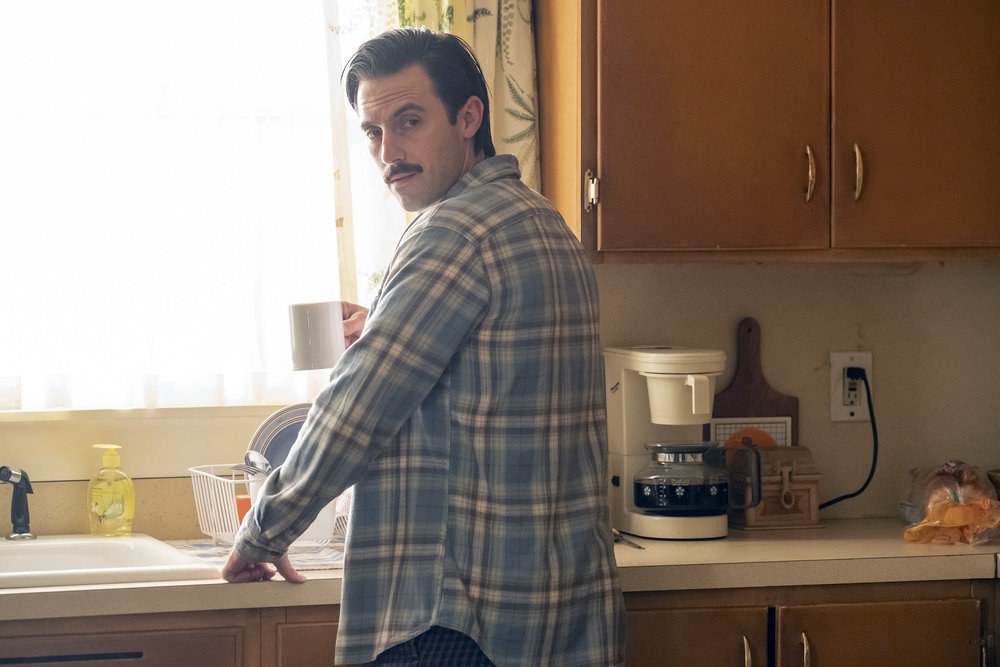
Milo Ventimiglia stars as Jack on This Is Us.

NBC

But what happens when siblings don’t stick together after a parent dies? Since my father’s death, my brothers and I have each relocated, moved back home, relocated again. We’ve experienced successful relationships—and toxic ones. We’ve furthered our education and carved out career paths completely distinct from one another. As we grew into adulthood, the legs of our tripod sank deeper, separating further and further apart. Now, with our father gone more than a decade, our individual demons are rearing their ugly heads and I’m not sure we have the strength to pull each other up anymore. I know I can barely handle my own.[TK]

Lucas is a 21-year-old art student in his last semester of college. He drowns in paint, each canvas more distorted than the last. In one of his self-portraits, he sits on a chair, his neck strained to the ceiling, his eyes masked by a virtual reality headset. His hands reach for the center of his chest, ripping it open. The wound is small, no bigger than a quarter, but there is blood and bone. After graduation, Lucas plans to travel back to the Azores to paint. I wonder if Lucas isn’t trying to disconnect, as he says, but to reconnect—to inhabit the space where his own father’s chest was ripped apart by a guardrail.

Lino, 26, is a video gaming fanatic. Unemployed, he spends the majority of his days in his bedroom. He barely leaves his cave except to walk his two-year-old dog, Bruin—the only companion he tells me he needs. I can do nothing but watch from a distance. Perhaps it’s only in the lives of his video game characters that he sees himself. Perhaps it’s in their gun-controlled grim reality that he has the courage to face his enemies. To get hit after hit after hit. To die. To live again. To keep moving forward.


Source link

Categories
Health

To Cope with My Father's Suicide, I Had to Learn to Love My Grief


November 17 marks International Survivors of Suicide Loss Day, dedicated to those affected by suicide loss.

At 21, I thought I knew exactly who I was: Daughter, sister, friend, student, woman with a disability. I was halfway through college and felt like a butterfly excitedly fluttering it its cocoon, just itching to break free and fly. Then, on a regular Monday morning—15 years ago this year—my father died from suicide.

Just like that, my whole life changed. My father’s death was sudden, unexpected, devastating—but above all, it was confusing. For the first time in my life, I felt lost.

Didn’t the universe know this wasn’t supposed to be my life? The suicide of a loved one leaves you in limbo with no way out—full of unfinished business and unsaid words that you’ll never get the chance to say. It’s the ultimate in cruelty—suicide keeps taking things long after the person has died. You’re forever reminded that there should have been more. More birthdays. More family road trips. More memories. More time. More. More. More.

As my family grieved, I felt out of place. Twenty-one is a weird in-between age—I felt on the cusp of adulthood but still wanted the guidance and reassurance of my parents. There were grief books for widows and grief books for children and teenagers, but no one really talked about what it’s like to lose a parent when you’re in your early 20s. Unlike “widow” or “child,” there was really no label that quite described the sense of loss I carried.

No grief book could tell me what it would feel like to see reminders of my father: birthdays, holidays, little girls holding their dad’s hand. Even worse, there was no way to prepare myself for what it would feel like to graduate from college and not pick out my dad’s smiling face from the crowd as I accepted my diploma. When a loved one commits suicide, they’re both everywhere and nowhere.

The most distressing and concerning thing about being left in the aftermath of a loved one’s suicide, I came to realize, is that it decimates your sense of identity. I was no stranger to feeling different—growing up with a physical disability, I was used to feeling different from my peers—but my father’s death brought with it an entirely new sense of isolation. I suddenly felt like a stranger in my own life, isolated from the person I used to be.

A loved one’s suicide doesn’t just leave you mourning for their life, it also leaves you mourning for your own.

That’s the thing no one tells you about dealing with a loved one’s suicide: It doesn’t just leave you mourning for their life, it also leaves you mourning for your own. A part of me died that day too. It took me a long time to realize in the aftermath of suicide, you have to grieve not just for your loved one, but for yourself, too.

I found myself again in subtle ways, little by little. A decade in therapy helped me deal with the effects of my father’s death. Blogging about my journey also helped. But what has made the biggest difference in my well-being is letting myself lean into my grief instead of running from it.

We’ve been conditioned to believe that grief is a bad word and something to be avoided. We even like to tell people how to grieve, when to grieve and, perhaps most importantly, when to stop grieving and just move on. But the more I talked and wrote about my grief, the more I realized that grief isn’t the enemy. Everyone’s grief is different—it’s as unique and individual as the losses we experience—but owning my grief, finally helped me find some relief for all my anxiety and sadness. Grief is not out to get you—it can actually be there to help you.

I like to think my 21-year-old self is still with me, tucked inside my heart, maybe even right next to the spot where my grief resides. I think there’s a place for all three of us—my grief, the girl I used to be, and the woman I am today—to coexist. All three make up the fabric of who I’ve become and in a way, they’re all linked. You can’t really have one without the other two. There’s a certain beauty in that.

When I remember that, I can tell the 21-year-old girl trying to piece together her life in the fallout of suicide that everything is going to be okay. I can spread my wings and my grief and I can finally get the chance to fly.

Melissa Blake is a freelance writer and blogger covering disability rights and women’s issues. She has written for The New York Times, CNN and Glamour, among others.


Source link