Categories
Health

AOL Instant Messenger Was a Surprisingly Safe Space for Girls to Talk About Sex


My screenname was WyldChica9. I tell you this because if we’re going to talk about what teen girls were doing on AOL Instant Messenger circa 1999, we should probably get the humiliation out of the way up front. When I think about using the messaging service, I think about being 13—a deeply embarrassing age, and AIM was, spiritually-speaking, the most 13-year-old app of all time.

In its heyday, it was beloved by the middle- and high-schoolers who came of age in the narrow gap between widespread middle-class home internet access and the omnipresence of what we now call social media. But when AOL announced in October that the service would be shutting down December 15, after 20 years, no one seemed particularly surprised. And why should they be? We have a million ways to conduct digital conversations now, most of which are tethered to services like Google or Facebook—companies that have gained a foothold in broader American life in a way AIM never quite did. We don’t need AIM now, but we did back then, and some of us more than others.

I was not wild, let alone wyld, but if you were a teenager between roughly 1995 and 2005, you already knew that. In 1999, I played the viola in the middle school orchestra and I included the “9” at the end of my AIM handle because that was the number I wore on my youth soccer team. I was a “chica” in that I was a girl, but I was definitely not Latina, and I’m not sure it ever crossed my mind that using the word might lead internet strangers to assume I was. The wide berth between my actual identity and my delusionally optimistic self-portrayal didn’t matter, though, because I was born in 1985, which means I didn’t really learn how to be embarrassed by my behavior on the internet until college.

At that point in digital history, you could be anonymous in ways that now seem unthinkable.

The halcyon days of AIM were a time before easily disseminated screenshots, so unless someone you knew in real life was mad enough to print out what you said in an IM and bring it to school, it was a receipt-free existence. And when teenagers are given communication tools, relative anonymity, and the opportunity to self-identify as cool, no parental controls on earth will stop them from immediately finding willing partners with whom to talk about boning.

When I was spending unsupervised afternoons and late weekend nights glued to AIM, Jason Biggs was famously copulating with desserts in American Pie. Though boyhood horniness is enshrined in cultural narratives so well-worn that it has its own cinematic lineage, when it comes to teen girls, sex is almost always characterized as something that happens to us. It’s either through pressure, force, or the type of perceived parental failure that didn’t instill the ways in which sex is something we should deny exists until we receive third-party approval. According to the stories we tell ourselves about how sex functions socially, teenage girls are never horny; they are merely horned upon by others.

In reality, my hormones were off the charts—and I was very much logged on, where I sensed these curiosities might be more satisfyingly explored than in real life, among my virginal peers and the older men I had no actual drive to be touched by just yet. At that point in digital history, it was possible to be anonymous in a way that’s pretty much unthinkable now. Google wasn’t even a company until late 1998, Facebook was years away, and the iPhone was still just a gleam in Steve Jobs’s eye. No one had the binding, cross-platform identities we all have now, and it was generally considered normal and safe to keep your full name, face, and personal details a secret. It would have been difficult to show anyone my face anyway; digital cameras were rare and very expensive, and messaging services didn’t support photo-sharing.

Teenage girls rarely get to be the narrators of their sexualities.

Plus, I didn’t want anyone to see my face because I knew I wasn’t supposed to be doing what I was doing: Searching out random people with whom I could potentially talk about sex over AIM, both in AOL chatrooms and via searching user profiles for the two horniest keywords my 13-year-old brain could think of, “sex” and “cyber.” (I told you this would be deeply embarrassing.)

Teenage girls rarely get the opportunity to be the narrators of their sexualities. In these conversations, though, my total anonymity and physical safety gave me the cover I needed to venture my best first guesses at what I might be into. Looking back, I very obviously had no idea how sex worked, despite regularly trying to get pornographic image galleries to load on my very slow internet connection and reading the entirety of Columbia University’s Go Ask Alice! archive. I wanted to understand how people thought about sex and, by extension, how I might think about it. I also wanted to masturbate, which I had learned how to do only recently. It seemed like I could kill these two birds with one stone.

I did most of the searching and chatting alone, but occasionally it took on the form of a group activity, often during a sleepover or lazy summer day in the finished-basement of my most-unsupervised childhood friend. We’d huddle around a single desktop computer and see if we could rile up anyone in an AOL chat room, taking turns at the keyboard. The results only veered sexual sometimes and, as a group, we never made it past giggling hysterically over tricking a grown man into wasting his time being gross with a room of kids. We didn’t acknowledge that finding and flirting with these people (or, to use the ignominious term of the era, “cybering”) was a pastime we never had to teach each other how to pursue, even though we all knew to feign shock at the results. Of course, this was only a silly party trick.

The sexualities of minors is always a tricky subject, even when you were the minor in question. But much to the relief of my current self—a woman in her 30s who worries about the safety of children—I found that not many of the men I contacted as a young teen would talk to me if I told them my real age. I tried that at first, of course, because I didn’t quite realize there was some big social gap between me and the people I wanted to talk to. By my reasoning, we weren’t doing anything mattered; back then, the internet seemed like one big video game, and the interactions we were having just about as real as blasting someone apart in Duke Nukem. But usually, only other admitted teens would talk to me when I told them I was 13, maybe because the adults had better instincts about the situation’s stakes. In any case, getting anyone calling themselves a grown man to flirt with a 13-year-old girl online was a little bit tougher than To Catch a Predator would later make it out to be. By the time I was 16 or 17, old enough probably to have seemed worth the attention to a wider variety of internet randos, boys in my own range seemed like the better objects of my internet overtures.

It never occurred to me that the people I talked with were also reinventing themselves on the internet.

And so, because I was also watching plenty of Cinemax After Dark during this era and knew the tropes pretty well, I became other people: A divorcée looking to have some fun for the first time in years, a curious college girl, a bored wife, or someone with no backstory at all beyond a fibbed A/S/L. It took no effort, because my account wasn’t a traceable part of my real-life existence.

In hindsight, a lot of the conversations I had about sex didn’t exactly track with how I now know it to work—and not just on my end. I was reinventing myself daily, but it never occurred to me that the people I was talking with were doing the same, or that, for instance, AIM generally couldn’t be installed or used on the computers at people’s workplaces. After all, I had never had a workplace. While some of the people I spoke with were undoubtedly adults, it seems likely that a generous portion of them were my fellow minors, bored and horny and intensely curious during summer vacation or before mom got home from work, looking to play-act their burgeoning sexualities at a safe distance and with people who had to know more than they did.

Whether this was an ultimately successful pursuit is beside the point; AIM was an open door to an internet that felt like an opportunity, or at least a place that we didn’t fully inhabit quite yet, or maybe somewhere we weren’t so trapped in the purgatory of adolescence. That internet is gone now, for both better and worse. And so is the messaging service that first gave my generation an entry point to it.

Any eulogy for AIM is really just an In Memoriam of the internet as a separate place, one which didn’t overlap and intersect with real life enough to become it. Now online and offline are the same thing, which was probably already inevitable by the time men were lying to me about how big their dicks were on AIM. But still, I can’t shake the feeling that I was lucky as a teen girl to have an internet that felt like an escape instead of just more of the same.

More:

I Went on a Month-Long Quest to Achieve Multiple Orgasms

My Disability Made Me Dread Going to Weddings Alone. It Shouldn’t Have.

The Best Sexy Gift Ideas for Someone You Love—Like Yourself


Source link

Categories
Health

Stem From Dance Is Using Dance to Turn Teen Girls Into Coders


Sadly, you’ll never be Beyoncé. But do you know what you can be? A badass woman in tech who can code better than the boys.

That’s the message of STEM From Dance, a nonprofit using the power of dance to get girls—particularly teen girls of color from disadvantaged communities—into coding. It was founded in 2011 years ago by Yamilée Toussaint, who started dancing when she was 4.

“Dance gave me a space to see that I was good at something, and a space to express myself and challenge myself,” she told Glamour. After high school, she studied mechanical engineering at MIT, where she came face to face with the gender gap in STEM: In her first mechanical engineering class she was one of two black women in a lecture hall of 200 students. After graduation she decided she wanted to do something about that.

“I was like, ‘There’s got to be some way to take what you can gain from dance—the fun, the community, the form of expression—and translate it into the STEM world,” she says. “Because the population that we work with, that’s exactly what what they need to feel like STEM can be meaningful.”

There’s research to back her up: A recent study found that students majoring in STEM subjects in college reported that being involved in dance helped them with creative problem solving and collaboration.

PHOTO: Damon Plant

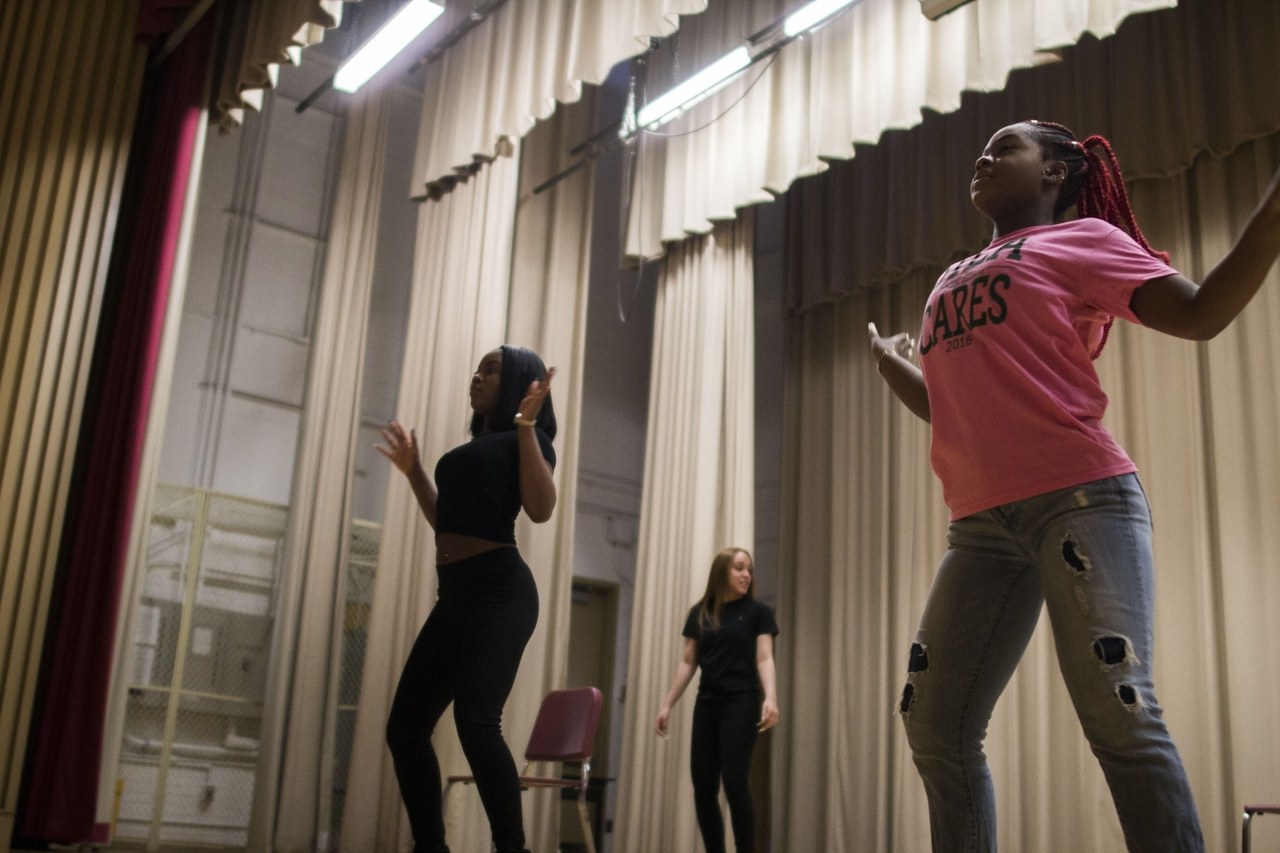
In STEM From Dance programs, a dance instructor works with students to choreograph a dance performance that incorporates technology in some way. Sometimes the girls code computer graphics that complement the dance that are projected onto the stage; other times, the students wear costumes with programmable lights on them, which flash or change color depending on the wearer’s movement. Instructors also use movement to teach math and science concepts.

[embedded content]

Admittedly, most of the students come to STEM From Dance for the dancing, not the STEM. But Toussaint isn’t ashamed of using modern dance—which most teen girls are already into—as a hook for coding. And most of the time, the girls bite: by the end of the program, many of the girls realize that coding is just as fun and cool as the dance moves they’re learning. Several students have even said that the program made them regret not getting involved in coding classes at their school sooner.

And that’s kind of the point: Teen girls of color can picture themselves dancing to Rhianna or Beyoncé, because Rhianna and Beyoncé look like they do. But picture themselves as coders? Not so much. STEM From Dance lets girls imagine themselves in that role, and with its supportive, Bey-loving, girl-centric environment, they learn that they have what it takes to code better than boys do.

“We’re using the confidence that you can gain through dance and translating it to the STEM side,” Toussaint says.

So far, the program has been implemented in 10 schools throughout the New York City area, and touched around 400 students. It remains to be seen how many of them will be the next Steve Jobs.


Source link

Categories
Health

Some Good News! The Boy Scouts Will Now Allow Girls to Join


PHOTO: Steven Gottlieb/Getty Images

There’s some major news from the Boys Scouts of America today: The organization will start accepting girls as soon as 2018.

Following “years of receiving requests from families and girls,” according to an official statement from the BSA, the board voted unanimously on Wednesday to make the change. Come next year, girls will be allowed to join the Cub Scouts (the program for first through fifth graders). A program for older girls—one that will allow them to earn an Eagle Scout ranking— will be announced sometime in 2018 with admission expected to open in 2019.

“This decision is true to the BSA’s mission and core values outlined in the Scout Oath and Law. The values of Scouting—trustworthy, loyal, helpful, kind, brave and reverent, for example—are important for both young men and women,” Michael Surbaugh, the BSA’s Chief Scout Executive, said. “We believe it is critical to evolve how our programs meet the needs of families interested in positive and lifelong experiences for their children. We strive to bring what our organization does best—developing character and leadership for young people—to as many families and youth as possible as we help shape the next generation of leaders.”

There will still, however, be instances in which boys and girls will be gender-segregated. “Dens,” groups that are comprised of six to eight members, will still keep boys and girls separate. “Packs,” which are groups of dens, will be given one of three options. Per the BSA statement, “Existing packs may choose to establish a new girl pack, establish a pack that consists of girl dens and boy dens or remain an all-boy pack.”

In recent years, the Boy Scouts have been moving toward greater inclusivity: In 2013, the organization began accepting openly gay members and earlier this year they opened admissions to transgender members.


Source link

Categories
Health

This Video of Young Girls Dancing To Beyoncé's 'Freedom' Will Give You Chills


PHOTO: Courtesy Project Everyone

There’s a lot to be mad about in the world today. (Think: Trump, Congress, Harvey Weinstein, the wage gap… you get the idea.) Which might be why this new video is really resonating with us.

Beyoncé lent her song “Freedom” to the #FreedomForGirls campaign just in time for the International Day of the Girl on Wednesday. It features fierce little girls, ages 5 through 11, singing along to the power anthem. And they. Are. Angry.

The #FreedomForGirls campaign is promoting the UN’s Global Goals, an ambitious set of objectives for what the world should look like by 2030. It’s a partnership between Project Everyone, UNICEF, and the Bill & Melinda Gates Foundation. The video was directed by MJ Delaney.__

This is the second time Delaney has teamed up with Project Everyone to create a video promoting the Global Goals. Last year, she used the classic Spice Girls song “Wannabe” to ask girls what they really, really want. (Answer: equality.) But this year, Delaney decided to strike a very different tone. “Happy, smiley joy doesn’t really cut the mustard now,” she says. “A lot has happened globally, and I wanted to do something defiant and angry and demanding.”

Also, Delaney says, “I feel like the only place you can go after the Spice Girls is Beyoncé.”

So what are the girls mad about? Violence against girls (which kills a girl every 5 minutes), child marriage (1 in 4 girls is affected), trafficking (71 percent of victims are female), female genital mutilation (63 million girls have undergone it), access to education (130 million girls are out of school), and HIV/AIDS (girls are twice as likely to be infected). For starters.

The Global Goals can create a world free of all of that injustice by 2030. But the only way to get there is by pressuring world leaders into action, and inspiring individuals to make a difference in their own communities. “Hopefully, we can use the Global Goals to define this spirit of defiance and optimism and demanding that we all feel,” Delaney says. “Every single person in the world has the ability to change something.”

To take action, share the film with what #FreedomForGirls means to you. You can also visit the Global Goals website for more information on groups that are working toward gender equality around the world.


Source link

Categories
Health

Join Glamour's Back-to-School Rally for Girls


Education is sexist.

In the U.S., girls are socialized out of STEM programs and targeted with unfair dress codes. In other parts of the world, they’re forced out of school and into child marriage, or they have to spend their days carrying water instead of studying. Around the world, 50 million girls of secondary school age won’t get to go back to school this fall.

At Glamour, we believe an educated girl can change the world. That’s why we founded our philanthropic initiative, The Girl Project, to give girls the tools they need to finish school and follow their dreams.

And it’s why on October 11, the International Day of the Girl, we’re hosting a back-to-school rally for hundreds of schoolgirls in New York City. Real-life superheroes Cory Booker, Yara Shahidi, Ashley Graham, Cleo Wade, and Herieth Paul will join them for some real talk about education, activism, and what it means to be a girl today, with live performances sure to inspire girls everywhere. Because let’s face it, now more than ever, the world needs girls to stand up, speak out, and make their voices heard.

To join us for “The Power of an Educated Girl”, tune in LIVE at 10:00 A.M. on Wednesday, October 11, and follow along on social media with the hashtag #Glamour4Edu.


Source link

Categories
Health

Black Girls Code Turned Down $125,000 From Uber—Then Crowd-Funded Even More


Not interested in $125,000 from Uber? No problem.

When Uber approached tech nonprofit Black Girls Code last week offering a $125,000 grant, founder Kimberly Bryant made headlines by turning it down.

Though Uber has been trying to mend its ways after a disastrous few months (see: donating $1.2 million to Girls Who Code; hiring Bozoma Saint John as the new chief brand officer; officially replacing former CEO Travis Kalanick), Bryant said she was skeptical of how sincere the company’s efforts truly are.

“[It] seems a bit tone-deaf to really addressing real change in how they are moving towards both inclusion and equity,” Bryant told TechCrunch on Friday. “It appears to be more PR driven than actually focused on real change. So we turned it down.”

Not long after news broke that BGC declined Uber’s donation, the organization’s widespread web following not only offered a wave of support via social media — they took action to crowdfund the money that Bryant had turned down. By mid-day Sunday, donations to Black Girls Code had surpassed $125,000.

Touched by the outpouring of support, Bryant took to Twitter to extend her own message of gratitude to the Black Girls Code community.


Source link