Categories
Health

Alyssa Milano Had to Explain How Rape Culture Works to Matt Damon


Once upon a time last week, actor Matt Damon made a couple of remarks about the Weinstein scandal—and the other once-powerful men who also have fallen due to sexual misconduct allegations in Weinstein’s wake. What he said in that interview with ABC News didn’t go over well: The Internet dragged him for tone-deaf comments about Hollywood’s casting couch problem and attempting to draw lines between various degrees of misconduct, seemingly in a way that suggested one should be considered more excusable than others. (Hint: None of them are excusable.) Luckily, Alyssa Milano was on hand on Twitter to give him a lesson in what exactly rape culture is and why his comments were off the mark.

He started off OK: “I think we’re in this watershed moment. I think it’s great. I think it’s wonderful that women are feeling empowered to tell their stories, and it’s totally necessary …”

Three sentences after he opened his mouth, though, it all went careening downhill: “I do believe that there’s a spectrum of behavior, right? And we’re going to have to figure—you know, there’s a difference between, you know, patting someone on the butt and rape or child molestation, right? Both of those behaviors need to be confronted and eradicated without question, but they shouldn’t be conflated, right? You know, we see somebody like Al Franken, right? I personally would have preferred if they had an Ethics Committee investigation, you know what I mean? It’s like at what point—you know, we’re so energized to kind of get retribution, I think.”

Well, yes. After living under patriarchal oppression for the better part of the last forever and having our bodies continually treated as commodities, there is a certain energy about finally being able to speak up about it—and actually be heard.

“And we live in this culture of outrage and injury, and, you know, that we’re going to have to correct enough to kind of go, ‘Wait a minute. None of us came here perfect,'” Damon continued. “You know what I mean? … The Louis C.K. thing, I don’t know all the details. I don’t do deep dives on this, but I did see his statement, which kind of, which [was] arresting to me. When he came out and said, ‘I did this. I did these things. These women are all telling the truth.’ And I just remember thinking, ‘Well, that’s the sign of somebody who — well, we can work with that’ … Like, when I’m raising my kids, this constant personal responsibility is as important as anything else they learn before they go off in the world.

And the fear for me is that right now, we’re in this moment where at the moment — and I hope it doesn’t stay this way — the clearer signal to men and to younger people is, deny it. Because if you take responsibility for what you did, your life’s going to get ruined.”

Later, by the way, Damon goes on to give a hypothetical example of what would happen if someone falsely (he makes sure to specify this) accused him of sexual harassment. His plans? Lawyer up, and get a settlement on the table.

“I mean, look, as I said, all of that behavior needs to be confronted, but there is a continuum,” Damon continues. “And on this end of the continuum where you have rape and child molestation or whatever, you know, that’s prison. Right? And that’s what needs to happen. OK? And then we can talk about rehabilitation and everything else. That’s criminal behavior, and it needs to be dealt with that way. The other stuff is just kind of shameful and gross.”

What Damon leaves out, obviously, is the “shameful and gross” things he’s referring to have the demonstrated potential to destroy women’s careers. Women don’t escape unscathed from the actions of these men, whether they are attacked or manage to fend off the harassment and assault. Damon putting them on a scale completely negates and ignores the damaging, lasting, and real fallout women experience.

Milano, who has been vocal in the #MeToo movement, called him out in a series of tweets that explained how rape culture works. It was an act of emotional and mental labor that was undoubtedly draining but definitely necessary.

“Dear Matt Damon,” she wrote. “It’s the micro that makes the macro. We are in a ‘culture of outrage’ because the magnitude of rage is, in fact, overtly outrageous. And it is righteous. I have been a victim of each component of the sexual assault spectrum of which you speak. They all hurt. And they are all connected to a patriarchy intertwined with normalized, accepted–even welcomed– misogyny.

We are not outraged because someone grabbed our asses in a picture. We are outraged because we were made to feel this was normal. We are outraged because we have been gaslighted. We are outraged because we were silenced for so long.

There are different stages of cancer. Some more treatable than others. But it’s still cancer. Sexual harassment, misconduct, assault and violence is a systemic disease. The tumor is being cut out right now with no anesthesia. Please send flowers. #MeToo”

Of course, it would be really nice if it were a woman—such as say, Milano—doing the highly visible interview with ABC News as a leader in the #MeToo movement, rather than another male Hollywood figure. Instead, Milano, a victim of sexual misconduct herself, had to do mental and emotional labor to correct Damon’s problematic thoughts. Exhausting.

Related Stories:
MeToo: Thousands of Women Share Stories of Sexual Harassment and Assault on Twitter
Post-Weinstein, These Are the Powerful Men Facing Sexual Harassment Allegations


Source link

Categories
Health

'This Is Us' Directors Explain Why We've Never Met Jack's Brother Before


Tonight’s episode of This Is Us—appropriately titled “Brothers”—packed a lot into 42 minutes. We learned via a super early flashback that Jack has a younger brother named Nicky, which gives us even more insight (and questions) into Jack’s mysterious past. We also saw Kevin struggle to keep up appearances at a charity gala because of his addiction to pain meds. Then, after Kate told Toby she’s pregnant, she sternly instructed him not to talk about their unborn child until after the baby is born. Of course, that was until she decided to bend that impossible rule and let Toby tell one person at a local coffee shop, which then turned into a Hootie & the Blowfish song-and-dance routine followed by an ode to Flashdance. Got that?

Obviously, we needed answers immediately about all of the above—so executive producers Glenn Ficarra and John Requa, who directed the episode, hopped on the phone to fill us in.

So, Jack has a brother. Was there ever any previous reference that this sibling existed?

John Requa: I don’t think we have, as far as we can remember. The point of this episode is to show that Jack has been hiding this. He also had a serious alcohol problem that he completely concealed from his wife and his family, and he’s concealed this dark part of his past as well. I think [it’s the same thing as] when we see Kevin keeping secrets and being evasive. We see the weaknesses of the father passed on to the son, so for this episode, titled “Brothers,” it fit nicely into the theme. The reveal informs all the scenes before it.

The way Jack is dealing with Kevin—it’s the first time you’re seeing Jack be a bit short and testy with his kids—and it turns out, there’s a reason because he really wants this brotherhood to work. Once you see he had a brother of his own, well, that raises all sorts of questions: Is there regret there? Is there something he’s trying to replicate? Or something he’s trying to fix?

Should we assume that Nicky Pearson is alive in the present day? Or will that be a mystery solved later in the season?

John: We’re never going to explore the Nicky storyline. [Laughs]

Glenn Ficarra: If This is Us has taught us anything, it’s never assume anything. It’s safe to say, though, that you’ll be surprised.

Fair enough. At the beginning of the episode, viewers are told that Jack’s dad, Stanley, is on his deathbed. We don’t see him die by the end of the episode. Will he be back, or was that it?

Glenn: Well, I think we’re certainly open to come back and revisit him, but the main takeaway is that this man, because of his choices and his relationship with Jack, is going to die alone.

John: Whenever his demise is, it will be a miserable and lonely one. The message of the episode is that there are two sides to Jack: the open, gregarious father, who really works hard to be a good dad and mend the fences between the two brothers, and there’s the side that keeps secrets. Then you see Kevin keeping secrets and going down a dark path. You see Randall being this very involved father, trying to make this relationship work with Déjà, and then you see, if you go down the dark path, where it leads. It leads to you dying alone with your son unwilling to visit you in a nursing home. In the microcosm of this episode, that’s what we’re trying to say.

In this episode, you worked with a lot of young actors—from Jack and Nicky to Kevin and Randall—on some really difficult scenes. What was that like?

John: Milo Ventimiglia has really taken it on to develop relationships with the kids. When we were shooting that really great scene in the tent with Parker [Young Kevin], it was just a great performance, and he’s this little guy! Milo came up to me and said, “Parker’s been working really hard, and he wants to deliver some emotional weight to this scene.” I said, “OK.” When somebody says that—an actor, or in this case, it was Milo—you really get your crew in line and get out of the way and let them do it. He came in there, and in take one he came from a really raw, emotional place. He really delivers a remarkable performance.

Glenn: To watch all the kids grow is a really great thing, but you don’t want them to lose that wildness of being children. We want them to be a family and drive their parents crazy, so you find a way to work with them that keeps them as a tight unit but doesn’t strip them down, either.

John: Milo knows all the rules right now. He’s like half-parent, half-acting coach for those guys. I always say when we’re about to direct an episode, “OK, Milo, what’s the deal?” And he says, “Well, this one, he’s thought about [the scene]…” Milo is a very thoughtful guy and he understands how tricky it can be. He was a young actor himself, and he really deserves a lot of the credit of the level of performances those kids get to.

Let’s talk about Kevin and Sophie for a minute. It’s really interesting to see him unravel just as his career is on the upswing and he’s back with Sophie. What can you share about what’s to come? And what’s Sophie’s role in this?

Glenn: In a lot of ways, he’s revisiting his relationship with Sophie. Kevin isn’t done growing yet. How Sophie factors into it, we’re going to see. Is Kevin on his way up or his way down? Just because he’s going back to this relationship with Sophie doesn’t mean he’s fixed all the problems. That’s really going to inform the next few episodes, and you’ll see where that’s going to go. It’s time he deals with that. Through no fault of her own, Sophie is unaware of what’s going on, just the way that Rebecca was unaware of what was going on with Jack and his problems. These things can be insidious and the shame of having a problem forces you to keep secrets. You can get really damn good at it.

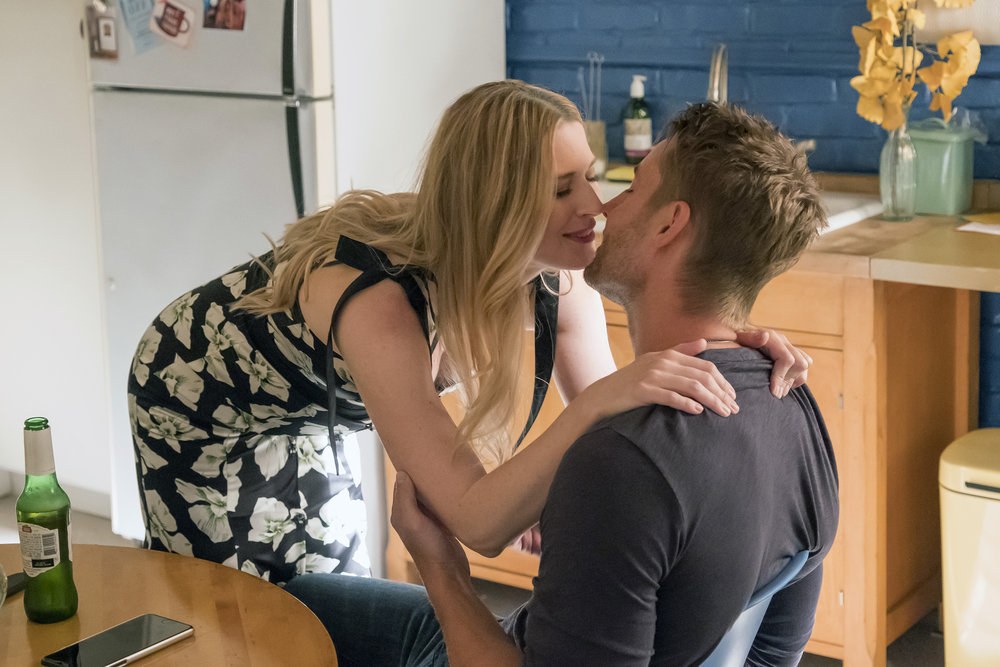
PHOTO: NBC/Ron Batzdorff

John: Sophie is what he can lose, and how it affects his family and how it affects his relationship…that’s really what addiction is about. It’s not about wandering the streets. It’s about the people you love, and the damage you do to those relationships that are so vital in your life. Addiction is always an ensemble. It’s never about one person. An addict will say, “This is my choice.” But ultimately it’s not really your choice, because your actions affect the people that you love. The stakes of your actions are that you hurt people you love. In many ways, Sophie is what Kevin has to gain and what he has to lose as he goes forward.

Glenn: We talked with an addiction expert, who said the opposite of addiction is not moderation. The opposite of addiction is connection. The only thing that really can cure you of addiction is human connection, and it’s one thing you lose as an addict. You sever all those connections, and you fold in on yourself.

Finally, I want to ask about Kate and Toby. Who among the writing staff is such a huge Hootie & the Blowfish fan that they wanted that song to play during Toby’s celebratory dad-to-be announcement?

John: [Laughs] Tyler Bensinger wrote the episode, and his favorite band is Hootie & the Blowfish. He actually, for a period, follows them around, like people follow The Grateful Dead. He follows them around, and he wears—to the writing room—a Hootie & the Blowfish hoodie once a week. He loves them. He’s obsessed with them! He’s been lobbying, ever since he’s come on the show, to get Hootie & the Blowfish in there. We love it because it kind of makes sense that that would be Toby’s favorite song. Actually, it’s not his favorite song; it’s his happy song! [Laughs] It makes the scene really funny, I think.


Source link

Categories
Health

Even Fan Theories Can't Explain the Problematic Timeline of 'Grey's Anatomy'


At this point, Grey’s Anatomy, which returns tonight for its 14th season, is less of a show and more of a cultural institution. It’s the bedrock of the Shondaland empire, required viewing (and tweeting) for its legion of devoted fans, and the place young actors go for career-boosting arcs—much like ER before it or, on the East coast, Law & Order: SVU.

There was a time, however, when Grey’s was a show like (and unlike) any other, when it hadn’t been running for a thousand years and killed off a dozen main characters. A time when it was just this juicy drama starring really, really good-looking people that I would binge-watch with my camp friends at our semi-regular sleepovers. After those had petered out, I didn’t pay attention to the show until a couple months ago, when it was on at the gym and I found myself watching it; before I knew it, I had fallen down a hole and started the series from the beginning. (Side note: Grey’s is the perfect gym show because it’s addictive, chatty, and will make you terrified of death so you want to work out more.)

But friends, as I watched I noticed something that I never noticed before, but now it’s completely blown my mind and I can’t get past it: The first three seasons take place over the course of one calendar year. Just think about what that means for a second. That means by the time Burke leaves Christina at their wedding, he has known (not dated, not been engaged to, known) her for 12 months. Meanwhile, George falls in love with Meredith, sleeps with Meredith, loses his father, falls in love with Callie, marries Callie, and sleeps with Izzie between July and the next July, approximately. Let’s not even get into the Denny of it all.

If you watch the episodes week by week, you might think the show’s romances move kinda fast; if you look at it in terms of a single trip around the sun, they’re insane. These people start sleeping with each other within days of meeting one another, and they get married at an alarming rate. And apparently, it’s not only normal but good to not know if you want to be with someone on a week-to-week basis. From day one, these interns are like, “We gotta be extra smart and dedicated because there aren’t very many female interns and it’s a competitive program” before they immediately and ceaselessly start sleeping with their attendings and talking about it to anyone who will listen, ad nauseum. And then they break up a bunch! Over and over! In front of patients!

It makes sense that after a short first season (9 episodes) the writers would extend the intern year dynamic into the second season. They set up a pecking order and a chain of command, so, sure, they wanted to continue exploring that. But season 2 is also a whirlwind, including the fact that Bailey has a baby. If little Tuck was conceived on, say, the very first day of season 1 that means that by the middle of season 2, when Bailey delivers, nine months have passed, and the rest of season 2 and all of season 3 take place over the course of three more months?

And it doesn’t get better after season three: Seasons 4 and 5 are over the course of George’s second year as an intern, which means all of the many, many, many things that happen in the first five seasons of this show are supposed to be over two years. At the end of season five, these people have known each other for two years max.

I’m not alone in my confusion. After discovering this, I spent hours combing through timelines that superfans made online trying to make sense of it all, and it just doesn’t work, no matter how many convoluted fan theories—Lexie Grey doesn’t exist, for instance—you pile on top of it. Maybe the first seasons just exist on a different plane of existence. There are multiple references to Meredith being blonde even though she demonstrably isn’t and in the super early days, there was a cheesy theme song:

[embedded content]

Maybe (and most likely) the writers’ room just didn’t care. Or maybe—and hear me out here—Meredith’s arrival at Seattle Grace opened up a rift in the space-time continuum and suspended the laws of physics as we know them? Yeah, that’s probably it.


Source link