Categories
Health

Jane Fonda Wanted Gray Hair to 'Surprise Everyone' at the Oscars


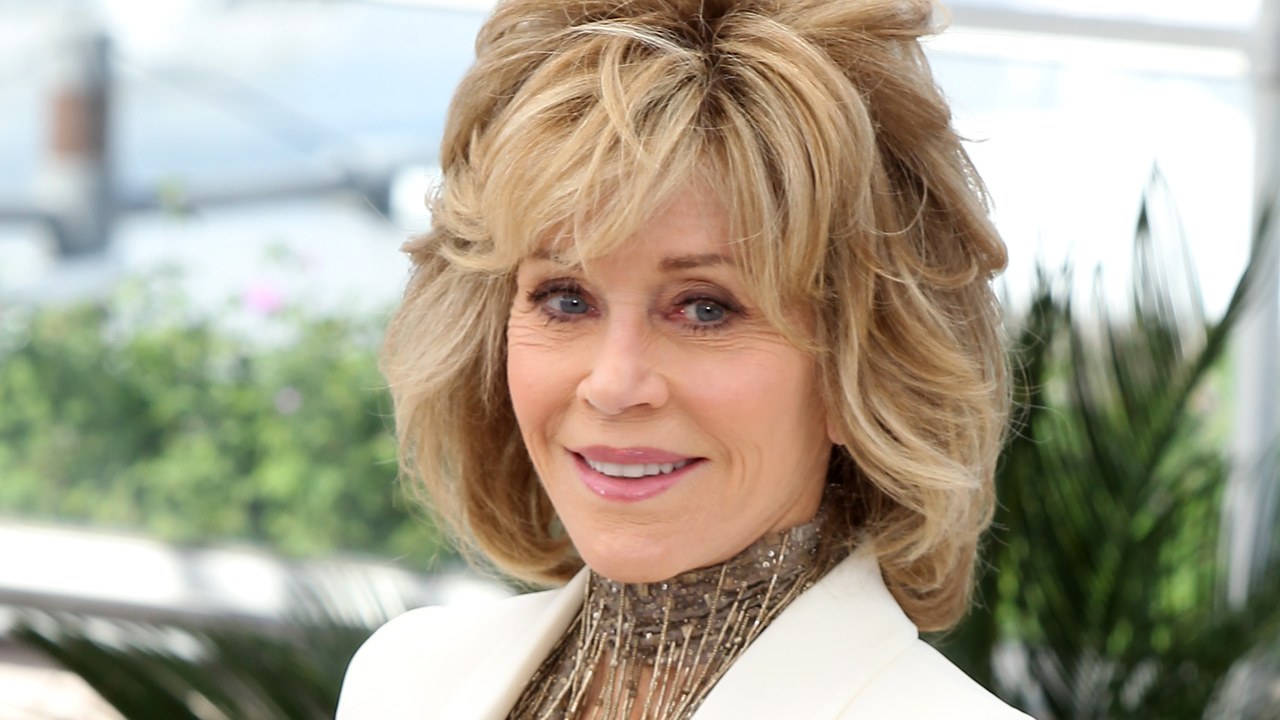
The Oscars 2020 brought many amazing fashion and beauty moments—but one of the best came at the very end of the night as Jane Fonda walked onto the stage to present the award for Best Picture to Parasite in a dress she recycled from 2014 and striking short, gray hair.

Fonda always looks phenomenal but this may have been one of her best looks yet—and her hair color was a very conscious choice. Her colorist Jack Martin shared some of the thinking behind the decision in a lovely Instagram post.

“I had the honor and the pleasure to transform the legendary actress @janefonda hair specially for the 2020 Oscar. Spending 7 hours with this amazing Hollywood star and witnessing her energy, beauty, strength and femininity was so inspiring,” he wrote. “For straight 7 hours while I was working on her hair she was writing chapters in her due soon book, and memorizing her lines in the famous tv show Frankie and grace [sic] that she is shooting the 7th season now, answering emails and reading her newspapers plus communicating with me and her team with the sweetest, humblest soul, she made me feel ashamed to complain of being tired.”

For a woman who’s been making both political and sartorial statements for the entirety of her career, it’s powerful to see her embracing the beauty of gray hair—especially during a time when so many women are pushing back against the idea that going gray means “giving up.” According to Martin, her decision to color her hair was purely for fun, plain and simple.

“Her goal color was a silver icy blonde to surprise everyone at the 2020 Oscars,” Martin continued, before sharing the formula he used in case you’d like your own colorist to give this a go. “Jane was extremely happy for getting her dream hair that took her a while to find a colorist that can do it perfectly in a very painless process.”

Naturally, Jane Fonda’s new look had a lot of fans on social media too.

Cheers to an 82-year-old icon who continues to live life on her own terms.


Source link

Categories
Health

I Never Wanted to Settle Down. Then I Met a Man Who Lets Me Be the 'Dude' in Our Relationship


You know this character: It’s as much a fixture of rom-coms as the lovelorn, desperate-for-roses-and-champagne woman. It’s the man who can’t settle down.

It doesn’t shock me now that those flings didn’t work out. As my sister liked to tell me, “No dude wants to date himself.” The men I tried to date were just like me; we were two dudes just dudeing around. We were two alphas competing over who was tougher and gave the fewest fucks. It never ended well.

I needed a man who wasn’t as afraid of love and relationships as I was. Someone who could teach me to be more thoughtful.

On our third date—after the prescient socks gift—my boyfriend and I watched Brené Brown’s special on Netflix. In it, she talks about the importance of vulnerability. He paused it every 10 minutes to discuss and share. At the end, he cried. He also cries when he sees old people holding hands and hears ballads on the radio: “I can’t help it. I love love!” When we watch movies together and there’s a sentimental moment, he’ll grab my knee and hug it close to him because he “wants to hold the person I love when I see love.” He’s so emotionally fearless; love comes easily for him. And that, in turn, has made me want to try harder to access those deeper parts of myself. As Brown says, being vulnerable in relationships is hard for some. It’s my “arena” to work in. To be honest, I still love hookups and think about one-night stands. I am admittedly reluctant to give up my bachelor habits. And yet, a cheap thrill on Tinder when I’m feeling insecure isn’t worth losing what I’m building toward.

I’ve spent that last several years on a bit of a Tinder bender to make up for all the years I spent too scared or pessimistic to even hazard dating. Other than one long-distant boyfriend and one open relationship, it was mostly wild affairs, numerous sex friends, and regular one-night stands. These were formative years for me, though, helping me to finally step into my power as a woman in her sexual prime, let go of my shame and fear around my sexuality, and fully embrace my inner “slut” and cougar. These years taught me to stop doing shit I didn’t want to in bed, to ask for what I want, and feel entitled to pleasure. I’m more confident than ever.

But after a while, it all started to get boring. Just like after traveling for too long, new experiences can stop feeling so exhilarating. I was tired. It was just then that I met Antoine and things changed.

After our first date, I thought, “I should probably bang as many dudes as possible before this gets serious!” But I never did. For once in my life, I prefer the depth of a close relationship to the thrill and of a one-night stand.

In a real show of growth for me, I even said “I love you” first. I knew he’d been holding back, afraid that he’d scare me if he said it too soon. So I picked a special moment and not while we were screwing—ugh, I mean “making love”—and said it. He cried.

I’m also working hard on being more thoughtful, remembering the names of his friends, coworkers, and relatives and asking about them often. I tell him how much I love him even though that runs counter to just about everything in my nature, and I try to talk about the future, too.

For the longest time, I thought there was something wrong with me because I’m not like most women. I didn’t want to settle down. I don’t care about Valentine’s Day or all the pink-heart bullshit that comes with it. I don’t believe we need to show love or be shown love with gifts. I have never wanted a box of chocolates. Instead I’m getting the one thing I’ve wanted out of a relationship and the one thing that the media and legions of plastic surgeons tell women we can’t get—the freedom to be a whole, unvarnished self.

Melanie Hamlett is a comedian, storyteller, and journalist from New York City who’s now based in Europe.


Source link

Categories
Health

Stassi Schroeder: I Never Wanted to Have Bridesmaids—Now I Have Nine


Basic Bride is a new wedding column from Vanderpump Rules star Stassi Schroeder. If you’re looking for advice, stop right here. But read on if you want honest, hilarious commentary on the trials of planning a wedding that millions of people will watch.

I never wanted to have bridesmaids. I love weddings, I love my friends, and I love being in my friends’ weddings, but I’ve always thought that having bridesmaids means more stress for the bride. You’re constantly delegating—choosing the bridesmaids, picking out their dresses, making sure they all get along and feel included. So when I got engaged to my fiancé, Beau, I thought, why add extra work for myself? My friends will be at my wedding no matter what.

When I told my friends that I didn’t want to have bridesmaids, though, they were livid. They were like, “Abso-fucking-lutely not. We love you, and this means more to us than it does to you. If you don’t do bridesmaids, we’re going to kill you.”

So I’m having bridesmaids.

But once I made that decision, I quickly realized: Oh shit. If I’m going to do this, I have to really do this. I don’t like when weddings have 20 bridesmaids and 20 groomsmen, but I have so many people I want to include: my sister, my fiancé’s sister, my friends that I grew up with, and the friends that are a big part of my life now. It became a situation. And now I have nine bridesmaids. Don’t judge me.

It was hard to narrow down to just nine! I had to limit it to people who are a big part of my life right now, as well as Beau’s. This isn’t a birthday party celebrating me—it’s about me and Beau. So my bridesmaids need to be people who’ve been around us as a couple. The friends who will continue to be in our lives after we’re married.

Still, I feel like such an asshole having nine bridesmaids when I always said I wouldn’t have any. I have my sister and Beau’s sister, some old friends, and a few cast members (I feel weird even calling them that, since they’re my best friends) in my bridal party. And I have no idea what I’m going to do about the order at the ceremony. This has actually haunted my dreams. Why would I rank my friends? I can’t possibly do that because they’re all important in different ways. Maybe I’ll just pick the names out of a hat—make a big show of it, so they can all see how fair it is.


Source link

Categories
Health

Alicia Keys Encouraged Her Four-Year-Old Son to Be Proud of a Rainbow Manicure He Wanted


Alicia Keys is encouraging people to stick to their creativity and embrace the feminine and masculine energies they hold—including her son.

On Instagram, the singer shared a story of how her four-year-old son, Genesis, shied away from getting a rainbow manicure, fearing that “people are not gonna like it.” But instead of allowing her son to be ashamed, she offered him tons of support and then took her thoughts to social media.

In an Instagram video that she captioned, “Less Labels, More Expressions,” Keys explained that Genesis was excited about getting his nails done when she brought him to the salon. “So he tells the lady that he wants rainbow colors on his nails. And she brings all of these colors and she paints each nail a different color. And after she painted his nails, he looked at me and he said, ‘Mommy, I don’t want this on my nails,'” Keys said in the video. “And I was like, ‘Why? You were so sure. You were good.’ And he was like, ‘People are not gonna like it.’ Can you believe this? Four years old. He’s four!”

But his mom continued to encourage him: “Stick with it. You chose it. You liked it. You do it.” She added, telling all of her Instagram followers, “The way I see it, there is masculine and there are feminine energies inside of us all, period. It gets concerning to me that we can’t just explore these different sides of ourselves. These different energies that are within us.”

Keys isn’t the only person who has been encouraging expression through nail art. Male celebrities, among them Harry Styles, Bad Bunny, A$AP Rocky, and Shawn Mendes have been trying to show that nail polish doesn’t have to be a gendered aesthetic choice and that men can paint their nails whatever color they want. And now, thanks to his mom, Genesis is proudly joining the club.


Source link

Categories
Health

Judy Chicago Never Wanted to Have It All


Not that she wants to dwell on the past, but the fact is when artist Judy Chicago was fresh on the L.A. art scene in the 1960s, the best compliment a woman could hope to receive was that she painted “like a man.”

“And generally, there weren’t any compliments because most women artists were invisible. I was able to be somewhat visible,” Chicago insists now, with a note of pride. “But I kept running into obstacles.” Women couldn’t get a foothold in major shows. Dealers didn’t want to work with them. Their husbands wanted them at home, or their children needed them.

The odds—the men!—were stacked against them. And Chicago was determined to beat them. She wanted to make a contribution to art as a discipline. She wanted to create work that would be remembered. And she knew she couldn’t do that from the sidelines. So she began to wonder; how had women ever done it? To whom could she look for an example? But when she started to research her foremothers in the tradition, Chicago came up blank. “I wanted to see if women before me had encountered the same kind of challenges that I was facing, but I discovered that so much of what women had done—there was no record of it,” she recalls. “It had been erased.”

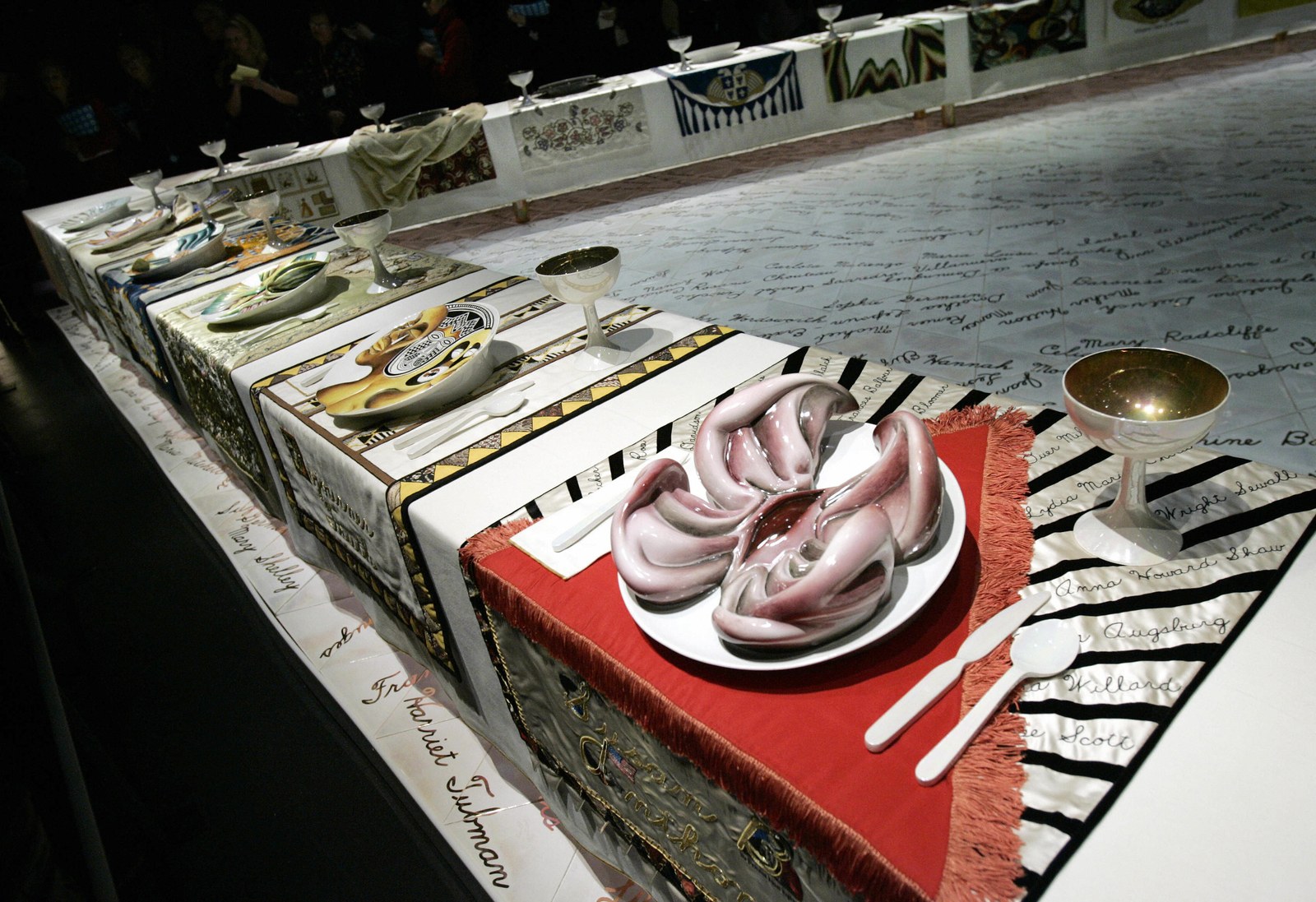
Judy Chicago, The Dinner Party, 1979.

STAN HONDA/AFP/Getty Images

Chicago unveiled the first of what would be a career filled with correctives in March 1979, introducing her most iconic work “The Dinner Party” at the San Francisco Museum of Modern Art. The massive installation was, as the New York Times recently put it, “theatrical, audacious and definitively feminist: a work of stark symbolism and detailed scholarship.” It was also replete with vaginas. The piece is made up of a triangle-shaped banquet table set with 39 plates. Each side is 48 feet, and each plate is labeled with the name of a woman Chicago thinks we should know. Not just other artists, but writers, adventurers, and activists; Sojourner Truth and Virginia Woolf and Georgia O’Keeffe. Within its first three months on view in San Francisco, over 100,000 people came to see it. But critics hated it, and reviews were vicious. It was amateur, graceless, and obvious, some said. It was too big, too loud, too much. After its stint at SFMoMA, Chicago put it in storage.

Ever since, Chicago’s mission has been twofold. First, to restore women to their rightful place in the art historical canon. Second, to ensure her own work wouldn’t meet the same fate as some at her proverbial table, consigned to the margins or worse; disappeared.


Source link

Categories
Health

Sex After Having a Baby: Everything You Ever Wanted to Know


The first thing most women think about after having a baby is not usually sex. But at some point in the postpartum period (or maybe while they’re still pregnant), many women start pondering the mechanics of sex after having a baby, and it isn’t always an easy thing to picture. Physically and mentally, sex can seem really daunting. But the most important thing to know is: It does work, as plenty of mothers can tell you. “People are always concerned that their vagina will never go back to normal, but your vagina is designed to do this exact task,” says Vanessa Marin, a sex therapist in Los Angeles. Sex may change after childbirth, sure, but for most women—whether you had a vaginal delivery or a C-section—it can be just as satisfying as before. The key is educating yourself (and your partner) on what to expect, she says, “so you don’t get rocked by the changes themselves.”

So what else do you need to know about having sex after a baby? We spoke to experts and real moms to find out. The reality is, in the first few months after giving birth, not only has your body pulled off a massive feat, but you’re sleep-deprived, your daily routine has changed dramatically, and your relationship with your partner is likely evolving as you take on new roles as parents. So the truth is that when you first try sex, it may not be great (or you may, as one mom told us, accidentally squirt your partner in the eye with breastmilk). It’s normal for your sex life to go through an adjustment period. As you do, you’ll have questions—and here are the answers:

How long should you wait?

Almost immediately after giving birth, the vagina will start to heal itself from whatever it has endured during a vaginal delivery, says Jennifer Conti, M.D., a clinical assistant professor of obstetrics and gynecology at Stanford University. “Vaginas are really elastic and really resilient. Even with really nasty lacerations, you see people back in clinic a few weeks later and it’s remarkable—sometimes you can’t even tell that they’ve had a tear.” Still, doctors typically tell women to wait six weeks after giving birth before having penetrative sex, but the experts we spoke with stressed this timeline is simply a guideline, not a rule.

“It’s so unique for every person, and that’s OK,” says Dr. Conti. “The recommendation has more to do with when it’s safe to have sex, not with when you’re actually ready to have sex.”

Many women are afraid to resume sexual activity. “People look at pictures of childbirth and they say, ‘Oh my God, this kid’s coming through my vagina and I’m never going to be able to feel anything again as long as I live,’” says Mary Jane Minkin, M.D., FACOG, clinical professor of obstetrics and gynecology at Yale University School of Medicine. “The thing to remember is that, although it can stretch to admit this baby, it comes back! The muscles don’t stay flaccid and stretched. Will they come back absolutely as tight as the vagina was initially? Maybe not. But they’ll do a pretty good job.”

Some women admit they didn’t know when they were ready to try again. “Leading up, I had no idea if I was totally ready,” says new mom Amy, 28, whose daughter is now one and a half. She and her husband gave it a go shortly after her six-week appointment with the understanding that if it wasn’t working, they’d stop. “We got through it,” she says. At the time, she remembers thinking, “OK, this isn’t most comfortable thing in the world, but it doesn’t feel wrong, or dangerous, so we’re good.”

Before you attempt to have full-on intercourse, you might also consider starting with milder sexual activities, says Liz Miracle, a pelvic-floor physical therapist in San Francisco who is also the mother of a five-month-old. “Start slow and ease into it,” she advises. Gentle touching and massage can help you “start feeling sexy and ready for penetrative intercourse.”

For women who are considering an elective C-section to avoid potential trauma to the vagina (and docs say some do!)—it’s not worth it. A C-section is a major surgery, and women generally take longer to recover from it than a vaginal delivery. (Also, sex will change after a C-section anyway: You’ve still got hormonal fluctuations to deal with and it’s surgery!) Fear not, your vagina will come back.

How will sex feel?

Real talk: The first time you have sex after childbirth, it probably won’t be all that pleasurable. In fact, some moms described having sex after childbirth as being similar to having sex for the first time ever. “I don’t think anyone thinks, Wow, that was so great, after the first time,” says Amy. On the bright side, since there’s “a little bit of hype and buildup” because it’s been a while, there’s also “a little bit of excitement.”

Eventually, over weeks or months, it becomes more comfortable. “I don’t remember exactly when my husband and I had sex for the first time, but I do remember that there were a lot of attempts,” says E.J., 28, whose son is now 10 months old. “And I remember that when it actually happened to completion, it was sort of a triumphant moment. I think we actually high-fived.”

One tip everyone we spoke with recommended to help ease pain or discomfort: lube. Considering purchasing lubricant before you even attempt to have sex so you have it handy.

What if my post-baby body image is affecting my sex life?

Adding to potential postpregnancy uncomfortableness around sex, it might take some time for you to mentally and emotionally get used to the roller coaster of change your body has been on. It’s not uncommon for new moms to wonder if they’ll ever feel sexy again. “A lot of women struggle with body confidence after giving birth,” Marin says. “Your body has gone through some enormous changes, and it can take a while to feel like yourself again.”

This is totally normal. With a new baby, your body takes on a totally different role. “Many women say that their bodies don’t feel like their own because the baby is so dependent on it. You literally have another human being attached to your body, relying on it for survival,” Marin says. “Not to mention the fact that you’re being touched and grabbed throughout the entire day.” When that’s your new reality, it’s no wonder feeling confident in your body in the same way that you used to can feel out of reach.

The first step in addressing any postpregnancy body-image issues is recognizing that you are not alone—even celebrities with all their fancy trainers, nutritionists, and stylists deal with body image issues after giving birth. “So many postpregnancy articles fixate on ‘snapping back’ after pregnancy, especially with celebrities, but there’s so much more to the pregnancy journey than that,” Marin says. “Give yourself time to adapt to this new stage in your life, and to build a new relationship with your body.” Start by carving out alone time with your partner when you can start reawakening the sexual part of yourself that might feel dormant. “This can be logistically complicated, of course, but it’s an extremely worthwhile endeavor,” Marin says.

Not all women feel self-conscious after giving birth—for some women it’s actually a major body-confidence boost. “Your body has done a truly miraculous thing and there’s so much to be proud of,” Marin says.” For many women, pregnancy helps put body hangups into perspective. “Maybe you were self-conscious of your breasts before pregnancy, but now you can appreciate that they keep your baby healthy,” Marin says.

Will you get pregnant?

Maybe. Amazingly, your body has the ability to make another baby pretty much immediately after you’ve given birth to one. However, doctors strongly recommend waiting at least 12 months between delivering one child and getting pregnant with another, which means using some form of contraception is essential. “Even if you want to have a child shortly thereafter, it’s the safest thing you can do for that next pregnancy,” says Conti.

While breastfeeding can help reduce the chances of getting pregnant, the popular belief that it acts as a surefire form of birth control is a misconception—you need backup.

For many women, the easiest solution is a postplacental IUD: Within minutes of delivering your baby and placenta, doctors can insert the device, and you’re good to go.

Does breastfeeding affect sex?

A little-known fact about breastfeeding is that it puts your body into a kind of temporary menopause (though not completely—remember you can get pregnant), particularly for the first six months, explains Conti. The biggest side effect of this possible state is extreme vaginal dryness, which can make sex painful.

If you want to have penetrative sex while you’re breastfeeding or pumping, doctors recommend using lubricant or vaginal estrogen to increase wetness. And in some cases, you may just need to wait it out. “Sex only really started feeling comfortable when I stopped pumping after six months,” says E.J. “That’s when it started feeling good again.”

Will it be the same?

It might be, but it might not be. You may find that what feels good during sex changes after giving birth. Some women who previously orgasmed through G-spot stimulation now prefer clitoral stimulation. If you’re breastfeeding, your nipples may feel especially sensitive—and not especially sexual. Many of the women we spoke with said that, while they were breastfeeding, their breasts played a much smaller role during sex than before.

“It is definitely possible to have a great sex life after kids, and maybe to even have it be better than it was before, because having kids forces you to get creative,” explains Marin. That goes for everything from carving out time to get it on to finding the position that feels best post-baby. As with all things sexual, the best thing you can do is experiment until you discover what works.

“It’s really important to acknowledge that sex is going to feel different, and to cut yourself some slack,” says Steph Montgomery, a writer, women’s health activist, and mother of five. Also, communicating your new preferences to your partner is essential. “I’ve found that missionary sex with him on top, and sex with him on top in general, is just not comfortable anymore,” she says. She now prefers all fours. “It sort of takes the pressure off—literally.”

Is there anything I can do to improve my post-baby sex life?

They’re brought up a lot, but for good reason: Kegel exercises, which involve contracting and releasing the vagina, can help strengthen the muscles in and around your pelvis in the postpartum period. Increased muscle tone in the vagina can make sex more pleasurable for women, says Minkin.

If you’re a few months postpartum and you suspect you need more than Kegels to restore your strength or control—or if you’re experiencing pain while doing Kegels or during penetrative sex—consider seeing a pelvic-floor physical therapist for help.

Perhaps most important of all, if you find that things are moving more slowly than you’d like, don’t give up and know that you are in good company. “There are tons of other women who are experiencing the same thing you’re experiencing,” says Miracle. “And there are tons of women who have gotten through it and are better and are having happy, healthy sex lives.”

This post has been updated.


Source link