When #MeToo started filling up my Facebook feed, I wavered about whether to join in. As a Rhode Island state senator, I know I’m already judged by the clothes I wear, the tone of my voice, and if I’m likable enough. I’m expected to be a fierce champion and a team player—all while wearing lipstick and nice shoes.
I don’t have a salacious story of sexual harassment at the State House. What I have is the story of sexism that permeates our daily lives.
Politics is all about relationships. We aren’t just making friends at work; we’re building rapport to advance our legislative agenda. When you call out your colleagues for everyday sexism, you earn a reputation of being “difficult,” “sensitive,” or worse. Too many men who are not perpetrating this behavior often turn their colleagues’ comments into jokes or simply shrug. This creates an internal struggle for elected women: Is it more important to gain your colleague’s support on legislation than to remind him that he should stop calling you “one of the girls” when he’s talking to you?
Sadly, for many women in office, if you start speaking truth to power, power talks back—by killing your bills, changing your committee assignments, and smearing your reputation.
In politics, your reputation and your word are everything. When women legislators raise the issue of sexism among our male colleagues, the price we pay is often subtle. We aren’t included in impromptu social gatherings. We’re passed over as bill sponsors. No one asks our opinions on legislation. Suddenly, a colleague who pledged to support your bill changes his mind. We risk losing our colleagues’ trust for not keeping their secrets.
When women in office start speaking truth to power, power talks back—by killing your bills, changing your committee assignments, and smearing your reputation.
And when sexism crosses the line and becomes sexual harassment, an elected woman must face a harsh truth: questions about the credibility of her story often lead to questions about her credibility as a legislator. If our male colleagues decide it just isn’t worth the “hassle” of working with us, it can be fairly easy to work around us. After all, three-quarters of all state legislators are men.
While we may be effective fighters for our policy ideas, confronting everyday sexism is exhausting.
When I was first elected to the state Senate, a strong woman leader who had been in office for decades gave me a piece of advice that made my stomach turn: Smile more, it’ll make some of the men more comfortable. A male colleague once stopped me in the middle of a policy discussion with another senator to tell me I looked pregnant. Work-related events involve alcohol served by women in low-cut shirts and plenty of “locker room talk.” Colleagues interrupt me and tell me to stop asking questions, to calm down, to be helpful. I am often one of the only women in the room.
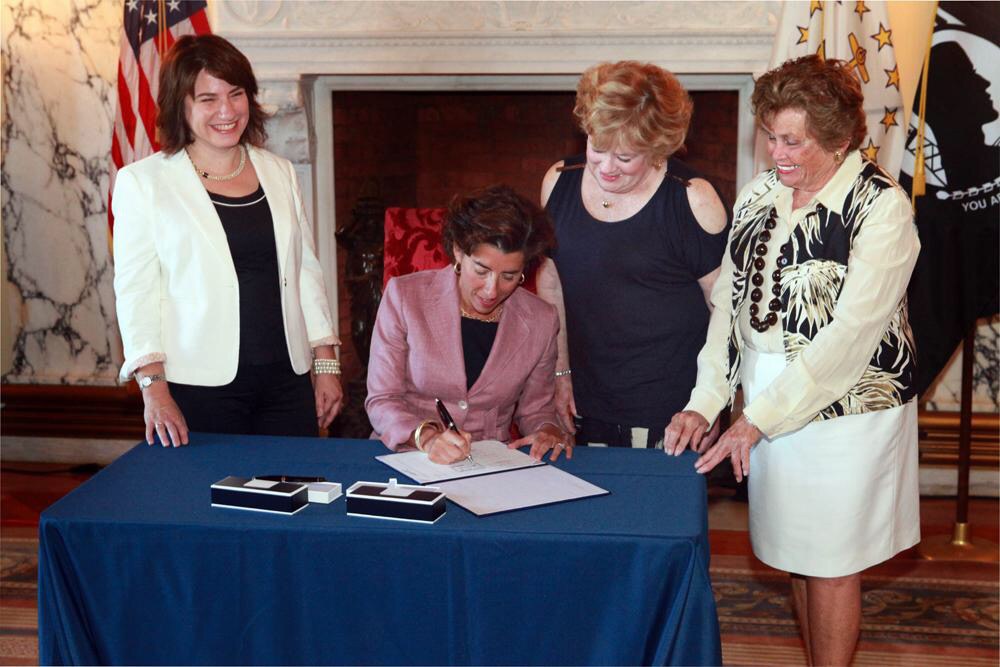
PHOTO: Courtesy of Gayle Goldin
Senator Gayle Goldin (left) attends a bill signing with Rhode Island Governor Gina Raimondo (center).
Individually, these incidents can seem small. Collectively, they are a relentless reminder of how hard women must work to earn basic respect. Sexual harassment and sexism are used to make the victim feel powerless. We learn to quickly calculate the repercussions for speaking up and keep our opinions quiet. We serve as advocates, but we spend too much energy and time trying to placate our colleagues and please the public.
The trouble is, the impacts of this behavior reach beyond me and my female colleagues. When men are not challenged to address their biases, the laws they make reflect them. Equal pay becomes “too difficult for business.” Child care subsidies are “not a priority.” Paid family leave is a “nice perk, but not a necessity.” Threats to reproductive rights are “not worth worrying about.” Removing guns from domestic abusers takes a back seat to guarding a man’s Second Amendment rights.
As more stories of sexual harassment come pouring out, I have thought about why, as women, we pick our battles. I’m finally realizing we shouldn’t have to. We should be able to do our jobs without getting comments about our looks, without having to avoid going into certain rooms alone, and without having to fear for our safety. And we shouldn’t have to mollify our male colleagues and tolerate their bad behavior in order to get a shot at passing legislation that improves the well-being and health of half the population.
We shouldn’t have to tolerate our male colleagues’ bad behavior in order to get a shot at passing legislation that benefits women—like equal pay or paid family leave.
We are elected to be powerful voices, but the reality is we must work twice as hard to be heard. It’s time that women in politics—regardless of party—stand together. I was lucky enough to be elected at a time when the Rhode Island Senate had its first woman president, who hired smart, talented women for our staff and moved women senators into committee chair positions. But the toxic environment won’t change until women are equally represented in every level of government. We need to recruit more women, elect more women, and pledge to support women in office. We need to hold men accountable for their actions and stop electing sexist men, and sexual predators, to office. We need our male colleagues to feel uncomfortable and insulted when a woman is discriminated against or harassed—and to stand up with her.
Mostly, we need to change not only our laws but also how we make them. Yes, we need laws that help create gender equity. But we also need to pay attention to how those laws are made — and to who is in the room. Let’s see state houses where at least half of all committee chairs are women, where every committee has equal representation. Let’s have transparent bill hearing processes and open access to information. Let’s have a government that represents all of us, equally, so that the next generation of women leaders has no reason to join me in saying #MeToo.
Now in her third term in office, Senator Gayle Goldin represents District 3 in Rhode Island. She is one of only 254 Democrat women state senators in the country. She also serves as the family and medical leave insurance campaign advisor to Family Values@Work, a national network of 25 state coalitions leading the movement for better family-friendly workplace policies.