Categories
Health

Thinx is Releasing a $400 Period Sex Blanket


During the last five years, our bedrooms have enjoyed a modern renaissance. We’ve seen the disruption of the mattress industry by companies like Casper, Leesa, and Tomorrow; our sheets have seen a shakeup with the growth of hip new direct-to-consumer bedding purveyors like Parachute, Brooklinen, and Boll & Branch; even our sex toys are more thoughtful than they used to be. Better sleep, better sheets, better sex: It’s basically a triple win.

Still, the period panties brand THINX believes there’s something missing from the mix. And that something is a blanket you can throw down when you’re on your period and want to have sex.

If you’re anything like me, you’re probably thinking: Wait, I have a towel for that. As someone who exclusively buys white sheets (and who’s easily driven to madness, Lady Macbeth style, by a stubborn stain) the idea that a carnal activity would leave my bedding speckled red and brown has always made the supremely unsexy, “hold on, I’ll get the towel” moment worthwhile. It also turned out that, during my single days, most of the men I encountered were game for period sex. In fact, I recall several of them used the same line—the mess is part of the fun!—as if they’d all attended the same woke male period sex sensitivity training seminar.

More often, I was the one who waffled when there was no towel around. Especially when the scene of the coupling was my expensive, pristine sheets. I am fortunate to have freed myself from period shame back in my teen years, and to currently have a partner who isn’t deterred by that time of the month. But what I realized in my twenties was that even if sex during your period was becoming less of a big deal for dudes, the “fun mess” still required cleanup—and I was often still the one with the detergent and scrub brush in the aftermath. Maybe it’s because I knew more about how to lift stains. Maybe it’s because domestic chores will be the last bastion of gender power imbalance in the bedroom. In any event, throwing down a towel was the easiest way to avoid all that.

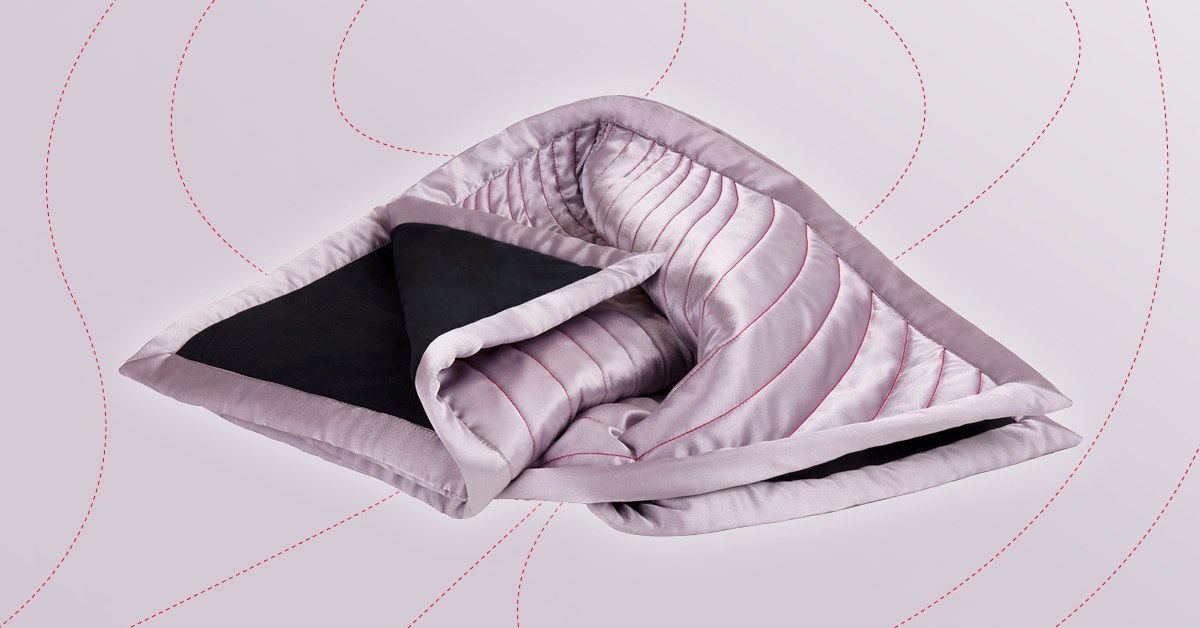
The THINX blanket is, admittedly, much better looking than the towel method. One side is pale lavender satin—a coverlet you could easily leave out at the end of your bed, or on the back of your couch, without anyone thinking, “I bet that’s a period sex blanket.” The cotton-backed side is where the magic happens: It utilizes the same four-layer technology that THINX underwear does, and purports to be capable of absorbing whatever you send its way. The Period Sex Blanket—that’s it’s proper name, no need to obfuscate there—is machine washable. But it needs to be hang-dried; depending on your sex schedule, that could be a drawback, though it also claims to be capable of handling “multiple rounds.”

Still, it’s the price tag that gave me the most pause when the press release arrived in my inbox—$369 for a sex blanket! You could buy tens of towels with that money! You could buy dozens of tarps! You could play a game of Twister and just see where things go!

When I asked Maria Molland Selby, the THINX CEO, about the price, she told me it is meant more to be a conversation starter about period sex than something the company expects every woman to bring into her own bedroom. “We’re not expecting to sell thousands,” she said, with a laugh. The aim is to take the stigma out of period sex in general, and also sing its praises; if they also wind up selling lots of blankets—well, all the better.

And the thing is: Even in this body positive, sex positive world, that conversational spark something we still sorely need. When I asked certain progressively-minded friends, who will talk about pretty much anything, about their period sex experiences, a few refused to go there with me; others said that their partners refused to go there with them. Others still said that, while their partners would be more than willing, they themselves were still working out complicated feelings about the taboo.

There was another camp, too, who thought that it boiled down to trust, comfort levels, and compatibility. “I think you’re more willing to do the grosser, weird sexual things with someone one you feel comfortable experimenting with,” one women told me, in response to a period sex question I posted to Twitter. The takeaway: Trust and acceptance are not things you can buy, like a fancy, highly absorbent blanket. But we’ve all gotta start somewhere, right?

MORE: In Defense of Period Sex


Source link

Categories
Health

Most Period Pain Products Are Pretty Pointless, Actually


There’s something of a boom happening right now when it comes to new period pain products. Take Whoopi & Maya, Whoopi Goldberg and Maya Elisabeth’s line of cannabidiol-infused period-relief products, including a salve, a tincture, and a bath soak all made with CBD (which comes from, you know, cannabis). The founders recently announced the line would be expanding to Colorado (it’s currently available in California). “We’re trying to make people more productive, to eliminate an issue that’s been around for as long as women have been around,” Goldberg explained to The Daily Beast. But let’s take a step back. Are products like these really filling a need, or are they just another ploy to make money off our periods?

Whoopi & Maya is hardly an outlier: The period-product market has recently seen the release of Foria’s “weed tampons,” the shock therapy device Livia, Comforté pain relief cream, “Moon Cycle” tea, and “women’s moon” chocolate. Looking at this list left us with one major question: Does any of this really work?

The jury is kind of mixed. While some research has shown that cannabis aids in pain relief, other research suggests it’s not as effective for women, and there’s no rigorous research specifically on period pain. For her part, ob-gyn Aimee D. Eyvazzadeh, M.D., is not a fan of the marijuana-based period products, particularly since the active ingredients in cannabis can decrease fertility. A study in the Journal of Clinical Investigation, for example, found that THC prevented mouse embryos from getting to the uterus from the ovaries. “While you’re trying to help with your period cramps, you could be harming your chances for a future pregnancy,” explains Dr. Eyvazzadeh.

What about the non-weed-related products designed for menstrual pain relief? Sure, most of them won’t hurt, but they’re probably no more effective than just popping an ibuprofen like Advil or Motrin, says ob-gyn Sherry Ross, M.D., author of She-ology: The Definitive Guide to Women’s Intimate Health. Period.

Livia, which you attach to the part of your body that’s hurting with stickers so that its electrical impulses can target your pain receptors, was tested on 163 women. But Dr. Ross believes the idea of zapping period pain with the push of a button sounds too good to be true and would require more research to be endorsed for severe cramps. Pain relief creams may work, but you’d need to make sure they contain lidocaine and are specifically formulated for pain, she adds. And while foods and drinks or menstrual pain relief may help a little, you don’t need specially labeled food items. Foods with high water content like berries and cucumber can help keep you hydrated, calcium-rich foods reduce cramping, and hot water with ginger can relax the uterine muscles, for example, says Dr. Ross. Classic remedies like hot water bottles and heating pads can also be equally effective options.

So sure, it might be encouraging that more companies are dedicating themselves to women’s health, but this can be a double-edged sword. The more we talk about our vaginas, the more they’ve become the focus of ridiculous treatments, from cucumber cleanses to ground-up wasp nests. When it comes to period products, they might help some women, but the makers of these products are also trying to make money, which means they’re invested in convincing women they need them. In reality, all most of us actually need are pads, cups, or tampons—and maybe some pain relievers.

While we’d all love a quick fix for period pain, there probably is none, says Dr. Ross. You can’t get around the need to maintain a healthy diet, exercise routine, and sleep schedule. That may not be as easy as attaching electrodes to your body or sitting in a weed-infused bath, but hey—at least it’s cheaper.


Source link

Categories
Health

This 20-Year-Old Entrepreneur Started Aunt Flow to Help Women Get Period Products


It’s been less than a year since Claire Coder launched Aunt Flow in November 2016, and there’s been a lot going on since: the company, which sells and donates menstrual products in a buy-one-give-one fashion similar to TOMS, has grown from selling tampons and pads to consumers to getting connected with businesses. It’s part of Coder’s larger mission to make sure everyone who gets a period also has access to free products right in their office bathroom—and, in this case, 100-percent cotton, FDA-regulated, hypoallergenic, and biodegradable free products. (The tampons, it should be noted, are sans applicator—common enough in Europe, and they generate 58 percent less waste, Coder says.)

First things first, though: you better not call them “feminine products” or refer to the category as “feminine hygiene” around Coder. A huge part of her business concept is normalizing the conversation around periods and making it inclusive to a wide range of gender identities. Like the “#JustSayPeriod” campaign by cycle-tracking app Clue, Aunt Flow is all about getting rid of euphemisms. (“Tampons” and “pads” are the preferred terms.) There’s also the recognition that it’s not just cisgender women who get periods: transmen and people who don’t identify as one gender get them, too—so the company has eliminated the gendered pronouns of “her” and “she” from their materials.

As far as why periods, of all things, are her passion, she has a compelling narrative: “Growing up, my mom would talk to me about how many women she would serve—she’s a therapist—who would come to her groups wearing plastic bags or dirty socks when they were flowing,” she told me last December, soon after she started up. “I didn’t understand why. At my house, we always had a stock.” But for people receiving food stamps or WIC assistance, running to Walgreens isn’t financially an option with the cost of getting your period so high—and their assistance doesn’t cover menstrual products. Plus, she says, many organizations that provide tampons to those in need only have enough for two tampons per person per month.

“Craziness,” Coder told me. “I knew I wanted to create a sustainable solution to this problem.”

As of last week, Coder is bringing tampons to the “every-menstruator” (a term she coined to cover everyone who gets a period). The pivot to targeting businesses and organizations has seen her calling upon CEOs—men and women alike—to persuade them to make her tampons and pads available for free in company restrooms. After all, who among us hasn’t been caught out at work when our period strikes unexpectedly—whether it’s due to post-pregnancy spotting, adjusting to a new method birth control, or just switching purses from the night before and forgetting to throw a tampon in?

“I was inspired to start the business because I was at an event and I got my period,” she says. “There were no tampons. It was one of those events where there’s only men—a tech event—and you don’t feel comfortable asking for a tampon. So I had to leave the event early.”

When Coder approaches CEOs to praise the wonders of having free products available to their employees, she approaches it from a language they’ll understand: money—and in a way that totally gets rid of the “we don’t have budget for that” argument. According to research she commissioned with like-minded organization Free the Tampons, it costs more in time for a company to have an employee leave the office and go buy tampons if they’re out than it costs for the company to stock them for free.

But the CEOs that are the most receptive isn’t who you might think: instead of men being the ones to shy away from the idea, they’re the ones embracing it. “Our biggest supporters are typically male high executives,” Coder says. “We call them our flow bros.”

“Whenever we’re talking to men, what we’ve noticed is that these men have never had the opportunity to ask questions, to talk about menstruation in a comfortable environment,” she adds. “Ever since middle school they were separated from the conversation and put in separate heath courses.”

Instead—and surprisingly—it’s women who aren’t up for free tampons for all.

Why? Coder’s theory is this: “Women have been told their whole lives: don’t talk about menstruation. Carry your own supplies—it’s up to you. So female executives have said to me, ‘I have personally have had an experience that was personally embarrassing, but I learned from it: now I carry things with me all the time.’ It’s a really sad system where women have been told over and over again: don’t talk about it; be prepared; it’s your responsibility.”

According to data from Free the Tampons, almost two-thirds of younger women somewhat or strongly agree with the idea of free menstrual products. Conversely, only 33 percent of women 55-plus do. Fifty-five percent of women in that older age group strongly believe that it’s a women’s personal responsibility to be prepared. And yet, according to more data from the organization, a whopping 86 percent of women have had their period strike when they weren’t prepared for it.

She acknowledges that of course it’s someone’s responsibility to have the supplies they might need. “But at the same time bathrooms are not created equal: you don’t carry around toilet paper all the time.” And for people on their periods, menstrual supplies are, in fact, as basic as toilet paper.

“That doesn’t mean there haven’t been great female advocates for the company, but when we look at ratio of our supporters, it’s really been men who have backed us and supported us,” she says. “We haven’t done enough research on understanding why this is, but we always joke if a man turned us down he’d look like a douchebag. Or continuing the patriarchy, right?”

There’s more to come as Coder continues trying to sell companies on the idea that every menstruator should have access to free tampons and pads: to date, they’ve sold enough product that they’ll be donating, in TOMS fashion, 60,000 menstrual products to organizations around the U.S., she says. And, after all, she’s not even 21. But when she finally hits the age when she can “talk about it over drinks” with potential clients (that’s February 27, by the way), you better believe she’ll be ready.


Source link

Categories
Health

A Shocking Amount of Women Say Period Pain Has Affected Their Job


Despite what some men try to claim, period pain is zero percent a myth for many women. Wrenching waves of cramps, throbbing lower back pain, and vise-like headaches are par for the course every month for some of us, with varying levels of pain—and that doesn’t include the sudden onsets of tears, general rage, or never-ending refrigerator raids others experience. But what’s even worse than having to go through all of this every 28 days or so is that we still have to schlep our bloated, pained selves to an office in work-appropriate clothing (versus our old college sweats), pretend like nothing’s wrong, and make it through the day.

As miserable as those nine-plus hours of work can feel, though, there’s probably some solidarity in the office: 42 percent of women said that period pain has affected their job, according to a recent YouGov survey. Unfortunately, 82 percent also said that their employers don’t make any accommodations for this recurring health issue that half the population faces.

According to the survey, most women whose period pain is so severe that they have to take time off don’t feel comfortable telling their employers the real reason. Out of the 30 percent of respondents who said their period pain was bad enough that they stayed home, 68 percent said that they didn’t tell their supervisors the real reason. Only 6 percent of the total respondents said that they’d be comfortable discussing with their boss that period pain was affecting their work.

There’s still a long way to go for most companies when it comes to acknowledging this, however—and sadly, there’s precedent for women to be nervous about discussing debilitating period pain with their supervisors. Although some companies allow women to take period leave, other women have been fired for getting their period on the job. In June, a model was allegedly fired by Hyundai after asking repeatedly (and not being allowed) to use the bathroom to change her tampon during an auto show she was working (Hyundai said the model was fired due to “poor performance”). More recently, a 911 call taker was allegedly fired due to accidental period leaks at work.

To be clear, no one is asking for a ready supply of hot water bottles in the break room (although…), but a little understanding—and maybe not getting fired—would go a long way in corporate culture.

Related Stories:
Woman Sues Former Employer for Firing Her Over a Heavy Period
This Model Claims She Got Shamed and Fired for Being on Her Period During a Job
Do Our Brains Really Work Differently When We’re on Our Periods?


Source link

Categories
Health

There's a Reason Your Ob-Gyn Always Asks When Your Last Period Was


When you visit your ob-gyn, there are a few things you can always count on: You’ll talk about your vagina and she’s going ask what the first date of your last period was. The period question makes sense if you’re going to the doctor because you’re pregnant or you’ve been having irregular periods, but it seems kind of irrelevant otherwise. Turns out, it’s actually not as random of a question as you might think.

“Almost everything we talk about revolves around the menstrual cycle,” says Maureen Whelihan, M.D., an ob/gyn at the Center for Sexual Health & Education. And knowing when your last menstrual cycle started helps with diagnostics, says Lauren Streicher, M.D., an associate professor of clinical obstetrics and gynecology at Northwestern University Feinberg School of Medicine and author of Sex Rx: Hormones, Health, and Your Best Sex Ever. “The No.1 reason why someone comes in is that something is wrong with them,” she says. “So many potential diagnoses are dependent on where someone is in their cycle.” And, of course, doctors do still want to rule out that you aren’t pregnant and figure out if you have a regular cycle, says board-certified ob-gyn Pari Ghodsi, M.D.

Here are just a few issues where your the date of your last period helps more than you might have realized:

You found a lump in your breast

Naturally, that can make you freak out and assume that you have breast cancer, but where you are in your cycle will help your doctor figure out how they should respond. If you’re young, found a bump, and it’s three days before your period, Streicher says she’s less worried than if you just finished your period. “Many women will develop cysts and bumps right before their period,” she says, adding that she often tells women to come back after their period for another check (it’s usually gone by that point).

Your discharge looks different

You might not realize it, but your discharge actually changes with your cycle, says Whelihan. In the first half of your cycle, there’s a lot of mucousy, clear discharge; in the second half, it’s more white, milky, and thick, she says. If you suddenly experience thicker discharge in the beginning of your cycle, it could be a sign that something is off—but if it’s in the later half, it’s probably nothing to worry about.

You have spotting

If you’re spotting in the midway point of your cycle, it could simply mean that you’re ovulating. Some women spot a little when they ovulate because a little bit of their uterine lining breaks down before their period, Streicher explains. But spotting during a different time in your cycle could mean that you have uterine fibroids, a polyp, or some other condition that needs to get checked out. Either way, the period question helps your doctor know what they should start looking for.

You’re having vaginal pain

There can be dozens of reasons for this, which is why Streicher says the period q is so important to help docs ID the source. If it happens after you missed a period, your doctor may try to find out if you’re pregnant and what could be causing you pain. But if you’re not pregnant or you didn’t miss a period, it could be a sign of an ovarian cyst or even something that isn’t related to your vagina at all. “So many women think the minute they have pelvic pain that it’s ovarian cancer, but it could be IBS,” Streicher points out. “There’s a lot going on in the pelvis that doesn’t apply to your gynecologist.“

You’ve been trying to get pregnant with no luck

Understanding where you are in your cycle can let your doctor help you plan for pregnancy attempts, Whelihan says. Heads up: Your doctor will probably want to know the first date of your last six periods, Streicher says, so they can figure out how regular you are and the length of your cycle to help time when you should try to have sex.

So, next time you head to your ob-gyn, come prepared to answer the period question—it’s actually really important.


Source link