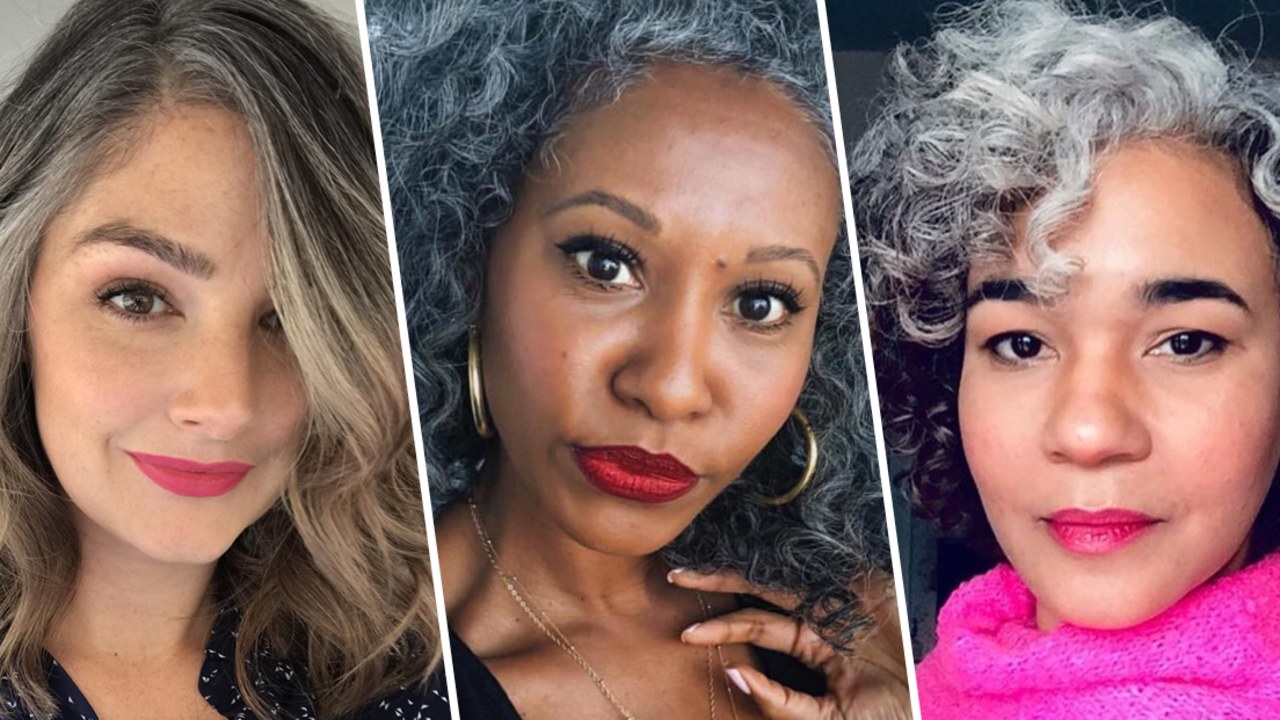
Elizabeth Collins was 13 years old when she started going gray. As any teenager would do, she colored her hair dark brown, sometimes black to cover up her gray hairs, settling into a cycle of coloring it every four weeks. But four years ago, she decided to stop. “I was pregnant with my fourth daughter and knew I wouldn’t have the time to do it myself or get it done,” she says. “I’d been thinking about it for a couple of years, and once I decided to do it, I knew nothing would stop me.” Now, at 31, she’s documenting her transition into gray on an Instagram account she made specifically to track her progress, @young_and_gray29.
She’s not alone. You might have noticed that lately, gray hair is on a redemption tour. You could even call it cool—so much so that women are now seeking it out advice on how to grow it out instead of frantically Googling “does tweezing a gray hair really mean that three grow back in its place?“ (For the record, the answer to this is no.)
The collective embrace of gray hair is inarguably a good thing. After all, chasing away grays can be as futile, time-consuming, and expensive as trying to locate an actual fountain of youth. “Coloring my roots every three weeks was getting expensive,” says Nicole Andrus, who’s in her mid-30s. Plus, the burden to conceal gray hair falls disproportionately on women. “I was really annoyed with the double-standard for men and women when it came to gray hair,” says Collins. “My dad, whom I inherited my premature gray hair from, had never felt the pressure to color his hair. Yet it was expected of me.” Even the language we use when describing men who have gone gray is favorable—salt-and-pepper, Silver Fox, distinguished—far from the “you better cover it up” messaging targeted at women.
That’s slowly starting to change, though, and the effort has been aided in part by style-setters like Vogue UK fashion features director Sarah Harris, who first began going gray in her teens, and Instagram accounts like @grombre, which re-posts and celebrates women who show off their new silver growth (a.k.a. their gray-ombré). What began as a resource to help women feel less embarrassed or ashamed about grays has now grown into a community of 74,000 where its followers share stories about why they decided to transition.
“It just hit me one day. I was done. And I was scared,” wrote one woman on Grombré. “I researched and found that I wasn’t the only one going through this rollercoaster and that I could get off. So I did. Two months dye free. I feel free. The gray no longer disgusts me. I feel powerful. Not everyone gets it, but that’s OK. I may have aged myself, but that’s OK too. I look at myself and I don’t feel like I’m letting myself go. I know that’s what we have been programmed to believe. But it simply isn’t true.”
Celebrities, too, have played a big role in this shift. First, at the 2018 Golden Globes, Jessica Biel, 36, walked the red carpet with a few subtle gray streaks in the front of her updo. Then, at the 2018 Grammys, Katie Holmes (who is 40) had a few silver slivers peeking through parts of her dark hair. Chrissy Teigen even tweeted about her grays (“I have a skunk like streak of grey hair and I’m actually very into it. My Cruella dreams are coming true!”), which women responded with enthusiasm and selfies, showing how they embrace their own gray hair. “I find new grey hairs on my head every day and I LOVE THEM,” one user wrote. “I’m only 24, so I’m not sure why they’re already here but I call them my unicorn hairs.”
What makes this movement feel so revolutionary, though, is that it’s not about 20-something influencers getting ashy, faded, Instagrammable silver-blonds. It’s about women owning what happens to us naturally.
“I was 31 and always coloring my hair—but within a few weeks, would have a silver stripe down my roots,” says Liz Kamarul, now 34, who’s blogged about going gray. “It just so happened at the time that silver hair was very popular and everyone was coloring their hair intentionally that way. I thought to myself, well, I have this naturally, so I might as well go for it.”
But that doesn’t mean the transition is easy. Despite the supportive networks on social media, women say they’re still feeling pressure from friends and family who are stuck in antiquated mindsets. “The biggest challenge is seeing social media memories of when I had dark brown hair,” says Andrus. “And before I went with it, I had so many people try to convince me I was ‘too young’ to go gray.” Janelle Gambino, who stopped coloring her hair at 38 after going gray at 22 and now documents her progress at @nellegreyz, says, shockingly, that it was women who gave her a harder time about her transition than men. In some cases that only strengthened their resolve though. “Once I told family and friends about my decision, I felt like I had to show them I could do it,” says Collins.
And then there are more surprising barriers to make it happen, like finding a colorist who agrees to help. (Really.) “When I talked to my stylist about letting it go [gray], she flat out refused to ‘condone’ it,” says Andrus. “I had to ask three colorists before I found one who would help me transition to gray.” She also found support from her husband (who, she thinks, is happy with the money they’re saving) and the Grombré account on Instagram. The women featured on it helped her stick to it, even though she’s been tempted to color it back. “My own mother still doesn’t have gray hair,” she says. “Every once in a while I’ll come across a gorgeous caramel color on Pinterest and think ‘Oh, I love it!’ But I remember how much upkeep it is. Will I ever color my hair again? I don’t think so. But I’m still working on separating the idea that gray means old.”
Plus, even once you decide to ditch the dye, your new color still needs special care of its own. If anything, gray hair can be trickier to care for than what you’re used to, even if you’ve had a standing appointment with your colorist for a decade.
Plan the Transition
First, know that growing out your grays could take awhile. “Grays seem to take forever to grow when you are actually trying to grow them,” says Collins. “I had moments that I just hated my hair when it was half-grown out and half-dyed hair, but I decided to tough it out.”
It’s almost a rite-of-passage in and of itself. “There are no shortcuts when it comes to Mother Nature and how fast your hair will grow,” says Min Kim, senior color specialist at Butterfly Studio Salon in New York City. Gray hair could grow in unevenly or look patchy if you’re only working with a few inches (in the same way that grown-out roots can look like you skipped a touch-up).
But even those with a game-plan can run into trouble. “I decided to color the majority of my hair bright white-blond and have it blended very close to my roots, so it would be less harsh as it grew out,” says Kamarul. “The hardest part was finding a hairdresser who could lighten my very dark brown hair that much without damaging it.”
Certain hair color formulas can blend or ‘camouflage’ the gray, according to Rebekah Nash, a colorist at Cutler Salon in New York City, who’s a fan of Redken’s Color Camo for Men line. She says she uses it for anyone who wants to add a little more “pepper” to their gray. It’s also ideal if you’re growing out a single-process color, since it’ll soften the line of demarcation. But if you’re looking for more “salt”—i.e. brightening the gray that’s grown in—a colorist can place highlights strategically to make that happen.
And for the more obvious advice: You can also just let it do its thing. That’s what Gambino has been doing. Her last color appointment was in March 2018.
Adjust Your Hair Care Accordingly
Once your grays begin growing in, you might need to tweak your routine to complement both the new color and texture. “Natural gray hair can lose its luster, often turning a slight yellow hue,” says Nash. “To keep hair looking bright, use a shampoo and conditioner containing silver or violet tones.” Try Davines Alchemic Shampoo Silver, which gently cleanses hair without harsh sulfates, or Clairol Shimmer Lights Shampoo – Blonde & Silver (it’s a stylist fave).
A heavier conditioner will also help, since gray hair is inherently dry. “As we get older, our scalp produces less sebum, or oil, which results in a drier and rougher hair texture,” Nash says. “In other words, the hormones that cause us to lose our natural pigments are the same ones that change the oil we produce to nourish new hair growth.” Try a moisturizing conditioner that has brassiness-neutralizing purple tones, like Sachajuan Silver Conditioner. Then, consider blow-drying your hair instead of air-drying it. “The actual gray hair is not shiny, so if you don’t blow-dry it, it can look very dull,” says Nunzio Saviano, hairstylist and owner of Nunzio Saviano Salon in NYC.
Don’t Be Afraid to Experiment
Sure, you might not want to go to the salon every week—but you can still experiment once you’re silver. “A few well-placed highlights, lowlights, or gloss can go a long way to complementing the gray,” Kim says. “So feel free to have fun and try things out.” That’s what Kamarul did a few months ago. She dyed her ends a lighter blond “to keep the bottom brighter” so it looks more intentional.
Despite the challenges, though, women who’ve embraced their gray agree that it’s worth it. For some, it’s a work in progress. “I’m still figuring out how to detach my ideas of youth and beauty from a box of ‘rich caramel brown,'” says Andrus. But across the board, those who’ve done it are happy with it. “My hair has never been so low-maintenance and received so much positive attention,” says Kamarul. Collins agrees. “I’ve had more compliments on my natural gray hair than I ever had on my dyed brown hair,” she says. “I have never been as content with my hair color as I am now.”