Since the shocking sexual harassment allegations were first reported against Hollywood mega-producer Harvey Weinstein in October, there’s been an avalanche of accusations against other power players in media, business, and yes, Hollywood. (If you, too, are having a hard time keeping up, we created this—horrifying, frankly—list of the latest men facing allegations, which we’re updating.)
In the wake of all these accusations, the concept of “toxic masculinity” has become a hotly debated topic. How are we (or “the patriarchy”) as a culture subtly reinforcing the kinds of stereotypes that may lead to detrimental behavior patterns? These stereotypes, like the idea that men are supposed to be “strong” and never show emotions, can easily lead to misogynistic ideas or acts. (Picture, say, a certain American president dismissing certain comments made on a certain Access Hollywood tape as “locker room talk”—typical male banter, made in jest, and not to be taken seriously.)
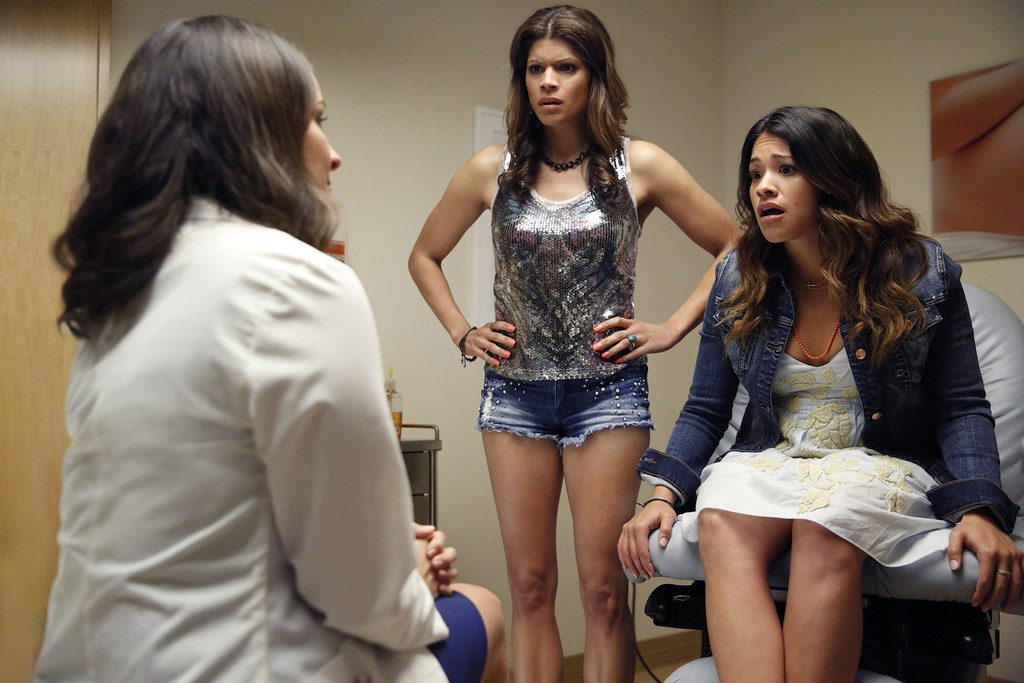
One of the emerging voices in this conversation is a surprising one: Justin Baldoni, an actor best known for his work as the—often shirtless—Rafael on Jane the Virgin.
At the TEDWomen conference in New Orleans, Baldoni gave an impassioned talk on the subject, saying the characters he’s often asked to play actually feel all too similar to the one he’s been encouraged to play all his life: a stereotypical man’s man. “This is the script that we’ve been given,” he said. “Girls are weak, and boys are strong…. I came here today to say as a man that this is wrong, this is toxic, and it has to end.”
Baldoni has started leveraging his impressive social following—1 million on Instagram, 160,000 on Twitter—to tackle this issue head-on, and, as he tells it, he got a really great response [from women]. In an effort to court more male followers, he started posting more content that felt stereotypically male—workouts, meal plans, etc.—and lo and behold, not only did men start to engage with him, but a men’s fitness magazine even offered to feature him as one of their “game changers.” (The irony of the moment was not lost on Baldoni.)
But Baldoni isn’t giving up. He’s developing an online talk show, titled Man Enough, and he’s putting himself out there at conferences like TEDWomen. “I believe that as men, it’s time we start to see past our privilege and recognize that we are not just part of the problem, fellas, we are the problem,” he said during his TED speech. “The glass ceiling exists because we put it there. And if we want to be a part of the solution, then words are no longer enough.”
I spoke with Baldoni at TEDWomen following his talk to discuss the correlations between these masculine tropes and pressing issues like sexual harassment in the workplace. (And yes, I asked if he ever worries about doing exactly what he rails against—taking command of a conversation in the women’s space and “mansplaining” it.) Read his responses, and watch his speech at TEDWomen below.
Glamour: Let’s first address that Glamour’s audience might not necessarily be the demo you’ve said you want to reach. What are the men’s brands you want to be interviewing you about this stuff?
Justin Baldoni: I think as a young man, I would collect Men’s Health and Men’s Fitness and GQ, Esquire, and all those magazines. As an actor, it was always kind of a bummer that none of them ever wanted to talk to me…. Part of it is also because I’m on a feminist show, primarily watched by women…. I’ve had my reps tell me, bluntly: “Men’s magazines are not going to write about you because you’re too feminine and because you don’t attract a male audience.” That’s just where it becomes frustrating because the men that I really want to have dialogue with are not listening unless their girlfriends tag them or their girlfriends send them something that I said…. And that’s a bummer because in reality I’m not telling them they have to be different. I don’t think that men have to change. I don’t think there’s anything wrong with men inherently; I think it’s what we’ve learned and the roles that we play.
“The glass ceiling exists because we put it there. And if we want to
be a part of the solution, then words are no longer enough.”
Glamour: I’m sure it’s anxiety-inducing to speak at TEDWomen because you run the risk of mansplaining a women’s issue.
JB: I actually hired a very good friend of mine who’s a very powerful feminist, and I had her tell me and make sure that nowhere in my talk was I mansplaining. There’s no way that I could have given this talk without the support and help of women, there’s just no way. By nature I would have mansplained something because I have the privilege of being a white male and I’ve been mansplaining my whole life—that’s just the way it is. I did everything I could to take out any part that could potentially be that, or to just be aware of what I was saying, because I really wasn’t trying to talk to women, I was really trying to talk to men.
Glamour: Working at a women’s media publication, we speak pretty openly about the “lady media” tropes that now feel incredibly not modern. For example, the myth of “having it all.” What are some of the men’s media tropes that you’ve run into?
JB: I’ve got to be honest, it breaks my heart when I look at both…. Men’s Fitness reached out to me to be a game changer, and what was interesting was that they knew about me for a few years, but it wasn’t until I started talking about working out—like how I tore my pec and I kind of followed my journey the whole way—that they were able to sell it up the chain. And that’s the bummer; it has to be, “Oh yeah, he’s a regular dude too,” because that’s the entry point. But at the same time that’s also a gift because I now understand the psyche of the system. If I want to talk to men, I do have to kind of be a man…. Because if I’m a “girly man,” then they’re not going to listen, but if i can do more pull-ups than you and if I can do that crazy workout that I guarantee can kick your ass, then you’ll listen to me, right? Like all right, cool, maybe I’ll start a whole fitness plan, maybe I’ll do something masculine-focused because I’m cool being a Trojan horse. I have to imagine that I was built the way that I was for a bunch of different reasons, but I have the heart that I have for a reason as well.
If I can be an entry point to help men recognize that being feminine and masculine is OK, then that’s beautiful work that I’m honored to do.… I hope that male fitness magazines and male magazines in general can put as much emphasis on men that are leading with their hearts, and men that are championing women, and men that are standing for equal rights as they do with the men that are making billions of dollars playing sports and men that are alpha males.
Glamour: In your talk, you also discuss sexual harassment and the “Me Too” phenomenon, and it must be acknowledged that women aren’t the only victims. Did you ever feel like you were harassed or victimized on set?
JB: When I was 21 or so, I was very new in the business. I had just done my first show and a girlfriend at the time had gotten me a spa certificate to go to Burke Williams in West Hollywood. I remember there were hot tubs and steam rooms and all kinds of stuff, and it’s kind of fancier people, wealthier guys. I went and jumped in the hot tub and I saw a guy kind of look over. I saw him look over at me, jump out of the other hot tub, and jump in with me, and he said, “Oh what do you do?” And I said, “Oh I’m an actor,” and he said, “Oh I’m a producer,” and he started talking about all of the movies he’s done and all the people he knows. He’s friends with Clooney, Cheadle, and this person and this person, and he slowly started to try to get me to take off my pants because I had my bathing suit on and he was naked.
And I remember the way he did it, using his power and what he does and who he knows as a way to make me feel less than, like I wasn’t going to be as successful as the other guys who’d been in the same hot tub with him, naked. I just remember that feeling and having a moment of saying, “Well, should I do that? And where does that lead?”… I remember a split second [of thought], and then going, “What? No,” and just leaving. I could imagine how hard and painful that must be for a woman. I mean I was stronger and bigger than the guy, and [then there’s] the fact that no one is going to believe you if you’re a woman because your voice is already not heard…. I’ve also experienced [harassment] as a man from women of power…. I’ve had my ass grabbed multiple times by powerful women.
I just think the system is broken, but thank God we’re now at a place where, as gross as it sounds, the infected pimple is finally being popped and healing can actually begin…. And then the other thing men are going to have to start doing now is recognizing when they did it and didn’t realize it. I think that’s when the other side of the “Me Too” movement is “I’m Sorry.” I guarantee at some point in my life there is a woman or two that I in some way made uncomfortable by saying something or doing something that was chauvinistic or sexist. There is one million percent probability that that exists, and all I can do is say, “I’m sorry, I was naive, I was young, I screwed up, and I’ll try to do better.”
“We’ve built in this system—the opposite of accountability—and now
it’s time to figure out how, as men, we can break that system.”
Glamour: For men who may have been enablers—either inadvertently or because they were intimidated—do you have any script or recommendations for guys to help combat this behavior in the moment?
JB: Well, can you be man enough to actually say something? The fact is that so many of us men are so terrified of losing our standing with our other male friends or our standing at our jobs because, at the end of the day, it’s a fraternity. The hierarchy of power is just a big fraternity, and if you go against one of your brothers, then you’re breaking this thing they call “the guy code.” Growing up, how many times did I hear “bros before hoes”? Just think about it. First of all, how demeaning, how sexist. What are we saying about women, and how we’re saying the importance is us, not them. Right? It’s the worst thing you could say, but all young boys, teenagers, guys, we get it. So you have a 17-year-old boy that witnessed another boy date-rape a girl? Bros before hoes. Are you going to break the guy code? We’ve built in this system—the opposite of accountability—and now it’s time to figure out how, as men, we can break that system, and it starts with showing what a real man is. A real man is someone that says, “Hey man, we’re still friends, but that’s not cool.”
Or if it’s a director or someone that’s in power, you could say, “I want to bring this up because I’m worried about you and this could be perceived the wrong way.” Every situation is different…. Men have to start small because it takes a lot of courage to stand up to another man and go against everything you’ve been conditioned to say…. Or in some cases it’s so obvious that you do need to stand up and say something. Like if you’re hanging out and you see a girl who’s so wasted and your buddy’s not, say, “No, don’t take her home, man, what are you doing?” Stop him. I think that it’s going to take some strong men to be willing to stand up and do that, so, hopefully, now thanks to the bravery of women, that men will finally find the strength to do the same thing.
This interview has been condensed and edited for clarity.
Watch Justin Baldoni’s speech at TEDWomen 2017: