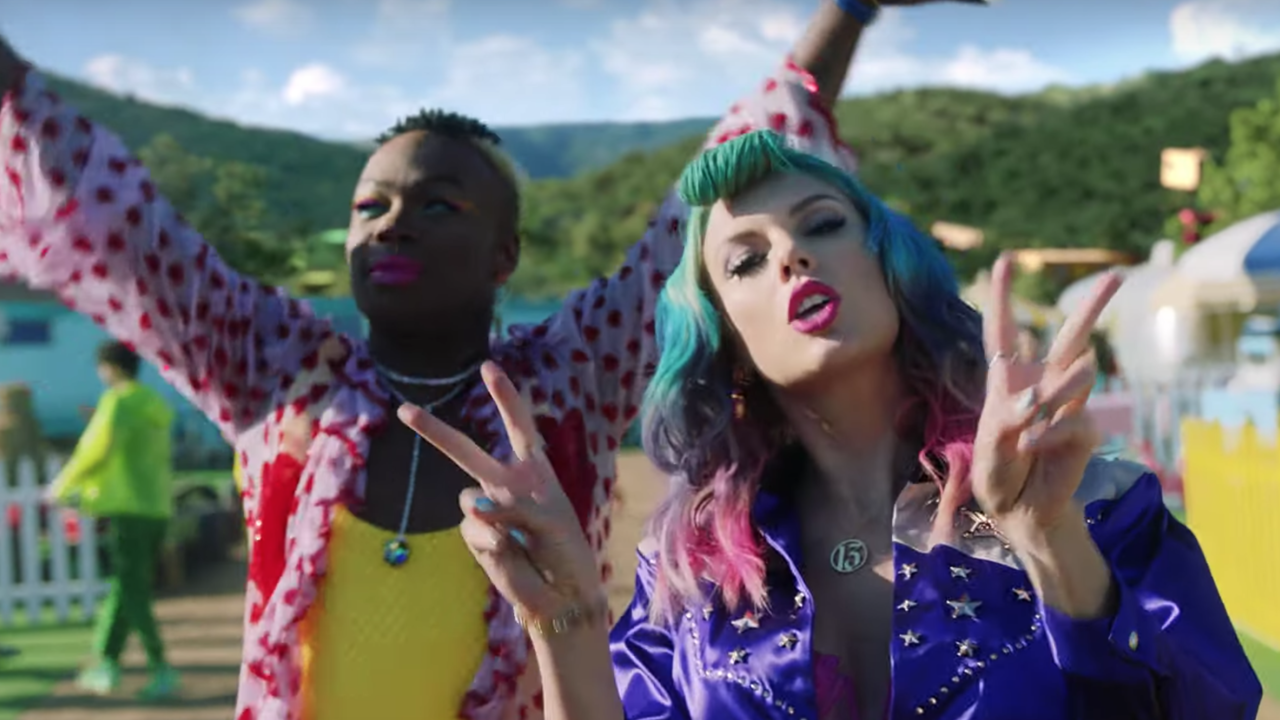
Taylor Swift has seemingly caused the gay apocalypse this week, with queer people running through the streets, banging pots and pans, and clashing over their feelings about her new music video, “You Need to Calm Down,” which dropped Monday. The video is the latest rainbow-painted moment in Swift’s new Lover era and features strong pro-gay messaging, including numerous cameos from LGBTQ+ stars like the Queer Eye Fab 5, Laverne Cox, Billy Porter, Ellen DeGeneres, and Hayley Kiyoko. At the end of the clip, Swift has a message urging fans to sign a petition demanding Senate support on the Equality Act.
Discourse over the video among queer people is, unsurprisingly, a mixed bag. Some fans are thrilled to have such a major pop act use her platform to effect potential change. Others feel that Swift isn’t reading the room; that a heterosexual-identifying person saying, “This is how you do gay rights, bitch,” feels silly in 2019. Especially since Swift was criticized heavily for being apolitical her entire career—even when the country could have used her voice in 2016. I understand how words like exploitative and opportunistic are making their way into discussions about the new video, and about Swift’s sudden, aggressive LGBTQ+ support (see also Swift’s surprising gay fans with a performance at Stonewall).
Then there’s the suggestion that Swift has been baiting fans with intimations that she, herself, is coming out, which is all Internet hearsay at this point. Theories about Swift’s alleged queerness have always existed—speculation goes back as far as 2008, with rumors about Swift and her fiddle player, Emily Poe, being romantically involved. There’s also an entire corner of the internet that believes Swift and her former best friend, Karlie Kloss, were actually dating. Shit really hit the fan, though, in April when rumors about Swift’s planning a coming-out announcement tore through Twitter like a lesbian natural disaster. Seemingly everyone on gay Twitter was talking about it:
Everything gay Twitter has dissected and dubbed a queer clue—the Kaylor theories, the “bisexual hair” in the “Calm Down” video, posting the words “ME! Out now!”—is just subtext, allusions, teases. But “clues” are currency for Swift. For years she’s hidden secret messages in her music videos, social media, and album covers, and encouraged fans to decode them. So even though she’s never explicitly said, “I’m coming out,” she has absolutely given Swifties the okay to sleuth. That’s the only reason speculating about her sexuality doesn’t feel wholeheartedly gross or wrong. She knows fans will read into her imagery. Even still, it’s important to note that none of us is entitled to information about Swift’s personal life. However she chooses to identify—and chooses to talk about it—is valid and 100 percent her business.
Swift obviously hasn’t come out. Instead, she says she’s an ally, which she declared on Tumblr this weekend in response to rumors that she and Katy Perry would kiss in the video. In the post she defended herself as knowing the difference between “allyship” and baiting: “To be an ally is to understand the difference between advocating and baiting. Anyone trying to twist this positivity into something it isn’t needs to calm down.”
Here’s the thing, though: It would be a win for representation if Swift, arguably the biggest mainstream pop star in the world, came out. It’d prove, once and for all, that queerness isn’t shameful or weird. Yes, things are marginally better for queer people these days, but not everywhere. Gay marriage has been legalized, but the quality of life for a queer person is still mostly subpar, even in the most progressive areas. I was lucky to be born into a liberal family, and I currently live in Los Angeles, where I’m surrounded by queer people—but I still get nervous in every public space where I hold hands with my girlfriend. And after growing up in a conservative, Catholic, Republican hometown, I’m still chipping away at all the trauma and shame surrounding queerness that feels irreversibly lodged in my core.