Categories
Health

Watch Sexual Assault Survivors Confront Sen. Jeff Flake After He Confirms Kavanaugh Vote


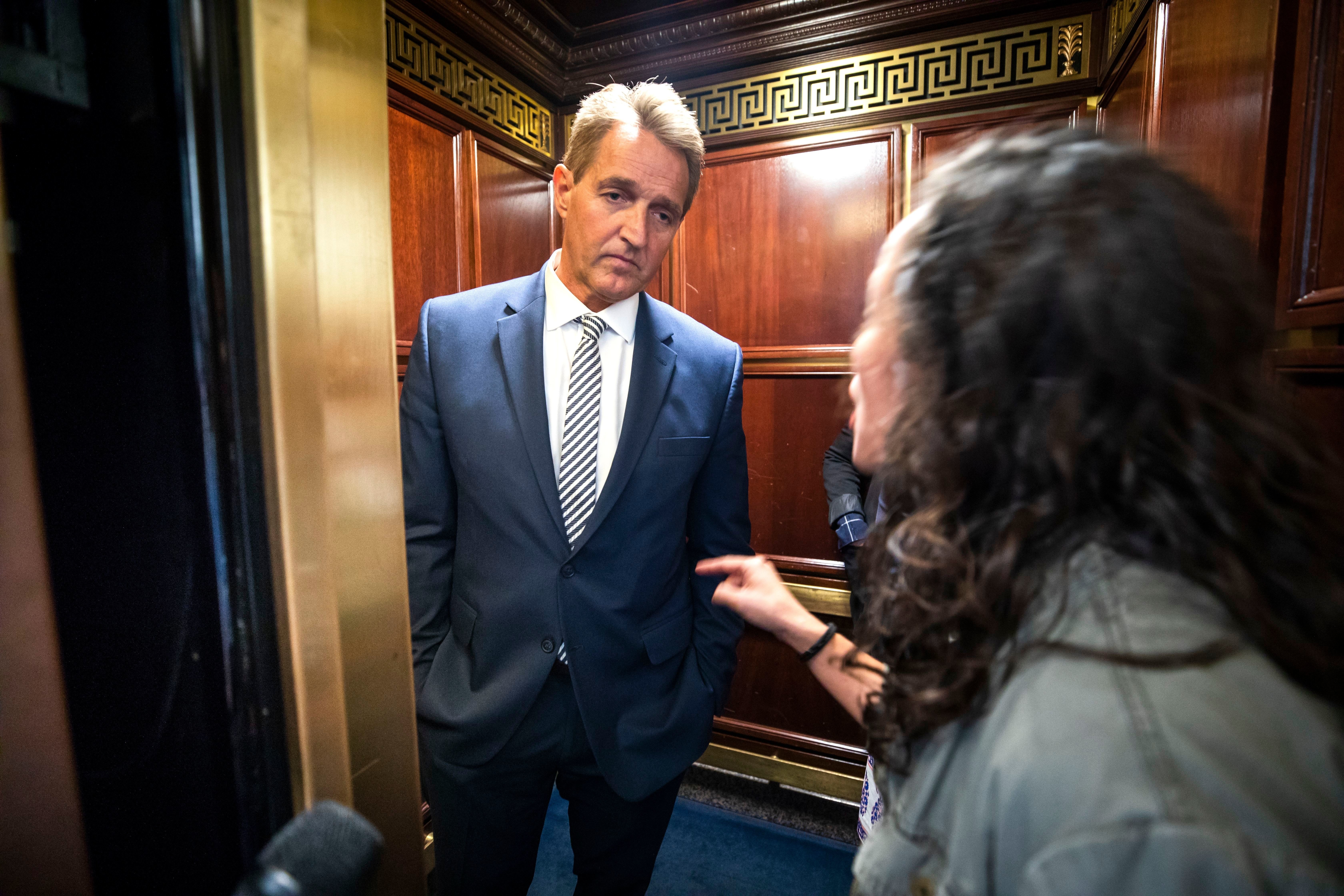
Sexual assault survivors confronted Senator Jeff Flake (R-Ariz.) and shared their experiences of abuse on Capitol Hill Friday morning, just moments after he announced his plans to back Judge Brett Kavanaugh in Friday’s Senate Judiciary Committee vote.

The Committee’s vote to move Kavanaugh’s nomination forward was scheduled less than 24 hours after the country heard tense and emotional testimony from both Kavanaugh and Christine Blasey Ford, the woman who has accused him of sexual assaulting her in 1982. While Flake, a key Republican swing vote, had indicated that he was undecided about Kavanaugh, he released a statement sharing his intentions to bring the embattled nominee closer to the Supreme Court. A short time later, a group of protesters followed Flake to an elevator and let him know what message he was sending to women and to survivors of assault.

“I was sexually assaulted and nobody believed me,” one woman told him through tears. “I didn’t tell anyone, and you’re telling all women that they don’t matter, that they should just stay quiet because if they tell you what happened to them, you’re going to ignore them. That’s what happened to me, and that’s what you’re telling all women in America, that they don’t matter, that they just keep it to themselves.”

Flake remained silent during the exchange, looking down at the ground. The woman continued, urging him, “Don’t look away from me. You’re telling me that my assault doesn’t matter… That’s what you’re telling me when you vote for him.”

“Senator Flake, do you think that Brett Kavanaugh is telling the truth?,” another woman asked.

Eventually, a reporter asks Flake if he wants to respond to the protesters’ concerns. Flake says simple, “No, I need to go to the hearing. I just issued a statement, I’ll be saying more as well.”

In his statement, Flake said that he hadn’t seen enough evidence that corroborated Ford’s story.

“Yesterday, we heard compelling testimony from Dr. Ford, as well as a persuasive response from Judge Kavanaugh. I wish that I could express the confidence that some of my colleagues have conveyed about what either did or did not happen in the early 1980s, but I left the hearing yesterday with as much doubt as certainty,” he said.

His vote is expected to round out support in the Judiciary Committee. After Friday’s vote, Kavanaugh’s nomination will continue to move through a full Senate vote. Republican leaders have said they will push to confirm Kavanaugh by early next week.

Related Stories:

During Christine Blasey Ford’s Testimony, Contempt for Women Was on Full Display

A Tale of Two Cities: A Snapshot of Washington D.C. on the Historic Kavanaugh-Ford Hearing Day


Source link

Categories
Health

Jeff Sessions Just Made It Impossible for Domestic Violence Survivors to Qualify for U.S. Asylum


A new ruling issued Monday by U.S. Attorney General Jeff Sessions stands to put women who are fleeing gender-based or gang violence in their home countries in danger by turning them away from the nation’s borders.

In short, immigrants under the threat of domestic violence will not qualify for asylum in the United States, a move that has left critics baffled by what dangers do qualify for protection. The decision is likely to affect tens of thousands of people hoping to have their immigration cases reviewed, and is a particularly blow to women who have come to this country to escape instances of violence.

“The mere fact that a country may have problems effectively policing certain crimes — such as domestic violence or gang violence — or that certain populations are more likely to be victims of crime, cannot itself establish an asylum claim,” Sessions wrote in his 31-page opinion.

Sessions came to this conclusion after personally intervening in Matter of A-B-, a case that revolves around a woman from El Salvador, who had said she had been sexually, emotionally and physically abused by her husband for more than 15 years. She had been granted asylum through the Board of Immigration Appeals on the grounds that, as a woman unable to leave a violent relationship or receive protection from her government, she had suffered persecution related to her particular social group.

However, Sessions reversed the board’s ruling, saying it had “been wrongly decided.” His move represents a much tougher stance on immigration and a sharp change in previous policies that had been more sympathetic to survivors of domestic violence since 2014, when a kind of precedent had been set by the case of a Guatemalan woman named Aminta Cifuentes. She was granted asylum after describing how her husband had burned her with acid and punched her—even when she was pregnant— for over a decade. After Cifuentes, other victims who had left their countries shared similar arguments for why they should receive asylum protections in the U.S.

Immigrant rights activists have pointed out that Sessions’ ruling will hit hardest when it comes to women fleeing areas like Central America and parts of Mexico, where gang and gender-based violence is especially high. According to a 2015 United Nations report, a “surging tide of violence” has swept over countries like El Salvador, Guatemala, and Honduras, forcing thousands of women and children to leave their homes every month. As part of the report, women told the UN they faced violence—such as rape, assault, extortion and threats by gangs—on a daily basis. Escaping to the U.S. and asking for asylum was often a final recourse for such victims

“What this decision does is yank us all back to the Dark Ages of human rights and women’s human rights and the conceptualization of it,” Karen Musalo, a defense lawyer on the case, told the New York Times.


Source link