Categories
Health

Ilana Glazer and Jameela Jamil Are Using Humor to Change the World


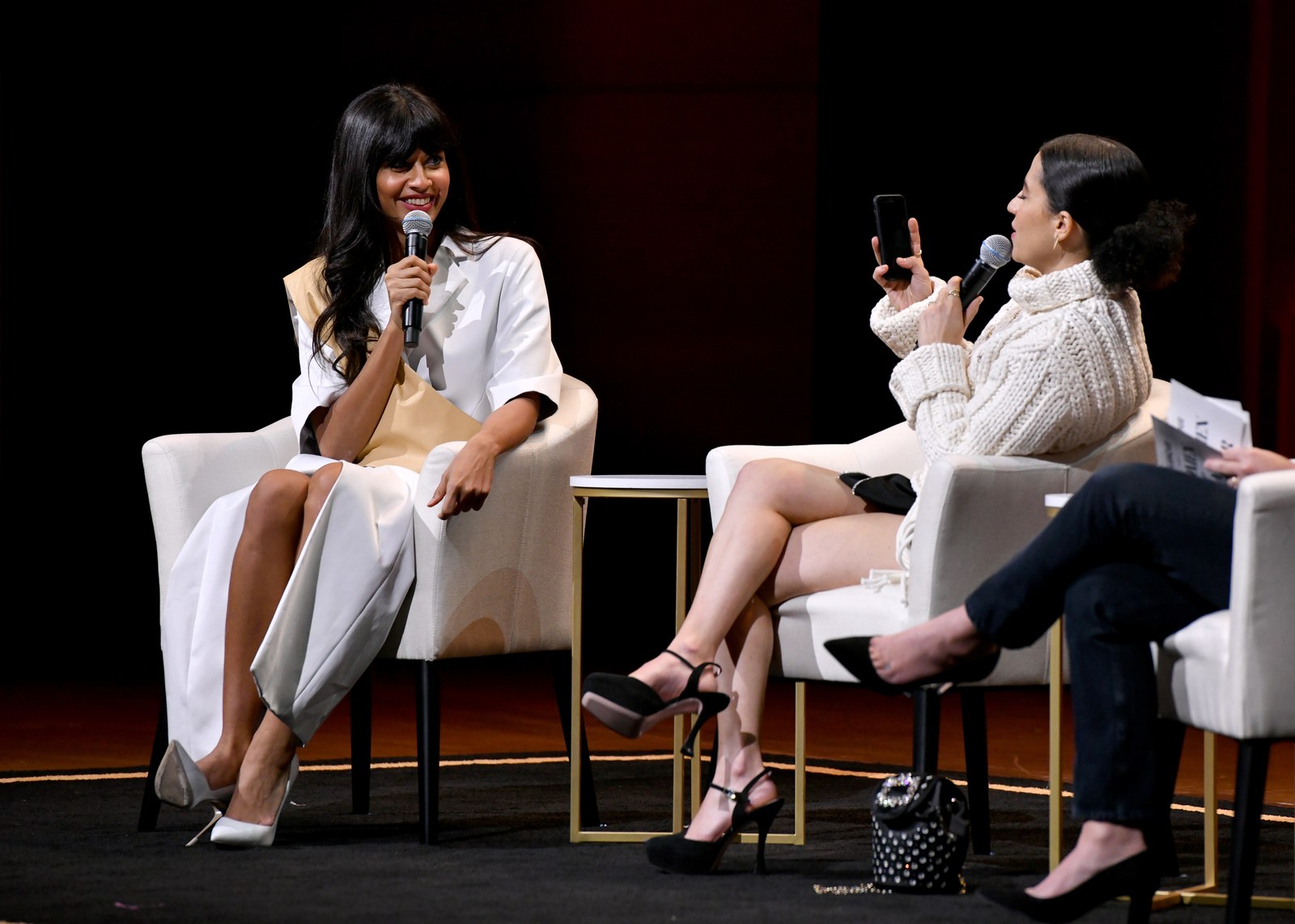
Ilana Glazer and Jameela Jamil have each had quite the year. Glazer’s hit TV series Broad City came to a hilarious, sentimental conclusion this past spring. Meanwhile, Jamil is only a few episodes away from saying goodbye to NBC’s The Good Place for, well, good. These two women are unique and talented in their own right, but they do share a commonality: They’ve used their authentic voices to effect real change, both in Hollywood and beyond. Whether it’s the body positivity movement or politics, Ilana Glazer and Jameela Jamil frequently use humor and genuine communication to move the needle forward. At Glamour‘s 2019 Women of the Year Summit on November 10, they taught us how we can do the same.

Jamil, who created I Weigh after being long-frustrated with women getting reduced to a number on the scale, began the conversation by opening up about her own journey to self-acceptance. The actor pinpointed a time when she was first bullied in school, which she says led to her developing an eating disorder. “My teacher made the stupidest fucking decision of all time…in order to teach us about charts, [she] weighed everyone,” she says. “I was the fattest, and my name was at the top of the chart. That’s when the bullying began about my weight, which led very quickly to my anorexia. That was the first time I realized I was a bit chubby.”

Glazer has also created a platform for social change, with hers connecting people to political policy. The actor and activist is the founder of Generator Collective, which was born out of her desire to learn more about our governmental systems. “I didn’t know what was coming up in the local elections. I didn’t realize that the primaries are different for states, you know, things like that,” she says. “It’s just saying, ‘I don’t know. I just want to learn the basic minimum.’ And it’s about finding minimal civic engagement and embodying that, which is voting whenever there’s an election and God forbid, canvasing once every four years.”

Jamil is just as fired up about American politics, particularly when it comes to women’s rights. “I’m really upset about abortion not being considered a woman’s right. I’ve had an abortion before. It was brilliant. I mean, it was also painful, but it was an excellent decision. And it wasn’t because of an emergency. It was just something that I needed to do because my life is as important as someone who was not yet born,” she told the audience.

Craig Barritt/Getty Images for Glamour

Aside from their activism, the two share a similar philosophy on life. Jamil considers herself a work in progress, and neither are obsessed with perfectionism, or portraying a persona online or in the press that’s anything other than their authentic selves. “In the 90s, when it was actually just TV and film and standard forms of media, [there was] a movie star image and this mystery behind it,” Glazer says. “The mystery is gone. I like it. I prefer it. Women are able to narrate their own stories.”



Source link

Categories
Health

How to Cope with Infertility: Humor Helped Me Get Through It


A fertility doctor, an ultrasound technician, and 17 interns walk into a vagina…

There I was at the fertility clinic. Signed in, sitting there in the waiting room. Waiting. I’ve been here before—just a couple of days ago, and a couple of days before that, actually. And yet here I am again. There are other women here, probably waiting for the same type of exam, but we won’t strike up a conversation. Or even make eye contact. Nope. This is the weird unspoken rule in the fertility clinic waiting room: Silence.

Finally, it’s my turn to go in. Some clinics make you strip down and change into one of those ultrathin robes, while others merely ask you to forgo your undies in exchange for a little paper sheet. Either way, there’s nudity involved. Not the sexy kind.

With each visit to the fertility clinic, I’m never sure what the protocol is when it comes to the stirrups. Should I swing my feet right on up there before the doc comes in? That seems efficient. But also like I’m greeting my doctor with a vagina. Then again, is it weird if you don’t greet your gynecologist with your vagina? Because let’s be honest, we both know that part is coming.

“Scoot down a little further,” he or she says (at least twice if not more). One time I planted myself precisely in the right spot—no scooting needed. I was very proud of myself, but nobody said, “Scoot no further! Your aim was perfect!” It is strange if I think about it (and trust me, I think about it). I’m sitting there, exposed, legs splayed out in stirrups like some equestrian gone kinky, and someone else is there! A stranger! Checking my insides. Live. Am I properly groomed? I wonder. Is there some sort of standard?

Next I say hello to my good friend “Wanda,” aka the vaginal ultrasound wand, or as I prefer to call it, the penis camera. For those who’ve never had the pleasure of meeting Wanda, it’s basically a rod connected to a machine with a screen, relaying moving images from your insides. The rod is usually covered with a condom topped with industrial amounts of lube, then inserted (hopefully gently) into your vagina. Then it’s moved around every which way in order to proceed with getting an image to check for a variety of female reproductive parts and processes. It can feel odd, but it’s bearable; for me it usually felt uncomfortably breathless, like some sort of uterus Spock grip. I always tried to just grin and bear it, smile and nod, because I wanted to seem cool and collected, as one does with her vulva on display. Mainly, I want to get it over with smoothly.

IÆve never liked gynecological examinations, but here I am, a veritable expert in the stirrups, years of experience under my belt. (If one were allowed to wear a belt during a gyno exam, that is.) I’ve experienced unexplained infertility and unexplained secondary infertility for a total of 11 years or more, including miscarriages, continuous two-week waits, emotional roller coasters, and probably a touch of PTSD from it all.

I honestly don’t remember how many rounds of intrauterine insemination (IUI) I’ve gone through. Somewhere around five. All of them unsuccessful. For each, I got an abnormally long tube shoved up my vagina while amped up on hormones in order to get inseminated with my husband’s top crop of sperm. During the more-complex in vitro fertilization, of which I did one round, I was under anesthesia so I didn’t feel anything during the egg retrieval procedure. I should add that after the IVF egg-retrieval procedure, my recovery from anesthesia began with me screaming like a deranged farm animal because I felt like just a floating head and was completely disoriented and scared. I apparently startled the whole recovery area, and several nurses had to crowd around me to handle the situation. (At the IVF embryo transfer a few days later, I assure you I was completely personable and lovely.) At some points, I really felt like some alien in a sci-fi movie, poked and prodded by white-coated strangers—although by choice—all in the name of having a baby.


Source link

Categories
Health

The Google Assistant Has a Sense of Humor Thanks to Elena Skopetos, the Device's "Funny Bone"


While she’s not in a traditional writers’ room—no, it doesn’t look like a scene out of 30 Rock, with writers feasting on pizza and at war over concepts—much of her time is spent coming up with timely jokes. She’s worked on special material for Mother’s Day, and is already gearing up for for New Year’s. Her favorite joke she’s ever written for the Assistant, was pegged to football. “Why did the center freak out during the play? I don’t know, he just snapped.”

According to Skopetos, writing jokes for the Google Assistant isn’t all that different from how you’d develop a regular on a sitcom or craft a standup persona. “We have a basic model for the Assistant of being a smart, humble, polite, person, but it’s always growing and evolving.” Still, there are certain nuances she employs when writing jokes for her own comedy, that you won’t find in one of the Assistant’s zingers. “With my comedy, I can go down a really niche rabbit hole. Like right now I’m working on a character that’s a Grey’s Anatomy surgeon. It’s kind of a niche thing where everyone might not get it, though I think it’s funny. But when I’m working on the Assistant, I have to really try to work in universals, and things that will appeal to everyone,” Skopetos says.

But the pursuit of universal appeal isn’t without its own pitfalls. A recent report from UNESCO found that devices like Amazon’s Alex and Apple’s Siri—all of which use a woman’s voice as the default—perpetuate gender stereotypes. They also encourage the belief that “women are obliging, docile, and eager-to-please helpers, available at the touch of a button or with a blunt voice command,” the report stated. Skopetos, who liaises across teams to make sure that the personality of the Assistant stays consistent, says those concerns are “certainly something we think about a lot.“

“The first thing I’ll say is we think of the Assistant as genderless,“ she says. “We never use the pronouns ’he’ or ’she’ when we’re referring to it. And we have a large selection of different voices from different backgrounds that you can choose from.”

Plus, having an acute awareness of how women are depicted and treated as we move about the world is one of the main themes of Skopetos’ own sets. In one of her sketches called, ”What Every Woman You’ve Ever Met Is Thinking”,” she cuts back and forth between the polite conversation a woman is having with a male colleague and her honest inner dialogue, which sounds like the heroine of an action movie plotting the different ways she could take him down in case he tried to make a move. “It’s funny, but it comes from a real place of, yeah, it can be really scary for a woman to be alone in a room with a guy you don’t know,” Skopetos says. “I’m thinking a lot about how I can take my experience as a woman and use comedy to amplify that voice.”

And while Skopetos is just as focused on her personal comedy career as ever—she performs at improv clubs all over New York—it can be tough to balance it all. Though Google is supportive of her second life (her managers will even come to her gigs), it can be straight up exhausting. ”Balancing two careers is a doozy. Just when you think you have it right, something blows up and you have to figure it out all over again,” Skopetos says. But she wouldn’t trade the experience, or what it’s done for her comedic development, for the world. ”It’s given me a broader perspective of how many different experiences and types of people are out there, and how to get into the mindset of putting myself in someone else’s shoes who might be radically different from me, and also write in a way that’s going to be empathetic and passionate to that.”

Samantha Leach is an assistant editor at Glamour. Follow her on Twitter and Instagram @_sleach.


Source link